ReactJS has transformed the development process for contemporary web applications, enabling software teams to build faster. The JavaScript library enables developers to create high-performance user interfaces that deliver interactive experiences. The library has earned the trust of multiple brands to build web applications ranging from small projects to large-scale systems.
The benefits of using ReactJS go beyond speed. The system enables developers to create scalable software through its clean coding functions. The system seamlessly integrates with all current web development processes.
According to a recent study by Statista (2025), 44.7% of developers worldwide use React.js as their primary web framework, making it one of the most widely adopted frontend technologies.
ReactJS is an open-source JavaScript library developed by Facebook to help developers build interactive user interfaces. The library enables developers to create components that will automatically update when their associated data undergoes changes. The introduction of React’s component-based system transformed how developers create web applications.
The library uses a virtual DOM to optimize rendering performance and minimize browser updates. Developers can build complex applications by combining simple components into larger structures. The framework enables developers to build applications by separating the presentation layer from the backend systems they require.
ReactJS has evolved significantly since its 2013 release, with continuous improvements from Meta and contributors. The framework now includes modern features such as hooks, concurrent rendering, and server-side rendering. The new features enable React to maintain its value because web development requirements continue to change.
Core Benefits of React JS
According to a 2026 report by eSparkInfo, 43.21% of developers report a positive experience with ReactJS, making it more preferred compared to alternatives like Angular and Vue.
Watch: Top 5 Benefits of React.js for Beginners
If you’re new to React, this short video provides an easy-to-follow overview of the framework’s biggest advantages, including reusable components, performance, scalability, and developer productivity. It complements the detailed explanations below and helps illustrate why React remains one of the most popular choices for modern web development.
Component-Based Architecture
React uses a component-based architecture to split user interfaces into compact, manageable components. The application consists of multiple components, each of which performs its designated functions and reusable functions throughout the system. The modular structure of the system enables developers to read, test, and maintain the codebase more efficiently throughout its development lifecycle.
The developers create components that they can reuse throughout the application to reduce redundant coding and accelerate development.
The developers use clear component hierarchies to create complex applications because this method matches their need to organize user interface elements. The setup enables developers to work simultaneously on different components without creating conflicts that would disrupt the entire application.
Virtual DOM for High Performance
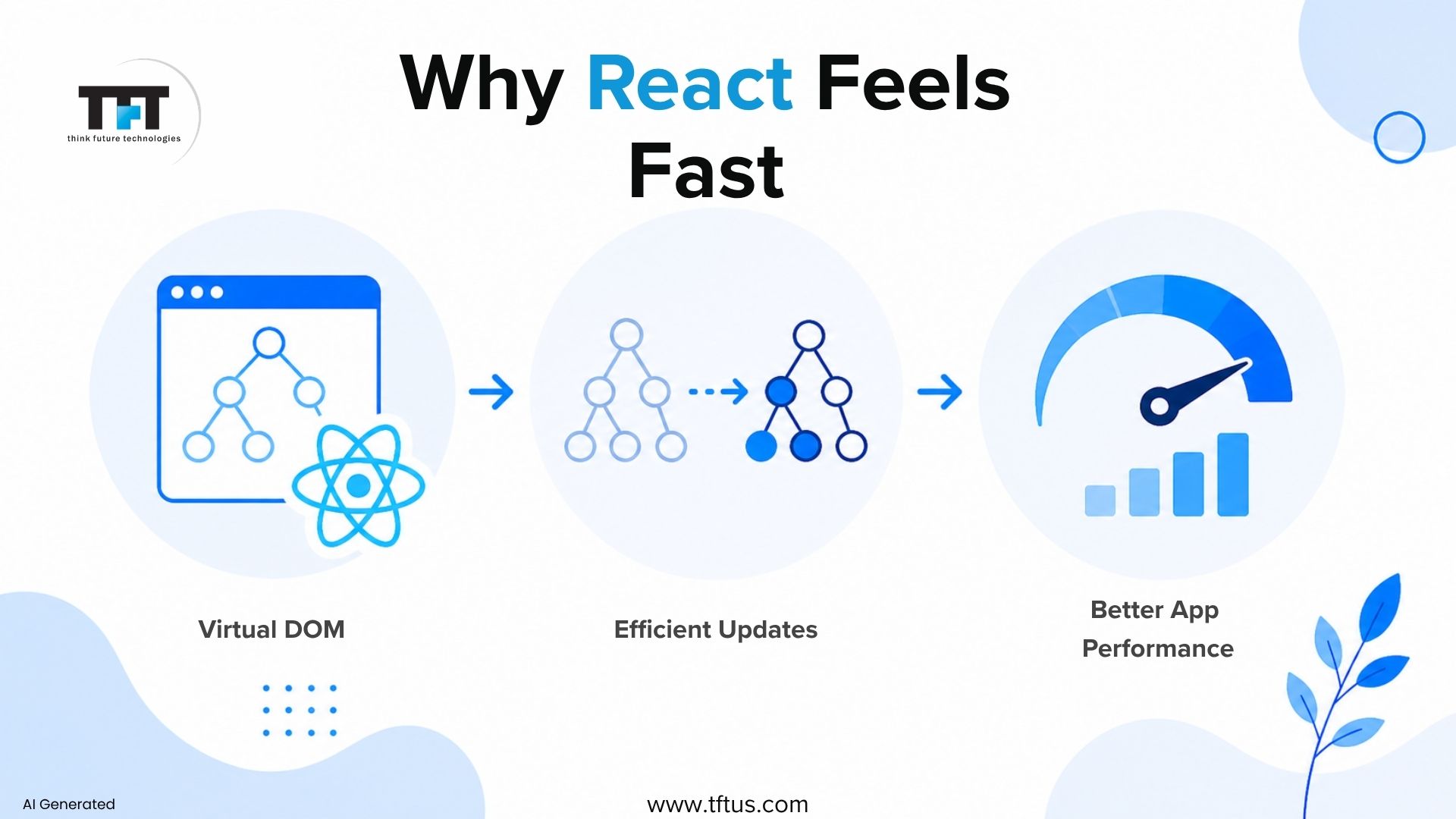
The virtual DOM is a lightweight replica of the actual DOM that React uses to render efficiently. React generates a new virtual DOM whenever data updates, then compares it with the previous one to identify differences. The system updates only the required elements instead of performing a complete system refresh.
The method prevents browsers from performing slow operations that consume resources by forcing complete layout recalculations and visual content updates. React achieves high performance by handling multiple user interface updates through both batching and controlled updates to the application. The developers define the interface appearance through their descriptions, while React handles everything, simplifying the workflow and reducing bugs.
Reusable UI Components
React’s reusable UI components are its most effective feature for extended application development. The button form and card elements become available for use in applications after they are created. The system enables designers to maintain design uniformity throughout different pages while saving time.
Organizations can develop shared component libraries and design systems that can be utilized in multiple projects. Developers can immediately access prebuilt and tested components from third-party libraries. The system enables teams to concentrate on developing specific business functionalities while avoiding the need to recreate standard interface components.
Case study:
A real-world example is Airbnb, which uses React to deliver seamless and interactive user experiences on its platform. By leveraging reusable components, Airbnb improved user engagement and ensured consistent design across its marketplace.
React Fiber is the essential rendering system that accompanies React version 16. It enables React to interrupt, resume, and reorder tasks based on their priority.
Fiber divides the rendering job into tiny pieces and allocates them to different frames. This way, the app doesn’t get stuck when it’s processing changes. It is also the main engine behind features like suspense and concurrent updates that give users the feeling of faster speed and better interaction.
Optimized Update Mechanism
To keep performance stable as the application grows, React only re-renders components that are directly affected by state changes.
React’s memo and useMemo are techniques that can prevent a component from rerendering unnecessarily when its data remains unchanged.
Learning optimization is easier with one-way data binding plus unidirectional data flow. It’s simple to raise a developer’s skill level in performance optimization for complex applications when data movement is clear.
Fast Initial Load Times
React leverages code splitting and lazy loading to minimize the initial bundle size. Users get the code just for the page they are currently on. Hence, the startup times are shorter.
Server-side rendering is beneficial for load speed as it sends pre-rendered HTML from the server and also enables search engines to index content efficiently.
Static site generation prepares pages in advance and serves them at high speed from CDNs. Both these methods make React well-suited for highly interactive applications as well as super-fast websites.
Development Speed Benefits
Quick Prototyping and Development
React enables developers to create prototypes and minimum viable products through its component system and prebuilt components. The create-react-app tool provides development teams with ready-made templates that enable them to begin programming without going through complicated installation procedures.
Hot reloading enables immediate change detection while preserving the current application status, thus enhancing testing efficiency and maintaining uninterrupted development progress.
Simplified Maintenance and Updates
React uses a modular structure where each component works independently, which makes maintenance easier and safer. The independent operation of components allows developers to easily locate and resolve software defects.
The system allows developers to safely perform project updates because all components have defined input and output specifications.
Enhanced Productivity with Developer Tools
React developer tools provide browser extensions that display component designs, operational status, and performance metrics to simplify debugging. The ecosystem supports tools such as ESLint, Prettier, and modern code editors to maintain clean, consistent code.
The system leverages advanced code completion and TypeScript integration to identify errors early, boosting productivity and improving software quality.
Case study:
In a business use case, a large retail platform reduced cart abandonment by 35% and increased checkout conversions by 25% after implementing a React-based checkout system. This highlights how React can directly impact business performance and user experience.
React boasts one of the largest communities for web development, comprising millions of developers who contribute resources, tutorials, and solutions. You can find React, related discussions, and questions on platforms like Stack Overflow, so you can easily get help when you encounter issues. The community continually publishes articles, videos, and courses at different proficiency levels, making it easy for teams to learn quickly and adopt best practices with confidence.
Extensive Ecosystem
The React ecosystem is home to a wide range of libraries for various functionality, including routing, state management, styling, forms, animation, and testing. You can seamlessly integrate with popular tools such as Redux and MobX, while build tools like Vite and Webpack will help you optimize your production apps.
You can also access npm and Yarn, the most popular package managers, which give you the ability to tap into a huge collection of JavaScript packages, thereby making React versatile enough to meet virtually any project requirement.
Regular Updates and Innovation
Meta supports React as an open-source project, providing continuous maintenance and new updates that enhance the framework’s functionality and performance. React 19 rolled out server components and improved concurrent rendering.
Updates are collaboratively tested with community feedback, and a strong backward-compatibility guarantee means that existing projects remain stable while still able to take advantage of the latest innovations.
According to a 2026 analysis on Medium, React remains one of the most in-demand skills in the developer job market, with companies actively hiring React developers for modern web applications.
Cross-Platform Development
React Native for Mobile App development
React Native builds on React to create mobile applications for iOS and Android. The developers can reuse their skills and share the code across platforms. It uses real native components for high performance while still using JavaScript. Facebook, Instagram, Airbnb, and Microsoft are among the companies that use it in their production, thereby underscoring its trustworthiness.
Code Sharing Across Platforms
React facilitates sharing business logic, utilities, and, at times, UI components between web and mobile apps. Teams can maintain a single main codebase, thereby significantly reducing duplication and maintenance costs. With tools such as monorepos, shared code can be managed very efficiently, enabling faster updates and ensuring consistent work across platforms.
Desktop Applications
React can be used to develop desktop applications in conjunction with frameworks such as Electron. The usage of Slack, Discord, and Visual Studio Code is some concrete examples of its potential even beyond simple web surfing. This gives web developers the opportunity to create cross-platform desktop software without the need to master other native languages.
Scalability and Flexibility
Works for Small and Large Projects
React is suitable for projects ranging from minor landing pages to major enterprise platforms catering to millions of users. The component-based architecture of React enables continuous addition of new features without a complete overhaul. Companies can thus go from MVP to full-scale application without hesitation.
Integration with Backend Technologies
React is backend-agnostic and works with Node.js, Python, Ruby, Java, and .NET via REST or GraphQL APIs. Tools such as Axios and Apollo Client simplify data fetching through those APIs. This allows teams to combine their back-end stack of choice (based on their microservice architecture) with React.
Case Study
A healthcare technology company, Avantas, modernized its legacy platform using React, enabling faster scaling and improved system performance. By replacing outdated systems with a React-based frontend, the company was able to deliver new features more efficiently without a complete rebuild.
React has a minimal design, allowing teams to select their routing, state management, and styling solutions on a per-project basis. The minimal framework allows developers to start simple and add tools like Redux only if/when they become necessary. This adaptability reduces over-engineering and promotes the project’s long-term growth.
Testing & Quality
Component Testing Made Easier
React components are easy to test because of their well-defined input/output. Developers can test expected behavior in isolation using quality assurance tools (e.g., Jest, React Testing Library). Good unit tests can ensure code quality, detect defects early, and enable safe refactoring.
End-to-End Testing with Automation
End-to-end testing tools, such as Cypress and Playwright, enable automated full user workflows in a browser. The consistency of React’s architecture enables stable, maintainable end-to-end tests. In addition, automated tests launched as part of a continuous integration process can run before deploying code, thereby reducing bugs in production and improving reliability.
Real-World Success Stories
Industry Adoption
Facebook created React to solve its own scaling challenges and uses it to serve billions of users, proving its reliability at massive scale. Netflix uses React to build streaming interfaces that deliver optimal performance while processing intricate data in real time. Airbnb uses React and React Native to develop its web and mobile applications, enabling it to reuse components and build products more quickly.
Enterprise Adoption
React has become the standard web development framework for many Fortune 500 companies because its ecosystem offers stability and its long-term support package ensures security.
React serves as the foundation for secure, high-performance, accessible applications that banks, financial institutions, healthcare organizations, and government agencies develop.
The solution provides businesses with complete system compatibility, regulatory compliance, and proven performance capabilities, enabling them to safeguard their operations.
Startup Success
React has become the preferred framework for startups because it enables rapid development, allowing small teams to build and test their work. The presence of a major developer community simplifies hiring, which remains essential for companies expanding their workforce.
React has become the primary technology for venture-backed startups and Y Combinator companies because it enables them to build products that can scale without changing their core technology.
When Should I Choose React?
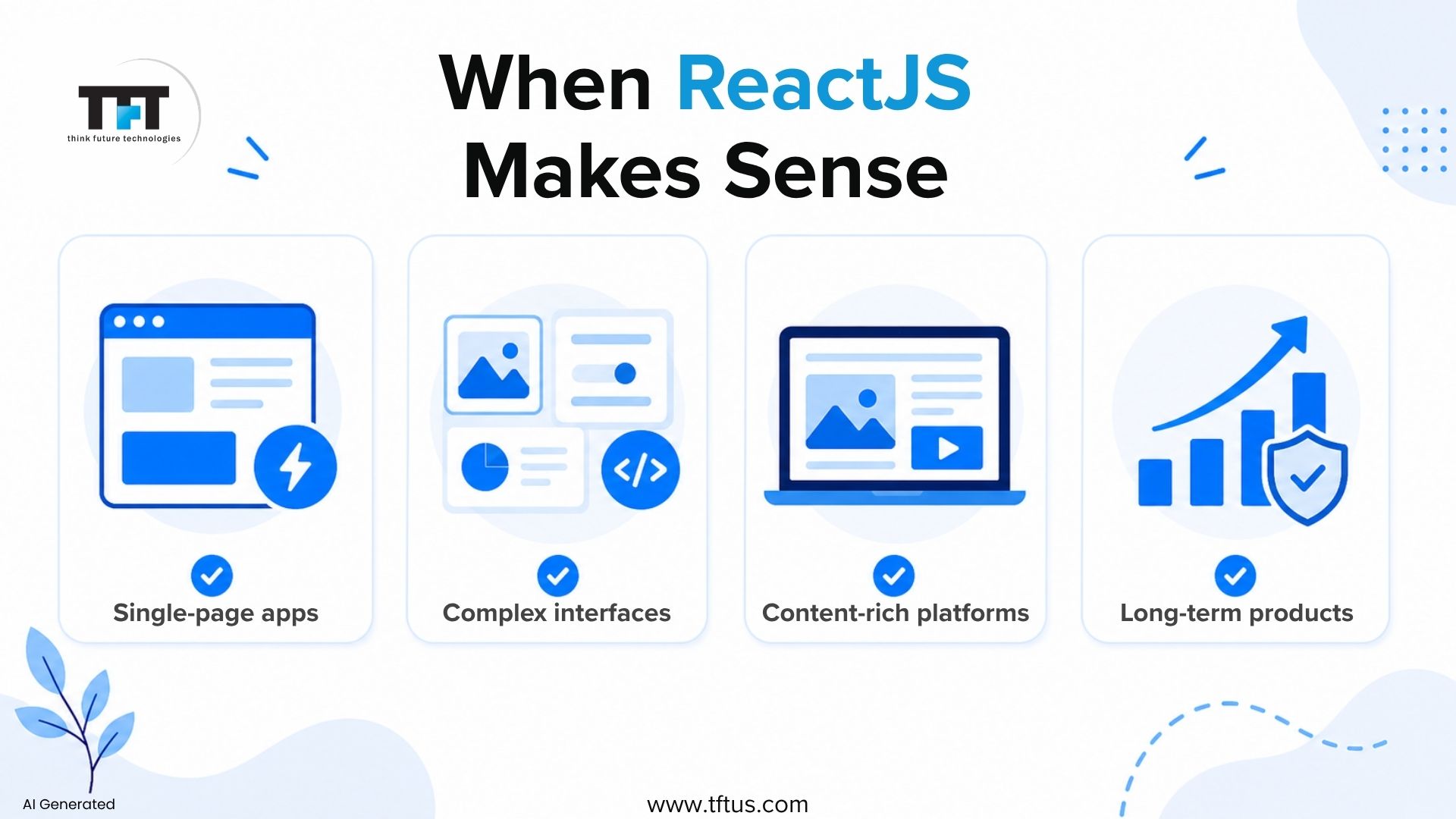
Perfect for Single Page Applications
If you are building an SPA (single-page application), you should definitely consider using React as your technology of choice for its fast navigation and smooth user experience. This is especially true because it allows for more efficient handling of complex routing and state management.
Examples of SPAs that can benefit from React include dashboards, social feeds, and collaborative tools. Moreover, the declarative model in React simplifies creating highly interactive, dynamic interfaces.
Great for Complex Apps
The component-based architecture of React makes it easier for developers to build complex applications, as each feature can be broken down into smaller, reusable components. Similarly, React enables developers to use advanced state management tools to handle complex business logic.
Therefore, if your development project is for the long term, you will find it easier to maintain your code over time, as React allows you to easily update your application, and its component-based architecture gives you the ability to scale your app without having to completely rewrite your code.
Suitable for Content Sites
Developers building content-heavy websites should consider using React alongside either server-side rendering or static site generation, as it improves SEO performance and speeds up page load times for marketing and blog sites.
It integrates smoothly with headless CMS platforms, allowing developers and content teams to work efficiently while delivering fast and search-friendly websites.
Conclusion
There are numerous advantages of utilizing ReactJS for projects, which extend to performance, developer experience, and long-term viability. React’s virtual DOM, component-based architecture, and vast ecosystem make it the best choice in modern web development. Companies of all sizes use React to build applications users love and that scale alongside the business.
Understanding these benefits allows teams to make sound technology choices for their new projects. React not only increases productivity at the very beginning of the project but also supports future growth and evolution. With the help of a robust community and through regular updates, React remains a go-to technology for years to come.
No matter if you are making simple websites or complicated apps, React offers you the methods and concepts to be successful. Go ahead and try out React on your next web project and see the advantages for yourself. The time you spend on learning React will be repaid with a faster pace of work and better products.
ReactJS is used in projects because it provides high performance through the virtual dom and efficient rendering mechanisms. The component-based architecture enables code reusability and faster development while maintaining clean and organized codebases. Strong community support and an extensive ecosystem provide solutions for virtually any development challenge teams encounter.
The main advantages include reusable components that speed development, virtual dom for excellent performance, and flexibility that works with any backend. React offers strong community support, extensive libraries, and tools that enhance productivity throughout the development process. The technology scales from small projects to enterprise applications while maintaining consistent patterns and practices.
Yes, React is excellent for large projects because its component-based architecture manages complexity effectively at scale. Major companies like Facebook, Netflix, and Airbnb use React for applications serving millions of users daily. The technology supports code organization, team collaboration, and long-term maintenance that big projects require.
JSX combines JavaScript and HTML syntax, making UI code more intuitive and easier to read. It enables type checking and provides better error messages during development through compile-time validation. JSX supports embedding expressions, prevents injection attacks through automatic escaping, and compiles to optimized JavaScript. The syntax allows developers to visualize UI structure while maintaining the full power of JavaScript.
Ankaj Goyal brings a software engineering background to his role as Associate Lead L1 at TFT. His experience as a Senior Software Engineer provides a practical foundation for exploring the development work behind digital products. With an academic background at Maharaja Agrasen Institute of Technology, he combines his technical education with professional experience at Think Future Technologies. His engineering perspective adds context to conversations about software development and the challenges teams encounter when turning requirements into working solutions.








Leave a Reply