
Press ESC to close

Security Concerns in Offshore Software Testing: Risks, Controls, and How to Stay Safe

In 2024, Deque Systems sued BrowserStack over claims that trial-account access to its proprietary code led to verbatim reuse of its testing questions — a reminder that “we signed an NDA” isn’t the same as being protected. Every year, US companies hand offshore testers a database export, a repo clone, or admin credentials without checking whether that single act just triggered a HIPAA or CCPA violation, breached a BAA flow-down requirement, or handed a competitor’s future vendor your test scripts. This article shows you exactly where those triggers sit and how to close them before they cost you.

This article is informational and does not constitute legal advice. Compliance obligations vary by jurisdiction, industry, and contract specifics — consult qualified counsel before relying on any guidance here for HIPAA, CCPA, GDPR, or contractual decisions. Facts and figures are drawn from the named sources cited throughout; one scenario below is explicitly marked as an illustrative composite, not a real company.
Contents hide

Key Takeaways

  • Offshore software testing delivers significant savings and lets companies leverage global talent, but it amplifies data security and intellectual property risks that can dwarf those cost benefits if left unmanaged.
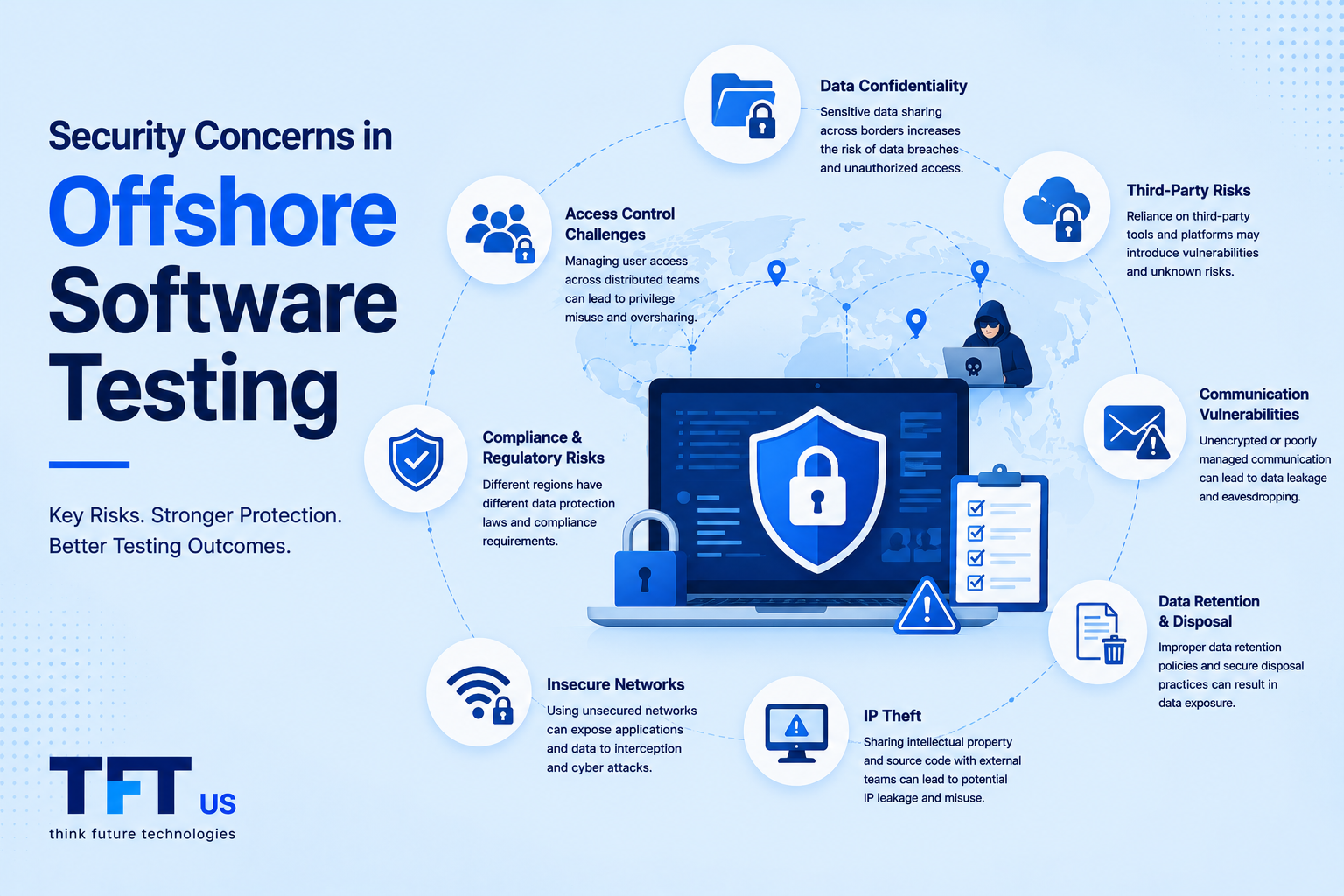
  • The most serious threats are data breaches, intellectual property theft, weak access control, and uneven security testing practices at offshore vendors.
  • Production data routinely ends up in offshore test environments without proper masking — a HIPAA/CCPA compliance trigger on its own, independent of whether a breach ever occurs.
  • Strong contracts (NDAs, audit rights), technical safeguards (encryption, zero-trust access, continuous monitoring), and rigorous vendor due diligence are non-negotiable for any offshore software development security program.
  • Regulated industries such as finance, healthcare, and government must treat offshore QA like any other critical supplier and align with GDPR, HIPAA, PCI DSS, or equivalent industry standards — and verify that a Business Associate Agreement flows down to the offshore vendor’s own cloud subcontractors.
  • Offshore software testing can compromise data, intellectual property, and compliance status, but with the right vendor, these security concerns can be managed without losing the benefits of offshore software development.

Introduction: Why Security Matters More in Offshore Software Testing

Offshore software testing became mainstream in the 2010s as companies discovered they could run quality assurance around the clock by distributing testing across time zones. By the 2020s, cloud adoption and remote work accelerated the trend further: the global offshore software development market is projected to reach USD 389.7 billion by 2033, up from USD 120 billion in 2023 — a 12% CAGR, according to a Market.us Research Report. A separate Research and Markets estimate puts the market at USD 204.32 billion in 2026, growing toward USD 347.99 billion by 2030. The figures diverge by methodology, but the direction is the same: more offshore software development, not less.
 
Today, sharing source code, test data, and architecture diagrams with an offshore QA team is routine. But so are the consequences when controls are weak: IBM’s 2023 Cost of a Data Breach Report found that the global average breach cost hit US$4.45 million, an all-time high, and more recent IBM 2024 figures put the average breach cost at US$4.88 million — a 10% year-over-year increase. Distributed testing lowers costs but introduces critical security vulnerabilities that demand attention.

This article focuses specifically on the security risks of testing software offshore, not generic outsourcing pros and cons. We catalog the most common risks, explain exactly what you’re liable for under US law, and walk through practical mitigation and vendor evaluation criteria.

A few definitions to set context. Offshore software testing refers to QA activities performed by teams in foreign countries, typically to reduce costs or access specialized testing capabilities. An offshore QA team is the personnel or vendor partner carrying out that work. Offshore software development is the broader umbrella that includes coding, architecture, and maintenance alongside QA. This kind of third-party quality assurance introduces risks like data exposure and loss of compliance control, and that is exactly what we will address.

Core Security Risks in Offshore Software Testing

This section catalogs the main security threats that appear repeatedly across offshore QA engagements. Test environments frequently mirror production systems, making them an attractive target for attackers if not hardened to the same level. Security concerns are amplified when multiple vendors are involved, such as a separate testing vendor and an offshore development team with overlapping access to the same codebase.

Risk level varies by geography, local cybercrime prevalence, and the maturity of legal enforcement. Remotely managed environments may lack the enterprise-grade security measures present at a company’s headquarters. Black Duck’s 2026 Open Source Security and Risk Analysis Report found that 65% of organizations experienced a software supply chain attack in the past year — offshore software development adds another layer of third-party exposure on top of that baseline risk.

A quick way to triage: rank each risk below by likelihood (how often it actually occurs in offshore engagements) against impact (regulatory, financial, reputational) — data breaches and access control gaps score high on both axes and should be fixed first; cultural friction scores lower on impact and can be addressed in parallel.

Data Security and Data Breaches in Offshore QA Environments

Real production data is routinely cloned into offshore test systems without proper anonymization, exposing PII, PHI, and payment data. Data exposure risks increase when testers access production-like data during performance or regression testing against realistic datasets.

Sensitive customer data can be leaked during offshore testing, increasing the risk of data breaches.
Common mishandling patterns include:
  • Unencrypted test databases with no encryption at rest
  • Credentials are stored in plain text or shared across the offshore software testing team.
  • Shared administrator accounts that prevent individual attribution.
  • Unsecured infrastructure in remote testing labs that may lack firewalls or encryption, increasing security risks
Remote testers may use public Wi-Fi or unprotected devices, increasing security risks during testing. Offshore teams may require access to sensitive databases, which can lead to privacy violations if their networks lack strict access controls.

Typical vectors include insecure VPNs, weak endpoint protection on testers’ laptops, and outdated test servers that are not patched on schedule.

Data breaches and information leakage are significant risks in offshore software development, especially when sensitive data is transmitted across borders without robust security measures in place. Continuous monitoring and strict network segmentation between test and production environments are often missing at low-cost providers. Vendor-caused breaches average US$4.9 million and take 98 days to detect versus 81 days for internal breaches — the longer an offshore software testing services provider goes undetected, the more sensitive data is exposed.

Intellectual Property Theft and Code Leakage

Intellectual property in offshore software testing includes source code, test frameworks, custom test data generators, architecture documents, and proprietary test cases. Granting offshore teams access to source code increases the risk of unauthorized distribution or intellectual property theft.

Realistic IP theft scenarios include:
  • Testers retaining local copies of code repositories after a project ends.
  • Offshore vendors reusing unique test scripts or automation frameworks for competing clients
  • Uploading code samples to public forums for troubleshooting
Intellectual property theft is a major concern in offshore software development, as proprietary software and business ideas can be copied or misused without proper legal safeguards. In 2024, Deque Systems sued BrowserStack, alleging that BrowserStack accessed Deque’s proprietary code via trial accounts and reused testing questions verbatim from Deque’s tool.

Lessons learned, regardless of how the litigation resolves: trial and sandbox accounts are a real attack surface, not a formality — if a trial account can reach proprietary code or test content, treat it under the same access controls as a paid engagement, not a lighter one. Verbatim reuse is hard to prove without records, so log what trial accounts actually accessed and for how long. And a generic NDA doesn’t specify what “competing use” means for test content specifically — a contract clause should name test cases, test data generators, and proprietary scripts as protected IP explicitly, not rely on a boilerplate confidentiality clause to cover them by implication.

Weak contracts, vague IP rights clauses, and the absence of robust non-disclosure agreements enable intellectual property theft. Weak local laws in offshore locations may allow theft of proprietary source code, and legal recourse in some jurisdictions is expensive and time-consuming.

Access Control Gaps and Over-Privileged Offshore QA Teams

A common pattern emerges where offshore testers receive production-level credentials “temporarily,” and those permissions never get revoked. Shared generic accounts like “qa_offshore” make it impossible to attribute actions to individual testers during incident investigations. Weak access controls can expose internal networks to external testers during offshore software testing.

Frequent gaps include:
  • Lack of multi-factor authentication for offshore access to CI/CD tools, test management systems, and cloud consoles
  • Personal devices used without enforced endpoint detection and response
  • No regular entitlement reviews covering offshore users
Multi-factor authentication and Role-Based Access Control can enhance security for remote logins. Strict access and identity controls should enforce the principle of least privilege for offshore testers — narrower during early-stage feature testing, expanded only when a task requires it, and revoked the moment that task ends.

Tools differ in how well they support this: Okta handles cross-organization SSO and lifecycle automation well, but charges per active user; Azure AD (Entra ID) Privileged Identity Management bundles just-in-time elevation directly into a Microsoft-centric stack at a lower incremental cost if you’re already licensed for it.

Weak oversight in offshore testing can lead to malicious code injection, including backdoors or malware. Disgruntled offshore employees might intentionally steal or corrupt data, leading to insider threats. Organizations must implement strict access controls with just-in-time access elevation and regular reviews.

Cultural and Language Differences as Indirect Security Risks

Cultural norms such as reluctance to say “no” or strong deference to authority can cause offshore testers to accept risky shortcuts rather than escalate security concerns. Offshore teams often come from different cultural and linguistic backgrounds, which can lead to miscommunication due to language differences and varying work cultures.

Effective communication is critical in offshore software development, but cultural differences, language barriers, and time zone gaps can lead to misaligned expectations and misunderstood project requirements. For example, a directive like “retain logs for 90 days” may be interpreted as “delete everything after 90 days” or “keep indefinitely until 90 days pass,” potentially violating GDPR or internal data protection policies.

Time zone differences can limit live communication between offshore teams and clients, making it harder to synchronize work and feedback. Security training should be localized with examples, terminology, and local laws rather than simply translating onshore content. Clear written standards and checklists help bridge cultural and language differences more effectively than verbal instructions alone, supporting cost efficiency without sacrificing security.

Compliance, Legal Exposure, and Cross-Border Data Transfers

Offshore software testing interacts with regulations like GDPR, CCPA, HIPAA, and PCI DSS — and each carries its own enforcement teeth. GDPR fines reach up to €20 million or 4% of global annual revenue, whichever is higher; British Airways was fined £20 million by the UK’s ICO after a breach traced to inadequate security controls, and Marriott was fined £18.4 million on similar grounds. Put plainly: a few dollars an hour saved on offshore rates does not offset a multi-million-pound enforcement action if the underlying controls were never in place.

After the Schrems II ruling in 2020, organizations transferring EU personal data offshore must rely on Standard Contractual Clauses or adequacy decisions, often with supplementary measures like encryption or pseudonymization. The EU’s NIS2 Directive, effective January 2026, adds another layer: it establishes a unified legal framework for cybersecurity across 18 critical sectors, and any offshore software development security program touching EU customers or infrastructure now needs to account for it.

Consider a European fintech using an Indian offshore QA center: it must document data processing agreements and adequate safeguards for EU personal data before that data ever reaches the test environment — not after an incident forces the question. The subsections below get specific about what this means under US law.

What You’re Actually Liable For: US Legal Exposure in Offshore Testing

Most guidance on offshore software testing security leads with a list of risks before answering the question a US-based engineering director or compliance officer actually asks first: what happens to us if something goes wrong? Liability does not shift offshore just because the work does.

Run through this quickly: Does your offshore vendor hold PHI or cardholder data without a BAA or equivalent agreement on file? Has anyone verified their cloud subcontractor is covered, too? Is their most recent compliance report a Type I snapshot rather than a Type II? A “yes,” “no,” or “not sure” to any of those is your starting point for the fixes below.

The Compliance Trigger Most Companies Are Already Violating

Handing an offshore testing team a cloned copy of a production database that still contains real PII or PHI is, on its own, a HIPAA or CCPA violation — independent of whether that data is ever stolen. Data masking and synthetic data sets that preserve statistical properties for functional and usability testing are the fix, but many offshore software testing arrangements skip this step because it takes engineering time, which a tight timeline doesn’t budget for.

Penalty Table: What a Breach or Non-Compliance Actually Costs

HIPAA Up to $1.9 million per violation type, per year
CCPA $7,988 per intentional violation
PCI-DSS $5,000–$100,000 per month of non-compliance
Average breach cost (IBM, 2024) $4.88 million, up 10% year-over-year
Athens Orthopedic Clinic settled with regulators for $1.5 million over a missing Business Associate Agreement — not because of how a breach happened, but because the contractual safeguard wasn’t in place. The same exposure applies the moment PHI touches an offshore test environment without a BAA covering that vendor.

The Enforcement Gap: Why a Signed BAA Doesn’t Fully Protect You

A BAA is legally required before any PHI enters an offshore test environment — it isn’t satisfied by a generic NDA. What most companies miss is the flow-down requirement: under 45 CFR §164.308(b)(4), the offshore vendor’s own cloud provider also needs a downstream BAA.

Even a complete contract has a jurisdictional limit — if the vendor breaches it, the US company bears the fallout, while enforcement against a foreign entity is often slow or unavailable. The real protection is technical: data masking, strict access controls, and audit rights that let you verify compliance rather than hope for it.

SOC 2 Type I vs. Type II: Why It Matters for Vendor Vetting

Auditing vendor security requires certifications like ISO 27001 or SOC 2 — but “they have SOC 2” isn’t, by itself, sufficient. A Type I report is a point-in-time snapshot confirming controls were designed correctly on the audit date. A Type II report covers operating effectiveness over three to twelve months. For any offshore software testing engagement longer than a single project, accepting Type I as equivalent to Type II is a vetting gap.

AI Tool Governance: The Risk Most Contracts Don’t Cover

Offshore testers using AI coding assistants like Copilot or Cursor routinely submit proprietary code and schemas as prompts to third-party AI services. A 2026 survey found LLMs increasingly improve practices like vulnerability detection and secure code generation in distributed development — a genuine benefit, but it also means proprietary inputs leave the controlled environment in a way most NDAs never anticipated. Contracts negotiated even two years ago typically have no clause addressing this, making it one of the highest-value additions to any vendor agreement renewal.

Evaluating the Security Posture of an Offshore Software Testing Partner

Due diligence should treat offshore QA vendors as critical infrastructure, not generic staff augmentation. Evaluation must combine paper checks, such as policies and certifications, with practical evidence, including tooling, incident history, and penetration testing reports. When possible, visit facilities virtually or onsite to verify that stated controls are actually enforced.

A simple tiering model keeps this proportional: Tier 1 vendors (access to production-like data, PHI, or cardholder data) get a full evaluation — certifications, named assessment frameworks like CAIQ or SIG Lite, and quarterly re-review. Tier 2 vendors (synthetic data only, no regulated data) get a lighter annual review. Tier 3 vendors (UI/cosmetic testing, no data access) need only baseline NDA and access hygiene checks.

Evaluation should be repeated on that cadence, not just at vendor selection, especially when the scope expands or data protection laws change. The subsections below provide specific criteria covering certifications, technical safeguards, test-environment hardening, people processes, and contract structure.

Security Certifications, Audits, and Documented Controls

Key certifications to request from any offshore software testing company include:
ISO/IEC 27001 Information security management system Global engagements
SOC 2 Type II Security, availability, confidentiality U.S.-focused vendors
ISO 27701 Privacy information management GDPR-related work
HITRUST Healthcare information trust Healthcare sector
PCI DSS Cardholder data security Financial services
Verify the scope of certifications: Does the ISO 27001 certificate cover test environments and all subcontractors? Request recent audit reports, penetration testing summaries, and data protection policies tailored to test environments. ISO 9001 and ISO 27001 certifications are among the key features companies evaluate when selecting offshore testing partners in the US market, according to an Avekshaa report.

Key questions for prospective vendors:
  • Who is your CISO or security lead?
  • How often do you run internal security testing (SAST, DAST, red teaming)?
  • What is your risk management policy for non-conformities?
Lack of any formal security framework is a strong warning sign for engagements involving sensitive data.

Vendor Evaluation Scorecard

Score prospective vendors against the items below, then total the points. 80+: proceed. 60–79: Proceed only with the specific gaps named as contract conditions. Below 60: treat as a disqualifier for any engagement touching regulated data.

Holds a SOC 2 Type II report dated within the past 12 months (not Type I)? 15
Holds ISO/IEC 27001 certification covering the actual test environment, not just headquarters? 10
Encrypts test data at rest using AES-256 or equivalent? 10
Will sign a BAA that explicitly flows down to their cloud subcontractor? 15
Permits an independent, client-commissioned penetration test of the test environment? 10
Supports data masking or synthetic data generation natively, rather than requiring the client to pre-mask everything? 10
Can name their average time-to-patch for critical CVEs? 5
Enforces MFA and individual (non-shared) credentials for every tester? 10
Will provide anonymized incident history rather than claiming zero incidents ever? 5
Offers contractual audit rights with a defined frequency, not just “upon request”? 10

Technical Safeguards: Encryption, Network Segmentation, and Tooling

Baseline defenses for any offshore QA facility should include full-disk encryption, up-to-date endpoint detection and response, centralized logging, and regular patching. Third-party tools used by offshore vendors may introduce unpatched vulnerabilities, creating additional security risks.

Critical technical controls:
  • Encryption in transit (TLS 1.2+ minimum) and at rest for databases, storage, and backups
  • Network isolation via separate VLANs or VPCs for QA with restricted outbound internet access
  • Dedicated jump hosts with MFA and IP filtering for secure remote access
  • Secrets management through tools like HashiCorp Vault or AWS Secrets Manager, not passwords over email
Testing software and popular tools such as Selenium, Cypress, JMeter, and Postman should run within controlled CI/CD pipelines rather than ad hoc on laptops. Automated testing and automation testing frameworks must be configured with the same rigor as production tooling.

Data Masking, Secrets Management, and Test Environment Hardening

Securing the testing infrastructure itself is often overlooked — attention defaults to securing the application under test, not the environment doing the testing. Offshore QA teams build their own test environments, CI/CD pipelines, and automation frameworks, each needing the same hardening as production systems.

Data masking should be the default for any offshore software testing services engagement, not an exception requested after the fact. Equally important: secrets management. Offshore automation testers need API keys, database credentials, and service accounts, and hardcoded credentials in test scripts are a recurring, preventable source of exposure. Rotation policies and a centralized secrets vault remove the temptation to hardcode anything.

Operationalizing “don’t send production data” means mapping each data type to a technique and an access tier, not leaving it to individual judgment calls by call:
PII (names, emails, addresses) Tokenization or format-preserving synthetic substitution Manual and automation testers
PHI (medical records) Full synthetic generation — never tokenized from real records Test leads only, under BAA
PCI (cardholder data) Synthetic test card numbers (test BIN ranges only) Manual and automation testers
Trade secrets / proprietary algorithms Not exposed in test data; tested via interface contracts and mocked outputs No offshore access by default
The same logic that maps data to technique should map to who can see it — a junior manual tester and a test lead should not have identical access just because they’re on the same project.

Vetting Third-Party Testing Tools and Vulnerability Disclosure Protocols

Offshore teams often rely on testing libraries and third-party automation tools that may carry their own vulnerabilities or backdoors. Vetting these dependencies — checking for known CVEs and restricting which packages testers can install without approval — closes a gap that generic secure-coding guidance rarely addresses.

A related, frequently missing piece: what happens when an offshore tester discovers a vulnerability mid-testing? Without a secure reporting channel and a defined embargo period, there’s no clear path between “found a bug” and “responsibly reported it” — and room for a flaw to be exploited or sold rather than disclosed. A simple internal disclosure protocol closes that gap before it becomes one.

People, Processes, and Non-Disclosure Agreements

Human factors often override technical controls. Conducting background checks on offshore personnel helps ensure that only vetted individuals have access to sensitive data — specify criminal history, employment verification, and credit checks for anyone touching financial data, though the depth varies by what’s actually available locally. Onboarding and offboarding processes must include formal credential issuance and revocation, security training, and immediate disabling of access when testers roll off projects.

Non-disclosure agreements should exist at both the company and individual levels, specifying confidentiality, intellectual property, and non-compete terms. NDA enforceability is not uniform: courts in India and the Philippines generally enforce confidentiality clauses but are slower and costlier to pursue than US courts, while non-compete provisions are often unenforceable in several Eastern European jurisdictions regardless of what the contract says — treat the NDA as a deterrent and a paper trail, not a guaranteed remedy, and lean harder on technical controls where enforcement is weak. An experienced project manager should oversee enforcement.

Ask the partner for anonymized examples of past incidents. Vendors with a proven track record of transparency are generally more trustworthy than those claiming zero incidents ever.

Contractual Safeguards and Liability Allocation

Establish clear and detailed contractual agreements that define each party’s responsibilities regarding security measures and risk management so all stakeholders understand their roles and obligations.
Key clauses to include:
  • Breach notification timelines (within 24 hours of discovery)
  • Data localization requirements and restrictions on subcontracting
  • Governing law, jurisdiction, and dispute resolution mechanisms
  • Liability caps are typically set at 2–3x annual contract value, plus cyber-insurance requirements of $5–10 million minimum coverage, and indemnification for third-party claims.
  • Clear intellectual property ownership, assigning all rights to the hiring company
  • Contractual audit rights, so that due diligence can be proven after the fact rather than assumed.
  • A data destruction clause requiring verified deletion of all client data when the engagement ends
Legal teams should review how the offshore QA vendor’s standard terms address data breaches, especially for high-risk industries like a financial institution outsourcing testing work.

What Weak vs. Strong Clause Language Actually Looks Like

Vendors often offer a version of these clauses that sounds protective but isn’t. Compare:
  • IP assignment — Weak: “Vendor agrees not to use Client materials for unauthorized purposes.” Strong: “All work product, including test scripts, test data generators, and test cases created in the course of this engagement, is works made for hire and the sole property of Client, whether or not separately identified as confidential.”

  • BAA flow-down — Weak: “Vendor will maintain appropriate safeguards for PHI.” Strong: “Vendor shall execute a Business Associate Agreement with each subcontractor and cloud infrastructure provider that will process, store, or transmit PHI, and shall provide Client with documentation of each such agreement upon request.”

  • Audit rights — Weak: “Client may request information about Vendor’s security practices.” Strong: “Client, or a third-party auditor designated by Client, may conduct an on-site or remote security audit of Vendor’s systems and processes no more than twice annually upon 10 business days’ notice, and without notice in the event of a suspected security incident.”
The weak versions aren’t unenforceable, exactly — they’re just vague enough that a vendor can argue compliance after the fact without having changed anything. The strong versions name specific obligations a vendor either does or doesn’t meet.

Best Practices to Secure Offshore Software Testing Operations

Security belongs at each phase of the testing lifecycle, not bolted on at the end: data minimization and masking at intake, identity and access controls during active testing, secure pipelines throughout, and monitoring that runs continuously rather than at quarterly checkpoints. The four subsections below map to those four phase-gates, in order.

Minimize and Anonymize Data in Offshore Test Environments

Avoid shipping full production datasets offshore by default. Data masking replaces real customer data with realistic dummy data to protect privacy — purpose-built platforms like Delphix, Tonic.ai, and Synthesized handle this at scale, with pricing generally running from low five figures to the low six figures annually, depending on data volume and integration scope, and implementation typically takes 4–8 weeks for a first environment.

Recommended strategies:
  • Use synthetic data sets that preserve statistical properties for functional and usability testing.
  • Split test scenarios so only a controlled subset of real data ever leaves the primary jurisdiction.
  • Define a data inventory: what data exists, where it’s stored, who can access it, and retention periods.
  • Automate retention and purge policies so obsolete test data is deleted with verification

Implement Strong Identity and Access Management for Offshore QA

A Zero Trust approach restricts tester access strictly to necessary environments. No implicit trust should be granted based on network location or VPN alone.

Offshore engagements add wrinkles generic IAM guidance skips: shared workstations in some offshore facilities mean a login doesn’t guarantee a single identity unless paired with device-level controls; access windows should map to each tester’s actual working hours rather than staying open around the clock; and contractors rotated onto a project mid-stream need a faster identity lifecycle than salaried staff, since they’re also the most likely to be forgotten during offboarding.

  • SSO and MFA for all core systems that the offshore team accesses
  • Role-Based Access Control limits testers to specific projects, environments, and datasets.
  • Regular access reviews (monthly or quarterly) validated by both client and vendor
  • Logs that clearly tie actions to individual identities for forensic analysis

Secure Tooling, DevOps Pipelines, and Security Testing Integration

Offshore software testing services often run inside shared CI/CD pipelines where poor segmentation can expose secrets and builds. The introduction of malicious code is a risk when sharing source code with offshore teams, which can lead to vulnerabilities in the software being developed.

Recommended controls:
  • Integrate automated security testing (SAST, DAST, SCA) into pipelines with clear rules about visibility of results.
  • Control plugin installation and script execution in tools like Jenkins, GitLab, and Azure DevOps
  • Restrict the use of public code repositories or unsanctioned cloud services for storing test scripts.
  • Apply clear change management processes with approvals and documented rollbacks.
  • Ensure secure coding practices are followed throughout the development process.
The software development team and the offshore development team should follow identical security protocols for pipeline access. Offshore QA teams have started doubling down on code analysis, vulnerability assessments, and red-team exercises in response to rising cyber threats — a shift worth matching with equivalent rigor on the client side.

Continuous Monitoring, Logging, and Incident Response

Continuous monitoring is essential when the QA process happens thousands of miles away, outside direct physical control. Centralized logging via SIEM platforms should collect events from offshore endpoints, test servers, and VPN gateways.

Essential practices:
  • Define incident response runbooks that explicitly include offshore QA roles, contact trees, and responsibilities.
  • Conduct tabletop exercises with the offshore team at least annually.
  • Track metrics such as mean time to detect and mean time to respond for incidents related to offshore testing environments
  • Establish clear communication channels between the in-house testing team and offshore partners for rapid escalation.
  • Build time zone coverage into the runbook itself — an incident discovered at 2 a.m. local time for the offshore team needs an on-call path that doesn’t wait for business hours to overlap.
The Thales Cybersecurity Predictions for 2026 podcast is a useful primer for security leads setting monitoring priorities for distributed teams.

Embedding Security Culture in Offshore QA Teams

Generic policies don’t change behavior; specific, measurable tactics do. Run a monthly security champion program where one tester per offshore pod owns surfacing near-misses to the wider team. Use gamified phishing simulations with a published pass-rate target (most mature programs aim for 90%+ click-avoidance within two quarters) rather than one-off annual tests.

Tie a small bonus or recognition to zero-incident sprints rather than only penalizing mistakes — teams that adopt a structured near-miss reporting incentive commonly see reporting volume rise by 30–40% within the first two quarters, simply because people stop hiding small mistakes. Culture-building takes months and belongs in long-term partnerships, not one-off test cycles.

Security Training and Role-Specific Awareness

Mandatory onboarding training for all offshore testers should cover data handling rules, phishing awareness, and client-specific policies — platforms like KnowBe4 or Proofpoint Security Awareness Training cover the baseline phishing/data-handling curriculum.

But a manual tester, an automation engineer, and a test lead need different depth: manual testers need data-handling and phishing basics; automation engineers need secrets-management and secure-scripting training since they’re the ones touching API keys and credentials directly; test leads need threat modeling and regulatory literacy since they’re making the access-scoping calls. Update training yearly to reflect new attack patterns such as MFA fatigue and supply-chain compromises — the kind of evolving threat landscape covered in talks like Grey Matter Talks’ AI security in 2026 briefing.

Use real anonymized incidents from the client’s environment to make risks concrete rather than abstract. No offshore QA member should work on sensitive projects without a current certification through the training program.

Communication Practices that Support Security

Regular, structured communication through stand-ups and weekly risk reviews helps surface concerns from the offshore team early — a dedicated Slack or Teams channel with DLP monitoring works well for this, since it keeps the trail searchable instead of buried in DMs. Encourage a “no blame” approach to reporting near-misses. Document all security-related decisions in accessible channels, not ephemeral chats.

Clear escalation paths should bypass local hierarchy if necessary, so testers can raise issues directly to security owners — a simple escalation matrix (who to contact, by what channel, within what time window, for each severity level) removes the guesswork in the moment it matters most. Cultural and linguistic gaps require concise, jargon-light documentation supplemented with diagrams, supporting cost efficiency without sacrificing security.

Checklist for Securely Onboarding an Offshore QA Team

Pre-Contract Phase

Treat this checklist as a living document, updated after every major project or incident.
  • Perform vendor risk assessment: security posture, historical incidents, certifications, audit reports — require SOC 2 Type II plus ISO 27001 as a floor, not a nice-to-have, and treat a vendor’s refusal to permit an independent penetration test as a disqualifier, not a negotiating point.
  • Define security baseline: required certifications, permissible data types, minimum data security measures — score prospective vendors on a simple 1–5 scale per category rather than a pass/fail gut check.
  • Agree on IP ownership, non-disclosure agreements, subcontractor policies, and liability allocation through robust contractual agreements.

Pre-Access

  • Formalize NDAs at the organization and individual level — and require re-signing within 48 hours of any staffing change, since teams routinely skip individual NDAs for contractors rotated in mid-project
  • Set up IAM infrastructure (Okta or Azure AD for SSO/MFA/RBAC) and inventory expected accounts.
  • Agree on data handling plan: what test data the vendor receives, anonymization methods (Delphix or Informatica for enterprise-scale masking), storage locations, retention periods

Initial 90 Days

  • Run a pilot project using test environments only and monitor for misconfigurations.
  • Complete access reviews confirming who has access to what
  • Verify security training completion for all assigned staff.
  • Establish logging, monitoring, and alerting thresholds — for example, flag any data export over 50MB from a test environment for review.
  • Set an explicit go/no-go gate: don’t expand into production-adjacent testing until every 90-day item above is signed off by the security lead.

Annual Review Milestones

  • Recertification or surveillance audits of ISO or SOC compliance
  • Penetration testing of test infrastructure by independent assessors — sequence this to start roughly 90 days before contract renewal, so results can actually inform renegotiation rather than arriving after the ink is dry
  • Contract renewal with updated security terms reflecting any regulatory changes
  • Post-incident review to determine if any breach or near-miss occurred, with documented lessons.

When Not to Offshore: Disqualifying Scenarios

Most guidance on offshore software development security stops at “here’s how to mitigate” without saying which scenarios should rule out offshore development entirely. A few do: local data residency laws that mandate on-premises processing, such as government or defense contracts, leave no room for an offshore testing vendor, regardless of certifications.

Early-stage products with unpatented, highly sensitive IP often warrant onshore-only testing until legal protections exist — the cost of a leak outweighs the savings before the IP has any legal shield. And if data masking tooling ($5,000–$50,000/year), legal BAA drafting ($5,000–$10,000), and independent penetration testing ($8,000–$30,000, separate from a SOC 2 audit) would erase most of the savings, onshore or nearshore testing is the more honest answer.

A rough decision tree: if your test data includes PHI, PCI, or ITAR-controlled technical data, and your shortlisted vendor lacks SOC 2 Type II or ISO 27001, budget an additional $20,000–$60,000 for a dedicated secure environment, an extra audit cadence, and a cyber-insurance rider before treating offshore as cheaper. If your annual testing budget is under roughly $75,000, that compliance overhead often erases the offshore discount entirely — at that scale, a smaller onshore or nearshore team can be the more cost-effective choice once the full compliance bill is counted, not just the hourly rate.

For illustration — this is a composite scenario, not a real company: a mid-sized healthcare SaaS provider moves QA offshore to cut costs, skips data masking because synthetic data generation wasn’t budgeted, and eight months later, a tester’s unencrypted laptop is stolen with a full test database export on it.

The realistic cost stack in a scenario like this is regulatory (HIPAA breach notification and potential OCR penalties), remediation (forensics, legal, customer notification), and reputational — and it is reliably larger than the data masking tooling that would have prevented it. That ordering is the entire argument for budgeting security before the engagement starts, not after an incident forces the question.

Conclusion

Close these three gaps first, because they’re the ones most likely already live in your existing engagements: production data sitting in test environments without masking, a BAA that doesn’t flow down to the vendor’s own cloud subcontractor, and a SOC 2 Type I report being treated as equivalent to Type II. A practical sequence: within 30 days, audit your current offshore arrangements against the checklist above; within 60 days, close any BAA or flow-down gaps you find; within 90 days, have a Type II audit timeline confirmed with every vendor handling regulated data.

Offshore software testing can safely unlock cost savings, faster releases, and access to specialized testing capabilities once security is engineered in from day one — the major risks center on data security, intellectual property theft, access control weaknesses, and compliance challenges, not on geography alone. Treat your offshore partners as long-term strategic allies held to the same security standards as internal teams.

Frequently Asked Questions


Segment projects so the offshore team works only on components that don't require direct access to raw medical records or cardholder data. Use de-identified or synthetic data wherever possible, and require dedicated VDI environments where nothing is stored locally. The requirements differ by sector: HIPAA requires a signed BAA plus adherence to the "minimum necessary" standard for any PHI exposure, while PCI DSS requires network segmentation and quarterly ASV scans for anything touching cardholder data. A financial institution outsourcing testing should require the same offshore software development security standards it demands from internal teams.

Activate the incident response plan immediately. Contain access from the offshore environment, preserve all logs — accounting for cross-jurisdictional evidence-preservation rules and likely time-zone delays in containment — and involve legal and compliance teams. Review contract obligations, including notification timelines (GDPR requires notification within 72 hours, HIPAA within 60 days) and indemnities, and notify regulators and affected customers as required under applicable data protection laws. Conduct a post-incident review and update your vendor risk register.

Location alone does not determine security. Weak policies and controls are the root cause of vulnerabilities, whether teams are onshore or offshore — Verizon's Data Breach Investigations Report has repeatedly found that third-party involvement raises breach risk regardless of where that third party is physically located, which points to vendor governance, not geography, as the real variable. Evaluate any vendor, onshore or offshore, against the same five factors: access controls, audit frequency, data handling practices, training completion rates, and incident response times. Offshore testing can be comparably secure when the vendor is held to the same standards, audited regularly, and integrated into a mature security program.

Prioritize a small number of high-impact controls: MFA for all access, data minimization in test environments, clear NDAs covering intellectual property rights, and reputable cloud providers with built-in security features. A minimum viable security stack for a cash-strapped startup looks like: free-tier MFA (most identity providers include this), AWS Free Tier or GCP free credits for isolated test infrastructure, a free or low-cost password/secrets manager, and a template NDA reviewed once by a lawyer rather than custom-drafted each time — realistically under $200–500/month all in. Start with a smaller, low-risk pilot to validate the offshore software testing partner's security capabilities before scaling.

A Type I report confirms a vendor's controls were designed correctly as of a single audit date — a snapshot. A Type II report confirms those same controls operated effectively over a three-to-twelve-month window. For any ongoing offshore software testing engagement, Type II is the minimum bar; a vendor who can only produce Type I hasn't been verified to operate securely over time.

Siddharth Jain

I'm a technology entrepreneur and product strategist with over 15 years of experience in software development, analytics, market research, and startup leadership. I enjoy building innovative products, exploring emerging technologies, and leveraging data-driven insights to solve complex business challenges. My work focuses on the intersection of technology, innovation, and growth, helping turn ideas into scalable and impactful solutions.

Leave a Reply

Your email address will not be published. Required fields are marked *