

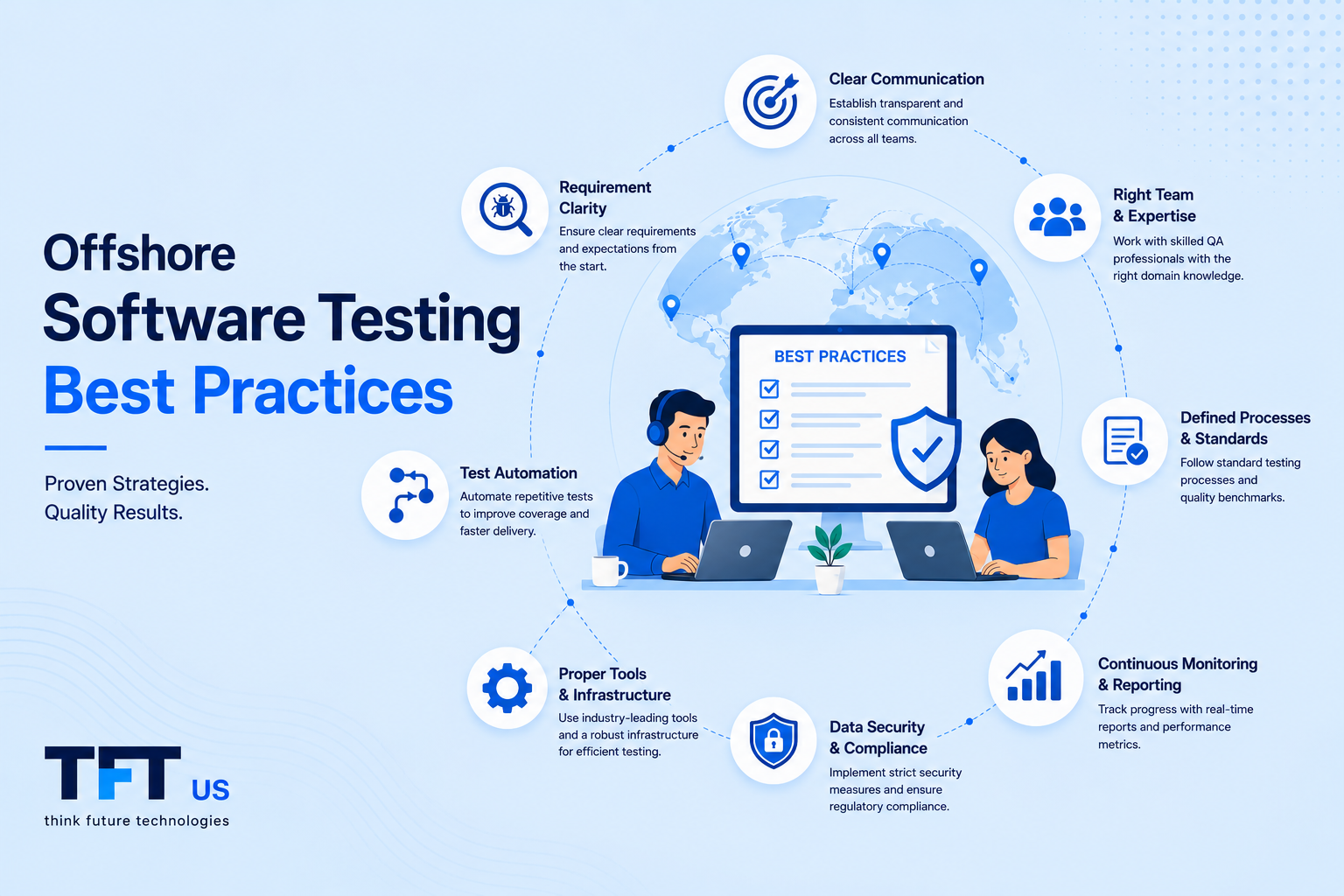
Thirty-four percent of offshore QA engagements end up in IP disputes — usually because someone treated a signed NDA as if it were an IP assignment clause, which it isn’t. This playbook is built in the order that actually prevents that: compliance and contract terms before vendor selection, vendor selection before operations, because the mistakes in the first two are the ones you can’t undo later.
This guide is informational, not legal advice — consult counsel before relying on it for contract or compliance decisions. Statistics and figures are drawn from the named sources cited throughout; the fintech example is an illustrative composite, not a verified named company.
Contents
hide
Why Best Practices Matter in 2026
The remote-work acceleration after 2020 changed how companies think about quality assurance. Offshore QA hubs in India, Eastern Europe, and Latin America have matured into reliable centers of specialized expertise.
The global software testing market is projected to grow from $55.8 billion in 2024 to $112.5 billion by 2034 — a 7.2% CAGR, per ThinkSys’s 2026 QA Trends Report — and the broader software development outsourcing market is projected to reach $977 billion by 2031, according to Keyhole’s Software Development Outsourcing Statistics. Offshore software testing is no longer a stopgap; it is a deliberate strategy, and Keyhole’s same research puts AI adoption among outsourcing companies at 83% as of 2026.
The global software testing market is projected to grow from $55.8 billion in 2024 to $112.5 billion by 2034 — a 7.2% CAGR, per ThinkSys’s 2026 QA Trends Report — and the broader software development outsourcing market is projected to reach $977 billion by 2031, according to Keyhole’s Software Development Outsourcing Statistics. Offshore software testing is no longer a stopgap; it is a deliberate strategy, and Keyhole’s same research puts AI adoption among outsourcing companies at 83% as of 2026.
Here is what that looks like in practice. Offshore software testing involves delegating the software testing process to a service provider located in another country, often in a different time zone, allowing companies to access global expertise and talent:
- Offshore testing teams often provide access to global talent, enabling companies to find the best testing experts regardless of their location.
- Utilizing offshore software testing services can accelerate the testing process, enabling quicker product launches and helping meet project deadlines.
- Typical goals include cost optimization through lower labor costs, faster releases via follow-the-sun testing, and access to niche testing methodologies such as mobile automation, performance labs, and security audits.
- Key risks include data security threats, communication gaps driven by cultural differences, a mismatched testing strategy, and poorly managed test environments.
Here is where most guides get the sequence wrong: they lead with benefits and tooling, then mention compliance as an afterthought. The correct order is compliance mapping, then vendor vetting, then contract terms, then operations — because a compliance gap or a missing IP clause is the kind of mistake you can’t fix retroactively. This article follows that order.
How to use this guide in the next hour: (1) run the Go/No-Go check below before you talk to a single vendor, (2) find your industry in the Compliance Framework table and note which certifications are non-negotiable for you, (3) skip straight to “The Contract Non-Negotiables” before you sign anything, even a letter of intent.
Go/No-Go: Are You Ready to Offshore QA?
Before vendor shortlists or contract terms, answer this honestly: Is your documentation mature enough to hand to a team that has zero implicit context about your product? If requirements live in Slack threads and tribal knowledge, offshoring will surface that gap immediately — expensively.
Four readiness signals worth checking first:
- Test cases and acceptance criteria exist in writing, not just in your head or your senior developer’s
- You can name which data your test environments touch, and whether any of it is real PII, PHI, or cardholder data.
- Someone other than your offshore vendor is going to own quality strategy and vendor governance.
- You know your release cadence well enough to define a defect escape rate target before, not after, the first release.
If two or more of these are shaky, fix them before signing anything — an offshore vendor cannot compensate for missing internal process maturity, and trying to outsource your way past it is a common, expensive mistake.
Offshore QA by Region: India vs. Eastern Europe vs. Latin America
India and Eastern Europe remain the top regions for offshore software development for US companies in 2026, with India the most preferred destination overall. Nearshoring has grown as a trend, with US companies increasingly favoring geographically closer offshore partners for the easier time-zone overlap it provides.
| India | Low — favors async/follow-the-sun | Lowest | Scale, deep talent pool, mature QA industry |
| Eastern Europe | Moderate — partial overlap with EU mornings/US evenings | Mid | Strong technical depth, EU legal alignment |
| Latin America | High — near-real-time with US business hours | Mid | Best live-collaboration fit for agile teams |
The “right” region depends on which constraint hurts more: if your team needs real-time pairing, Latin America’s overlap usually outweighs India’s lower rate; if you need 24/7 follow-the-sun coverage and can tolerate async handoffs, that calculus reverses. Decide this before the vendor search, not during it — it narrows your shortlist immediately.
Designing a Robust Offshore Testing Strategy
Every effective offshore software testing engagement starts with a written testing strategy document, agreed between onshore product owners and the offshore QA lead, that defines scope by test type. Unit testing and architecture-critical experiments stay close to developers onshore, since they require tight coupling with design decisions and rapid feedback.
System testing, regression testing, smoke testing, functional testing, performance testing, and security testing can be delegated to the offshore testing team, provided they have domain context and environment access. Acceptance testing criteria should be jointly authored so both sides share the same definition of done.
Apply risk-based testing to prioritize coverage: identify which functionalities carry the most severe business impact if they fail, and weight test depth accordingly rather than spreading effort evenly.
Set measurable quality goals before test execution begins: a target defect escape rate (fewer than 2 critical production bugs per release), performance SLAs (95th-percentile response time under 500ms), and security vulnerability thresholds (zero unpatched critical CVEs older than 60 days).
Document a shared test cycle structure — test planning with requirement analysis and sign-off, environment confirmation, test execution, regression runs, defect triage, and test cycle closure — with explicit entry and exit criteria.
Document a shared test cycle structure — test planning with requirement analysis and sign-off, environment confirmation, test execution, regression runs, defect triage, and test cycle closure — with explicit entry and exit criteria.
Example: a US fintech startup retained roughly 200 payment API unit tests onshore, delegated a 1,200-case regression suite and performance test harnesses to an offshore QA center in India, and ran collaborative security audits with a Polish partner.
Defect categories shifted measurably: payment-logic defects (highest severity) stayed concentrated in the onshore-tested core, while UI and integration defects — the bulk of the regression suite’s findings — were caught offshore before reaching staging. Within six months, production bugs dropped 50%, and regression cycles shrank from five days to one.
Defect categories shifted measurably: payment-logic defects (highest severity) stayed concentrated in the onshore-tested core, while UI and integration defects — the bulk of the regression suite’s findings — were caught offshore before reaching staging. Within six months, production bugs dropped 50%, and regression cycles shrank from five days to one.
Compliance First: What Your Industry Requires Before Granting Access
When source code and test data leave the home country, compliance becomes the highest priority — not a checkbox to revisit later. No amount of cost savings justifies the kind of exposure IBM’s Cost of a Data Breach research puts at a $4.4 million global average.
The mapping procedure is three steps: identify which regulated data types your test environment will touch, match each type to the framework table below, and budget the compliance surcharge before you sign — not after a vendor tells you they “don’t currently support” the certification you needed.
The mapping procedure is three steps: identify which regulated data types your test environment will touch, match each type to the framework table below, and budget the compliance surcharge before you sign — not after a vendor tells you they “don’t currently support” the certification you needed.
Compliance Framework by Industry Vertical
| Healthcare | HIPAA | Signed Business Associate Agreement required before any PHI access |
| Fintech / Payments | PCI-DSS | Network segmentation; cardholder data never in plain test environments |
| Enterprise SaaS | SOC 2 Type II | Vendor’s own controls audited over time, not just designed |
| EU customers | GDPR | Standard Contractual Clauses for cross-border transfer |
Budget for this upfront: HIPAA and GDPR compliance work typically adds roughly 15% to a QA project’s cost. Treating it as a late addition is how budgets blow past their original estimate.
Vendor Certification Checklist: Red Flags to Watch
For regulated industries, three credentials matter and one common substitution is a red flag: ISO 27001, a current SOC 2 Type II report (not just an attestation letter, which is a much weaker substitute), and CMMI Level 3. A vendor who offers an attestation in place of an actual report, or who can’t produce one dated within the past 12 months, represents a fundamental security risk regardless of how polished their sales pitch is.
Questions worth asking directly during vendor evaluation, before any contract is drafted: Can you show three client references where you handled data under the same regulation we’re subject to? What’s your tester-to-lead ratio, and how does that affect escalation speed on critical defects? Walk me through your last IP or access audit — how do you trace code ownership through your own subcontractors? Vague or deflected answers to any of these are themselves a signal.
Secure Access Controls and Data Protection
Enforce VPN-only or Zero-Trust Network Access for every offshore QA team member, require single sign-on with two-factor authentication, and apply role-based, least-privilege permissions with regular review and revocation of unused accounts. Use production-like, anonymized data for performance tests; mask or synthesize PII to comply with privacy laws rather than exporting real records.
Security testing activities suitable for offshore testing teams include vulnerability scanning of code and dependencies, API security checks, and fuzzing against the OWASP Top-10, and penetration testing executed under controlled conditions in sandboxed staging environments.
Vignette: at one offshore vendor, a tester was granted broad database access during onboarding and retained it months after their project role changed. An internal audit caught the misconfiguration before any data was exfiltrated. The fix — just-in-time access approvals, mandatory MFA, comprehensive access logging, and quarterly access reviews — is cheaper than the incident it prevents.
The Contract Non-Negotiables: IP, Jurisdiction, and Subcontractors
Contracts must include data processing agreements, confidentiality clauses, IP ownership, breach notification obligations, and governing-law jurisdiction. Three specific gaps cause most of the damage when they’re missing — and they’re rarely caught until the relationship has already gone wrong, at which point a missing clause isn’t a paperwork problem, it’s the reason you have no recourse.
IP Assignment Clause vs. NDA: Why They’re Not the Same
An NDA protects confidentiality — it says the vendor won’t disclose your secrets. It says nothing about who owns the work product. In one documented case, a vendor kept and relaunched a fintech startup’s codebase after the contract ended, because the agreement only covered confidentiality, not ownership.
A separate IP assignment clause naming test scripts, automation frameworks, and all testing artifacts as your company’s property is non-negotiable, and roughly a third of offshore engagements — 34%, per Accelerance’s 2024 research — end up in IP disputes, frequently over exactly this gap.
A separate IP assignment clause naming test scripts, automation frameworks, and all testing artifacts as your company’s property is non-negotiable, and roughly a third of offshore engagements — 34%, per Accelerance’s 2024 research — end up in IP disputes, frequently over exactly this gap.
Sample language that actually binds subcontractors, not just the vendor: “All work product, including but not limited to test scripts, automation frameworks, test data generators, and documentation, shall be deemed work made for hire and the sole property of Client.
Vendor shall ensure this assignment binds all subcontractors and affiliates engaged in performance of this Agreement, and shall provide Client with a current list of such subcontractors upon request.” The subcontractor sentence is the part most template NDAs skip entirely — without it, the clause protects you from the vendor but not from whoever the vendor quietly brought in.
Vendor shall ensure this assignment binds all subcontractors and affiliates engaged in performance of this Agreement, and shall provide Client with a current list of such subcontractors upon request.” The subcontractor sentence is the part most template NDAs skip entirely — without it, the clause protects you from the vendor but not from whoever the vendor quietly brought in.
Subcontractor Chain Disclosure
Your NDA and IP clause only bind the parties who sign them. Vendors routinely use subcontractors who were never asked to sign anything, and an unbound subcontractor is the most common IP leak vector in the entire relationship. Require vendors to disclose every subcontractor by name and bind each one to the same NDA and IP terms — a contract that doesn’t reach the actual hands touching your code protects nothing.
Jurisdiction and Arbitration Clause
US court judgments are generally not enforceable in most offshore jurisdictions. Require a US-state governing law clause (Delaware and Texas are common choices) or a binding international arbitration clause naming a specific venue (New York City and Singapore are standard). Skipping this isn’t a minor oversight — unclear jurisdiction is a factor in a meaningful share of the IP disputes cited above, and it’s the one gap that’s entirely avoidable with a single clause.
Two more clauses worth pairing with it: a liability cap (“Vendor’s total liability under this Agreement shall not exceed twelve (12) months of fees paid, except in cases of gross negligence, willful misconduct, or breach of confidentiality and IP obligations”) and a data residency restriction naming the specific countries test data may transit or be stored in, rather than leaving “appropriate safeguards” undefined.
What Offshore QA Actually Costs: The Real Number
Labor arbitrage alone is not a strategy. Offshore software development enables cost savings of 30–70% compared to maintaining in-house US teams, but the headline hourly rate — typically $25–$50/hr offshore versus $100–$120/hr onshore — is not the real number. A team that quotes $30/hr and looks 70% cheaper than a $100/hr onshore hire often lands closer to 30–40% cheaper once the items below are added back in — still real savings, just not the number on the rate card.
Pricing Models
Software testing services come in a few standard shapes, and the offshore software testing services market has converged on the same four:
| Time-and-materials | Exploratory or evolving scope | Any size, but track hours weekly or overrun risk compounds |
| Fixed price per release | Well-defined, stable scope | Works best under ~$150K with locked acceptance criteria |
| Dedicated offshore team | Long-term, ongoing QA needs | Most cost-effective above ~$200K/year sustained spend |
| Hybrid (fixed + T&M) | Stable core with exploratory edges | Common above $150K when scope has both elements |
Whichever model you choose, get it in writing before testing tools, test cases, or automation code cross any border.
The True Cost Model, Beyond the Hourly Rate
Add these to any quote before comparing it to an in-house budget:
- Compliance setup: roughly 15% for regulated industries
- Ramp dead-zone: 4–6 weeks of partial output while the new team reaches full productivity
- Rework and scope creep: 10–25% budget overrun risk, especially with vague requirements
- Onshore coordination overhead: a rule of thumb is 0.5–1.0 FTE of onshore coordinator time per 5 offshore testers
Worked example: a quoted $30/hr rate for a regulated fintech engagement carries a 15% compliance surcharge (+$4.50), a 5-week ramp dead-zone averaging 50% productivity during that stretch (effectively +$3/hr amortized over a 6-month engagement), and an 8% rework allowance (+$2.40) — landing closer to $40/hr actual, not $30/hr. That’s still a real discount against a $110/hr onshore rate, just a 64% discount instead of the 73% the headline number implied.
Stacked together across a full engagement, these routinely make the real cost 30–40% higher than the headline rate suggests. A five-person in-house US QA team costs roughly $500,000/year; a dedicated offshore model with ten testers may run $250,000/year even after these additions — the savings are real, just smaller than the hourly-rate math implies.
Stacked together across a full engagement, these routinely make the real cost 30–40% higher than the headline rate suggests. A five-person in-house US QA team costs roughly $500,000/year; a dedicated offshore model with ten testers may run $250,000/year even after these additions — the savings are real, just smaller than the hourly-rate math implies.
Onboarding and the 4–6 Week Ramp
Most organizations need four to eight weeks for onboarding: tool access, domain training, environment readiness, and pilot test cycles under oversight. Complex regulated products (banking, medical devices) can take two to three months to reach full productivity. Start with a limited scope — one product module or a subset of test types — and expand as the vendor demonstrates reliability in real deliverables, not in the sales pitch.
Document handoff requirements explicitly: who owns defect triage during the ramp, what “full productivity” actually means in measurable terms, and which test types stay onshore until the vendor has proven domain competence.
Core Roles in a Typical Offshore Testing Team
Role clarity is the difference between a productive offshore software testing team and an expensive communication bottleneck — when two testers both assume the other owns the environment setup, the bug doesn’t get reproduced until someone notices three days later. A simple RACI split prevents this: one person Accountable per role below, everyone else Consulted or Informed, documented before the first sprint, not discovered during it.
A QA Lead owns the testing strategy offshore and acts as a quality gatekeeper. Manual testers handle exploratory and usability testing. Automation engineers build and maintain automated testing suites and integrate test scripts into CI/CD. A performance tester runs load and stress testing.
A security testing specialist is critical in regulated domains, and a DevOps/environment engineer handles environment provisioning and parity — this role matters more offshore than onshore, specifically because environment drift is harder to catch when the team setting up the environment isn’t in the same room as the team debugging it.
For a typical 10-person offshore team, a rough starting ratio is 5 manual testers, 3 automation engineers, 1 performance tester, and 1 shared security/DevOps specialist — shifting toward more automation as the product matures. During MVP, lean toward more manual QA; as the product matures, invest in test automation and performance labs.
A security testing specialist is critical in regulated domains, and a DevOps/environment engineer handles environment provisioning and parity — this role matters more offshore than onshore, specifically because environment drift is harder to catch when the team setting up the environment isn’t in the same room as the team debugging it.
For a typical 10-person offshore team, a rough starting ratio is 5 manual testers, 3 automation engineers, 1 performance tester, and 1 shared security/DevOps specialist — shifting toward more automation as the product matures. During MVP, lean toward more manual QA; as the product matures, invest in test automation and performance labs.
Collaboration Patterns
Daily standups need at least 1–2 hours of overlap with the onshore time zone, weekly quality reviews assess defect trends and test coverage, and monthly strategy syncs between QA leads keep metrics and planning aligned. Centralized tools for documentation and bug tracking — Jira or Azure DevOps for defects, TestRail or Zephyr for test case management, Slack or Teams for day-to-day communication — improve efficiency across both teams.
Mini-example: a SaaS platform’s offshore QA team wrote an automated smoke testing suite covering 50 critical workflows using Cypress, triggered nightly via GitHub Actions. Over three months, the regression window compressed from four days to four hours, freeing testers to focus on exploratory and usability testing.
Test Environment Setup and Execution Best Practices
Inconsistent test environments are a top cause of false failures in offshore projects. When your offshore testing partner reports a bug that cannot be reproduced onshore, the culprit is usually environmental drift, not tester error. Quick diagnostic before you blame the tester: compare middleware and dependency versions against your baseline, check config files for silent overrides, and confirm the test data itself hasn’t quietly diverged between environments.
Standardizing Test Environment Setup
Use infrastructure as code (Terraform, Pulumi, CloudFormation) to define environments, containerize services with Docker, and orchestrate via Kubernetes for microservices, and maintain shared configuration baselines so operating systems, middleware versions, and dependencies match between onshore and offshore.
| QA | Day-to-day functional testing, smoke testing | Offshore QA team |
| Staging | Full regression, performance, compatibility testing | Both teams |
| Security/Sandbox | Pen-testing, vulnerability scanning, masked PII | Security specialists |
Realistic Test Data Management
Use production-like, anonymized data for performance tests. Mask or synthesize PII with purpose-built tools like Delphix or Tonic.ai rather than ad-hoc scripts, secure data refresh pipelines, control access, and audit usage. Run smoke tests after every deployment to QA or staging to validate environmental readiness before launching the full suite — this catches blocking issues in minutes rather than hours. CI/CD tools such as Jenkins, GitHub Actions, or GitLab CI can automatically provision environments and trigger test cycles for the offshore testing team.
The offshore-specific wrinkle generic data-masking advice skips: sending EU customer data to an offshore testing team in India isn’t just a masking problem, it’s a GDPR cross-border transfer question, and masking after the fact doesn’t fix a transfer that should have used Standard Contractual Clauses in the first place. Map data residency obligations before the data moves, not after.
Agile Delivery and Shift-Left Testing
Process discipline is what offsets time zone gaps. Effective software testing doesn’t look different offshore than onshore in principle — the same testing methodologies and quality bar apply. The most common offshore-specific failure of Shift-Left isn’t philosophical; it’s logistical: “shift testing earlier” assumes QA can ask a clarifying question and get an answer the same day, which breaks down when QA is 10 hours ahead of the product owner.
The fix is async-friendly requirement reviews — written acceptance criteria with explicit edge cases, reviewed asynchronously before sprint start, so the offshore team isn’t blocked waiting for a real-time answer that won’t arrive until tomorrow.
The fix is async-friendly requirement reviews — written acceptance criteria with explicit edge cases, reviewed asynchronously before sprint start, so the offshore team isn’t blocked waiting for a real-time answer that won’t arrive until tomorrow.
Use two-week sprints with the definition of done including unit testing, integration testing, and acceptance criteria verified by the offshore testing team. Include QA from sprint planning — requirement analysis and acceptance criteria reviews by offshore testing experts before development begins.
One team that moved acceptance criteria review into sprint planning instead of leaving it for QA to interpret during execution found roughly 40% more defects caught in-sprint rather than surfacing in UAT — the kind of gap async-first review closes that a generic “shift testing left” slogan doesn’t.
One team that moved acceptance criteria review into sprint planning instead of leaving it for QA to interpret during execution found roughly 40% more defects caught in-sprint rather than surfacing in UAT — the kind of gap async-first review closes that a generic “shift testing left” slogan doesn’t.
Automation Strategy for Offshore Testing Teams
Over 20% of respondents in the 2025 State of Testing™ Report have replaced 75% of previously manual testing with automated testing — but automation offshore needs different design choices than automation in-house: favor frameworks with minimal maintenance overhead, write self-documenting test code since the person debugging it in six months may not be who wrote it, and define explicitly who owns a given automation suite when testers rotate off a project.
Automation is most effective when driven by clear quality objectives, not just coverage targets, to avoid amplifying noise and maintenance overhead.
Automation is most effective when driven by clear quality objectives, not just coverage targets, to avoid amplifying noise and maintenance overhead.
Performance and Reliability Testing with Offshore Testing Teams
Performance testing is often pushed to the end of the development cycle, but it’s ideal to offload to a specialized offshore center that runs overnight cycles while the onshore team sleeps — load testing before major launches, stress testing critical APIs and payment endpoints, and endurance testing leveraging the time-zone advantage.
Tools like JMeter, Gatling, k6, and Locust, with results shared via Grafana or DataDog dashboards visible to both teams, keep performance SLAs (95th/99th-percentile latency, error rate thresholds, throughput targets) measurable rather than aspirational. One geographic caveat worth flagging explicitly: load generators physically distant from your production region introduce network latency that can skew results — interpret offshore performance numbers with that variable accounted for, not as a direct substitute for in-region testing.
Example: an e-commerce platform preparing for a Q3 traffic spike shifted performance test cycles to its offshore testing team, running nightly load tests against staging. They found a database bottleneck under peak concurrent users, fixed it pre-launch, and cut expected outage risk by roughly 80%.
Communication, Culture, and Collaboration Across Time Zones
Even the best testing strategy fails without intentional communication patterns. Tools and processes cannot replace the discipline of showing up consistently. Three patterns from Karen Johnson’s Managing an Offshore Team presentation hold up well in practice: rotate who bears the off-hours meeting burden instead of defaulting to the offshore side every time, write status updates as if the reader has zero context (because by the next time zone, they effectively don’t), and treat the first few weeks of a new offshore relationship as relationship-building time, not just task assignment — the trust built there is what makes the inevitable first miscommunication a non-event instead of a crisis.
Overlap Hours and Communication Norms
A minimum of 2–3 overlapping hours daily is recommended, with fixed recurring slots for standups, backlog grooming, defect triage, and demo reviews. A blocker notification template keeps async handoffs from losing information: what’s blocked, what was tried already, what’s needed to unblock (a decision, an access grant, a code review), and the deadline before it cascades into the next task. Document response-time expectations (e.g., within two hours for blockers during overlap) and escalation paths for critical defects — a blocker discovered mid-day offshore should trigger that template immediately, not wait for the next sync.
Cultural Awareness and the Onboarding Checklist
Cultural alignment through onboarding sessions integrates offshore testing teams with product vision and quality standards. One concrete friction point worth naming explicitly: in several offshore hubs, testers are culturally less likely to push back on an ambiguous requirement than to quietly make their best guess and move on — build an explicit “clarification is expected, not a sign of weakness” norm into onboarding rather than assuming it.
A time-phased onboarding checklist, not just a bullet list:
- Week 1: product vision session, access provisioning, and a recorded walkthrough of the codebase or product for async reference
- Week 2: shadowing an onshore tester or sprint, paired test-case writing with feedback
- Weeks 3–4: first independent test pass under oversight, with a scheduled retro before going fully solo
For onshore product owners: write unambiguous requirements with clear acceptance criteria, include UX and performance expectations in every user story, and document every test case and QA workflow in a centralized knowledge base. Rotate meeting times so one side doesn’t always bear the off-hours burden.
Core Metrics and SLA Benchmarks
Offshore QA must be run as a measurable, continuously improving system, not a black-box service. Track defect escape rate, reopened defect rate, test case effectiveness, automated vs. manual coverage ratio, and average time from discovery to resolution. Without baselines, “define KPIs” is just advice with no way to measure failure — use specific targets: defect detection rate above 85% in UAT, escape rate below 5% to production, and a 24-hour bug triage SLA.
Continuous Improvement and Knowledge Management
After each major release, run a formal test cycle closure review: metrics, root-cause analysis on major defects, and agreed process or tooling changes. This is where the value actually surfaces — one team’s closure review traced 30% of escaped defects to stale test data rather than missed test cases, and the fix (an automated weekly data refresh) cut that category of escape to near zero within a quarter.
Version-control automation code and environment setup scripts, and maintain a shared knowledge base so new joiners can onboard quickly. As complexity grows, shift team composition toward more automation engineers and gradually expand performance and security labs.
Version-control automation code and environment setup scripts, and maintain a shared knowledge base so new joiners can onboard quickly. As complexity grows, shift team composition toward more automation engineers and gradually expand performance and security labs.
Red Flags and Exit Triggers: When to Restructure or Fire the Vendor
No competitor guide covers this, which is exactly why engagements that should have been restructured six months earlier limp along instead. Watch for: velocity quietly dropping, release over release, a “ticket ping-pong” pattern where defects bounce back and forth without resolution, a rising rate of clarification requests on work that used to be straightforward, and automation ROI declining as maintenance eats the time it was supposed to free up.
One or two of these in isolation can be a bad sprint. All four together, sustained for two release cycles, is a pattern — and the response should be a structured conversation with the vendor about root cause, not a unilateral decision in either direction. Restructure (change scope, add oversight, or renegotiate pricing) when the root cause is fixable; exit when it’s a sustained skills or integrity gap, and when you do, the IP assignment, jurisdiction, and subcontractor clauses from earlier are exactly what make an exit a contract event instead of a legal fight.
As complexity grows, shift team composition toward more automation engineers and gradually expand performance and security labs. Effective software testing in 2026 is a discipline of continuous improvement, not a one-time setup: quality testing powered by data, retrospectives, and a proven track record of delivery is what separates an offshore engagement that becomes a genuine quality multiplier from one that quietly erodes software quality release after release.
Choosing the right offshore testing partner, confirming their cost and pricing model upfront, and validating their testing tools and testing methodologies against your real-world scenarios — not just their sales deck — determines whether customer satisfaction holds steady as you scale. Software testing offshore succeeds or fails on exactly these unglamorous, write-it-down-in-advance details, not on the hourly rate.
FAQ
How do I decide which testing activities to keep in-house versus offshore?
Unit testing and architecture-critical experiments typically stay in-house because they demand tight coupling with design decisions and immediate feedback. Regression, system, smoke, performance, and much of the security testing can be delegated to an offshore testing team with the right domain knowledge. Conduct a risk assessment per component — sensitivity, change frequency, business impact, technical complexity — rather than applying a blanket rule.
What’s the difference between an NDA and an IP assignment agreement?
An NDA only obligates the vendor to keep information confidential — it doesn’t say who owns anything created during the engagement. An IP assignment clause explicitly transfers ownership of automation scripts, test frameworks, and testing artifacts to your company. Treat them as two separate, both-required documents, not one covering the other.
What is a realistic timeline to ramp up a new offshore QA team?
Most organizations need four to eight weeks for onboarding. Complex regulated products may need two to three months due to compliance learning curves. A representative 8-week schedule: weeks 1–2 are tool access and domain training; weeks 3–4 are paired/shadowed test execution under oversight; weeks 5–6 are the first independent test pass with daily check-ins; weeks 7–8 reduce oversight toward steady-state cadence, with a go/no-go review at the end. Start with a limited scope and expand as the partner demonstrates reliability in real deliverables.
How can I protect intellectual property when working with an offshore testing provider?
Use strong NDAs plus a separate IP assignment clause covering automation code, test frameworks, and all testing artifacts. Restrict repository access with least-privilege permissions, require VDI so local storage is restricted, disable local copying of test data, and require disclosure and binding of all subcontractors. ISO 27001 alignment and periodic security audits reduce leakage risk further.
How do I know whether my offshore QA strategy is working?
Use a traffic-light check against specific thresholds rather than a gut feeling: green if escaped defect density is under 0.5 per thousand lines of code and automation coverage exceeds 60%; amber if change failure rate is creeping above 5% or automation coverage has stalled for two consecutive releases; red if escape rate or change failure rate has worsened for three releases running. Track these in whatever you already use for defect tracking — Jira dashboards or Allure reports both work — rather than standing up a separate measurement tool.
One practical trap: a team that hits 95% test-case pass rate but has a rising production escape rate is optimizing a vanity metric, not quality — pass rate measures whether your existing tests pass, not whether you’re writing the right tests. Run quarterly KPI reviews with the offshore QA lead using the thresholds above as the agenda, not a free-form discussion. If firefighting is declining while release frequency increases, it’s working; if pass rate looks great but escapes keep climbing, the test suite itself needs an audit.


Leave a Reply