

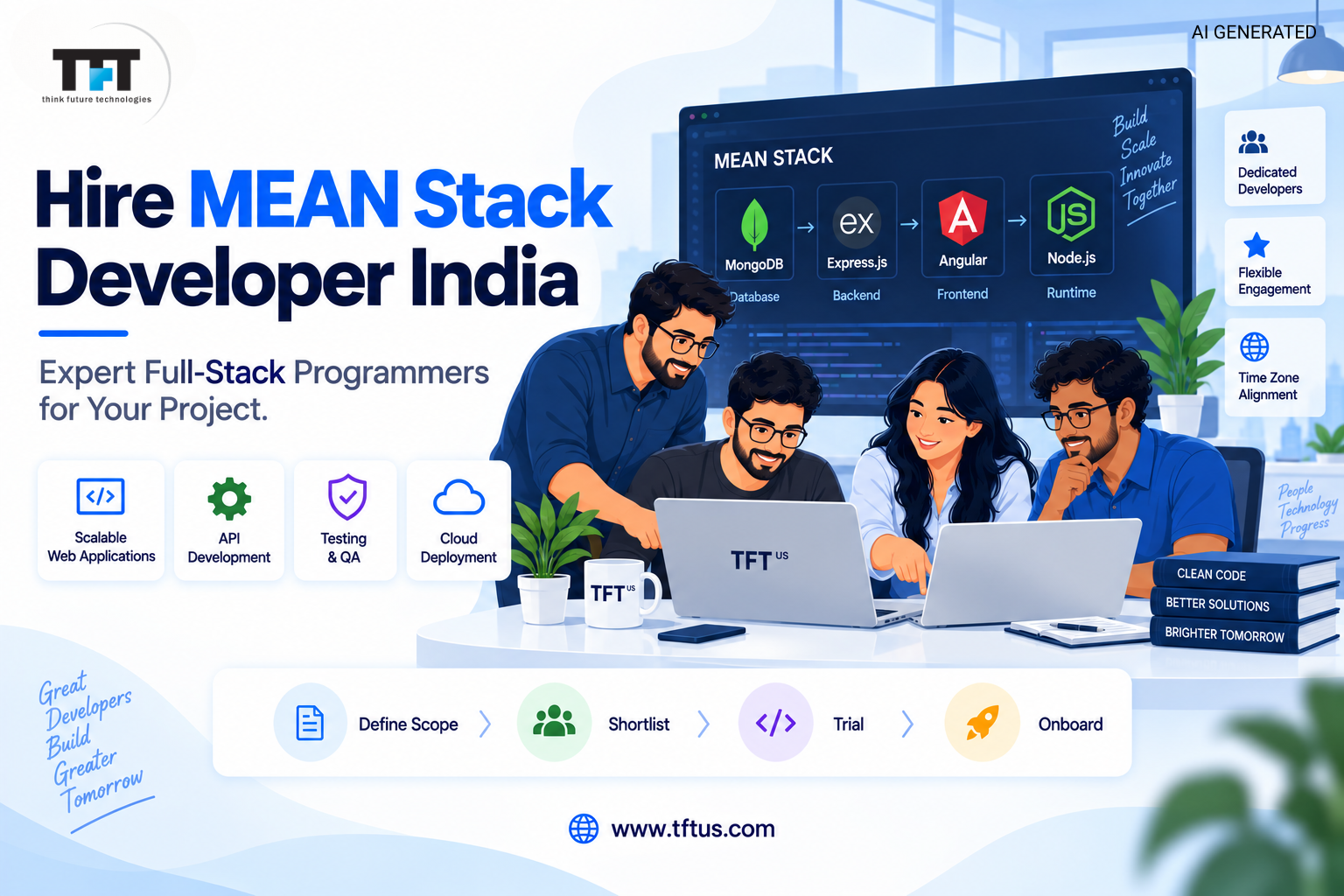
Businesses building modern web applications need a technology stack that moves fast without breaking under real-world load. That is exactly why so many founders and CTOs search for ways to hire MEAN stack developer teams in India before they write a single line of code. The MEAN stack- MongoDB, Express.js, Angular, and Node.js- lets a single group of engineers own the entire application, from the database schema to the pixels a user taps on screen. When you hire MEAN stack developers who have shipped production systems before, you are not just filling a resourcing gap. You are buying speed, consistency, and a shorter path from idea to working product.
India has become the default sourcing destination for this kind of talent. The reasons are practical rather than sentimental: a deep bench of engineers who trained specifically on JavaScript-based stacks, English-fluent teams that overlap comfortably with US and European working hours, and cost structures that let a startup afford a senior MEAN stack development team it could never staff locally. This article walks through what the MEAN stack actually is, why dedicated MEAN stack developers from India are worth considering, how development costs and hiring models compare, and what questions to ask before you sign a contract.
What Is the MEAN Stack, Really
The MEAN stack is not a single technology. It is four technologies that were designed, or later adapted, to speak the same language: JavaScript. That shared language is the entire point. A MEAN stack development team does not need to context-switch between a Python backend, a Java service layer, and a JavaScript frontend. Every layer of the application, from database queries to browser rendering, runs on the same syntax and often the same engineers.
MongoDB: The Document Database Layer
MongoDB stores data as JSON-like documents instead of rigid rows and columns. This matters for teams building products where the data shape changes often, a SaaS dashboard adding new fields, a marketplace app with variable product attributes, or a content platform with nested comment threads. MEAN stack engineers use MongoDB because it maps naturally onto the objects JavaScript already works with, cutting out a translation layer that other stacks require.
Express.js: The Application Framework
Express sits on top of Node.js and handles the unglamorous but essential work of routing, middleware, and request handling. It is deliberately minimal, which gives stack developers room to structure an API the way a specific project actually needs rather than fighting a framework’s opinions. Most backend logic, authentication, validation, and third-party services integration passes through an Express layer at some point.
Angular: The Frontend Framework
Angular is a full frontend framework maintained by Google, built for teams that need structure and long-term maintainability rather than a loosely assembled set of libraries. It ships with dependency injection, a component model, and strong typing through TypeScript, which makes it a natural fit for complex, data-heavy web apps where a small inconsistency in state management can cause real bugs. Angular components map cleanly onto the kind of responsive user interfaces enterprise clients expect.
Node.js: The Runtime
Node.js is what makes the whole stack single-language. It runs JavaScript outside the browser, on the server, using a non-blocking event loop that handles many simultaneous connections efficiently. For applications with heavy real-time components, chat, live dashboards, notification systems, Node’s architecture is a genuine technical advantage, not just a convenience.
Why Hire MEAN Stack Developer India Teams Specifically
There is nothing stopping a company from hiring MEAN stack developers anywhere in the world. But India carries a specific combination of advantages that shows up repeatedly in engineering budgets and delivery timelines.
A Deep, JavaScript-Native Talent Pool
India has produced JavaScript engineers at scale for over a decade, largely because global outsourcing demand pushed local training programs, bootcamps, and computer science departments to prioritize web development skills that travel well internationally. The result is a large pool of MEAN stack engineers who have already worked across multiple industries and project types before a new client ever meets them.
Cost Efficiency Without Cutting Corners
Development costs in India are lower than in the US, UK, or Western Europe, but the gap is driven by cost of living and currency differences, not by a difference in skill ceiling. A company can hire dedicated MEAN stack developers with five or more years of production experience at a fraction of the equivalent domestic salary, and redirect that saved budget into product scope, marketing, or a longer development runway.
Time Zone Overlap That Actually Works
Contrary to the old outsourcing stereotype of asynchronous, overnight handoffs, most Indian MEAN stack development companies now structure their day specifically to overlap with US and European working hours. Standups, code reviews, and sprint planning can happen live rather than through delayed messages, which shortens the feedback loop on every decision.
Technical Expertise You Should Expect From a MEAN Stack Team
Not every developer who lists “MEAN stack” on a resume can deliver production-grade software. Before you hire MEAN stack developer talent in India, it helps to know what real technical expertise looks like at each layer of the stack.
Backend Architecture and API Design
A capable MEAN stack development team designs APIs with clear versioning, consistent response formats, and proper error handling from day one. This sounds basic, but a surprising number of freelance engineers skip it, leaving a client with an API that breaks every time the frontend requirements shift slightly.
Database Schema and Query Performance
MongoDB’s flexibility is a double-edged sword. Without disciplined schema design, indexing strategy, and query optimization, a MongoDB-backed application can slow down badly once real user data accumulates. Experienced stack engineers plan the data model around actual query patterns, not just around what is easiest to insert.
Testing and Quality Assurance
A MEAN stack development team with real technical expertise treats automated testing as part of the build, not an optional extra. Unit tests around backend logic and API endpoints, combined with integration tests across the Angular frontend, catch regressions before they reach a client’s users.
Scalable Web Applications: What the Stack Enables
One of the strongest reasons companies choose to hire MEAN stack developers is scalability. Node’s non-blocking architecture, MongoDB’s horizontal scaling model, and Angular’s component-based frontend structure combine to support applications that need to grow well past their original scope.
Handling Traffic Growth
Node.js was built to handle a large number of concurrent connections without spinning up a new thread for each one, which keeps memory usage predictable as traffic grows. For businesses expecting seasonal spikes or rapid user growth, this architecture avoids the kind of infrastructure rewrite that other stacks sometimes require.
Scaling the Database Layer
MongoDB supports sharding, which distributes data across multiple servers as a dataset grows. A MEAN stack development team that plans for this from the early stages of a project avoids a painful migration later, when the application already has real users and real data to preserve.
Modular Frontend Growth
Angular’s component architecture means new features can be added as self-contained modules rather than tangled additions to an existing codebase. This matters most for web apps that start as an MVP and are expected to grow into a full platform over one or two years.
Understanding Development Costs When You Hire MEAN Stack Developers
Development costs vary widely depending on experience level, project complexity, and hiring model, and getting a realistic sense of pricing up front prevents budget surprises later.
What Drives the Price of a MEAN Stack Project
Three factors matter more than any others: the seniority of the stack engineers assigned to the project, the complexity of the backend logic and integrations required, and whether the client needs a single developer or a full MEAN stack development team spanning frontend, backend, and QA.
Hourly Rates vs Fixed Price vs Dedicated Team
Hourly engagements suit projects with unclear or evolving scope, where paying for actual hours worked protects the client from overpaying for idle time. Fixed-price contracts work better for well-defined projects with a locked specification. A dedicated team model, where a client pays a monthly rate for a committed set of engineers, tends to offer the best value for long-term products that need sustained development over many months.
Comparing India to Other Outsourcing Regions
Compared to Eastern Europe or Latin America, Indian MEAN stack development services generally offer lower hourly rates for comparable experience levels, which is a major reason the region remains the largest global hub for outsourced JavaScript development. That price advantage holds even as demand for stack developers has grown steadily over the past several years.
Flexible Hiring Models for MEAN Stack Development
Different projects call for different hiring models, and a mature MEAN stack development company should offer more than one option rather than forcing every client into the same structure.
Dedicated Development Team
A dedicated team model assigns a fixed group of engineers exclusively to one client’s project. This works well for companies building a long-term product, since the team accumulates deep context on the codebase and business logic over time rather than starting fresh with every engagement.
Staff Augmentation
Staff augmentation adds individual MEAN stack developers into an existing in-house team, filling a specific skill gap without the overhead of standing up a separate outsourced project structure. This model suits companies that already have a project manager and technical lead in place and simply need more hands.
Project-Based Engagement
A project-based model fits well-scoped work with a clear beginning and end, a new feature build, a platform migration, or an MVP built to a fixed specification. The vendor manages the internal team composition and delivers against agreed milestones.
How to Evaluate MEAN Stack Developers Before You Hire
Technical interviews alone rarely reveal whether a developer or team can actually deliver. A more complete evaluation process looks at several dimensions together.
Reviewing a Portfolio of Past Projects
Ask for examples of web applications the team has shipped, ideally in a similar industry or with similar technical requirements. A proven track record of comparable work is a stronger signal than a general list of technologies on a company website.
Assessing Code Quality Directly
Request a sample of code from a past project, or set a small paid test task, to see how the team structures a codebase, handles error handling, and documents their work. This reveals far more about technical expertise than a resume ever will.
Checking Communication and Project Management Style
Ask how the vendor handles daily updates, progress tracking, and change requests mid-project. A MEAN stack development team with strong project management practices will already have a clear answer, usually involving a named project manager and a defined reporting cadence.
Building a Dedicated MEAN Stack Development Team
For companies planning sustained product development rather than a single project, building a dedicated MEAN stack development team is usually the stronger long-term investment.
Team Composition That Works
A well-balanced dedicated team typically includes backend-focused Node.js and Express engineers, a frontend specialist with deep Angular experience, a database administrator or MongoDB specialist for larger projects, and a QA engineer responsible for testing across the full stack.
Onboarding a Remote Team Efficiently
Clear technical documentation, access to existing systems, and a short but structured onboarding period help a new dedicated team reach full productivity within the first few weeks rather than months. Vendors with mature onboarding processes will proactively request this information rather than waiting for the client to organize it.
Ensuring Code Quality Across a MEAN Stack Project
Code quality is not a one-time checkpoint. It needs to be built into the daily workflow of a MEAN stack development team.
Code Review Practices
Peer code review before merging changes catches bugs, inconsistent patterns, and security issues before they reach production. Teams with strong code quality practices treat this as non-negotiable, regardless of project deadline pressure.
Automated Testing Pipelines
Continuous integration pipelines that run automated tests on every commit catch regressions immediately rather than days or weeks later, when the original context behind a change has already faded from memory.
Technical Documentation Standards
Clear technical documentation, API references, architecture diagrams, and setup instructions reduce the risk of a project becoming dependent on a single developer’s memory. This matters especially for dedicated teams that may see individual engineer turnover over a multi-year engagement.
API Development and Backend Logic in the MEAN Stack
Backend logic is where most of a MEAN stack application’s real complexity lives, and it deserves focused attention separate from frontend work.
RESTful API Design Principles
A well-designed REST API in Express follows predictable conventions for resource naming, HTTP methods, and status codes, which makes it easier for frontend teams, whether Angular or a future mobile app, to integrate without guesswork.
Handling Third-Party Services
Most real applications need to connect to third-party services: payment processors, email providers, analytics platforms, or external APIs. Skilled MEAN stack engineers isolate these integrations behind clean interfaces, so swapping a vendor later does not require rewriting business logic elsewhere in the application.
Authentication and Authorization
Secure authentication, typically built with token-based approaches like JWT, combined with clear authorization rules for different user roles, protects both user data and the business logic that depends on knowing who is making a request.
Database Management With MongoDB in Production
Running MongoDB well in production requires more planning than simply connecting to a database and inserting documents.
Schema Design for Flexibility and Performance
Even though MongoDB is schema-less by default, experienced stack developers still design a logical schema, balancing the flexibility MongoDB offers against the query performance that a more structured approach provides.
Indexing Strategy
Proper indexing is what keeps MongoDB queries fast as a collection grows from thousands to millions of documents. Teams that skip this step often see performance degrade sharply once an application reaches real scale.
Backup and Disaster Recovery
A MEAN stack development company managing production databases should have a clear backup strategy and a tested disaster recovery plan, not just a general assurance that “the data is safe.”
Building Responsive User Interfaces With Angular
The frontend layer is where users form their opinion of a product, and Angular gives stack developers the tools to build interfaces that hold up under real use.
Component-Based Design
Breaking a UI into reusable Angular components keeps a frontend codebase maintainable as a product grows, letting new features reuse existing pieces rather than duplicating code.
Responsive Layouts Across Devices
Responsive user interfaces that adapt cleanly across desktop, tablet, and mobile browsers are now a baseline expectation, not a differentiator. Angular’s component and styling architecture supports this without requiring a separate mobile-specific codebase.
Performance Optimization on the Frontend
Lazy loading of modules, efficient change detection, and careful bundle size management keep an Angular application fast even as it grows in size and feature count, something that matters directly for user retention and SEO performance.
Full Stack Expertise: Why One Team End to End Matters
There is a real advantage to having full stack expertise concentrated in one team rather than split across separate frontend and backend vendors.
Faster Decision-Making
When the same team owns both the API and the interface that consumes it, decisions about data shape, response format, and feature scope happen in a single conversation instead of a slow back-and-forth between two separate vendors.
Fewer Integration Bugs
Integration bugs between frontend and backend are one of the most common sources of delay in multi-vendor projects. A single MEAN stack development team eliminates much of this friction because the same engineers understand both sides of every API contract.
Industries That Benefit From MEAN Stack Development
MEAN stack projects show up across a wide range of industries, each with slightly different technical priorities.
ERP Development
ERP development projects benefit from MongoDB’s flexible schema, which accommodates the varied and often client-specific data structures that enterprise resource planning systems need to support.
CMS Development
CMS development is a natural fit for the stack, since Angular’s component model maps cleanly onto the kind of modular content blocks modern content management systems require.
E-Commerce Platforms
E-commerce platforms benefit from Node’s ability to handle high concurrent traffic during sales events, combined with MongoDB’s flexibility for product catalogs with widely varying attributes.
SaaS Products
SaaS products, especially those with frequent feature iteration, benefit from the stack’s overall development speed and the ease of adding new modules to an Angular frontend without disrupting existing functionality.
Project Management and Progress Tracking
Even the strongest technical team underperforms without solid project management wrapped around it.
Sprint Planning and Milestone Tracking
Clear sprint planning, defined milestones, and visible progress tracking give a client confidence that a project is moving forward, rather than relying on assurances between sparse status updates.
Tools for Transparency
Shared access to project management tools, ticketing systems, and repositories lets a client see real progress directly rather than depending entirely on a vendor’s self-reported updates.
Managing Scope Changes
Business requirements evolve during a project more often than not. A MEAN stack development company with mature project management practices has a clear, low-friction process for evaluating and pricing scope changes as they come up, rather than treating every change as a crisis.
Post-Launch Support and Long-Term Technical Support
Launching an application is a milestone, not a finish line, and the support relationship afterward matters as much as the initial build.
Bug Fixes and Stability Monitoring
A responsible MEAN stack development team monitors application stability after launch and resolves bugs quickly, since early production issues shape a client’s long-term trust in the platform.
Feature Iteration After Launch
Most successful products keep evolving after their initial release. A development partner offering long-term technical support can carry that iteration forward without the client needing to onboard an entirely new team.
Scaling Support as the Business Grows
As user numbers grow, support needs change, from occasional bug fixes to active performance monitoring and infrastructure scaling. A vendor able to scale resources up or down as needed avoids forcing a client into a rigid, one-size support contract.
How to Choose the Right Development Partner
With so many MEAN stack development companies competing for the same clients, a structured evaluation process helps narrow the field.
Defining Project Requirements Clearly
Before reaching out to vendors, define project requirements as specifically as possible: target users, core features, technical constraints, and timeline, since vague requirements make it hard to compare quotes fairly across vendors.
Comparing Multiple Vendors
Requesting proposals from several MEAN stack development companies, rather than committing to the first one contacted, gives a clearer sense of realistic pricing and delivery timelines for a specific project.
Evaluating Cultural Fit
Beyond technical skill, evaluate how well a vendor’s communication style and working rhythm fit with the client’s own team, since this affects daily collaboration far more than most technical differences do.
Steps to Hire Dedicated MEAN Stack Developers
Once a company has decided to move forward, the actual hiring process follows a fairly consistent sequence.
Step One: Define Scope and Budget
Write down the project scope, target timeline, and budget range before starting conversations with vendors, so evaluation criteria stay consistent across every proposal received.
Step Two: Shortlist and Interview Vendors
Shortlist three to five MEAN stack development companies based on portfolio, reviews, and initial conversations, then run a structured technical interview with the specific engineers who would be assigned to the project.
Step Three: Run a Paid Trial Period
A short paid trial period, ideally two to four weeks, reveals far more about a team’s real working style than any interview process can.
Step Four: Finalize Contract Terms
Once a vendor is chosen, finalize contract terms covering intellectual property ownership, data security obligations, payment schedule, and the specific hiring model: dedicated team, staff augmentation, or project-based.
Step Five: Onboard and Set Communication Norms
Set clear communication norms from day one: meeting cadence, reporting format, escalation process, so the working relationship starts on solid footing rather than being defined reactively after the first miscommunication.
Conclusion
Choosing to hire MEAN stack developer India teams is, at its core, a bet on speed and consistency, a single group of engineers who understand the whole application, from MongoDB schema design to the Angular components a user actually interacts with. The cost advantages are real, but they matter most when paired with genuine technical expertise, disciplined project management, and a hiring model that fits how a company actually plans to grow. Whether the need is a dedicated team for a multi-year product, staff augmentation to fill a specific gap, or a project-based engagement with a clear endpoint,
India’s mean stack development companies offer enough range to match almost any stage of a company’s growth. The businesses that get the most value from this approach are the ones that treat vendor selection with the same rigor they would apply to a technical hire made in-house, checking real code, talking to real references, and starting with a scope small enough to prove the partnership before scaling it.
Frequently Asked Questions
How much does it cost to hire MEAN stack developers in India?
Costs vary by experience level and hiring model, but Indian rates are generally significantly lower than US or Western European rates for comparable technical expertise, making a full MEAN stack development team affordable for companies that could not staff the equivalent locally.
How long does it take to build a MEAN stack application?
Timelines depend heavily on project complexity, but a well-scoped MVP typically takes a few months from kickoff to launch, while larger platforms with extensive backend logic and integrations take longer.
Is MongoDB a good fit for every project?
MongoDB works especially well for applications with evolving or varied data structures, but more rigidly relational data may be better served by a different database, which is a conversation worth having with a technical partner early in planning.
What is the difference between hiring a freelancer and a dedicated team?
A freelancer offers flexibility for small tasks, while a dedicated team provides consistency, redundancy if someone is unavailable, and the project management structure needed for larger, longer-running products.
Can an existing application be migrated to the MEAN stack?
Yes, though migration complexity depends on the current technology and how tightly coupled the existing frontend and backend are, so a proper technical audit should precede any migration commitment.

Leave a Reply