

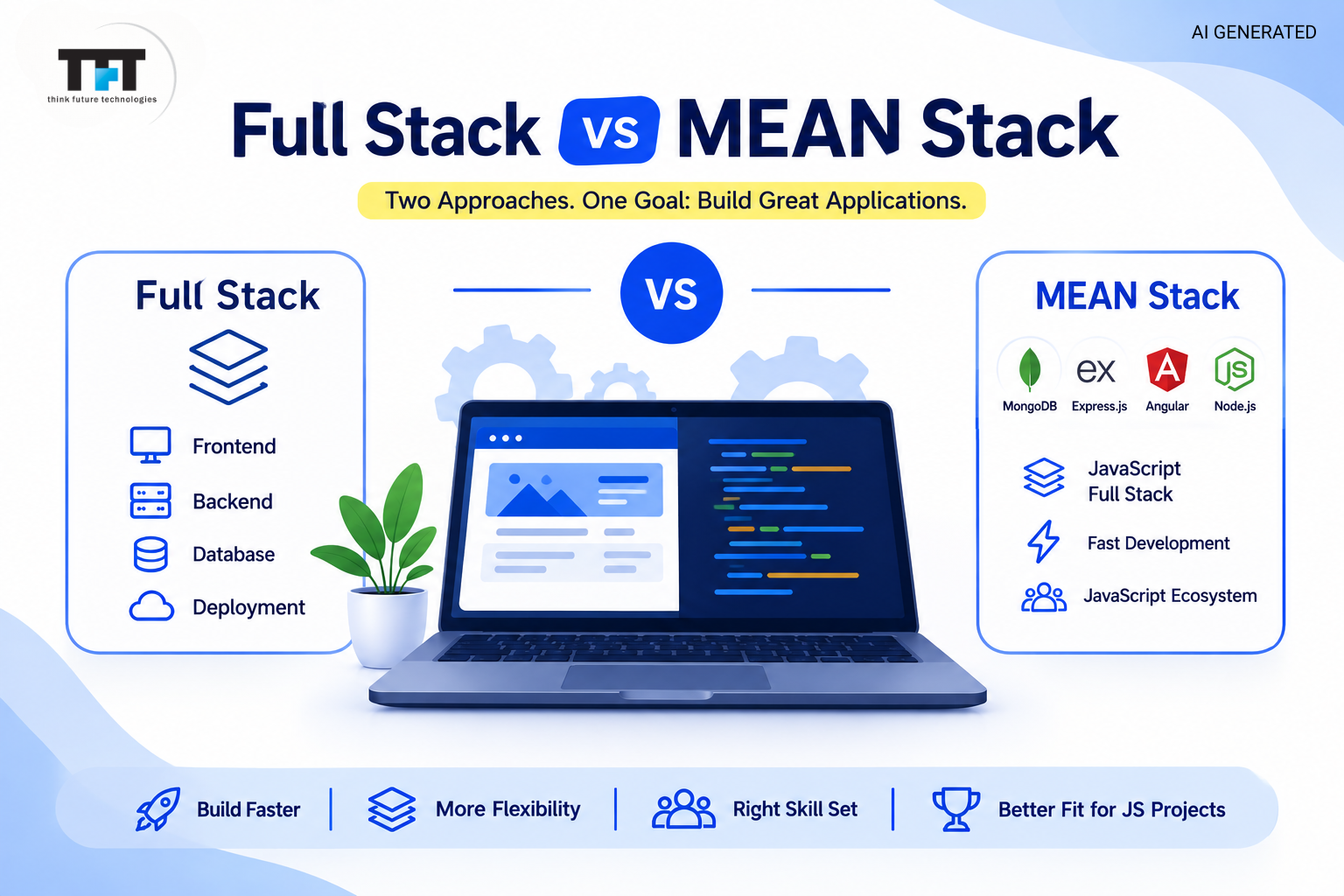
The technology stack you choose affects build speed, cost, and your app’s scalability. One of the most common questions teams ask before starting a new web application is whether to choose Full Stack or MEAN Stack.
Full stack refers to any combination of programming languages and frameworks for both the front end and back end. MEAN stack development is a particular framework that is based on four unalterable technologies and is written in JavaScript.
This tutorial demystifies the developer debate between full stack vs MEAN stack. You will understand the meanings of each stack, when to use each, and how they differ in cost, skills, and scalability.
What Is Full-Stack Development?
Full-stack development is a type of web app development where you build both the client-side and server-side of an application. A full-stack developer builds websites from scratch, from the user interface to the database.
Full-stack developers aren’t limited to a single technology stack. On the front end, they can use React, and on the back end, they can employ Python or Java, depending on the project.
This flexibility is why companies often choose to hire full-stack developers. One person or a small team can handle both front-end and server-side development, without relying on experts in each field.
What Does a Full Stack Developer Do?
A full stack developer is proficient in both front- and back-end development, database management, and sometimes version control and deployment. They work with almost every layer of a web application.
Full-stack developers have a steeper learning curve early in their careers because they use multiple technologies. Over time, this skill set becomes a valuable asset for smaller teams and startups.
What Is MEAN Stack Development?
The MEAN stack is a JavaScript-based stack of four technologies that work together. It is known as M.E.A.N., which means MongoDB, Express.js, Angular, and Node.js.
MEAN stack development is a development that is based on the same programming language (JavaScript) in the front end and back end, unlike general full stack development. This is sometimes referred to as isomorphic coding.
The MEAN stack developer doesn’t need to learn multiple languages, as everything is done in JavaScript. This allows teams familiar with JavaScript to onboard faster.
What Makes Up the MEAN Stack?
MongoDB is a document-based NoSQL database that stores data in flexible, JSON-like documents rather than in tables. This provides teams with flexibility when the data structures are changing frequently.
Express.js is an express routing and middleware and server-side logic management framework. Angular is a front-end development framework developed by Google to create interactive single-page applications.
Node.js is the JavaScript runtime environment that enables JavaScript to be executed outside the browser. It is used on the server side of all MEAN stack applications.
Client Side and Server Side Development Explained
On the other hand, the client side (also known as the frontend) refers to the components that the site user interacts with directly, such as user interface elements, forms, buttons, and so on, on a web page.
The backend, also known as server-side development, is the logic that takes place behind the scenes. This involves server-side logic, user authentication, and interacting with the database when a user requests something.
Full-stack and MEAN stack developers work on both sides. It is not about whether they render user-side or server-side code; it’s about how many tools they’re using to get there.
Business Logic and How It Fits In
Business logic refers to a set of rules that determine how an application processes, validates, and transforms data. Typically resides on the server.
For MEAN stack apps, the business logic is implemented entirely in JavaScript code in the Express backend framework. In full-stack projects, it could reside in Python, Java, or any other backend framework used for the project.
Business logic that isn’t tightly coupled to the user interface makes it easier to update an application later, regardless of the stack.
Full Stack vs MEAN Stack: Key Differences
Technology Stack
Multiple technologies and multiple languages within the project in full-stack development. For instance, a team could have Java on the back end and React on the front end.
A single-language application spans the front end and back end, using JavaScript. This maintains consistency across the stack, from the browser to the server to database queries.
Learning Curve
Full-stack developers may have a steeper learning curve as they need to learn several programming languages, frameworks, and tools on both the front end and back end.
MEAN stack developers make use of one programming language. This shortens the learning curve, particularly for JavaScript developers.
Flexibility and Project Requirements
Full-stack development is ideal for projects with specific requirements that no template can meet, such as apps that need a particular database or must integrate with an existing legacy system.
Projects that have a tight timeline, require consistency, and need to be produced rapidly, such as single-page applications, dashboards, and dynamic websites created from the ground up, are ideal for using the MEAN stack.
Team Expertise
If you’re building a full-stack team, you’ll likely need people with different specialties, or generalists comfortable with multiple back-end technologies and multiple front-end frameworks. A MEAN stack team can be smaller because the team shares expertise in JavaScript. This can help to accelerate communication and code reviews.
Building Web Applications, Web Apps, and Mobile Apps
Full-stack development can create web apps and standalone web apps and share the same APIs with mobile apps. This makes full-stack development a popular option when the product is used across multiple platforms.
MEAN stack is a great choice for developing primarily browser-based applications, especially single-page applications that don’t require a full page refresh.
A team that wants to develop an app later may prefer full-stack development early on, as the backend logic stays reusable for web and mobile clients.
Full Stack Development Process
Planning the User Interface
The process typically begins with planning the user interface and defining how users will interact with the application. This helps establish the features and requirements for the development process.
Designing the Backend and Database
Once the interface is planned, developers design the backend architecture and database. This includes defining APIs, business logic, data structures, and how different components will communicate.
Testing and Deployment
After development, the application is thoroughly tested to identify bugs and performance issues. Once it meets the required standards, it is deployed and monitored in the production environment.
Managing the Development Workflow
Full-stack development can involve different tools and configurations across the frontend and backend. Version control systems such as Git help teams manage these changes, track versions, and coordinate development across the entire application.
MEAN Stack Development Process
A more consistent development process is used when using the MEAN stack, as all layers are in JavaScript. The Angular front end, Express backend, and MongoDB schema use a common syntax and tools.
This uniformity can speed the web development process for small to medium-sized applications. Teams spend less time context-switching between different technologies.
GeeksforGeeks states that the MEAN stack is one of the most preferred technology stacks for building full-stack web applications quickly because all layers use the same base language.
Angular’s Role in Creating Interactive Interfaces
In the MEAN stack, Angular is a front-end framework that builds interactive single-page web applications using reusable two-way data binding.
Angular affords developers the added advantage of its built-in structure, minimizing the decisions required when developing dynamic web applications as opposed to constructing them from a combination of different front-end libraries.
Programming Languages and Frameworks Compared
Depending on the project, a full-stack developer may use several programming languages, such as JavaScript, Python, PHP, Java, or Ruby. This strength is also a challenge.
In the MEAN stack, developers use only one language for the entire application. Switching to a backend (written in one language) and a front end (written in another language) is not possible.
This one-language solution minimizes the number of bugs resulting from data format differences between layers. It also makes it easier for new team members to get aboard a MEAN stack project.
NoSQL Database vs Traditional Database Management
The database used in the MEAN stack is NoSQL, called MongoDB, which stores data in flexible documents and not fixed tables. This is ideal for applications that require dynamic data structures.
Any database management system, such as MongoDB, PostgreSQL, or MySQL, can be used for full-stack projects depending on the application’s needs; this gives the team flexibility but requires an early decision.
Choosing a database system may be more of a business decision, influenced by project needs for data structure, query complexity, and size, than a matter of preference.
Full Stack vs MERN Stack vs MEAN Stack
The MERN stack is very similar to the MEAN stack, but it replaces Angular with React. Both stacks share three technologies.
On the front end, a MERN stack developer uses React, and for smaller projects, many teams prefer React because the developer community is larger and the learning curve isn’t as steep as Angular’s.
Full stack is broader and more expansive than the two categories above. Full stack and MEAN or MERN create full-fledged web applications; however, full stack isn’t tied to any particular JavaScript-based framework.
Modern Web Development Trends Shaping Both Stacks
Cloud-native tools, TypeScript, and AI-assisted coding are becoming preferred trends in modern web development, regardless of whether you choose a full-stack or MEAN stack.
Both stacks are still growing. Full-stack teams are now frequently putting TypeScript on top of JavaScript for increased type safety, and MEAN stack projects are implementing it throughout their codebase.
Cost-Effective Development: Which Is Cheaper
For small to mid-sized apps, the overall cost of a MEAN stack project can be lower because a single team with shared JavaScript skills can build the project.
Full stack development can also be cost-effective, especially when you hire a full stack developer rather than a frontend and a backend developer. This means smaller teams need fewer people.
The real cost difference depends on the size of the project. While smaller, simpler enterprise applications may be cheaper to develop in the short term, larger applications may require the flexibility of full-stack development.
Scalability for Enterprise Apps and Real-Time Apps
Node.js’s non-blocking architecture makes it suitable for real-time apps, making the MEAN stack a better choice. For this reason, many chat apps, live dashboards, and collaborative tools are built with MEAN.
If the app has a lot of business logic and has complex requirements, full-stack development allows you to add specialized databases to the application, message queues, and more that MEAN has no built-in support for.
The technology stack for a scalable web application depends on its particular load patterns. No single stack is inherently more scalable than another. It depends on the system’s design.
Large Developer Community and Active Support
More people are developing it, which means that it will get faster answers and more tutorials for bugs, and more third-party libraries to pull from, rather than building everything from scratch.
The communities of all the languages and frameworks it involves are helpful in full-stack development. MEANstack has a smaller but active developer community, with strong support in the Node.js, Angular, and MongoDB forums.
Developer Community and Job Demand in the US
There’s a huge developer community and demand for full-stack developers in the US. The Bureau of Labor Statistics (BLS) shows that software developer positions are expected to increase much faster than average over the next decade.
The developer community around the MEAN stack is also as active as the full-stack developer community but not as large. MEAN roles are grouped around startups and JavaScript-heavy companies.
FULL STACK and MEAN stack positions remain strong in cities such as San Francisco, New York, and Austin, TX, with salaries often well above the national average in these metro areas.
Full Stack vs MEAN Stack Developer: Career and Salary
According to Glassdoor, the average salary for a full stack developer in the United States is about $118,877 annually and can reach nearly $195,000 for seasoned professionals and those in high-demand areas.
When it comes to salary, a MEAN stack developer vs full stack developer comparison is close, as they are full stack developers with a specialization in one particular stack technology.
Pay is based more on experience than on the stack. Frontend and backend masters make more than single-layer masters for any stack.
Addressing Common Objections to Each Stack
Others believe the MEAN stack is not suitable for enterprise applications because it is too complex and may require heavy computation that JavaScript alone cannot handle, unlike a backend language.
Others say full-stack development is too time-consuming for small projects, since selecting and integrating various technologies adds overhead that isn’t necessary with a fixed stack like MEAN.
Both objections have some truth. It depends on the project size, the time frame, and your team’s expertise with the products you plan to use.
Offshore and Distributed Team Considerations
Many US companies now build full-stack and MEAN applications using distributed teams worldwide. For this, clear documentation and effective communication are essential to keep the web development process on track.
Weekly check-ins and shared version control, whether the team is remote or in-house, keep everyone aligned on the same objectives.
| Factor | Full Stack Development | MEAN Stack Development |
| Technology stack | Multiple languages and frameworks | Single language, JavaScript only |
| Learning curve | Steeper, broader skill set needed | Narrower, one language to master |
| Best for | Complex, custom project requirements | Fast build of dynamic web applications |
| Database | Any database management system | MongoDB, a nosql database |
| Team size | Often needs specialists or generalists | Smaller team, shared JavaScript skills |
| Cost | Cost effective with generalist hires | Cost effective for small to mid projects |
Which Stack Fits Enterprise Apps Better
However, enterprise apps with numerous integrations, strict compliance requirements, or complex data handling tend to prefer full-stack development to ensure flexibility and integrate specialized tools as necessary.
Pros and Cons of Each Stack
With full-stack development, teams can use the most appropriate tool in each layer, but it can also lead to longer setup times and a more challenging hiring process.
MEAN stack is faster and more consistent as it has a single language, but may be less well suited to very large, complex enterprise applications that require specific backend tools that are not JavaScript-based.
Security and Industry Standards Considerations
Security considerations should be part of the stack choice, along with speed and cost. For both full-stack and MEAN stack applications, proper authentication, input validation, and timely dependency updates are essential.
While flexible document structures may make them easier to compromise (if rules aren’t enforced), NoSQL databases like MongoDB still require careful schema design to prevent injection.
Projects like healthcare or financial compliance are often best suited for full-stack projects that adhere to strict industry requirements and standards, which may be outside the scope of a single JavaScript-based framework.
If you use either stack, integrating security from the start is much cheaper than patching holes after the product is in the wild.
6 Common Mistakes When Choosing a Tech Stack
1. Choosing Trends Over Project Requirements
A common mistake is choosing a technology because it is popular rather than because it fits the project. The right stack should be based on project requirements, complexity, budget, timeline, and long-term goals.
2. Underestimating the Learning Curve
Teams often overlook their developers’ existing skills when choosing a stack. For example, hiring a MEAN stack developer for a team with little JavaScript experience can create a steep learning curve and slow development.
3. Failing to Plan for Scalability
A stack that works for a small application may struggle as users, data, and features increase. Consider future traffic, integrations, and data growth to avoid expensive migrations later.
4. Ignoring Long-Term Maintenance
A stack that is quick to build with may become difficult to maintain over time. Consider community support, documentation, security updates, and the availability of skilled developers.
5. Overlooking Development Costs
The cost of a stack includes more than development. Hosting, infrastructure, third-party services, licenses, and maintenance can significantly affect the overall budget.
6. Not Considering the Existing Ecosystem
Your tech stack should work well with your existing tools, databases, APIs, and platforms. Poor compatibility can create unnecessary integration challenges and increase development time.
Why This Matters
Your tech stack choice significantly affects your budget, hiring pool, and how quickly you can deliver new features. A mismatched stack can significantly impede a project without anyone realizing it, for months.
If you get it right from the start, you reduce rework. “Teams that align their tech stack with the real requirements of the project, rather than trends, generally deliver more stable web apps.”
Making the Final Call
There isn’t a definitive answer to full stack vs MEAN stack. The best option depends on your project’s timeframe, your team’s current abilities, and how much flexibility you need down the line.
When your team is proficient in JavaScript and the project follows a typical web application structure, you can get up and running faster with fewer frills using the MEAN stack.
If the project has distinct, specific requirements, must connect to existing legacy systems, or may need to expand to mobile or enterprise apps later, full-stack development offers greater flexibility to adapt without the prospect of an entire rebuild.
Discuss these considerations with your development team before deciding. This is a lot more time-efficient than changing stacks halfway through a build.
Practical Checklist for Choosing the Right Stack
- State your project requirements, including anticipated traffic, data structure needs, etc.
- Review current team skills and learning curve.
- Determine whether you need a NoSQL database or a traditional database management system.
- Do not compare cost-effectiveness based on the popularity of the tool alone; compare cost-effective options based on the number of people in the team.
- If you plan to expand later, find out how each stack would handle mobile apps.
- Check out the size of the developer community for long-term hiring and support.
Conclusion
The debate between full stack vs MEAN stack is not one of “which one is good” vs “which one is bad”. It’s about finding the right match for your project needs, talent level, and budget for maximum impact.
While full-stack development provides you with flexibility in different technologies and languages, MEAN stack development offers speed and consistency to you with a single JavaScript-based framework. It’s not a matter of which one sounds more modern; it’s about what works best for your project, what you know, and what your budget allows.
Frequently Asked Questions
What is the main difference between full stack and MEAN stack?
Full stack encompasses any combination of front-end and back-end technologies, while MEAN stack uses one specific combination of front-end and back-end technologies, all in JavaScript: MongoDB, Express, Angular, and Node.js.
Is a MEAN stack developer also a full stack developer?
Yes, a MEAN stack developer is a full stack developer, but instead of using multiple languages, it is a developer who specializes in the MEAN technology stack.
Which is more cost-effective, full stack or MEAN stack?
For smaller projects, where multiple specialists may be needed to build an app using multiple stacks, the MEAN stack might be a more cost-effective option.
Is the MERN stack better than the MEAN stack?
Neither is inherently better than the other. While MERN uses React instead of Angular, it may have a larger developer community, so the best choice depends on the team’s knowledge and the project’s requirements.
Do full stack developers need to know multiple programming languages?
Yes, most full stack developers work with a couple of programming languages and frameworks for both the front end and back end, unlike most MEAN stack developers, who are only proficient in JavaScript.
Which stack is better for real-time apps?
Node.js’s non-blocking design and its usefulness for real-time apps make it a popular choice for tools like chat and live dashboards; hence, the MEAN stack is good for real-time apps.
Do I need a large team to build a MEAN stack application?
No, small teams can usually develop full MEAN stack apps because there’s only one language to learn, so fewer specialists are needed to cover the front end and back end.

Leave a Reply