

The choice of a ReactJS development company will define the future of your web application, either success or failure, from the very beginning. In the current environment, with dozens of agencies claiming to be React specialists, it’s not easy to choose the right one without a comprehensive plan.
This article outlines the key criteria to consider when choosing a ReactJS development company. You will have a better understanding of how to distinguish an experienced vendor from an unqualified one. No matter what kind of project you’re going to launch, this piece of advice will help you make the right decision.
According to a 2026 React development companies analysis, approximately 44.7% of developers use React as their primary framework for web development, making it one of the most widely adopted technologies for building modern web applications. This popularity is one reason why many businesses specifically seek ReactJS development partners when launching new projects.
Why ReactJS Should Be Considered the Ideal Framework For Your Application
Before understanding how you should go about choosing your ReactJS development company, let us first take a look at why React is the preferred framework for most modern web development. There is no coincidence in React’s market position; it is the result of continuous excellence.
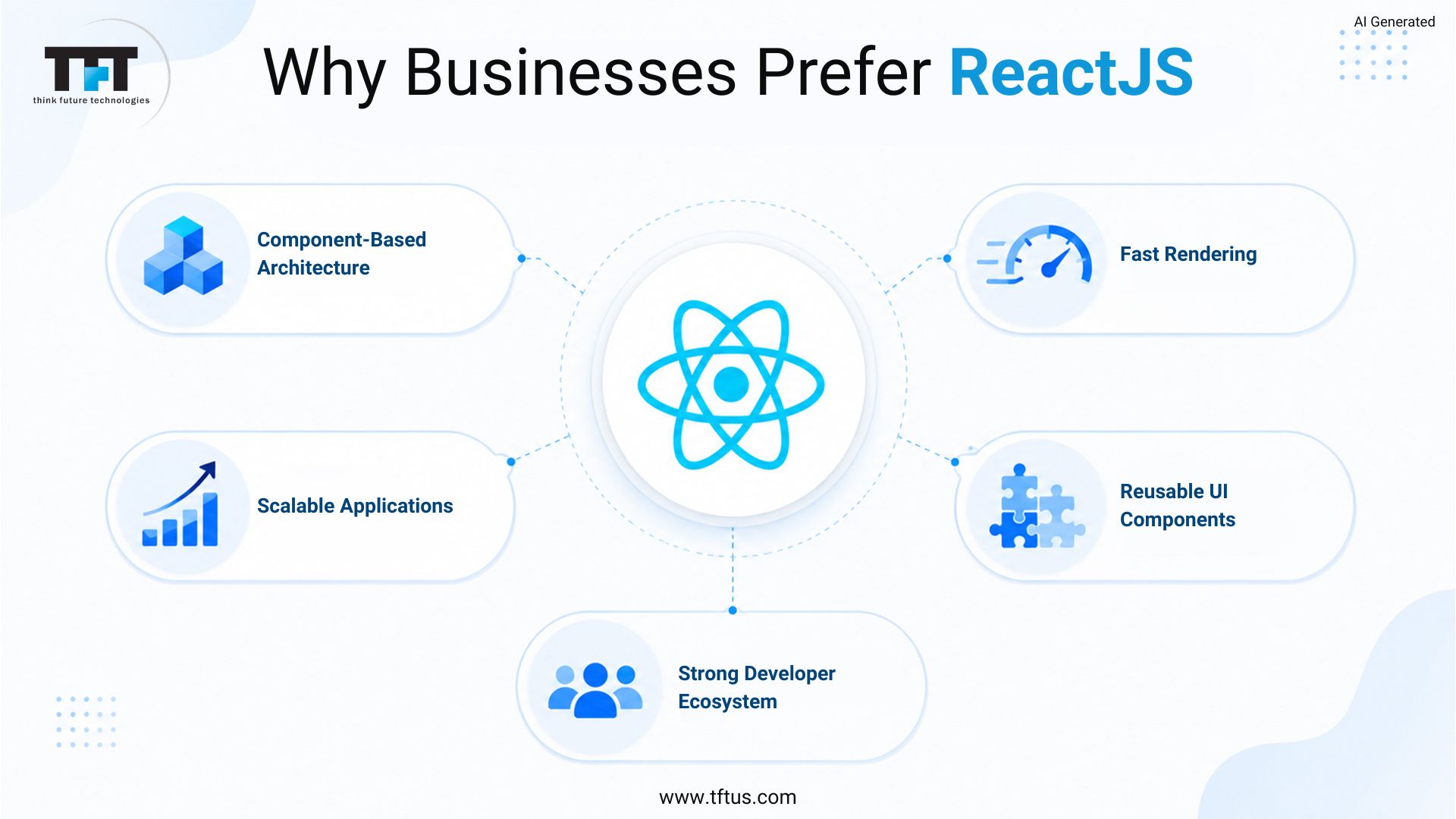
React allows developers to adopt a component-based approach in their coding practices. This allows larger, complex user interfaces to be divided into smaller units, known as components. As a result, the code becomes easier to maintain and expand.
With React.js, there is no need to fear slow response times because the framework uses the virtual DOM, enabling fast rendering. This framework is ideal for handling big data and complex UI interactions. Lastly, one of the best things about React.js is that it allows teams of developers to easily collaborate on projects, since each developer works on individual components.
3 Important Parameters for Selection when Considering best ReactJS Development Company
It goes without saying that choosing a ReactJS development company depends not only on whether they know how to use React, but also on their ability to meet your needs within the scope of their expertise and experience.
This video explains the factors businesses should consider when comparing React development partners, including technical expertise, project delivery capabilities, and long-term support practices.
1. React Technical Expertise and Proficiency
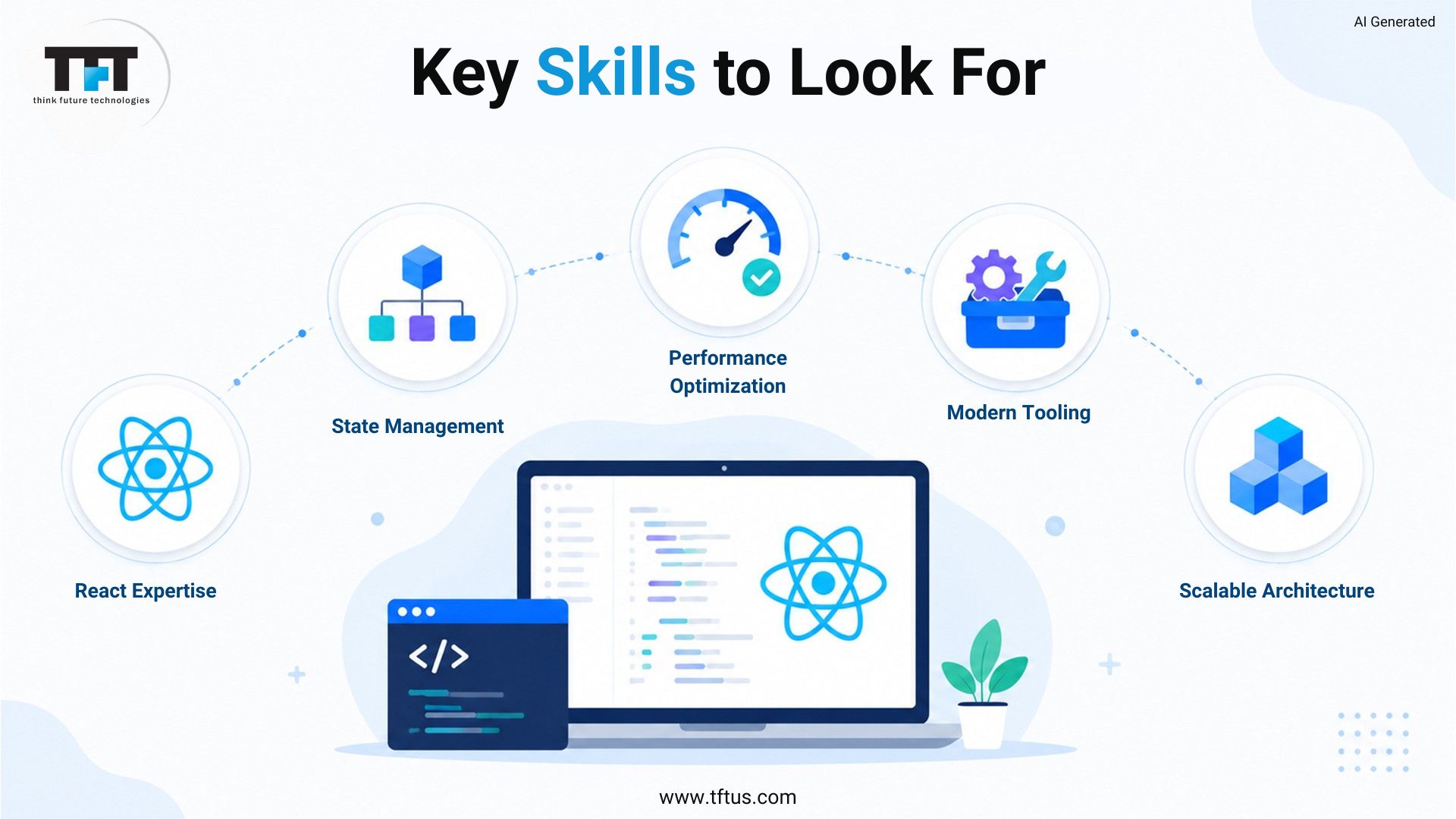
The first step is to assess how deeply the company understands React and its core concepts, not just in terms of marketing buzzwords. An experienced company should be able to demonstrate its understanding of React features such as efficient state management, virtual DOM optimization, and component reusability.
Make sure the company is aware of state management techniques and the differences between Redux, the Context API, and the useReducer hook in terms of efficiency and scalability. An experienced developer knows which of these solutions to choose for different projects.
Look for an understanding of the tools currently used in modern React applications. For example, modern React development uses Vite instead of create-react-app for improved build performance, but sometimes older build solutions are applied even when they aren’t required.

2. Portfolio and Case Studies
Past work is perhaps one of the best indicators of what a firm will produce for you. Ask for relevant case studies of past React projects that match yours in terms of scale, industry, or complexity.
Seek actual results from previous work in the form of performance improvement, user growth, or scalability achievements rather than mere presentation of the project’s screenshots. An excellent portfolio will always contain information about what was achieved, which React frameworks were utilized, what challenges the firm encountered, and how they were tackled.
If a particular firm cannot provide you with samples of its live work due to an NDA, then asking for direct contact information of past clients is your best bet for assessing their competence and credibility.
Case Study: Why Proven React Experience Matters
SnowShow, one of Europe’s largest winter tour operators, partnered with a React development team to rebuild its booking platform using a modern React architecture and machine-learning-powered recommendations.
The project resulted in more than a 70% increase in digital sales, demonstrating how the right development partner can directly influence business outcomes beyond code delivery.This highlights why companies should evaluate measurable project outcomes rather than focusing only on visual portfolio examples.
source: Snowsnow
3. Project Team & Project Development
It is vital to know which team will be building your React project before deciding. Determine if you will work with a consistent team or a rotational pool of developers, because consistency makes all the difference for more complex projects.
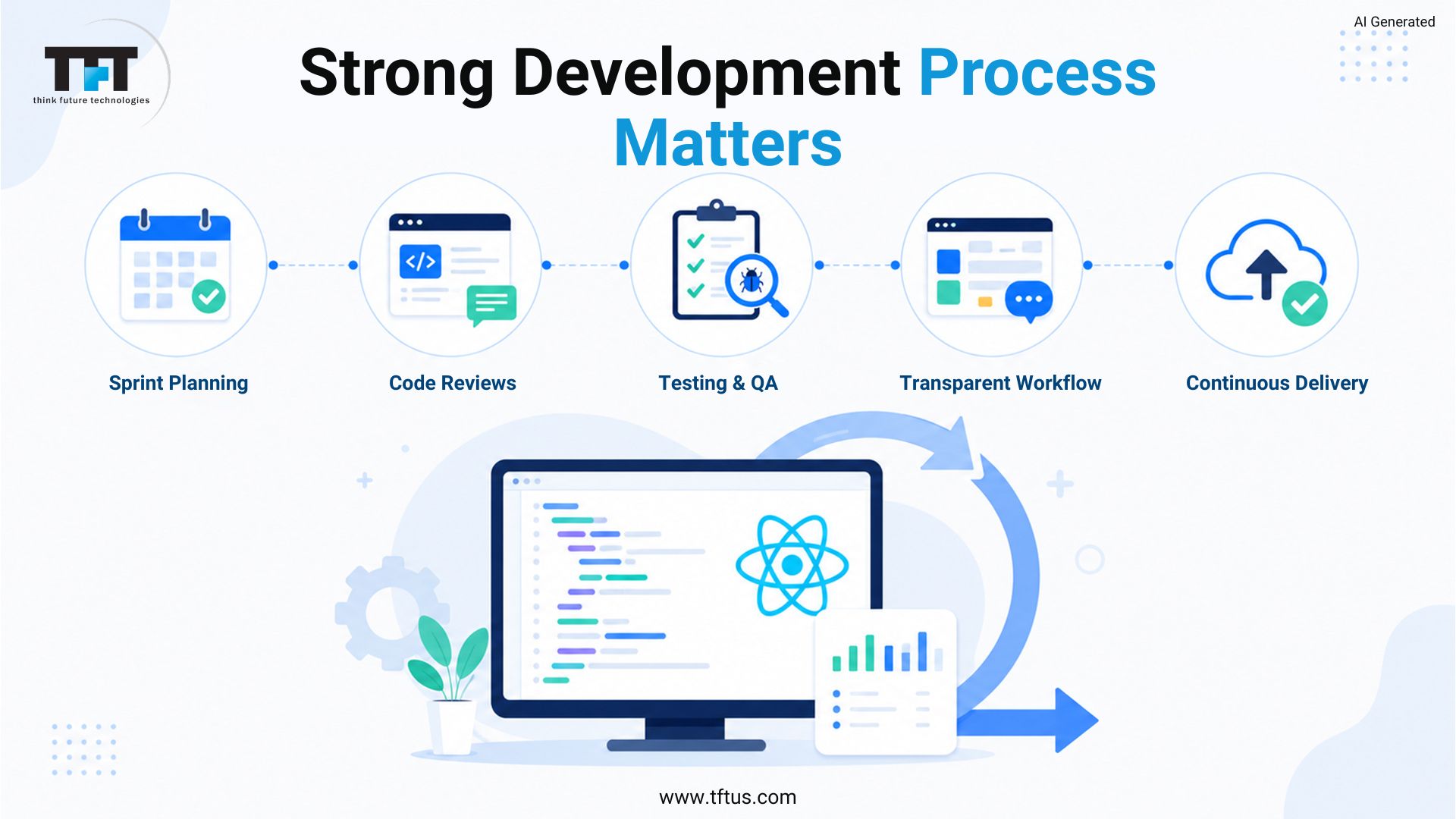
A process involving sprint meetings, code review, and quality assurance testing reflects that the company prioritizes proper delivery rather than coding for the sake of coding. It is much easier to hold an accountable company that has a set workflow process.
Make sure they understand how to approach a project from an architectural perspective, particularly when it involves multiple pages or interactive elements that require additional libraries like react-router-dom.
The effectiveness of the project team is what will determine the success of your project launch date.
According to McKinsey’s Digital Quotient research, talent quality remains one of the most important drivers of digital success, reinforcing why businesses should evaluate the actual project team—not just the agency brand—when selecting a ReactJS development partner.
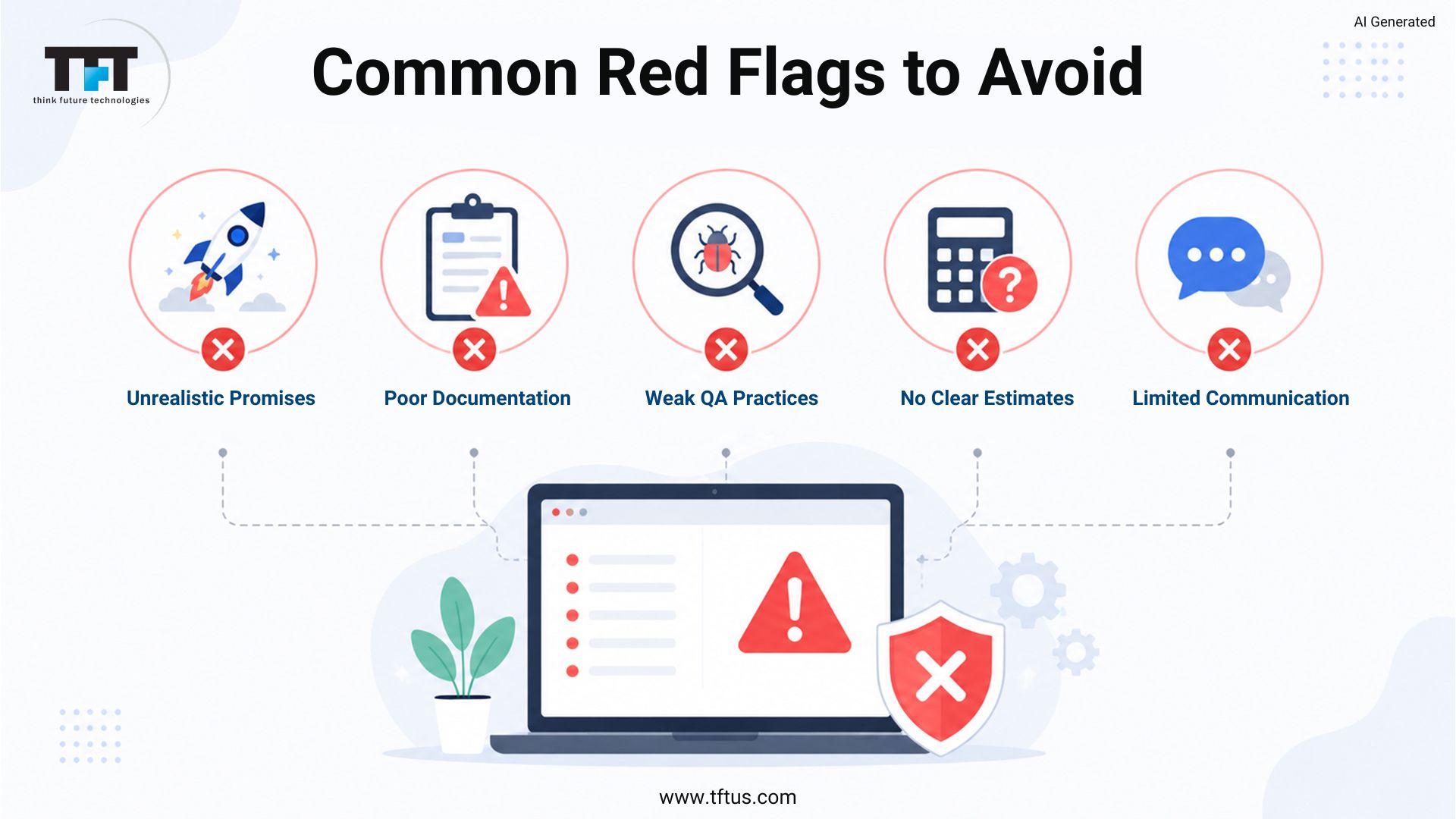
3 Red Flags to Consider While Choosing a Development Partner
Being aware of the characteristics you should see makes things easy, but being equally aware of the things that might not be right is necessary as well. Certain indicators can help avoid costly mistakes later on.
1. Making Promises Not Backed by Facts
Stay away from companies that promise you things without asking you in detail what your needs are. A legitimate ReactJS development company realizes that scoping takes time and that quick estimations will result in false promises.
Empty phrases such as “we develop enterprise React applications” without any references to case studies or technical background are just marketing talk. Ask about the specific ReactJS practices they employ, their approach to state management in complex applications, and how they dealt with comparable projects.
It is quite improbable that such a company will become more responsive regarding your queries after signing a contract with them.
2. Insufficient Testing and QA Practices
If a developer takes the React development seriously, there should definitely be a solid QA process in place. Don’t hesitate to ask about unit testing, integration testing, and performance testing practices concerning React components.
With React, you can divide your application code into smaller parts that can be loaded asynchronously, which makes the loading speed faster. If a development team does not consider performance issues in the process of coding but only at the time of delivery, you may expect to receive something of poor quality.
QA processes that are absent or informal lead to bugs getting into production and hastily developed hotfixes, which ultimately destroy trust between the sides.
3. Undocumented Code and Poor Knowledge Transfer
Ask every potential company about their documentation practices and knowledge transfer process in case of project transfer. Undocumented React applications will be costly for you since any further work with them will be challenging for either internal or external development teams.
Good documentation involves comments at the component level, architectural decisions recording, and comprehensive information on running, building, and deploying a React app provided in the Readme file. Failing to take care of documentation means creating dependencies instead of offering a full-fledged product to work with.
When your development partners need onboarding all over again in six months just to change something simple in your React app, you don’t get your money’s worth from them.
Such red flags usually emerge early, and believing in them is the key to success when choosing a React developer.
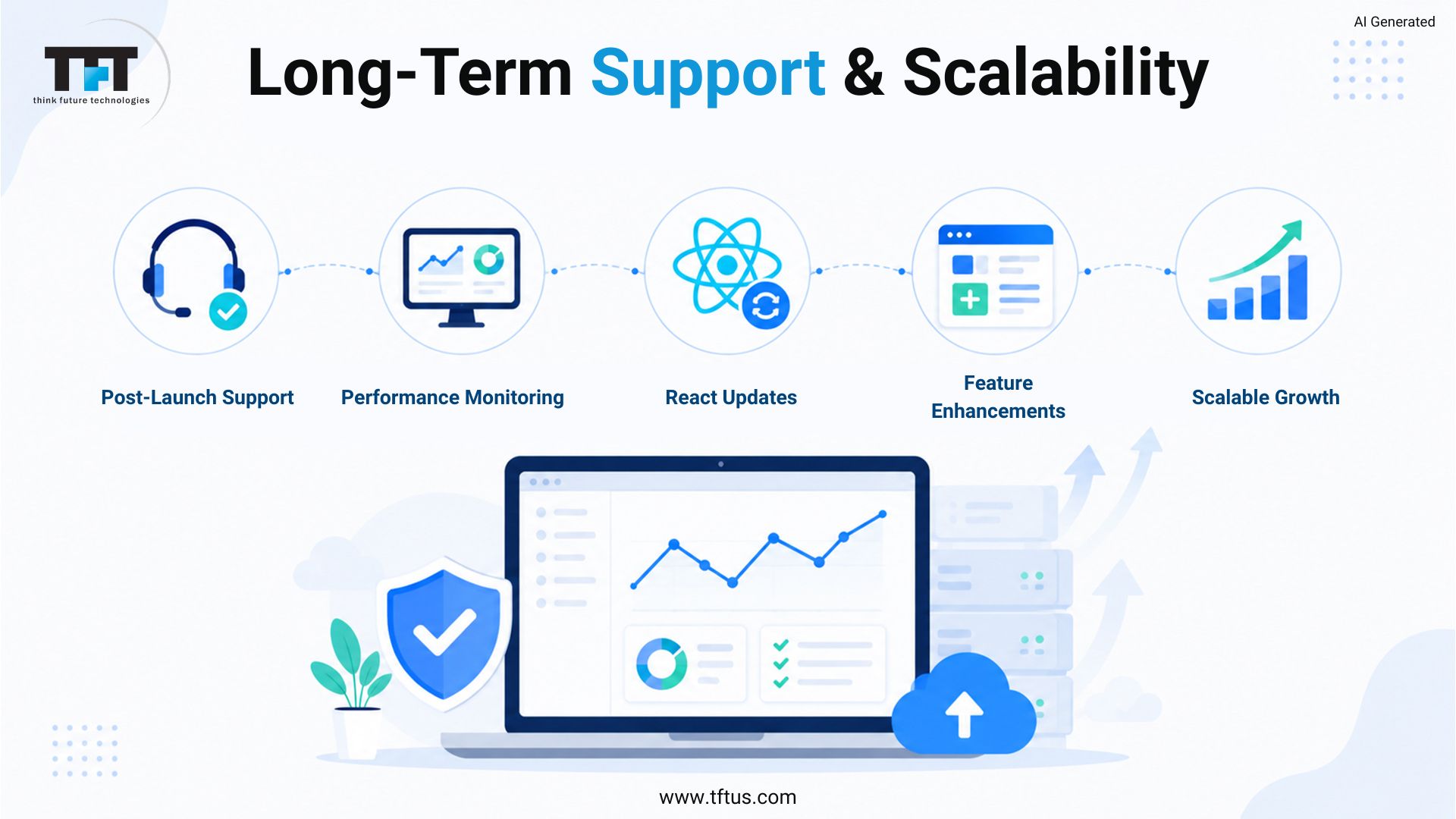
Assessing Communication, Pricing, and Ongoing Support
Being technically competent is not enough to be a great development partner. Your ability to communicate, your pricing model, and how you support the product post-launch may matter equally as much as the product itself.
Communication and Transparency
Good communication skills help prevent most project failures; thus, assessing a company’s communication practices right from the start should be considered crucial. One should also note a company’s responsiveness while interacting with it in the early stages of cooperation; usually, such responsiveness remains unchanged even after signing an agreement.
Inquire about a company’s designated contact person and the tools it uses for project management. In addition, find out about the frequency of update exchanges. Companies that rely on transparent software solutions for tracking their tasks and projects are always easier to cooperate with.
Moreover, language and time zone barriers might affect communication negatively in a distributed setting. It is therefore essential to discuss a company’s asynchronous communication strategy in detail and learn about escalation procedures.
Price Models and Alignment With Budget
Most ReactJS developers will either work on fixed price models, time & materials pricing models, or a dedicated team. Each pricing model is suited to particular projects.
Request a clear breakdown of everything that will be done within the quotation and what is likely to incur extra fees. Any proposal that offers you all-in-one quotations without itemization should raise some red flags.
Please note that the cheapest developer is not necessarily the one that you want. It may pay more upfront to get an affordable but scalable product.
Support and Maintenance After Launching
The React app needs maintenance and continuous improvement, performance optimization, dependency updates, and feature additions to continue after the launch. Determine if there is a post-launched support policy and what kind of support it implies.
Once the React app was developed, it became necessary to deploy the project by building a highly optimized version and uploading it onto services such as GitHub Pages, Netlify, and others capable of providing web app hosting. A company experienced in the process of deployment and further work with your app would be an asset to you.
Clarify if there are guaranteed response times when it comes to dealing with critical issues, as well as updating React frameworks with each new release. A company ready to plan for the future of your project would make a worthy partner.
The selection of a development company is a long-term commitment.
Selection Process Procedure
With the help of a selection process procedure, you will be able to have an effective way of comparison between different vendors, since a structured process avoids making decisions based on emotionally appealing demonstrations and presentations.
Identify Your Project Needs First
Do not contact companies without specifying your needs, features, technologies used, expected deadlines, and budget range. In doing so, you will ensure that the potential service provider can submit a precise proposal, rather than a standard quote.
Be sure to state whether your React project involves the creation of a brand-new product or the development of an existing product into another one, because the process will vary accordingly. Additionally, indicate whether you need React to develop a server-rendered app, a statically generated website, or a regular single-page application.
Well-defined projects help you avoid scope creep and offer a good foundation for comparison among providers.
Conduct a Structured Discovery Call
Your first call with the candidates should not be merely an opportunity to demonstrate your product but a structured interview as well. Come up with a list of technical and business-related questions that will help you evaluate the answers from all vendors on an equal footing.
Ask them how they would work on your particular project; what React patterns they would apply, how they would organize state management, and what their build tools would be and why. You should appreciate those candidates who will be curious about your users, data structures, and long-term growth strategy.
Write down all the answers from your calls, as your memory won’t serve you right when you try to evaluate several options at once. According to Atak Interactive’s 2024 ReactJS development company selection guide, technical assessment, expertise evaluation, development process analysis, and communication capabilities are among the most important factors businesses consider when choosing a React development partner.
Request for Payment for the Discovery Phase or a Technical Proposal
If it’s a major project, you might want to request a payment for the discovery phase from finalists. A paid discovery phase will include a technical architecture proposal, a refined project estimate, and an analysis of risks.
The paid discovery phase will show you how a company operates, how they communicate, and how reasonable their React architecture proposals are before spending more money. The companies that refuse to do a discovery phase may not be as cooperative and open about their practices as they were in the initial meetings.
Looking at a proposal will expose some assumptions that were never mentioned before, and this is often why major projects run out of budget and get delayed.
A systematic approach always beats selecting a company based on first impressions.
Case Study: Validating a Product Before Scaling
TRAVELDUCK partnered with a React development team to build a marketplace platform from scratch. Beyond delivering the application, the development partner helped validate the business model and prepare the platform for future scaling.
The project demonstrates how a strong ReactJS development company contributes to architecture planning, product validation, and long-term business growth—not just implementation.
Source: Travelduck
Conclusion
How to identify the most suitable ReactJS development firm? By assessing the relevant factors in the proper sequence, which can ensure low risk and high probability of success in collaboration.
These companies will pose as many questions as answers, demonstrate achievements by means of verified cases, and create projects whose life cycle will extend beyond the date of delivery. Cutting corners when selecting a vendor is inevitably going to translate into additional expenses later on.
Make sure that the selection process is systematic, references are sought, and technical claims are proven. A true partner for your project does much more than just building it; they build it right.

Leave a Reply