

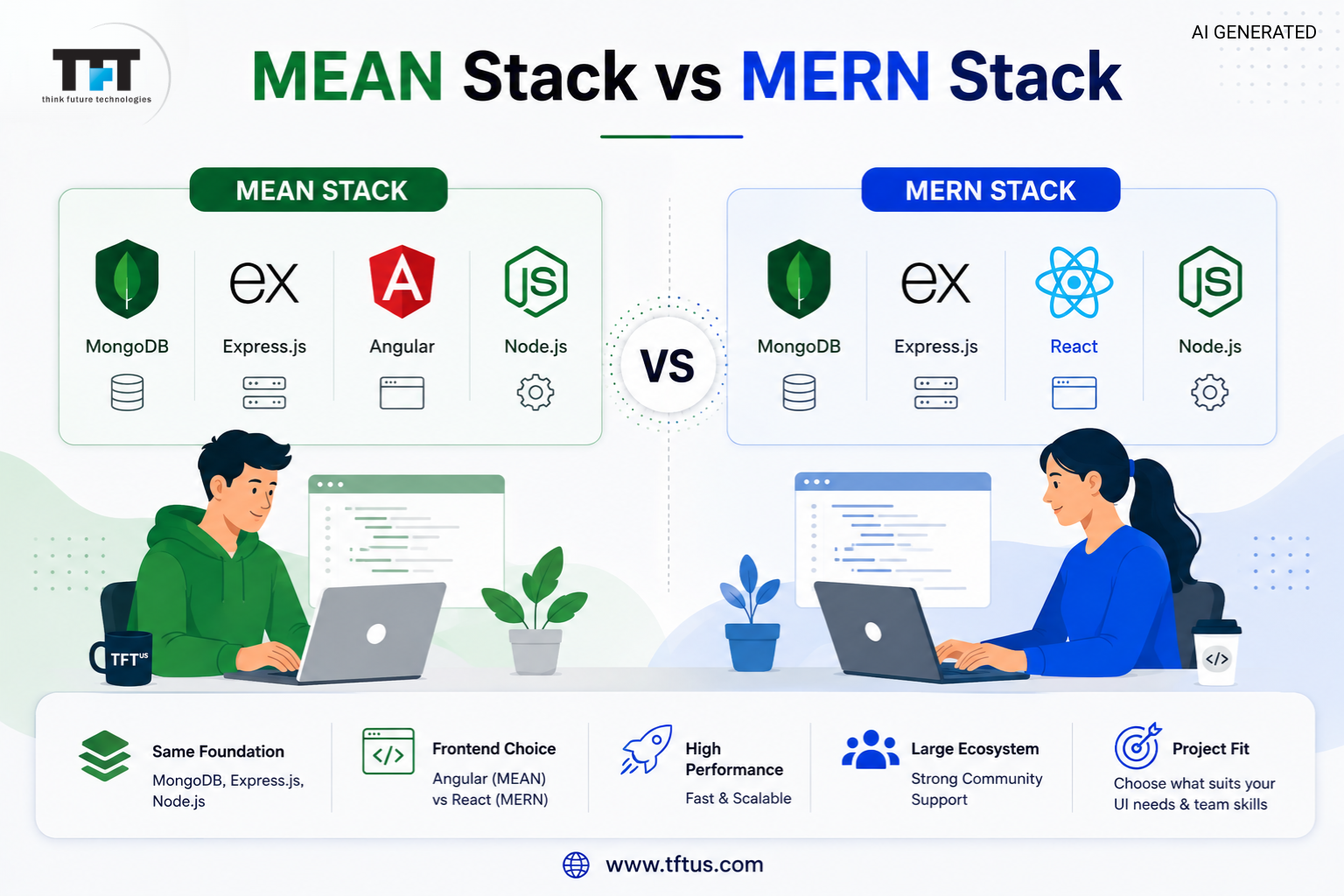
MEAN stack and MERN stack are both full-stack JavaScript frameworks built on MongoDB, Express.js, and Node.js. They diverge at one point: the frontend framework. MEAN uses Angular; MERN uses React. That single difference cascades into everything else: how your team structures code, how fast you hire, how long onboarding takes, and what your application looks like in three years.
Choose MEAN if your situation fits these criteria:
-
Team of 10 or more developers who need consistent architecture without team-specific conventions
-
Project lifespan of 3 or more years where Angular’s LTS (long-term support) release cycle reduces upgrade risk
-
Enterprise compliance requirements that favor TypeScript’s strict typing
Choose MERN if your situation fits these criteria:
-
Team of 2–8 developers who want to ship quickly with familiar tools
-
Hiring from the open market where React’s 44.7% developer adoption (Stack Overflow Developer Survey 2025) means a shorter time-to-fill
-
Product extending to mobile via React Native
Choosing as an individual learner or bootcamp graduate:
-
Start with MERN if your primary goal is landing your first web development job: React’s 44.7% adoption rate means proportionally more job listings, more tutorials, and a lower entry barrier into components and hooks
-
Start with MEAN if you are targeting enterprise roles or already have TypeScript experience: Angular’s structured framework teaches dependency injection (framework auto-supplies class dependencies) and module architecture that enterprise teams expect, with skills that transfer to .NET and Java environments
-
If you are undecided, start with React and MERN; you can learn Angular on the job in an enterprise role once you have the JavaScript fundamentals solid
|
Feature |
MEAN Stack |
MERN Stack |
|
Frontend |
Angular |
React |
|
Backend |
Express.js + Node.js |
Express.js + Node.js |
|
Database |
MongoDB |
MongoDB |
|
Language |
TypeScript (primary) |
JavaScript/TypeScript |
|
Architecture type |
Full framework (opinionated) |
UI library (flexible) |
|
Developer adoption |
18.2% all devs / 19.8% professionals (SO 2025) |
44.7% all devs / 46.9% professionals (SO 2025) |
|
Learning curve |
Steeper (framework concepts + TypeScript + RxJS) |
Gentler entry, grows with ecosystem choices |
|
Best for |
Large teams, enterprise apps, long-term projects |
Startups, rapid UI iteration, mobile extensions |
Developer adoption figures from the Stack Overflow Developer Survey 2025.
What Is the MEAN Stack?
MEAN is an acronym for four technologies that together cover the full application stack:
-
MongoDB: a NoSQL database that stores data in a flexible, JSON-like format that maps naturally onto JavaScript objects, making schema iteration faster than a rigid relational model. Teams that need to pivot their data model frequently also find Angular’s TypeScript typing friction, not a safety net, until the schema stabilizes.
-
Express.js: a minimal web application framework for Node.js that handles routing, middleware, and HTTP request/response cycles
-
Angular: a full-featured frontend framework maintained by Google with built-in tooling for routing, forms, state management, and HTTP communication
-
Node.js: a JavaScript runtime that runs the backend server logic
Angular’s 18.2% developer adoption (Stack Overflow Developer Survey 2025) is lower than React’s 44.7% / 46.9% professional share, but it is a stable number inside enterprise environments where Angular’s long-term Google support and strict versioning policy matter more than raw ecosystem size.
MEAN stack development follows a structured architecture enforced by Angular’s opinions. Starting with Angular 17, standalone components are the default; NgModules are optional rather than required for most applications. Every Angular application organizes code into components, services, and decorators (metadata annotations that configure classes): structures the framework imposes rather than leaves to team convention. For large development teams, that enforcement is the point: a new hire joining a MEAN project finds the same file layout, the same dependency injection patterns, and the same TypeScript strictness they would find in any Angular project.
What Is MERN Stack?
MERN is an acronym for the same four-layer architecture with one substitution:
-
MongoDB: the same NoSQL database as MEAN
-
Express.js: the same backend framework as MEAN
-
React: a UI library developed by Meta focused on component-based rendering with a virtual DOM (in-memory UI representation for efficient updates)
-
Node.js: the same JavaScript runtime as MEAN
React is used by 44.7% of all developers and 46.9% of professional developers (Stack Overflow Developer Survey 2025). That gap from Angular’s 18.2% is the single most important hiring signal in this comparison.
React handles UI development using a component-based architecture and a virtual DOM for efficient rendering. Unlike Angular, React makes no decisions about routing, state management, or HTTP libraries; those choices belong to the team. A MERN project uses React for the UI layer and assembles the rest from the JavaScript ecosystem: React Router or TanStack Router for navigation, Redux, Zustand, or Jotai for state, Axios or React Query for data fetching.
Next.js as the standard MERN frontend in 2026: For production MERN applications, Next.js has become the de facto frontend choice, replacing Create React App (which is now deprecated). Next.js adds server-side rendering, static generation, and React Server Components to the MERN frontend, making it the framework most MERN teams reach for when starting a new project in 2026. Vite is the standard for client-only React builds where a full framework is not needed.
MERN stack is the more popular choice among startups and rapid-iteration teams because React’s smaller surface area means faster initial productivity. The trade-off appears at scale: without team-enforced conventions, large MERN codebases can fragment across different state management patterns, folder structures, and component styles.
Frontend Framework: Angular vs React
The frontend framework is the only meaningful technical difference between MEAN and MERN. Every other layer (Express.js, Node.js, MongoDB) is shared and identical in behavior.
|
Dimension |
Angular (MEAN) |
React (MERN) |
|
Type |
Full framework |
UI library |
|
Language |
TypeScript (required) |
JavaScript or TypeScript (optional) |
|
Learning curve |
Steeper (framework concepts + TypeScript) |
Gentler entry, grows with ecosystem choices |
|
Developer adoption |
18.2% all devs / 19.8% professional (SO 2025) |
44.7% all devs / 46.9% professional (SO 2025) |
|
Data binding |
Two-way (template ↔ component in sync) |
One-way (data flows parent → child) |
|
State management |
NgRx (third-party, Redux-style); Signals (Angular native) |
External library (Redux, Zustand, Jotai) |
|
Routing |
Angular Router (built-in) |
React Router (external, standard) |
|
HTTP client |
Angular HttpClient (built-in) |
React Query or Axios (external) |
|
Mobile extension |
Ionic |
React Native |
|
Architecture |
Component/service/decorator enforced |
Component-first, conventions team-managed |
Developer adoption figures from the Stack Overflow Developer Survey 2025.
Angular’s built-in HttpClient and React’s ecosystem approach to data fetching produce meaningfully different code for a common task. For an Angular service fetching user data:
Angular uses dependency injection — the framework automatically provides the HttpClient to any service that requests it via the constructor, so you never instantiate it manually.
// Angular HttpClient service (MEAN stack)
import { Injectable } from '@angular/core';
import { HttpClient } from '@angular/common/http';
import { Observable } from 'rxjs';

@Injectable({ providedIn: 'root' })
export class UserService {
  constructor(private http: HttpClient) {}

  getUser(id: string): Observable<User> {
    return this.http.get<User>(`/api/users/${id}`);
  }
}
The equivalent MERN pattern using React Query’s useQuery hook:
React Query handles caching automatically — the same user data will not be re-fetched if the component unmounts and remounts within the configured staleTime window, saving unnecessary network requests.
// React Query useQuery hook (MERN stack)
import { useQuery } from '@tanstack/react-query';

function UserProfile({ userId }: { userId: string }) {
  const { data: user, isLoading } = useQuery({
    queryKey: ['user', userId],
    queryFn: () => fetch(`/api/users/${userId}`).then(r => r.json()),
  });

  if (isLoading) return <div>Loading...</div>;
  return <div>{user?.name}</div>;
}
Angular’s approach centralizes the HTTP logic in an injectable service available across the application. React Query’s approach co-locates data-fetching with the component that needs the data and adds automatic caching and background refetch. Neither is objectively superior. Angular’s service pattern scales better in large teams; React Query’s component-level approach produces less boilerplate for smaller components.
Learning Path Considerations for Solo Developers
If you are a solo developer or bootcamp graduate deciding which stack to learn, the team-scale decision criteria in this article mostly do not apply to you. Here is what does:
Tutorial and resource availability: React’s 44.7% adoption translates directly into tutorial volume. As of 2025, React has more free video courses, project walkthroughs, and Stack Overflow answers than Angular. A beginner hitting a React problem will find a solved version of it faster.
Community Q&A volume: On Stack Overflow, React-tagged questions outnumber Angular-tagged questions by a significant margin. For self-taught developers, this means faster unblocking when you are stuck — the answer is more likely to exist already.
Time to first deployed project: With Vite (the current standard for React scaffolding) or Next.js, a React developer can build and deploy a functional app with less framework overhead than Angular’s CLI-scaffolded project structure requires up front. Expected time to first working portfolio project: 2–3 weeks for React, 4–6 weeks for Angular, assuming a developer starting with JavaScript fundamentals already in place.
Job market signal for entry-level roles: MERN roles appear in higher volume in junior and mid-level job listings. MEAN roles at the junior level are rarer, because Angular’s structured framework is more commonly found in established enterprise teams that hire more experienced developers.
When to choose Angular as a solo learner: If you are targeting a specific enterprise environment (financial services, government contracting, consulting) or have an existing job offer at a company on Angular, learning MEAN from the start is the right call. Angular’s patterns transfer to .NET and Java enterprise ecosystems and signal discipline to enterprise hiring managers.
Database Layer: MongoDB in Both Stacks
Express.js and Node.js are shared across both stacks, so backend development, API design, and server-side logic look nearly identical whether you are building with MEAN or MERN.
MongoDB stores data in BSON documents (a binary representation of JSON-like structures) that map naturally onto the JavaScript objects both stacks use throughout the application. The same MongoDB queries, Mongoose models, and aggregation pipelines run identically on a MEAN or MERN backend.
When MongoDB’s schema flexibility justifies choosing MEAN or MERN over a SQL alternative:
MongoDB makes sense when your data structure is likely to evolve: product catalogs with variable attributes per category, user-generated content with unpredictable fields, or event-stream data where the schema grows with business requirements. Adding a new field to a MongoDB document requires no schema migration; adding a column to a PostgreSQL table requires an ALTER TABLE statement that locks the table on large datasets.
MongoDB is a poor fit when your data has strong relational integrity requirements (financial transactions where foreign-key constraints matter), when you need complex multi-table joins as a primary access pattern, or when your organization runs existing SQL infrastructure and migration cost outweighs the flexibility benefit. Choosing MEAN or MERN does not require MongoDB — both stacks work with PostgreSQL or MySQL via Sequelize or Prisma — but the MEAN/MERN acronym assumes it.
“When to Skip Both” scenario: If your application is primarily relational (a billing system, an ERP, a CRM with complex reporting), a PostgreSQL-backed stack (NestJS + React or Angular + PostgreSQL) is likely a better fit than either MEAN or MERN. The MongoDB assumption baked into both acronyms does not match every project.
Real-World Migration: 40-Person SaaS Moving from MEAN to MERN
The following scenario is a composite based on patterns representative of 2024 Angular-to-React migrations in mid-sized SaaS companies; figures are illustrative.
A 40-person engineering team running a project management SaaS on MEAN stack evaluated migrating to MERN after noting that React developers were easier to hire and that the React job pool was growing faster.
Migration timeline and outcomes:
-
Decision and planning phase (months 1–2): The team audited 62,000 lines of Angular code, identifying 340 components, 89 injectable services, and 12,000 lines of RxJS-heavy reactive logic as the highest-effort migration units. They chose an incremental strangler-fig approach (replace pieces gradually, old system stays live) over a big-bang rewrite.
-
Pilot phase (months 3–5): A four-person team built three new features in React while the existing Angular codebase continued running. React onboarding took 2–3 weeks versus the 4–6 weeks Angular had required. The pilot areas shipped features approximately 20% faster during the iteration phase, but the team spent 8 weeks debating state management libraries before standardizing on Zustand.
-
Migration phase (months 6–14): Teams migrated modules in order of business priority. The RxJS-heavy notification and real-time collaboration modules required architectural redesign, not just syntax translation, and consumed 40% of the total migration effort.
-
Measured outcomes at completion: Time-to-hire for frontend roles dropped from 6 weeks average to 3.5 weeks. Deployment frequency increased from weekly to twice-weekly after the migration stabilized. The first 3 months post-migration showed a 15% increase in bug reports as teams adjusted to React’s less-enforced patterns before settling back to baseline.
The lesson: lower hiring friction and faster initial velocity are real advantages of MERN, but teams underestimate the migration cost of an established Angular architecture, especially one with significant RxJS usage. The decision is worth making on a new project; on an existing one, plan for 12–18 months and budget for a parallel testing rewrite.
Backend Framework Consistency
The backend is where MEAN and MERN are genuinely the same stack. Express.js routes look identical. Node.js server logic is interchangeable. MongoDB schemas, Mongoose models, and aggregation pipelines copy between MEAN and MERN projects without modification.
// This Express.js route works identically in MEAN and MERN projects
const express = require('express');
const router = express.Router();

router.get('/users/:id', async (req, res) => {
  const user = await User.findById(req.params.id);
  res.json(user);
});
A backend developer moving between MEAN and MERN projects needs only to learn the frontend framework; the entire server layer transfers directly.
Virtual DOM in MERN Stack
React’s virtual DOM is the rendering mechanism that makes MERN’s UI layer performant for complex, dynamic interfaces. Instead of updating the browser’s actual DOM directly on every state change, React maintains a lightweight virtual representation of the DOM in memory, calculates the minimum set of changes needed, and batches those updates. This reduces the expensive DOM manipulations that cause UI lag in large applications.
3-step performance profiling checklist for MERN components:
-
Run React DevTools Profiler: open the Profiler tab in React DevTools, record a user interaction, and identify which components are rendering unnecessarily (any component that re-renders without a prop or state change is a candidate)
-
Apply memoization where warranted: wrap expensive components in React.memo, use useMemo for derived values, and useCallback for event handlers passed as props; verify in the Profiler that re-renders dropped
-
Check against the 16ms frame budget: smooth UI runs at 60fps, meaning each render must complete within 16ms; use the Profiler’s commit timing to find renders that exceed this and either defer them with startTransition or virtualize long lists with react-window
The virtual DOM’s benefit is most visible in applications with 100 or more dynamic DOM updates per second: real-time dashboards, collaborative editors, live data feeds. For CRUD applications with standard form interactions, the virtual DOM overhead is negligible in either direction.
Bundle size and performance benchmarks:
Framework runtime size is no longer the clear React advantage it once was. Since zoneless change detection became the Angular default, new Angular apps no longer ship Zone.js, and bundles have shrunk accordingly: in the open-source Angular evolution benchmark, the same test application compiled to 78.0 kB gzipped on Angular 14 and 71.5 kB gzipped on Angular 22. React 19’s runtime (react plus react-dom) is not a lightweight library either, so for most production apps the final bundle is decided by application code and third-party dependencies rather than by the framework. Measure your own production build before treating bundle size as a deciding factor.
Angular’s Ivy compiler does aggressive tree-shaking, meaning unused framework features do not ship — large Angular apps do not necessarily carry a larger bundle than equivalent React apps once application code dominates the total. Any remaining runtime difference matters only at the minimal end; parity arrives quickly as application complexity grows.
For time-to-interactive (TTI) benchmarks, both stacks depend far more on application code optimization (lazy loading, code splitting, image optimization) than on the framework’s own runtime overhead. Framework choice is rarely the performance bottleneck in production MEAN or MERN applications; MongoDB aggregation pipeline complexity, unoptimized API payloads, and uncompressed assets are more common culprits.
Structured Framework Approach in MEAN Stack
Angular’s framework structure is its defining characteristic: the framework enforces conventions rather than recommending them. Every Angular application uses the same module system, the same dependency injection hierarchy, and the same decorator patterns, regardless of the team that built it.
Angular onboarding checklist for new joiners (MEAN projects):
-
Map the service injection hierarchy: identify which services are provided at the root level (application-wide) versus scoped to individual components or feature areas; this determines what is globally available versus locally instantiated
-
Identify standalone vs. module-based components: Angular 17+ defaults to standalone components, but older codebases may still use NgModule boundaries; understanding which model the project uses prevents circular dependency errors and keeps feature code isolated
-
Trace the decorator chain: @Component, @Injectable, and @Directive decorators are the structural glue; following them from a UI interaction back to the service and data layer maps the application’s full data flow
This structure means that a new engineer joining a MEAN project can understand the codebase’s organization before reading a line of business logic. Angular’s enforced patterns are the reason: there is only one way to create a service, register a component, or scope a dependency.
Full Stack Developer Skill Requirements
A full stack developer working in either stack needs to understand JavaScript deeply, since the same language runs client-side and server-side. This JavaScript-everywhere characteristic is one of the core selling points of both MEAN and MERN: a developer who understands Node.js and Express.js on the backend can understand React or Angular on the frontend without switching languages.
The Stack Overflow Developer Survey 2025 found that JavaScript remains the most commonly used programming language overall (66% of all respondents), and the single-language advantage of both stacks is a meaningful productivity argument for engineering teams evaluating technology choices. A developer context-switching between a Python backend and a React frontend carries more cognitive load than one working in JavaScript end-to-end.
Shared TypeScript interface between Angular and Express.js (MEAN stack):
// shared/interfaces/user.interface.ts
// This file is imported by both the Angular frontend and the Express.js backend
export interface User {
  id: string;
  name: string;
  email: string;
  role: 'admin' | 'editor' | 'viewer';
  createdAt: Date;
}

// Backend usage: Express.js route
// import { User } from '../shared/interfaces/user.interface';
// const user: User = await UserModel.findById(req.params.id);

// Frontend usage: Angular service
// import { User } from '../shared/interfaces/user.interface';
// getUser(id: string): Observable<User> { ... }
Sharing a TypeScript interface between the Angular frontend and the Express.js backend catches mismatches at compile time rather than at runtime. If the API response shape changes, every TypeScript file that imports that interface flags the error before the build.
When TypeScript adoption in MERN justifies the learning-curve cost: TypeScript is optional in React, but its value scales with team size and codebase age. A solo developer or two-person startup moving fast may find TypeScript’s setup friction slows initial velocity. A team of six or more, or any codebase maintained beyond 12 months, usually recoups the TypeScript investment quickly as runtime type errors drop and refactoring becomes safer.
To illustrate that payoff: in a representative TypeScript MERN codebase, refactoring a MongoDB schema from embedded documents to referenced documents required updating TypeScript interfaces across many services — a task that compile-time checking surfaces immediately rather than in production. Catching that impact before runtime prevents production incidents while adding several hours to the sprint; the net is almost always positive on codebases older than six months.
Angular enforces TypeScript, so for MEAN teams this decision is already made. For MERN teams, the decision is theirs. Teams whose data models are still in flux — early startup, pre-product-market-fit — often find TypeScript’s strict typing adds friction at exactly the moment when speed matters most. The pragmatic path: start MERN with TypeScript if your team has experience with it, and consider adding it at the six-month mark if you started without it.
Role of MEAN Stack Developer
A MEAN stack developer covers the full application: Angular components and services, Express.js API routes, MongoDB schemas, and Node.js server configuration. In practice, most MEAN developers have a stronger side (either frontend-heavy, Angular-focused, or backend-heavy, Express + MongoDB focused) but can work across the entire codebase when needed.
MEAN stack developers earn a US average of $123,262 per year, with the middle half of salaries between $102,500 and $142,000, according to ZipRecruiter MEAN Stack Developer Salary data as of October 2026. In enterprise-dense hiring markets like New York, Chicago, and Boston, senior Angular developers can command a premium above the national average because of enterprise demand and a smaller candidate supply.
MEAN stack developer job market:
Demand for MEAN stack developers is strongest in enterprise, regulated industries, and consulting firms. MEAN/MERN skills appear broadly across web application architecture roles, with Angular developers commanding stronger enterprise demand in sectors like financial services, logistics, and government contracting despite having a smaller candidate pool than React.
Role of MERN Stack Developer
A MERN stack developer performs the same full-stack responsibilities as a MEAN developer, with React replacing Angular as the frontend concern. MERN developers typically spend more time evaluating and integrating third-party libraries (routing, state management, form handling, data fetching) because React’s philosophy is to provide only the UI layer and leave the rest to the ecosystem.
MERN stack developers earn a US average of $123,262 per year, with the middle half of salaries between $102,500 and $142,000, according to ZipRecruiter MERN Stack Developer Salary data as of October 2026. That is the same figure ZipRecruiter reports for MEAN roles, which reflects that both stacks draw from the same full-stack JavaScript talent pool and that job-title samples overlap heavily. The real salary differentiation appears at the regional and seniority level.
US national averages mask significant regional variation. In markets with concentrated enterprise tech hiring (New York financial sector, Chicago logistics, Boston biotech), senior Angular roles can pay above React rates. In startup-dense markets (San Francisco, Austin, Miami), MERN roles at the senior level are more abundant and competitive, because Series A/B companies draw from the larger React talent pool. For broader context, Glassdoor full-stack developer salary data puts the US average total pay for full-stack developers at $119,011 per year, with a range of roughly $92,000 to $155,000 depending on metro area and seniority.
MERN stack developer job market:
React’s 44.7% adoption rate translates directly into job listing volume. MERN-related job postings consistently outnumber MEAN postings in US job markets, with the ratio skewing further toward MERN in startup and consumer tech segments. Enterprise and financial services segments show the most balanced distribution.
MEAN Stack Learning Curve
Learning MEAN means learning Angular, and Angular is a comprehensive framework that requires TypeScript knowledge and introduces concepts like dependency injection, decorators, and RxJS (reactive streams library) observables from the start. Most developers need four to six weeks of consistent practice before becoming productive in a MEAN project.
Onboarding timeline benchmarks for mid-level developers on MEAN:
-
Weeks 1–2: TypeScript fundamentals, Angular CLI, component creation, and template syntax — enough to understand existing code and make small changes
-
Weeks 3–4: Dependency injection, services, Angular modules, and routing — enough to add a new feature within an existing module
-
Weeks 5–6: RxJS basics (Observables, pipes, common operators), NgRx (Redux-style state management for Angular) patterns, and the Angular change detection cycle — full independent productivity on non-trivial features
Angular’s learning curve is front-loaded: the framework’s core concepts are all required knowledge before a developer can build anything non-trivial. This investment pays dividends on large projects where the structure that felt burdensome at the start becomes the architecture that prevents chaos at scale. Modern Angular (v17+) also supports zoneless change detection; applications can opt out of zone.js entirely for more predictable performance in demanding use cases.
MERN Stack Learning Curve
The MERN stack learning curve tends to be gentler at first, since React itself is a smaller library focused on rendering user interfaces. Developers new to React encounter a smaller surface area: components, props, state, and hooks cover most of what they need to build functional UIs. Difficulty increases as teams add third-party libraries for routing and state management, but the entry point is lower than Angular’s.
Onboarding timeline benchmarks for mid-level developers on MERN:
-
Weeks 1–2: React components, props, useState, useEffect, and JSX (HTML-like syntax in JavaScript) — enough to build and modify UI components independently
-
Week 3: React Router for navigation and fetching data with React Query or Axios — enough to build a full page with server-side data
-
Weeks 4–6: State management patterns (Zustand or Redux), performance optimization (memoization, caching render results to skip redundant recalculations, and profiling), testing with Vitest or Jest, and integrating the Express.js backend — full independent productivity on new features
Bootcamp Cohort: MEAN vs MERN Ramp-Up Comparison
The following scenario is a composite modeled on 2024 curriculum patterns across React and Angular bootcamp tracks; figures are illustrative.
A 60-student bootcamp cohort split into two tracks (one learning MEAN, one learning MERN) and tracked progress over a 24-week curriculum. After 12 weeks, the React group had built and deployed more projects and reported higher confidence with the frontend framework. After 24 weeks, the Angular group showed more consistent code architecture across their portfolios. The React group had shipped more features; the Angular group had built more maintainable structure.
Which Stack Is Easier to Learn?
For career-switching developers or bootcamp graduates targeting the US job market, starting with React and the MERN stack maximizes short-term employability given React’s 44.7% adoption rate and the proportionally larger number of MERN job listings. MEAN’s learning curve is a better investment for developers joining enterprise teams where Angular is already the standard.
The practical answer: MERN gets developers shipping faster; MEAN gets developers building more consistently once shipped. The right answer depends on where you are going to work.
MERN Community and Third-Party Libraries
React’s community is larger by adoption metrics and produces a proportionally larger ecosystem of third-party libraries. Evaluating a library for a MERN project requires more diligence than in Angular, because the React ecosystem’s openness means some widely-cited libraries are unmaintained or bundle-heavy.
5-point library evaluation checklist for MERN projects:
-
Weekly npm downloads: check npmjs.com for the library’s weekly download count; anything below 10,000/week for a general-purpose library warrants scrutiny
-
Last-commit recency: check the GitHub repository’s commit history; a library with no commits in 6 months that also has open breaking-change issues is a maintenance risk
-
Bundle size: use bundlephobia.com to check the library’s minified + gzipped size and its dependency tree; a library that adds 50KB for functionality available in 5KB elsewhere is worth replacing
-
TypeScript support: check whether the library ships its own type definitions or relies on community @types packages; first-party types are more reliable and stay current with major releases
-
Breaking change history: scan the library’s CHANGELOG or GitHub releases for how frequently major versions break the API; frequent breaking changes in a dependency you cannot control are a maintenance burden
React’s npm download counts and GitHub star counts reflect genuine community adoption, not just enterprise mandate. In October 2026, react on npm recorded more than 115 million weekly downloads, against about 3.4 million for @angular/core; raw download counts include automated and transitive installs, so treat the gap as directional rather than a headcount.
Building Scalable Applications with MERN Stack
MERN stack scales effectively for applications with complex, interactive user interfaces where React’s virtual DOM and component model manage rendering performance. The challenge at scale is architectural: without Angular’s enforced module system, large MERN codebases require deliberate internal standards to prevent fragmentation.
Illustrative Case: E-Commerce Platform on MERN
The following scenario is a composite illustrating common MERN architectural patterns in mid-market e-commerce; figures are representative, not from a single real company. A mid-market e-commerce platform (referred to here as ShopEase) built its product catalog, shopping cart, and checkout flow on MERN. The team chose MERN because the product catalog required a highly dynamic UI with real-time inventory updates, variant selection, and personalized recommendations: use cases where React’s component model and virtual DOM delivered measurable rendering improvements over server-rendered alternatives.
The ShopEase architecture used React Query for all server-state management, Zustand for client-side cart state, and React Router for navigation. MongoDB’s flexible schema allowed the team to add product variants and bundle configurations without schema migrations. Express.js handled the API layer with middleware for authentication, rate limiting, and request logging.
At 200,000 monthly active users, ShopEase maintained sub-200ms API response times and 95th-percentile page loads under 2 seconds. The performance ceiling they hit was not React rendering but MongoDB aggregation pipeline complexity, an infrastructure concern, not a framework one.
Real-World Companies Using MEAN vs MERN
Understanding which organizations use each stack provides context for the hiring and technology decisions behind the framework choice.
Companies using React (MERN stack):
-
Meta: React’s creator uses it across Facebook, Instagram, and WhatsApp web interfaces
-
Netflix: uses React for its streaming interface, with a custom rendering pipeline optimized for time-to-interactive on low-powered devices
-
Airbnb: built its property listing and booking interfaces on React; contributed several widely-used open-source React libraries
-
Atlassian: Jira and Confluence use React; Atlassian has published extensively on their UI modernization toward React-based components
-
Shopify: uses React across its merchant admin and Polaris design system; the Shopify App Bridge is a React-based framework
Companies using Angular (MEAN stack):
-
Google: Angular is a Google project; Google Cloud Console, Firebase Console, and Google Ads interfaces run on Angular
-
Microsoft: multiple Microsoft web applications use Angular across internal enterprise tooling and Azure management interfaces
-
Deutsche Bank: uses Angular for internal banking interfaces where TypeScript’s strict typing and Angular’s structured architecture meet enterprise governance requirements
-
Forbes: rebuilt its content management and publishing platform on Angular for editorial team scale
-
IBM: IBM’s portfolio includes Angular-based enterprise product UIs; note that the IBM Carbon Design System supports multiple frameworks including React (its primary web implementation), Angular, Vue, and others
The pattern holds: consumer-facing products with high UI interactivity and large developer talent pools skew toward React/MERN. Enterprise products with governance requirements, large internal development teams, and regulated industry constraints skew toward Angular/MEAN.
Security Considerations: MEAN vs MERN
Both stacks share the same backend (Express.js + Node.js + MongoDB), so the security surface for API, database, and server-side concerns is identical. The frontend framework differences create distinct security considerations.
Shared security concerns (both stacks):
-
NoSQL injection in MongoDB: MongoDB’s query operators ($where, $ne, $gt) can be exploited if user input reaches the query without sanitization; use Mongoose schema validation and avoid passing raw request bodies directly to MongoDB queries
-
Express.js middleware security: use helmet for HTTP security headers, express-rate-limit for API rate limiting, and cors with explicit origin allowlists rather than wildcard permissiveness
-
JWT (JSON Web Token) handling: store tokens in httpOnly (JavaScript-inaccessible) cookies rather than localStorage to prevent XSS (cross-site scripting) exfiltration; validate tokens server-side on every protected route
Angular-specific security (MEAN):
Angular has built-in XSS protection through its template binding system. By default, Angular sanitizes all values inserted into the DOM through template expressions, so a string bound via Angular’s interpolation syntax is HTML-encoded automatically. The framework also includes a built-in sanitizer for URLs, styles, and HTML content. Angular’s strict Content Security Policy support and its template compiler’s compile-time analysis of template expressions make XSS significantly harder to introduce accidentally.
React-specific security (MERN):
React’s JSX also escapes string values by default, but dangerouslySetInnerHTML (the escape hatch for raw HTML injection) is a common source of XSS vulnerabilities when user-controlled content reaches it. MERN teams should audit every use of dangerouslySetInnerHTML and sanitize its content with DOMPurify before rendering. React’s flexibility around routing and authentication also means that protected routes are team-managed rather than framework-enforced, requiring explicit authorization checks on every route.
Testing and Debugging Tools for Each Stack
Testing infrastructure is a practical operational concern that affects development velocity, bug catch rate, and deployment confidence.
MEAN stack testing tools:
|
Tool |
Purpose |
Notes |
|
Vitest / Jest + ts-jest |
Angular unit testing (current default for new projects) |
Angular CLI now sets Vitest as the default unit test runner for new projects; Jest with ts-jest is common in established codebases |
|
Angular Testing Library |
Component testing |
Preferred for behavior-driven tests; tests components as users interact with them |
|
Protractor (deprecated) / Playwright |
E2E testing |
Protractor is deprecated; Angular projects now use Playwright or Cypress |
|
Angular DevTools |
Browser debugging extension |
Profiles change detection cycles, component tree, and dependency injection |
|
Jasmine + Karma |
Legacy unit testing |
Older Angular projects may still use Karma; new projects should migrate to Vitest |
Protractor deprecation per Angular testing documentation.
MERN stack testing tools:
|
Tool |
Purpose |
Notes |
|
Jest / Vitest |
Unit and integration testing |
Jest remains widely used in MERN projects; Vitest is increasingly preferred with Vite-based setups for faster test runs; both support snapshot testing |
|
React Testing Library |
Component testing |
Industry standard; tests component behavior from the user’s perspective, not implementation details |
|
Playwright / Cypress |
E2E testing |
Both work well; Playwright has broader browser support, Cypress has a better developer experience for debugging |
|
React DevTools |
Browser debugging extension |
Profiles renders, component state, and the React tree; the Profiler tab is the primary tool for rendering performance |
|
MSW (Mock Service Worker) |
API mocking |
Intercepts network requests at the service-worker level; test React components against realistic API responses without a real backend |
React DevTools Profiler per React developer tools documentation.
Debugging Angular vs React:
Angular DevTools’ change detection profiler is the primary tool for diagnosing performance problems in MEAN applications, showing which components triggered a change detection cycle and how long each took. React DevTools’ Profiler tab serves the equivalent role for MERN, showing component re-renders and their causes. Both tools integrate with browser DevTools and require the framework’s browser extension.
When MEAN Stack Fits Best
Choose MEAN when:
-
The team is large (10+ developers) and architectural consistency matters more than individual developer preference.
-
The project is long-lived (3+ years of active development) and the structured framework’s onboarding dividend compounds over time.
-
Enterprise compliance requirements favor TypeScript’s strict typing and Angular’s stable, versioned release cycle.
-
The organization already has Angular talent or has existing contracts with Angular development firms.
-
The application is form-heavy (government portals, HR systems, enterprise dashboards) and Angular’s two-way data binding reduces form boilerplate.
Angular onboarding advantage, illustrative scenario: In a representative case (figures are illustrative), a 30-developer team onboarding 4 new engineers per quarter found that Angular’s enforced module structure reduced onboarding time from 4 weeks to 2 weeks after they standardized their feature module template. The structure meant new joiners spent less time understanding where code lived and more time writing it.
MEAN stack is the stronger fit wherever governance and consistency matter more than flexibility: large teams, long-lived codebases, and enterprise environments where Angular’s structured architecture reduces onboarding variance and upgrade risk.
When MERN Stack Fits Best
Choose MERN when:
-
The team is small (2–8 developers) and wants to ship quickly with familiar tools.
-
The project needs rapid UI iteration with complex, interactive user interfaces.
-
Hiring from the open market is necessary, as React’s larger talent pool reduces time-to-hire.
-
The product will extend to mobile via React Native, letting the team reuse component patterns.
-
The startup or scale-up environment prizes feature velocity over architectural uniformity.
MERN stack is the stronger fit where React’s large talent pool, flexible library selection, and faster initial velocity outweigh the cost of managing your own architectural conventions.
Mobile Apps and Cross-Platform Considerations
React’s ecosystem extends naturally into mobile apps through React Native, letting teams reuse component patterns and JavaScript code across web and mobile applications. A MERN team that needs a mobile companion app can hire React Native developers who share the same mental model as the web team.
Angular’s mobile pathway exists via Ionic, but it is less directly tied to the core frontend framework than React Native is to React. Teams building Angular web apps and Ionic mobile apps often maintain more separation between the two codebases than MERN teams using React and React Native.
Code-sharing benchmarks: React Native vs Ionic
-
React Native (MERN + mobile): Well-structured projects can share most of the non-visual code between a React web application and a React Native mobile app, covering business logic, data-fetching hooks, utility functions, and API integration layers. UI components themselves (the visual layer) are rarely shared directly because React Native uses native primitives (View, Text, Pressable) instead of HTML elements (React Native core components). The shared code represents the highest-value layer: data models, authentication flows, API calls, and state management.
-
Ionic (MEAN + mobile): Ionic apps use web technology (HTML, CSS) wrapped in a native shell, so the code-sharing model is different: a team can in principle run the same Angular components in both Ionic and the web browser, achieving higher surface-level code sharing. In practice, performance-sensitive screens often require Ionic-specific optimizations, and teams usually end up with meaningful platform-specific divergence on navigation and native API access.
-
Team-size threshold: Maintaining two separate codebases (web + native) becomes cheaper than a shared stack when the teams diverge enough in UX requirements that shared code adds more constraint than it saves. For teams under 15 people maintaining both web and mobile, the MERN + React Native shared mental model typically outperforms the cost of maintaining Ionic alongside Angular.
Illustrative Case: SaaS Company Choosing React Native Over Ionic
The following scenario is a composite representative of 2024 MERN mobile evaluations; figures are illustrative.
A project management SaaS with a MERN web application evaluated building a mobile app in 2024. They tested both React Native and Ionic. The React Native implementation shared a substantial portion of component logic with the existing React web codebase; the Ionic implementation required rewriting most components to match Ionic’s framework conventions. They chose React Native.
The shared code covered authentication flows, data models, and utility functions (the highest-value reuse surface). A comparable MEAN + Ionic team would have faced similar rewrite pressure, because Angular and Ionic’s framework integration is tighter but the shared component code is less portable.
Enterprise Applications and Large Development Teams
For enterprise applications, the decision often comes down to governance. Angular’s structured framework and built-in tools reduce variance across large development teams, while MERN’s flexibility rewards teams with strong internal conventions but can fragment without them.
Neither stack is inherently more “enterprise-grade.” The surrounding engineering discipline matters more than the frontend framework itself. Organizations running successful enterprise applications on MERN (Meta, Netflix, Airbnb use React at enterprise scale) have invested in strict internal architecture standards that replicate what Angular provides by design.
MEAN stack advantages in enterprise:
-
TypeScript by default enforces contracts between layers
-
NgRx provides a predictable state management pattern with tooling
-
Angular’s stable release cycle with LTS support reduces upgrade anxiety
-
Easier to audit code quality across contributors with enforced module boundaries
MERN stack advantages in enterprise:
-
Larger developer pool lowers hiring cost and reduces time-to-fill
-
React’s flexibility allows stack-specific optimization per team
-
React’s adoption in enterprise products (Atlassian, Microsoft, Shopify) provides confidence
-
Incremental migration paths: individual UI components can be migrated without full rewrites
Is MERN stack dead in 2026? No. React’s 44.7% developer adoption rate and continued investment from Meta and the open-source community make MERN one of the most actively maintained web development stacks available. MERN stack is still worth learning in 2026. React development skills are among the highest-demand frontend skills in the US job market.
Cost, Hiring, and Talent Pool Considerations
Hiring is a practical factor that often gets overlooked in a purely technical MEAN stack vs MERN stack comparison. React’s popularity generally means a larger pool of frontend-focused candidates, while Angular developers, though fewer, often bring stronger structured framework discipline from enterprise backgrounds. Backend hiring is largely stack-agnostic, since Express.js and Node.js skills transfer directly between MEAN and MERN.
Employment of software developers, quality assurance analysts, and testers is projected to grow 10% from 2025 to 2035 according to the US Bureau of Labor Statistics Occupational Outlook Handbook, adding about 185,400 jobs, much faster than the average for all occupations. That macro tailwind benefits developers in both stacks equally, but the distribution of new roles will likely reflect the current adoption skew: more MERN positions in consumer tech and startups, more MEAN positions in enterprise and regulated industries.
Hiring Speed vs. Hiring Quality
The MERN stack’s larger talent pool means faster hiring: more candidates and shorter time-to-fill. The trade-off is signal quality: a React developer pool that is twice as large also has more developers with shallow React experience who have not built and maintained large applications. Interview processes for MERN roles need to probe architectural judgment more deeply, because the framework does not enforce it. MEAN hiring is slower but the structured framework signals a floor of discipline; an Angular developer who knows NgRx and dependency injection has necessarily dealt with non-trivial application architecture.
Migration: Switching Between MEAN and MERN
Migrating between MEAN and MERN is a frontend rewrite, not a full stack overhaul. The MongoDB database, Express.js API, and Node.js server are untouched; only the frontend framework changes. That boundary makes migration feasible but still significant: a 50,000-line Angular codebase takes approximately 2–4 months to rewrite in React with a dedicated team, depending on component complexity and test coverage.
3-step migration risk assessment before starting:
-
Audit component complexity: count the number of Angular components that use RxJS observables, NgRx store interactions, or Angular-specific decorators (@ViewChild, @ContentChild, custom structural directives); each is a non-trivial migration unit. Components with heavy RxJS logic often need architectural redesign, not just syntax translation
-
Map shared TypeScript interfaces: identify interfaces and types shared between the Angular frontend and Express.js backend; these can be preserved as-is and reused in React, which is the lowest-effort migration win. A well-typed shared interface layer reduces the risk of frontend–backend contract breaks during migration
-
Estimate test coverage debt: Angular’s CLI-generated testing setup (Jasmine + Karma in older projects, Vitest by default for new projects) often means MEAN projects have higher unit test coverage than MERN projects at equivalent age. During migration, plan for a parallel Jest + React Testing Library test rewrite alongside the component migration; migrating components without tests is faster short-term and significantly riskier long-term
Angular lazy-loading as a migration strategy: For teams migrating incrementally, Angular’s lazy-loaded module structure supports a strangler-fig pattern where new features can be built as React components embedded via micro-frontend architecture, while existing Angular modules continue running. This approach extends migration timelines but eliminates the big-bang risk of a full rewrite.
Cost of Switching: what ports easily and what does not
|
Component |
Migration effort |
Notes |
|
MongoDB queries and Mongoose models |
Low — port directly |
Identical between stacks; no rewrite required |
|
Express.js routes and middleware |
Low — port directly |
Backend is unchanged |
|
Shared TypeScript interfaces |
Low — preserve as-is |
Keep the shared interface layer; both Angular and React can import the same type definitions |
|
Angular template HTML |
Medium — convert to JSX |
Angular template syntax (*ngIf, *ngFor, [(ngModel)]) has React equivalents but requires manual conversion; not a line-for-line translation |
|
Angular services (non-RxJS) |
Medium — convert to hooks or React Query |
Simple HTTP services convert to React Query hooks in a day or less per service |
|
RxJS-heavy reactive logic |
High — architectural redesign |
Complex Observable chains, combineLatest, switchMap patterns often need rethinking rather than translating; this is where migrations stall |
|
NgRx state management |
High — full replacement |
NgRx has no direct React equivalent; teams migrate to Redux Toolkit, Zustand, or React Query for server state depending on the pattern |
Developer-week estimates by codebase size:
-
10,000-line Angular codebase: 3–6 developer-weeks for a team with React experience; 6–10 developer-weeks without
-
50,000-line Angular codebase: 2–4 months for a team of four experienced developers; 40–60% of effort concentrated on RxJS-heavy modules
-
200,000-line Angular codebase: 12–18 months with a dedicated migration team running in parallel with feature work; typically requires a strangler-fig approach over a big-bang rewrite
Pros and Cons of MEAN vs MERN
MEAN stack pros:
-
TypeScript enforced by default — type safety across the entire frontend without a separate decision
-
Structured, opinionated architecture reduces code-style debates in large teams
-
Angular’s LTS release cycle and Google backing reduce upgrade risk for long-lived projects
-
Two-way data binding reduces boilerplate for complex, form-heavy UIs
-
Dependency injection and module system make large codebases easier to audit and test
MEAN stack cons:
-
Steeper learning curve — Angular, TypeScript, RxJS, and dependency injection are all upfront requirements
-
Slower initial velocity for small teams compared to a lighter React setup
-
Smaller developer talent pool than React, leading to longer time-to-fill
-
Framework changes (standalone components, zoneless detection, Signals) require active tracking to avoid shipping stale patterns
MERN stack pros:
-
Gentler entry for developers already familiar with JavaScript
-
Largest developer ecosystem and tutorial library of any frontend framework
-
React’s component model scales to highly interactive, dynamic UIs
-
React Native extends the same mental model to mobile apps
-
Flexible library selection lets teams optimize for their specific use case
MERN stack cons:
-
No enforced architecture — large MERN codebases can fragment across teams without deliberate internal standards
-
Ecosystem churn: routing, state management, and testing tool preferences shift over time
-
TypeScript is optional, which can create type-safety gaps in fast-moving codebases
-
Hiring quality signal is diluted by the large pool of developers with shallow React experience
Making the Right Choice for Your Project
If your team values built-in structure, strong conventions, and long-term maintainability across large development teams, MEAN stack’s Angular foundation is worth the steeper learning curve. If your priority is building highly interactive user interfaces quickly, with the flexibility to choose your own third-party libraries and draw from a larger talent pool, MERN stack’s React foundation is usually the better fit.
Both stacks share the same backend framework and NoSQL database, so the decision really comes down to how your team wants to approach frontend development and what that choice means for hiring, architecture, and maintenance over time.
Related stack options: MEVN (MongoDB + Express.js + Vue.js + Node.js) offers a middle ground between Angular’s structure and React’s flexibility, with Vue’s gentler learning curve. Next.js-based stacks (replacing plain React with Next.js as the MERN frontend) are increasingly common for teams that need server-side rendering or edge deployments alongside the standard MERN backend.
|
Decision factor |
Favor MEAN |
Favor MERN |
|
Team size |
10+ developers |
2–8 developers |
|
Project lifespan |
3+ years |
1–3 years or iterating fast |
|
Hiring market |
Enterprise / regulated industry |
Startup / consumer tech |
|
Developer background |
Angular / TypeScript experience |
React / JavaScript experience |
|
Architecture preference |
Enforced by framework |
Self-managed conventions |
|
Mobile roadmap |
Ionic or web-only |
React Native |
|
Talent pool priority |
Depth over breadth |
Speed to hire |
|
UI complexity |
Form-heavy, structured |
Highly interactive, dynamic |
Conclusion
MEAN and MERN are not rivals so much as two variations on the same full-stack idea, separated by one decision: Angular or React. MEAN offers structure and built-in tools suited to large teams and enterprise applications where consistency matters most. MERN offers a lighter, more flexible frontend built around reusable components, suited to teams that want to move fast and assemble their own toolchain.
There is no single “winner” in the MEAN stack vs MERN stack comparison. The right choice is the stack that matches your project requirements, your team’s background, and how much structure you want baked in versus chosen by hand. Whichever you pick, you are still working with the same JavaScript runtime, the same backend framework, and the same NoSQL database underneath. Switching later is a frontend rewrite (plan for 2–4 months for a 50,000-line codebase), which means getting the choice right at the start saves months of future work.
Think Future Technologies builds and staffs both MEAN and MERN stack teams. If your organization needs engineers with hands-on Angular or React experience, explore our full-stack development and staffing services.
Frequently Asked Questions
What does MEAN stack stand for?
MEAN stands for MongoDB, Express.js, Angular, and Node.js. It is a full JavaScript technology stack covering the database, backend framework, frontend framework, and web server.
What does MERN stack stand for?
MERN stands for MongoDB, Express.js, React, and Node.js. It is the same stack as MEAN with Angular replaced by React as the frontend framework.
Which stack should I choose for my project?
Use this 3-question diagnostic: (1) Is your team 10 or more developers who need consistent architecture without debate? If yes, lean MEAN. (2) Are you building a highly interactive UI and need to hire fast from a large talent pool? If yes, lean MERN. (3) Does your product roadmap include a mobile app? If yes, MERN’s React Native pathway reduces mobile development cost. If none of these tips the scale, choose MERN, as its larger community and higher adoption rate give you more hiring flexibility over time.
Why is it called MERN stack?
MERN is an acronym for MongoDB, Express.js, React, and Node.js, reflecting the four core technologies that replace Angular with React compared to the MEAN stack.
Is the MERN stack difficult?
MERN has a relatively approachable starting point because React focuses on a small set of concepts around components and the virtual DOM. Difficulty tends to increase as teams add third-party libraries for routing and state management, but it remains gentler than Angular’s learning curve at the entry level.
Is MERN stack dead in 2026?
No. React’s 44.7% developer adoption rate (Stack Overflow Developer Survey 2025) and continued investment from Meta and the open-source community make MERN one of the most actively maintained full-stack web development options available in 2026.
Is MERN stack still worth it in 2026?
Yes. MERN stack skills remain among the highest-demand frontend development skills in the US job market. The combination of React’s widespread adoption and MongoDB’s flexible NoSQL database makes MERN a practical choice for most new web application projects, particularly those with interactive user interfaces and startup or mid-market team sizes. AI coding tools accelerate MERN development without replacing the architectural judgment a MERN stack developer provides.
Will AI replace MERN stack developers?
AI tools can accelerate MERN stack development by generating boilerplate, suggesting components, and speeding up debugging, but they do not replace the underlying architectural decisions a MERN stack developer makes. The stack’s core value is JavaScript across the entire application, from the NoSQL database through the backend framework to the React UI, and that remains a human-led design and architecture choice.
Which is better for large-scale applications, MEAN or MERN?
Both can support scalable applications. MEAN’s structured framework often suits large development teams that want consistency by default through Angular’s opinionated architecture. MERN’s flexibility suits teams that want to customize their architecture around specific performance or interactive UI needs, provided they invest in internal architecture standards to prevent fragmentation.
Is MEAN stack good for beginners?
MEAN has a steeper initial learning curve than MERN because Angular requires TypeScript knowledge and introduces concepts like dependency injection, decorators, and RxJS observables from the start. Beginners targeting the US job market typically benefit more from starting with React and the MERN stack, where the entry barrier is lower and the number of available positions is proportionally higher.
What are the cons of using MEAN stack?
The main drawbacks of MEAN are its steeper learning curve (Angular + TypeScript + RxJS), slower initial development velocity for small teams, and a smaller developer talent pool compared to React. Angular’s opinionated structure, while an advantage for large codebases, adds upfront scaffolding overhead that can slow the early stages of a project.
What are the cons of using MERN stack?
The main drawbacks of MERN are the lack of enforced architectural conventions (which requires deliberate internal standards at scale), ecosystem churn as library preferences shift over time, and a diluted hiring signal because the large React talent pool includes many developers with limited large-codebase experience. TypeScript is optional in React, which can create type-safety gaps in fast-moving teams.
Which is in more demand: MEAN or MERN?
MERN is in higher overall demand. React’s 44.7% developer adoption rate (Stack Overflow Developer Survey 2025) versus Angular’s 18.2% translates directly into more job listings, more tutorials, and a larger community. The demand gap is most pronounced in startups, consumer tech, and mid-market SaaS. Enterprise, financial services, and government sectors show more balanced or Angular-skewed demand, because Angular’s structured framework suits the governance requirements of those environments.
What does MEAN stack stand for?
MEAN stands for MongoDB, Express.js, Angular, and Node.js, a full JavaScript stack covering the database, backend framework, frontend framework, and web server.
Which stack should I choose for my project?
Choose MEAN if your team wants Angular's structured framework and built-in tools for large-scale, long-term applications. Choose MERN if you want React's flexibility and a large developer community of third-party libraries for building interactive user interfaces.
Why is it called MERN stack?
MERN is an acronym for MongoDB, Express.js, React, and Node.js, reflecting the four core technologies that replace Angular with React compared to the MEAN stack.
Is the MERN stack difficult?
MERN has a relatively approachable starting point because React focuses on a small set of concepts around components and the virtual DOM. Difficulty tends to increase as teams add third-party libraries for routing and state management.
Will AI replace MERN?
AI tools can accelerate MERN stack development by generating boilerplate, suggesting components, and speeding up debugging, but they don't replace the underlying architectural decisions a MERN stack developer makes. The stack's core value, JavaScript across the entire stack, remains a human-led design choice.
Which is better for large-scale applications, MEAN or MERN?
Both can support scalable applications. MEAN's structured framework often suits large development teams that want consistency by default, while MERN's flexibility suits teams that want to customize their architecture around specific performance or UI needs.

Leave a Reply