

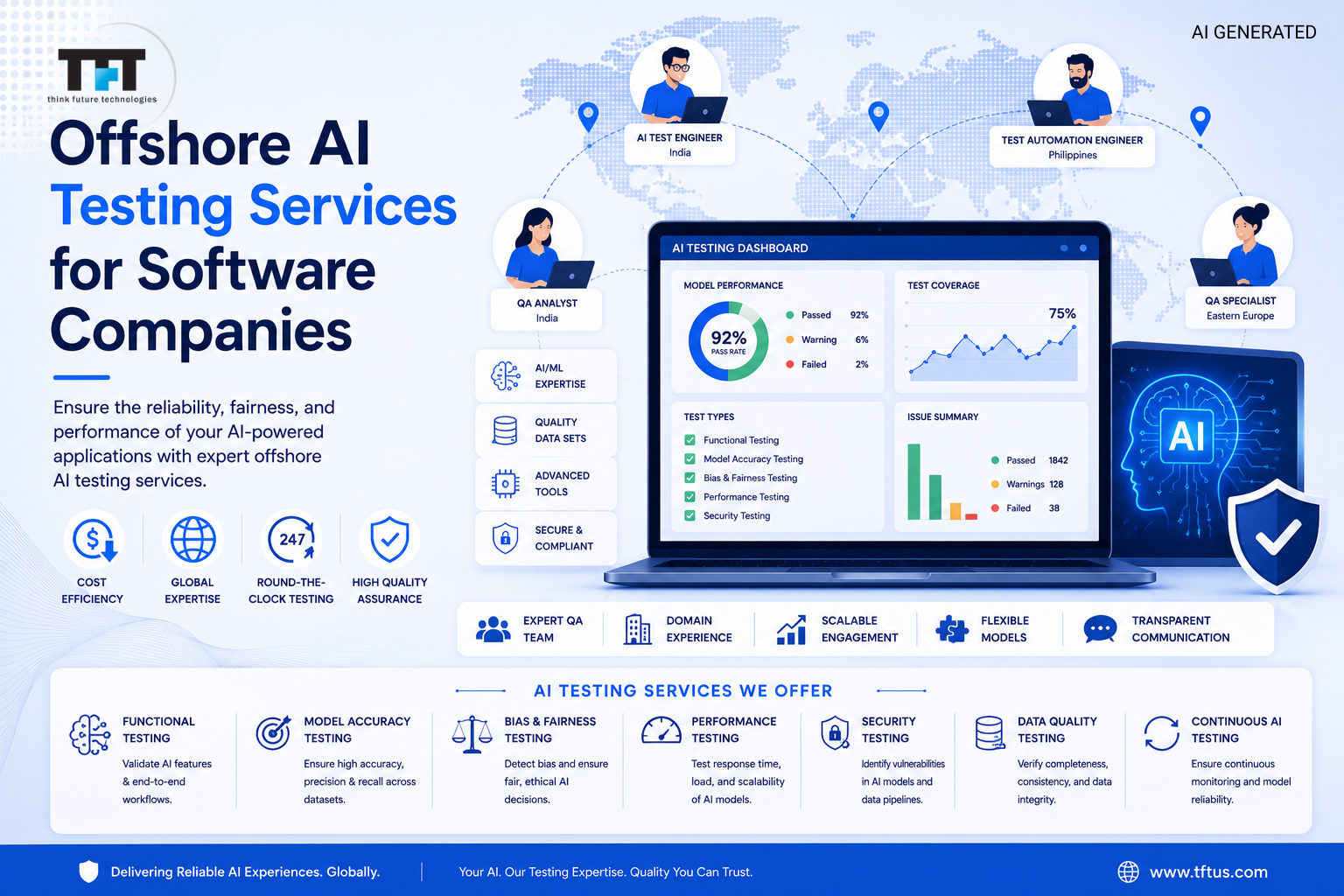
Software companies building AI systems face a testing problem traditional QA wasn’t designed for: models that produce probabilistic outputs, data that drifts over time, and edge cases that don’t show up in a fixed script. Offshore AI testing services have emerged specifically to close that gap Offshore AI Testing Services for Software Companies: Comprehensive Quality Assurance Solutions
Software companies building AI systems face a testing problem traditional QA wasn’t designed for: models that produce probabilistic outputs, data that drifts over time, and edge cases that don’t show up in a fixed script. Offshore AI testing services have emerged specifically to close that gap , offshore software testing teams built around machine learning models, generative AI, and autonomous agents, not just conventional application code.
The U.S. outsourced software testing market is expected to jump from $7.22 billion in 2025 to $27.24 billion by 2035, representing 14.2% annual growth , a trajectory that reflects how central both testing and AI have become to how software gets built and shipped.
This guide focuses on what makes offshore AI testing services distinct from general offshore QA: the specific validation work AI systems require, the skills an offshore team needs to do it well, and how to choose an offshore software testing company actually equipped for it.
What Are Offshore AI Testing Services for Software Companies?
Offshore AI testing services involve outsourcing the validation, monitoring, and performance evaluation of AI systems , machine learning models, generative AI applications, and autonomous agents , to specialized teams abroad. This is different from offshore software testing services in general, which cover conventional application logic with predictable, deterministic outputs.
Offshore Software Testing Services vs. Traditional Testing
Traditional testing services check whether software behaves as expected against fixed inputs. Testing machine learning models has to account for probabilistic outputs , the same input can produce a slightly different, still-valid response, which changes how test cases are designed and what “pass” even means.
Scope: What Offshore AI Testing Typically Covers
The scope spans generative AI features, recommendation systems, computer vision, and predictive models , each requiring a different validation approach. An offshore software testing team working across AI products needs to move between these categories, not apply one generic test plan to all of them.
Why Software Companies Choose Offshore Software Testing Companies for AI Work
The case for offshoring AI testing specifically goes beyond general cost savings.
Access to Specialized AI/ML Testing Talent
Testing AI systems demands data science literacy, statistical validation skills, and familiarity with ML frameworks , skills a generic offshore qa team doesn’t automatically have. Offshore software testing companies with dedicated AI practices give software companies access to data scientists and ML engineers without a lengthy domestic hiring cycle.
Cost-Effective Scalability for Large Dataset Testing
AI testing often means validating outputs across millions of data points. Offshore teams offer a cost-effective way to scale that volume of testing work, since compute-heavy, large-dataset validation is exactly the kind of testing activity that benefits from lower-cost regions and round-the-clock execution.
Round-the-Clock Model Monitoring
Time zone differences support continuous testing activities for AI in a way that matters more than for static software: models can drift or degrade in production, and an offshore team working while the primary team sleeps can catch that drift sooner.
The AI-enabled testing market, valued at $1.04 billion in 2026, is projected to reach $2.04 billion by 2030, growing at an 18.4% compound annual growth rate , a clear sign that AI-powered testing is becoming a standard line item in QA budgets, not a niche add-on.
Machine Learning Model Validation and Accuracy Testing
This is the core of what separates offshore AI testing services from general offshore software testing.
Accuracy, Precision, and Consistency Checks
Offshore qa engineers validate machine learning models using metrics like precision, recall, and confusion matrices, checking that a model performs consistently across different environments and data slices, not just on the training set it was built with.
Cross-Validation and Real World Validation
Lab accuracy numbers only tell part of the story. Real-world validation , testing the model against live-like data and actual usage patterns , is where offshore teams confirm a system holds up outside controlled conditions.
Generative AI and LLM Testing
Generative AI introduces testing problems that don’t exist in traditional software testing services at all.
Hallucination Detection
Offshore AI testing teams build specific test cases to catch hallucinations , confident but incorrect outputs , since these don’t throw errors the way a traditional software bug would.
Prompt Injection and Safety Filter Testing
Testing an LLM-based feature means actively probing it with adversarial prompts to check whether safety filters hold up and whether the system can be manipulated into ignoring its own guardrails.
Context Retention and Output Quality
For multi-turn or agent-based systems, offshore teams test whether context is retained correctly across a conversation and whether output quality stays consistent as interactions get longer and more complex.
Bias, Fairness, and Data Quality Testing
Testing AI systems for bias and data quality is a distinct discipline that offshore teams increasingly need to offer.
Bias and Fairness Testing Methodologies
This involves checking for demographic parity and disparate impact , confirming a model’s outputs don’t systematically disadvantage particular user groups, and documenting the methodology used to test for it.
Data Quality and Training Data Validation
Offshore teams also validate the data quality feeding a model, since biased or incomplete training data quality issues show up as biased outputs later, regardless of how well the model itself is built.
Model Drift Detection and Continuous Monitoring
AI models degrade over time in ways static software doesn’t, which is why offshore AI testing services extend into production monitoring.
Data Drift vs. Concept Drift
Offshore teams distinguish between data drift, where incoming data shifts from what the model was trained on, and concept drift, where the underlying relationship the model is predicting changes , each requires a different retesting response.
Setting Retesting Cadences
Part of an offshore qa team’s job is establishing how often a model gets re-evaluated in production and what triggers an unscheduled retest, rather than treating validation as a one-time pre-launch activity.
AI Security and Adversarial Testing
Security testing for AI systems goes beyond standard penetration testing.
Adversarial Examples and Model Robustness
Offshore security specialists test how models respond to adversarial examples , inputs deliberately crafted to fool a model , to evaluate robustness before attackers find the same weaknesses.
Model Inversion and Data Privacy Risks
AI-specific security testing also checks for model inversion risks, where an attacker could potentially reconstruct sensitive training data from a model’s outputs, alongside standard data protection review for any customer data involved.
Building an Offshore AI Testing Team That Actually Has the Right Skills
Getting good results depends on team composition, not just headcount.
Roles Beyond a Standard QA Engineer
An effective offshore AI testing team pairs a standard qa engineer with ML-literate specialists , people comfortable evaluating model outputs statistically, not just running functional test scripts against a UI.
Communication Protocols for Technical AI Concepts
Explaining model architectures and evaluation metrics across a distributed team needs more structured communication protocols than typical bug reports , shared dashboards and documented evaluation criteria keep both sides on the same page.
Compliance and Regulatory Considerations for Offshore AI Testing
New regulations like the EU AI Act are raising the bar for how AI systems get validated, especially in regulated sectors.
Testing for Regulated Industries
Medical devices and other regulated products built on machine learning models require stricter functional validation and documentation than a typical consumer app, since failures carry direct safety and legal consequences.
Data Protection When Sharing Training Data Offshore
Offshore AI testing often requires access to training data or model outputs that contain sensitive information. Confirm how a vendor handles data protection, anonymization, and data residency before sharing anything offshore.
Choosing the Right Offshore Software Testing Company for AI Work
Not every offshore software testing company is equipped to handle AI-specific quality assurance.
Verify AI/ML Technical Expertise, Not Just General QA Experience
Ask for specific past projects involving machine learning models , computer vision, NLP, or recommendation systems , rather than accepting general “technical competency” as evidence of AI readiness.
Flexible Engagement Models
The strongest offshore providers offer flexible engagement models , dedicated AI testing pods, project-based contracts, or hybrid arrangements , so the structure matches how experimental or established your AI product is.
Watch for Hidden Costs in Compute-Heavy Testing
Large-scale model validation can involve high computational costs. Ask for a full breakdown upfront so hidden costs around infrastructure don’t erode the cost-effective advantage that offshore testing is supposed to deliver.
Watch: How AI Is Reshaping Software Testing
Before wrapping up, it’s worth seeing how testers themselves are reacting to AI’s growing role in QA. The video below shares data from thousands of testers on where AI automation is heading and what it means for testing teams in 2026.
Case Study: AI-First Testing in a Fintech Environment
Groovy Web implemented an AI-first engineering methodology for a fintech fraud detection platform, combining AI-assisted development with automated testing frameworks and optimized infrastructure across the testing process.
The engagement delivered a 12-18X velocity gain and 55-70% cost reduction, with measurable ROI within 3-6 months.
According to Groovy Web, the approach worked because it delivered compound value across three layers: direct cost savings from smaller teams, velocity value from shipping faster, and opportunity cost avoidance from beating competitors to market.
Conclusion
Offshore AI testing services are a meaningfully different discipline from general offshore software testing , built around the probabilistic, data-dependent nature of machine learning models rather than deterministic application code. The software companies getting real value from offshoring this work choose partners with genuine ML expertise, not just a generic offshore qa team with “AI” added to their service list.
Frequently Asked Questions
What Makes AI Testing Different From Regular Offshore Software Testing?
AI testing has to account for probabilistic outputs, model drift, and bias , problems that don’t exist in traditional software testing, where the same input always produces the same expected output.
How Do Offshore Teams Test for Bias in Machine Learning Models?
Offshore qa teams use fairness metrics like demographic parity and disparate impact analysis, checking whether a model’s outputs disadvantage particular groups across different data slices.
Can Offshore Teams Test Generative AI and LLM-Based Features?
Yes , offshore AI testing services increasingly include hallucination detection, prompt injection testing, and context-retention checks specific to generative AI and conversational systems.
Is Offshore AI Testing Cost-Effective for Smaller Software Companies?
Yes , flexible engagement models let smaller software companies access specialized ML testing skills and compute-heavy validation without committing to a full in-house data science team.
What Should I Look For in an Offshore AI Testing Partner?
Look for verifiable experience with machine learning models specifically, clear data protection practices for handling training data offshore, and testing processes that go beyond functional testing into bias, drift, and security evaluation.

Leave a Reply