

Building a mobile app used to mean hiring a local team and hoping enough skilled developers were available nearby. Today, offshore mobile development has changed that equation entirely, giving businesses access to global talent, specialized expertise, and lower development costs without sacrificing quality.
This guide covers everything from how offshore mobile app development actually works to the specific offshore mobile app development services and offshore cross-platform app development options available today. We’ll also look at how to choose the right offshore mobile development company, manage time zone differences, and protect data security throughout the mobile app development process.
The rise of remote-first engineering culture over the past several years has only accelerated this shift, making offshore mobile development a mainstream choice rather than a niche cost-cutting tactic reserved for the largest enterprises.
Whether you’re planning your first offshore mobile application development project or looking to scale an existing offshore mobile development team, the sections ahead walk through what actually matters, from technical expertise and project management to the business goals that should shape every decision along the way.
According to Allied Market Research, the global mobile app development market was valued at $195.7 billion in 2023 and is projected to reach $606.1 billion by 2032, growing at a 13.1% CAGR. This growth reflects the expanding demand for mobile applications and the development capacity required to build and maintain them.
What Is Offshore Mobile Development?
Offshore mobile development means partnering with a mobile app development company based in another country to design, build, and maintain mobile apps on your behalf. Rather than relying solely on an in-house team, businesses tap offshore mobile app developers to add capacity, specialized skills, or both.
Offshore mobile development spans everything from a single offshore developer joining an existing app development team to a fully dedicated offshore team running an entire mobile app project from concept to launch. The right structure depends on project scope, timeline, and how much oversight a business wants to retain.
The term itself covers a broad spectrum of arrangements, and businesses new to offshore mobile development are often surprised by just how flexible the model can be once they start evaluating potential partners.
How Offshore Mobile App Development Works
Most offshore mobile app development engagements begin with a discovery phase, where the offshore partner reviews business goals, target platforms, and technical requirements before proposing a development approach and team structure.
From there, the offshore team typically sets up shared project management tools, communication channels, and a sprint cadence so that both sides can track progress on the mobile app project together from day one.
A short pilot phase, often lasting just a few weeks, is also common before the full engagement ramps up, giving both sides a low-risk way to confirm the working relationship before committing to a longer timeline.
Offshore Mobile Application Development Models
Offshore mobile application development is generally offered through a few core models: a dedicated offshore team assigned exclusively to one client, a project-based engagement with a fixed scope, or a hybrid model blending offshore developers with an in-house development team.
Choosing the right model depends heavily on whether the mobile app project is a one-time build or part of an ongoing product roadmap that will need continuous development cycles well past launch.
Businesses often start with a smaller, project-based engagement to evaluate an offshore partner before transitioning to a dedicated team arrangement for longer-term product work.
Offshore Mobile Development Team Structure
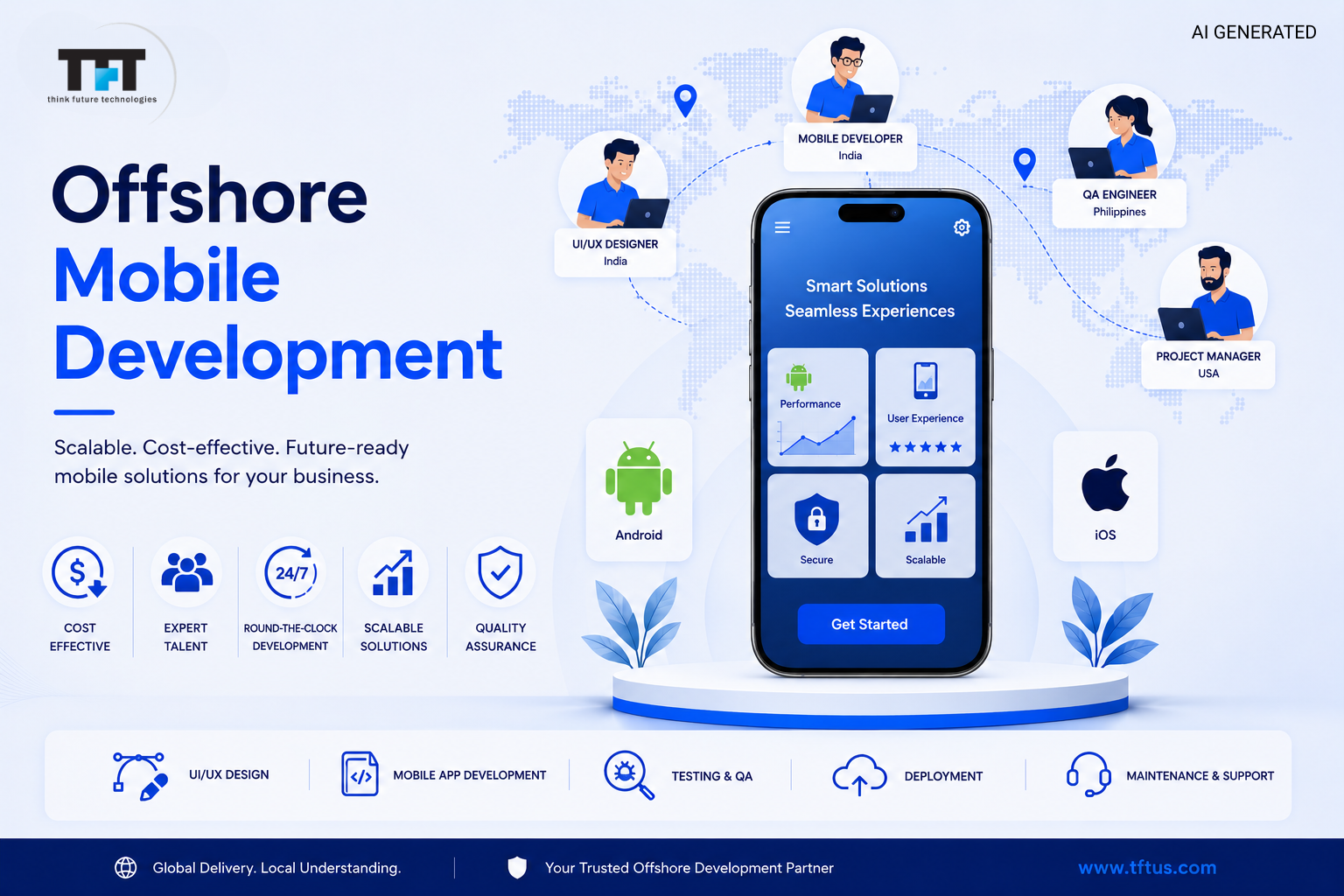
A well-structured offshore mobile development team typically includes mobile app developers for each target platform, a QA engineer, a UI/UX designer, and a project manager who coordinates directly with the client’s internal stakeholders.
Larger mobile app projects may also include dedicated backend software engineers and a business development manager who helps scope future phases of work as the product evolves.
Some offshore mobile development companies additionally offer a dedicated DevOps specialist for larger projects, handling deployment pipelines and infrastructure so mobile app developers can stay focused purely on the application itself.
Offshore Mobile App Development Services
Offshore mobile app development services typically cover the entire mobile app development process, letting clients rely on a single offshore partner rather than coordinating multiple vendors across different specialties.
This breadth matters because mobile apps rarely stay simple for long; even a straightforward app often needs backend infrastructure, ongoing quality control, and ongoing post-launch support once real users start relying on it.
A single offshore mobile development company that can cover this full range also reduces the coordination overhead of managing separate vendors for design, development, and QA.
Custom Mobile App Development
Custom mobile app development builds an app around a specific business’s exact requirements, rather than adapting a generic template that wasn’t designed for the workflow in question. Offshore mobile app developers experienced in custom builds often bring reusable components that speed up delivery without limiting flexibility.
Because custom mobile app development is tailored from the start, it also tends to scale more easily as a business’s needs grow, compared with retrofitting a rigid, off-the-shelf mobile solution.
This flexibility becomes especially valuable a year or two after launch, when new features and integrations inevitably come up that a generic template was never designed to support.
Android App Development
Android app development remains one of the most requested offshore mobile app development services, given the platform’s global reach across a huge range of devices and price points. Offshore Android app development teams typically maintain deep experience handling device fragmentation and varying hardware capabilities.
Skilled developers working on Android also need strong familiarity with the platform’s frequent OS updates, which can affect app behavior in ways that require ongoing monitoring after launch.
Google’s own review and update cadence for the Play Store also moves quickly, so offshore teams need a process for keeping pace with new requirements without disrupting an app’s existing user base.
iOS App Development for the Apple App Store
iOS app development follows a more controlled environment than Android, with strict guidelines governing what gets approved for the Apple App Store. Offshore mobile app developers experienced with Apple’s review process can help avoid costly rejections and delays late in a mobile app project.
This specialized expertise in App Store requirements often saves clients significant time, since first-time submission mistakes can add weeks to an already tight launch timeline.
Apple’s guidelines also shift periodically, so an offshore partner actively maintaining several live apps in the App Store tends to stay current in ways a team submitting only occasionally would not.
Web App Development
Many offshore mobile development companies also offer web app development alongside native mobile work, letting businesses build a companion web experience or a progressive web app using much of the same underlying codebase and business logic.
This combined approach can reduce total development costs, since backend systems and APIs built for a mobile app can often be reused for the web version with only modest adjustments.
Businesses launching both a mobile app and a companion website also benefit from a more consistent user experience across platforms when the same offshore team is designing and building both.
Post-Launch Support and Maintenance
Post-launch support keeps a mobile app running smoothly after release, covering everything from bug fixes to OS compatibility updates as new versions of iOS and Android roll out. Strong offshore partners build this ongoing support into their offering rather than treating launch as the finish line.
Without dedicated post-launch support, even a well-built app can quickly fall behind on compatibility, leading to poor reviews and declining user engagement over time.
Many offshore partners offer tiered post-launch support packages, letting clients choose the level of ongoing monitoring and response time that matches their app’s importance to the business.
Quality Control and Testing
Quality control is typically built into every stage of the mobile app development process rather than saved for a single testing phase at the end, catching issues while they’re still cheap and fast to fix.
Offshore QA specialists working closely with mobile app developers throughout development also tend to catch usability issues that a purely functional test pass would miss entirely.
This continuous involvement also builds a shared sense of ownership over app quality between developers and QA, rather than treating testing as an adversarial final gatekeeping step.
Offshore Cross-Platform App Development
Offshore cross-platform app development lets businesses build a single codebase that runs on both iOS and Android, rather than maintaining two entirely separate native apps side by side.
This approach has become increasingly popular as cross-platform frameworks have matured, now offering performance and native-feel user experiences that were much harder to achieve just a few years ago.
Many businesses that once dismissed cross-platform development as a compromise are now revisiting that assumption, given how far these frameworks have come in recent release cycles.
What Is Cross-Platform Development?
Cross-platform development uses a shared codebase, written once and compiled or rendered for multiple operating systems, instead of building and maintaining separate native apps for iOS and Android individually. This can significantly reduce development costs for mobile app projects targeting both platforms at once.
Offshore teams with deep cross-platform experience can also help clients decide which parts of an app, if any, still warrant native development for performance-sensitive features.
Complex animations, camera integrations, or heavy background processing are common examples where a small native module, layered on top of a shared cross-platform core, still tends to deliver the best result.
Popular Cross-Platform Frameworks
Popular cross-platform frameworks each come with their own trade-offs around performance, community support, and how closely they can access native device features. Offshore mobile app developers with experience across multiple frameworks can recommend the best fit for a given project rather than defaulting to whichever one they know best.
Framework choice also affects long-term maintainability, since some frameworks have stronger long-term corporate backing and community momentum than others.
An offshore mobile development company that regularly ships apps in multiple frameworks can offer a more grounded, comparative recommendation than a team that has only ever worked in one.
When to Choose Cross-Platform Over Native
Cross-platform development tends to make the most sense for mobile app projects with straightforward interfaces, tight budgets, or aggressive timelines, while native development often remains the better choice for apps with heavy graphics, complex animations, or deep hardware integration.
An experienced offshore partner can walk through this trade-off honestly, rather than steering every client toward whichever approach happens to be more profitable for the vendor.
Asking a potential partner to explain both sides of this decision, including where cross-platform falls short, is often a good early test of how transparent they’ll be throughout the rest of the engagement.
Benefits of Offshore Mobile Development
The benefits of offshore mobile development go well beyond simple cost savings, touching nearly every part of how a mobile app gets built and maintained.
The sections below cover the most significant advantages, though the actual value a business sees depends heavily on how well the offshore engagement is structured and managed day to day.
Cost Efficiency and Lower Development Costs
Cost efficiency remains one of the strongest reasons businesses outsource mobile app development, with offshore development costs often running well below what comparable in-house development would require for the same specialized skills.
These savings tend to compound further on longer engagements, since fixed onboarding and ramp-up costs get spread across a longer relationship with the offshore mobile development team.
Businesses that treat cost efficiency as only one factor among several, rather than the sole deciding one, also tend to end up with stronger long-term partnerships and better overall outcomes.
Cost differences can be significant across development markets. According to Aalpha Information Systems’ 2026 analysis, experienced mobile developers in the United States and Western Europe typically charge $80–$150 per hour, depending on project complexity and scope. This difference in regional rates is one factor driving businesses to consider offshore development models.
Access to Global Talent
Partnering offshore means businesses can gain access to global talent rather than being limited to whichever mobile app developers happen to live within commuting distance of a local office.
This wider pool also makes it far easier to find developers with experience in specific, less common technical requirements, rather than settling for generalists who need additional ramp-up time.
For niche integrations, like wearable device support or specialized payment systems, this global reach can be the difference between finding the right expertise quickly and spending months searching locally.
The potential audience for mobile products continues to expand. According to Zoolatech’s 2026 industry analysis, the number of smartphone users worldwide is expected to reach 6.38 billion by 2028. As mobile adoption grows, businesses increasingly need development teams that can build, launch, and maintain applications across platforms and markets.
Specialized Expertise and Technical Expertise
Offshore mobile development companies often maintain specialized expertise across specific frameworks, industries, and platform requirements that would be expensive and slow to build internally from scratch.
This technical expertise becomes especially valuable for complex mobile app projects involving payments, healthcare data, or other domains with their own regulatory and security nuances.
Rather than learning these nuances from scratch on a client’s dime, an offshore team with prior domain experience can flag potential issues early, before they turn into costly rework later in the project.
Case Study: Offshore Expertise Supported a Complex AI Mobile SDK
An AI development company building emotional well-being technology partnered with Pecode Software for offshore mobile development. The team developed Android and iOS applications, created a documented SDK using the MediaPipe framework, and handled testing and deployment.
The project included technically demanding capabilities such as facial-expression tracking, head-movement detection, and advanced computation algorithms. Pecode also validated the SDK through integration testing with external projects and maintained detailed documentation to improve third-party developer usability.
Faster Time to Market
Because offshore mobile app developers can often start immediately, without a lengthy local hiring process, offshore engagements frequently achieve a faster time to market than building an in-house team from zero.
Parallel workstreams, with offshore developers working across time zone differences, can also compress the overall timeline further by keeping progress moving around the clock.
For businesses racing to beat a competitor to market, this compressed timeline can matter as much as any single feature in determining whether the launch succeeds.
Scalability and Flexible Development Teams
Offshore development teams can scale up quickly ahead of a major release and scale back down afterward, offering flexibility that a fixed in-house development team usually can’t match.
This flexibility is especially valuable for mobile app projects with seasonal spikes in demand or aggressive feature roadmaps tied to specific launch windows.
Retail and events-driven apps, in particular, often benefit from this kind of elastic capacity, ramping up development ahead of a known peak period and scaling back once it has passed.
Focus on Core Business Activities
Outsourcing mobile app development frees internal teams to focus on core business activities, like product strategy and customer relationships, rather than getting pulled into day-to-day development execution.
This division of labor also reduces the common bottleneck where a small internal team becomes the limiting factor on how quickly new features can ship.
Freed from constant development execution, internal leaders can also spend more time on the strategic decisions that only they, with full context on the business, are really positioned to make.
The Mobile App Development Process With an Offshore Team
A structured mobile app development process helps keep offshore engagements predictable, even across time zone differences and cultural differences between client and vendor teams.
Discovery and Defining Project Scope
Every strong mobile app development process begins by defining project scope clearly, documenting business goals, target platforms, and must-have features before any code gets written.
Skipping this step is one of the most common causes of scope creep and budget overruns later in a mobile app project.
Investing extra time here, even if it delays the start of active development slightly, almost always pays for itself many times over once the build phase gets underway.
Design and Prototyping
Design and prototyping translate business goals into a visual, testable experience, letting stakeholders validate the app’s flow and usability before committing significant development resources to the build.
Offshore design teams often use interactive prototypes at this stage, which tend to surface usability issues far earlier and more cheaply than waiting until working code exists.
Stakeholder feedback gathered on a clickable prototype is also typically faster and more actionable than feedback gathered on static mockups alone, since it lets reviewers actually experience the intended flow.
Development and Continuous Integration
Development typically proceeds in short, iterative cycles, with continuous integration automatically building and testing new code as it’s committed, catching integration issues before they compound into larger problems.
This automation is especially valuable in offshore engagements, since it gives both offshore developers and internal stakeholders immediate, objective feedback on the state of the codebase.
It also reduces reliance on any single developer’s manual verification, which matters when a team is distributed across different time zones and can’t always confirm things in person.
Testing and Quality Assurance
Testing and quality assurance run throughout development rather than only at the end, covering functional testing, performance testing, and compatibility testing across the wide range of devices a mobile app might encounter.
Offshore QA teams often maintain device labs specifically for this purpose, giving clients broader compatibility testing coverage than most in-house teams could feasibly replicate.
This is particularly valuable for Android app development, where the sheer number of device models and screen sizes makes thorough manual testing on real hardware difficult to achieve without dedicated infrastructure.
Launch and Post-Launch Support
Launch involves submitting the app to the Apple App Store and Google Play, coordinating marketing timing, and monitoring closely for any issues that surface once real users begin downloading the app.
Post-launch support then continues the relationship, addressing bugs, compatibility updates, and new feature requests as the product matures and user engagement grows.
This ongoing phase is often where the deepest product knowledge accumulates, since the team handling post-launch work sees firsthand how real users actually behave once the app is live.
Agile Methodologies in Offshore Mobile Development
Agile methodologies help offshore mobile development teams stay aligned with shifting business goals, breaking work into short cycles with frequent checkpoints rather than a single, rigid plan set in stone at the outset.
This approach matters even more offshore, where structured, regular touchpoints help compensate for the reduced spontaneous interaction that comes with distance and time zone differences.
Teams new to agile methodologies in an offshore context sometimes underestimate how much discipline these regular touchpoints require, but the payoff in reduced miscommunication is usually well worth the extra structure.
Continuous Development Cycles
Continuous development cycles let offshore teams ship incremental improvements regularly, rather than batching all changes into a single large release that carries more risk and is harder to debug if something goes wrong.
Smaller, frequent releases also make it easier to gather real user feedback early, guiding the direction of later development phases.
This feedback loop is often the single biggest advantage of continuous development cycles, since it replaces guesswork about what users want with actual evidence gathered from the app itself.
Sprint Planning Across Time Zones
Sprint planning across time zones requires deliberate scheduling, often anchored around a small window of overlapping hours where both offshore and internal teams can meet in real time.
Clear async documentation between these live touchpoints helps keep momentum going even when a mobile app developer’s working day doesn’t fully overlap with the client’s.
Tools that let stakeholders leave asynchronous comments directly on designs, tickets, or builds also reduce the pressure to resolve every question in a live meeting.
How to Choose an Offshore Mobile Development Company
Choosing the right offshore mobile development company requires looking past a polished sales pitch to the actual people, process, and results behind it.
A short, paid trial project is often one of the most reliable ways to evaluate a potential partner’s real capabilities before committing to a longer engagement.
This trial period also gives internal stakeholders a chance to experience the offshore team’s communication style firsthand, which is difficult to judge accurately from a sales call alone.
Reviewing a Proven Track Record
A proven track record, ideally with mobile app projects similar in scope and industry to your own, is one of the clearest signals of what a partnership will actually look like.
Ask for references you can speak with directly, rather than relying solely on polished case studies or curated testimonials.
A quick reference call, even just fifteen minutes, often reveals far more about a partner’s day-to-day reliability than any amount of marketing material ever could.
Case Study: Choosing the Right Offshore Partner Revived a Failed Mobile App
A Kansas City-based freight factoring company partnered with Fluent Consultants after an earlier outsourced mobile app failed to meet its requirements.
The replacement app used Xamarin to create a single codebase for iOS and Android and was integrated with the company’s core backend systems, CRM, and web portal.
The redesigned application reduced freight factoring processing time from two days to seconds and expanded customer adoption from 30–40% to the broader customer base.
The case highlights why vendor selection, business-domain understanding, system integration, and choosing a technology aligned with internal capabilities matter as much as development itself.
Evaluating Skilled Developers and Software Engineers
Evaluate whether the company employs genuinely skilled developers and software engineers with hands-on experience in your required platforms and frameworks, rather than a rotating bench of generalists.
Live technical interviews or a small paid assessment task can help confirm this expertise before a full engagement begins.
Looking at recent work samples, rather than only portfolio pieces that may be several years old, also gives a more accurate picture of a team’s current technical expertise.
Working With a Business Development Manager
Most offshore engagements start with a business development manager who scopes the project and sets expectations, so it’s worth confirming who will actually lead delivery once the contract is signed.
A disconnect between the sales process and the delivery team is a common source of frustration once a mobile app project gets underway.
Meeting the actual project manager and lead developer before signing a contract, rather than only the business development manager, helps set more accurate expectations from day one.
Where to Find Offshore Mobile App Developers
Offshore mobile app developers are based across many regions worldwide, each offering a different mix of cost, time zone overlap, and specialized skills.
Eastern Europe
Eastern Europe has long been a strong source of offshore mobile app developers, known for rigorous computer science education and deep technical expertise in both native and cross-platform frameworks.
Many Western European and North American clients also benefit from workable time zone overlap with Eastern Europe, easing real-time collaboration on active mobile app projects.
The region’s long history of outsourcing has also produced a mature ecosystem of established offshore mobile development companies with well-documented processes and deep bench strength.
Other Popular Offshore Regions
Beyond Eastern Europe, regions across Latin America and South and Southeast Asia have all grown significantly as sources of offshore mobile app developers, each offering their own balance of cost efficiency and specialized expertise.
Choosing among these regions often comes down to which time zone differences a business can most comfortably work around, alongside the specific technical expertise a project requires.
Some businesses also run a short, structured comparison across two or three regions before committing, rather than choosing based on reputation or cost alone.
Managing Time Zone Differences
Time zone differences can be one of the biggest adjustments in offshore mobile development, but with the right structure they can also become an advantage, effectively extending the working day on a mobile app project.
Clear handoff documentation between shifts, along with a defined overlap window for live discussion, helps offshore teams and internal stakeholders stay aligned even when they’re rarely online at the same time.
Businesses that plan deliberately around this overlap window, rather than treating it as an afterthought, tend to get significantly more value out of it than those who let meetings happen ad hoc.
Overcoming Communication Barriers and Cultural Differences
Communication barriers and cultural differences are among the most underestimated challenges in offshore collaboration, even when the underlying technical work is strong on both sides.
Left unaddressed, these gaps can quietly erode trust and slow down decision-making, even on projects that are technically going well.
Investing early in building rapport, rather than jumping straight into task execution, tends to make these gaps much easier to navigate once real pressure and deadlines enter the picture.
Offshore Collaboration Best Practices
Offshore collaboration works best with detailed written communication, clear specs, recorded demos, and structured status updates, rather than relying heavily on quick verbal exchanges that don’t translate well across time zones.
Regular video calls during overlapping hours also help build the kind of rapport that pure text communication often struggles to establish.
Even brief, informal check-ins outside of strict status updates can go a long way toward building the trust that keeps an offshore collaboration running smoothly under pressure.
Project Management Tools for Offshore Teams
Shared project management tools give both offshore and internal teams a single source of truth for project scope, priorities, and progress, reducing the ambiguity that can otherwise build up across time zone differences.
Consistent use of these tools also creates a clear historical record, which is valuable if questions come up later about why a particular decision was made.
This record becomes especially important on long-running mobile app projects, where the reasoning behind an early decision can otherwise fade from memory well before the project wraps up.
Data Security in Offshore Mobile Development
Data security is one of the most important considerations in any offshore mobile development engagement, particularly for apps handling sensitive user information or payment data.
Strong offshore partners should be able to explain their data security practices clearly and specifically, rather than offering only general reassurances.
Businesses handling regulated data should treat this conversation as a hard requirement before signing any contract, not a nice-to-have detail to sort out later.
Protecting User and Business Data
Protecting user and business data starts with clear access controls, encryption standards, and secure handling of any production data shared with the offshore team during development or testing.
Businesses should confirm exactly what data the offshore team can access, and for how long, before any project work begins.
Time-limited access, revoked automatically once a specific task is complete, is a practice worth asking about directly during vendor evaluation.
Data Security Compliance Considerations
Depending on the industry, offshore mobile app development may also need to account for specific data security compliance requirements, from healthcare regulations to regional data protection laws governing how user data can be stored and transferred.
Reviewing these requirements upfront avoids costly rework later if a partner’s practices turn out not to align with what compliance actually demands.
Offshore vs In-House Mobile Development
Deciding between offshore and in-house mobile development depends on budget, timeline, and how much day-to-day oversight a business wants to maintain over the entire project.
Many businesses ultimately land on some blend of the two rather than choosing one model exclusively for every mobile app project.
Benefits of an In-House Team
An in-house team offers close, in-person oversight and deep, ongoing familiarity with a company’s specific business goals, which can be valuable for products with constantly evolving requirements.
The trade-off is usually higher development costs and a more limited pool of local, specialized skills to draw from.
When Offshore Makes More Sense
Offshore development tends to make more sense when a project needs specialized expertise not available locally, when budget constraints are significant, or when a business needs to add development capacity quickly.
Well-defined mobile app projects with stable requirements are also generally easier to hand off to an offshore mobile development team.
Hybrid Approach: Combining In-House and Offshore
A hybrid approach keeps core product strategy and architecture in-house while offshore developers handle a larger share of implementation, testing, and ongoing maintenance work.
This combination often delivers the strongest overall outcome, balancing cost efficiency with the oversight many businesses want to retain over critical decisions.
Dedicated Offshore Team vs Project-Based Outsourcing
A dedicated offshore team stays assigned to one client over an extended period, building deep product knowledge, while project-based outsourcing assembles developers for a fixed scope and disbands once the work is complete.
Dedicated teams tend to suit ongoing mobile app projects, while project-based engagements work well for a single, clearly bounded build with a defined end date.
Onshore Development vs Offshore Development
Onshore development keeps a team in the same country, offering shared time zones and business culture but typically at a higher cost than offshore alternatives.
The right choice between onshore development and offshore development usually comes down to how much a business values real-time collaboration versus the cost efficiency and global talent access that offshore work provides.
Common Challenges in Offshore Mobile App Development (and Solutions)
Common challenges in offshore mobile app development include time zone differences, communication barriers, and inconsistent quality control across teams, all of which are manageable with clear documentation, a dedicated project manager, and shared quality standards agreed upon from the start.
Most of these issues surface early in an engagement, making the first few weeks a particularly important window for identifying and correcting course before problems compound.
Project Management Best Practices for Offshore Mobile Projects
Strong project management practices are what typically separate offshore mobile app projects that succeed from ones that quietly drift off track.
Setting Clear Business Goals
Clear business goals, defined and shared with the entire offshore team from the outset, keep day-to-day development decisions aligned with what actually matters to the business.
Without this alignment, a technically well-built app can still miss the mark on what it was actually meant to achieve.
Defining Project Scope Early
Defining project scope early and documenting it in detail reduces the back-and-forth that often derails offshore mobile app projects once development is already underway.
Any changes to scope should also go through a clear, agreed-upon process rather than being absorbed informally into the existing timeline.
Assigning Dedicated Project Managers
Dedicated project managers on both the offshore and client side keep communication consistent, translate business goals into daily priorities, and proactively flag risks before they turn into missed deadlines.
This structure also gives both sides a clear, single point of contact for resolving questions quickly rather than routing everything through the entire project team.
How Offshore Teams Improve User Engagement
Offshore mobile app developers with deep technical expertise and QA discipline directly influence user engagement, since a fast, stable, well-tested app keeps users coming back far more reliably than one riddled with bugs.
Offshore teams focused specifically on post-launch support can also respond quickly to user feedback, iterating on the features that most affect day-to-day engagement.
Cost Breakdown: What Affects Offshore Mobile App Development Costs
Offshore mobile app development costs vary widely depending on app complexity, platform choice, team composition, and the specific region an offshore mobile development team is based in.
Understanding these variables upfront helps businesses set a realistic budget rather than anchoring only on a single quoted hourly rate.
Factors That Influence Development Costs
Key factors that influence development costs include whether the app requires native or cross-platform development, how many integrations it needs, and how much ongoing post-launch support the engagement includes.
Custom mobile app development with complex backend requirements will naturally cost more than a simpler app built largely from existing components.
Comparing Offshore and Onshore Pricing
Comparing offshore and onshore pricing usually reveals a substantial gap, with offshore mobile app developers often costing a fraction of onshore rates for comparable technical expertise and specialized skills.
Even after accounting for coordination overhead, most businesses still see meaningful cost savings by choosing an experienced offshore partner over a purely onshore team.
Offshore Mobile Development for Startups
For startups, offshore mobile development often provides development capacity that would be difficult to afford with an in-house team alone, letting a small founding team ship a full mobile app without a large local engineering staff.
This can be especially valuable in the earliest stages, when speed to a testable product matters more than building out a large permanent team.
Offshore Mobile Development for Enterprises
For enterprises, offshore mobile development more often supplements existing internal teams, adding specialized expertise or extra development capacity for a specific mobile app project or platform expansion.
Enterprises also tend to place a heavier emphasis on data security and integration with existing systems, given the scale and complexity of their broader technology environment.
Case for Outsourcing the Entire Project vs Partial Outsourcing
Some businesses outsource the entire project to an offshore mobile development company, while others outsource only specific pieces, like QA or a single platform, while keeping the rest in-house.
The right choice depends on how much specialized expertise exists internally already, and how much oversight a business wants to retain over the parts of the app it considers most critical.
Best Practices for a Successful Offshore Mobile App Development Partnership
A handful of consistent best practices tend to separate offshore mobile app development partnerships that thrive from ones that quietly underperform over time.
These include clear documentation, regular communication during overlapping hours, shared project management tools, and a willingness on both sides to raise issues early rather than letting them fester.
Conclusion
Offshore mobile development has matured into a reliable way for businesses of every size to gain access to global talent, specialized expertise, and lower development costs without compromising on quality. From offshore mobile app development services to offshore cross-platform app development, the right partner can meaningfully expand what a business is able to build.
Success ultimately comes down to choosing a partner with a genuine proven track record, setting clear business goals and project scope from the start, and building the kind of ongoing collaboration that turns an offshore mobile development team into a true extension of the business rather than a distant vendor.
FAQ’s
What is offshore mobile development?
Offshore mobile development means partnering with a mobile app development company based in another country to design, build, and maintain mobile apps, giving businesses access to global talent and lower development costs.
How much does offshore mobile app development cost?
Offshore mobile app development costs vary based on app complexity, platform choice, and team composition, but are typically well below comparable onshore or in-house development for similar technical expertise.
Is offshore mobile app development secure?
Reputable offshore partners maintain clear data security practices and compliance measures, but businesses should review a partner's specific policies on data handling before sharing sensitive user or business data.
Should I choose native or cross-platform development?
Cross-platform development tends to suit simpler apps with tighter budgets, while native development is often better for apps with complex graphics or deep hardware integration; an experienced offshore partner can help evaluate the trade-off for your specific project.
How do I manage time zone differences with an offshore team?
Clear handoff documentation, a defined window of overlapping hours, and consistent use of shared project management tools help offshore teams and internal stakeholders stay aligned despite time zone differences.
What should I look for in an offshore mobile development company?
Look for a proven track record with similar mobile app projects, skilled developers with relevant technical expertise, transparent data security practices, and a dedicated project manager who will actually lead delivery.
Can offshore teams provide post-launch support?
Yes, most offshore mobile development companies offer ongoing post-launch support, covering bug fixes, OS compatibility updates, and new feature development as a mobile app matures after release.

Leave a Reply