

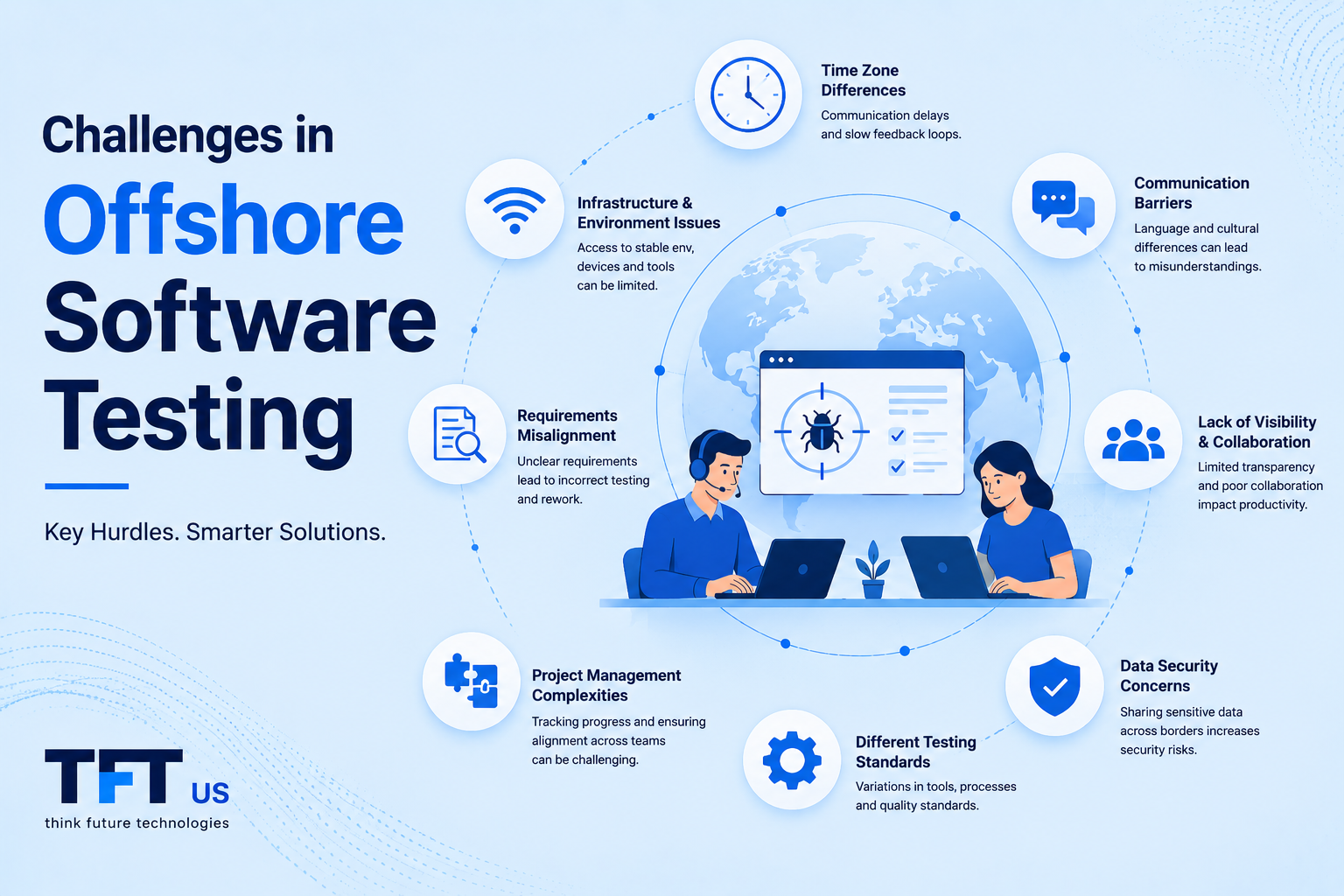
Offshore software testing can cut costs and scale a QA function fast, but it also opens specific failure modes — communication lag, compliance exposure, hidden costs — that don’t show up until a release is already at risk.
Since the late 2010s, offshore quality assurance teams have become standard practice for companies scaling their testing operations. The market reflects how mainstream this has become: the outsourced software testing market alone topped $36.39 billion in 2025, per Research Nester. But the promised savings frequently erode once the hidden challenges of distributed quality assurance take hold.
US and EU companies routinely offshore functional testing, performance testing, and mobile application testing to India, Eastern Europe, and Southeast Asia, with India and Eastern Europe remaining the two leading regions for offshore software testing in 2026, per DesignRush. The model works when it’s managed well. This article focuses on where it breaks down and how to anticipate those breakdowns before they cost you a release.
1. Communication Challenges and Time Zone Friction
Most offshore QA engagements fail first at communication, not at pure technical skills. Communication difficulties are cited as the single biggest challenge in offshore software development by 61% of organizations, and cultural differences are flagged by 51%, according to a Market.us offshore software development market report.
Many organizations report that cultural, tool, and process misalignment, rather than technical shortcomings, are the leading causes of offshore QA failure. Catch this early with a week-1 communication audit: who needs to talk to whom, how often, and where the actual time zone overlap is.
Linguistic and Cultural Issues
English proficiency varies widely among offshore software testing teams, even within the same vendor. Language gaps can result in misunderstood requirements and incorrect test cases — the issue isn’t just fluency, it’s nuance. Words like “optional,” “should,” or “and/or” in a requirements document get interpreted differently depending on context and native language.
In one engagement between a Japanese product team and Vietnamese QA engineers, an ambiguous specification was interpreted more strictly than intended, omitting critical negative test cases and forcing a full test cycle re-run.
Cultural differences may lead offshore team members to hesitate to voice concerns to superiors. In many offshore locations, team members are reluctant to push back on unclear requirements or to explicitly say “no,” which creates silent assumptions rather than vocal clarifications, and those assumptions become defects. Encouraging offshore testing teams to question requirements fosters psychological safety, which is the single cheapest investment you can make in improving defect detection.
Time Zone Gaps and Async Decision Lag
Time zone differences can lead to delayed feedback loops and slow down development. Typical gaps range from 9.5 to 12.5 hours between the US and India, and 6 to 7 hours between the UK and Vietnam. The real mechanism at work here is better described as async decision lag than a generic “communication barrier”: a single ambiguous requirement raised at 9am US time often doesn’t get resolved until the next overlapping window, 24 to 48 hours later, not the same day.
That lag compounds every time it recurs across a sprint, and defect triage waits until the next overlapping window while sprint momentum stalls. Establishing overlapping work hours of two to three hours daily can facilitate better communication and keep critical discussions synchronous.
Concrete QA Impacts
Bug reports arrive with missing environment info or wrong priority because of delayed clarifications.
Edge cases get missed due to a lack of synchronous brainstorming.
Handoffs between onshore teams and offshore QA team members become fragile; test scripts prepared offshore arrive late or incomplete, creating blockers.
Communication barriers and cultural differences can lead to misunderstandings, especially with no face-to-face meetings or brainstorming sessions. Teams that replace async-only standups with a daily 30-minute video sync typically see ambiguous priority calls resolved live instead of dragging across rounds of written comments. Video communication helps, but works best paired with a fixed overlap window, not as a substitute for one.
2. Quality Alignment and Maintaining Consistent Testing Standards
Offshore quality assurance teams often come with their own habits, testing methodologies, and internal definitions of “done,” which may not match yours. The mismatch is subtle at first and grows with every sprint. 56% of companies identify inadequate testing scope as a major concern in software testing, and 40% point to excessive operational expenses as a major challenge, according to research published in the International Journal of Scientific and Advanced Technologies.
A sprint-0 checklist heads this off: write down your definition of “done,” agree on minimum test depth per risk category, and confirm who owns sign-off when the two sides disagree.
Misaligned Test Depth
A common pattern: offshore QA engineers focus on happy path scenarios while the in-house team expects robust negative, boundary, and integration tests. Without domain knowledge in verticals like healthcare, fintech, or logistics, testers may not understand critical business rules — authorized versus unauthorized user flows, data retention policies, and financial rounding errors.
In one healthcare outsourcing engagement, the vendor was unaware of HIPAA’s specific testing requirements. Functional bugs were low, but compliance gaps caused delayed releases and a partial recall, wiping out the initial cost savings — a pattern that shows up again, with sharper numbers, in the data security section below.
Regression and Documentation Drift
Regression testing ensures stability after code changes by detecting new bugs in already tested functions, maintaining software quality over time. But keeping regression suites consistent across distributed testing teams is hard, especially when requirements change weekly. Test cases go stale, contradictory versions float across Confluence pages, and the manual QA team may not know which version of a spec to trust.
Knowledge silos occur when critical product context stays with the onshore team, affecting project continuity. Providing product training helps offshore teams understand the reasoning behind software features, not just their surface behavior.
A workable fix: one named owner per spec, retired test cases the moment a spec changes, and a weekly 15-minute sync between the product owner and offshore QA lead to confirm which version is current.
Measurable Quality KPIs
To expose quality gaps before they reach production, track these across your offshore testing team:
- Defect leakage rate — defects found in production divided by total defects found
- Escaped defects — critical bugs that bypass all test stages
- Re-open rate — bugs reopened after being marked “fixed”
- Defect Removal Efficiency (DRE) — percentage of defects caught before release
Benchmarks make these numbers actionable: a DRE between 85% and 95% is reasonably effective, above 95% is excellent, and a defect escape rate below 5% is good, with high-performing teams targeting below 2% — the broader US average sits closer to 15%, per Capers Jones’s research.
Below 85% DRE is a signal that your offshore quality alignment needs a structural fix, not just more testing hours.
3. Data Security, Compliance, and Intellectual Property Risks
Giving an offshore QA testing team access to staging or production-like data introduces real regulatory and IP exposure. Compliance should come before vendor selection, not after: deciding on data-handling requirements and Business Associate Agreements up front prevents signing with a vendor that can’t meet your regulatory obligations.
Data Access Risks
Data security risks increase when sharing sensitive production data across international borders, making data masking essential. Common problems include unmasked production data in test environments, weak access controls on test servers, and databases downloaded to personal machines.
More than half of tech leaders (51%) identified security as the biggest software development challenge for 2025, per ITransition, and a separate Reveal BI survey found 49% named security threats a major concern in 2026. A quarterly scan with a masking tool such as Delphix or Informatica catches unmasked fields before an offshore vendor touches them.
Regulatory Constraints
Offshore testing can pose security risks, exposing intellectual property and data compliance. In one documented case, a vendor presented fraudulent SOC 2 certifications, affecting over 400 client companies with legal exposure under HIPAA and GDPR.
In a separate, frequently cited example, an offshore medical-transcription vendor left a firewall down for roughly seven weeks, exposing the protected health information of 32,000 US patients ; because liability for PHI exposure rests with the US company regardless of where the breach occurred, the client retained full legal exposure under HIPAA.
Any offshore QA testing services vendor that touches protected health information must sign a Business Associate Agreement; a missing BAA constitutes a HIPAA violation that can now run up to $2.19 million per violation category, per year, regardless of where the vendor is physically located. That exposure compounds quickly: the average data breach now costs $4.88 million, according to IBM’s 2024 Cost of a Data Breach Report.
Regulations like GDPR in the EU, HIPAA in the US, and PCI-DSS for payments define strict rules about what data offshore testing teams can see and store. Failing to enforce a data processing agreement or relying on certifications that turn out to be invalid can lead to fines and legal liability.
IP and Vendor Exit Risks
Automated test code, proprietary test data, and specialized testing services workflows developed by vendor staff can be difficult to reclaim if the relationship ends. Work-for-hire provisions are only reliably enforceable in US courts when explicitly governed by US law; if the agreement defaults to the vendor’s home jurisdiction, IP ownership can become legally ambiguous.
Contract red flags worth negotiating out before signing: a vendor unwilling to commit to a fixed daily overlap window, no named team lead (just a rotating pool), resistance to using your toolchain, or an exit clause with no defined knowledge-transfer period. Demand explicit IP assignment, data residency terms, and a 60-to-90-day transition window if the relationship ends — a verbal promise of exit support is not a substitute for a written one.
A weighted scorecard turns vendor evaluation from a gut call into a comparison:
4. Process, Tooling, and Bug Tracking Gaps
Even skilled testers underperform if processes and tools are fragmented between your in-house testing team and offshore quality assurance teams — usually because nobody ran a process audit before kickoff: one bug-tracking tool, one defect taxonomy, one source of truth for requirements, written down where both teams can see it.
Tool Disparity
Tool disparity, where different teams use conflicting bug trackers or testing frameworks, can hinder collaboration. When onshore engineers use Jira and the offshore testing team uses Azure DevOps, bug reports arrive with different templates, missing reproduction steps, and unclear priority levels. In one case, an engineering manager in Australia reported that many bugs were marked “low priority” by the offshore team because they misinterpreted the severity matrix, partly due to cultural deference and partly due to missing definitions.
Requirements Chaos
When project requirements live across outdated specs, multiple wiki pages, and contradictory acceptance criteria, testers write contradictory test cases. There’s no single source of truth, so each location invents its own interpretation of project requirements. A named owner per the requirement document and a version-locked acceptance-criteria template linked from each Jira ticket prevent most of this before it starts.
Environment and Infrastructure Gaps
Unstable testing environments can lack synchronization across different locations. For mobile application testing, many offshore teams rely heavily on emulators rather than real device labs. Log access is often fragmented, and monitoring dashboards may not be shared. Cloning and containerizing test environments removes infrastructure as a bottleneck, letting offshore teams keep working if primary servers go down.
Practical recommendations:
- Define unified bug fields: severity, priority, environment, reproduction steps, and regression tag.
- Enforce a single defect taxonomy and workflow across all QA locations.
Maintain a central test case repository with consistent tagging for regression, smoke, and performance testing.
5. Managing Cost and Pricing Models Without Sacrificing Quality
The advertised hourly rate of an offshore quality assurance team is only part of the real cost. Testing already consumes 25% to 50% of a typical software development budget, per KPMG, which is exactly why hidden offshore costs matter so much.
Engagement Models
Common offshore engagement options include:
For context: a US in-house QA engineer runs up to roughly $132,900 a year with overhead, versus offshore rates in that $15–$80/hr range, per a 2026 cost analysis.
The Cheapest Provider Trap
Offshore software testing reduces labor costs significantly, as vendors handle office space, taxes, and benefits, so companies pay only for QA work performed. Offshore quality assurance rates in India are commonly quoted at $15 to $41 an hour, but the cheapest provider often produces higher defect leakage, sometimes 10 to 20% of defects escaping to production, pulling internal engineers into firefighting.
Hidden costs accumulate beyond the quoted rate: longer onboarding, extra internal QA oversight, tool licenses, security reviews, and the overhead of replacing low-performing offshore QA staff mid-project. Taken together, those additions can erase 30 to 50% of the headline savings. Layering HIPAA or GDPR compliance controls typically adds about 15% to the total project cost, and that figure needs budgeting upfront rather than discovery during an audit.
Aligning Pricing with Outcomes
In one documented comparison, a blended model (onsite senior QA plus an offshore team in a nearby time zone) matched purely offshore pricing on cost but delivered zero bugs in production and doubled automation coverage; the purely offshore alternative produced higher defect leakage that erased its savings.
Align pricing with outcomes: SLAs for defect turnaround, limits on bug reopen rates, and a clear definition of what “covered by automation” means.
6. Team Structure, Roles, and Collaboration Across Borders
Unclear responsibilities between onshore and offshore teams lead to duplicated work and unowned gaps — a common version of this: an offshore test lead assumes the onshore PM owns regression sign-off, the PM assumes the opposite, and a critical regression gap ships. A simple RACI naming one owner per testing activity closes most of this before it costs you a release.
Typical Offshore QA Roles
A mature offshore software testing company typically provides:
- QA Manager / QA Lead — owns test strategy and reporting.
- Test Analysts — manual QA team handling exploratory and scenario-based testing
- Automation Engineers / SDET — build and maintain automated test suites.
- Performance Testing Specialists — load, stress, and scalability tests
- Automation QA Lead — oversees automation frameworks, coding standards, and CI/CD integration.
As a starting allocation: keep domain-critical exploratory testing and release sign-off onshore, and put regression and automation execution offshore — most teams land around one onshore QA lead per four to six offshore test analysts past pilot size.
Authority, Attrition, and Decision-Making
When offshore quality assurance leads have limited authority, are unable to prioritize defects or control test environment access, delays accrue, with decisions bouncing back to onshore for approval, and adding a full day of latency per cycle.
High turnover rates in offshore teams can disrupt project continuity, and the replacement cost is a real budget line: replacing a single offshore QA engineer typically costs 1.5 to 2 times their annual salary once ramp time and rework are factored in. Simple introductions with photos and background information help foster relationships with offshore QA team members across borders.
Cross-Functional Collaboration
Friction increases when offshore testing teams are excluded from sprint planning, backlog refinement, or feature design. Including offshore QA staff in sprint planning calls, rather than handing them a finished ticket, tends to cut escaped defects traced back to misunderstood acceptance criteria, because the offshore side hears the “why,” not just the “what.”
Collaboration practices that work:
- Shared standups with at least 30 minutes of overlapping time across time zones
- Joint retrospectives that include both the in-house team and offshore partners
- Rotating ownership of critical test suites so knowledge doesn’t concentrate in one location
7. Technical Depth: Automation, Performance, and Mobile Testing Challenges Offshore
Modern software products demand specialized expertise in automation testing, performance testing, and mobile application testing. Not every offshore testing provider can truly deliver on all three — “full mobile automation coverage” on a pitch deck means little if the vendor can’t produce a real-device test report when asked. Before signing, ask: What’s your actual automation coverage, with evidence? Which tools run in production? Can you show a real-device report, not an emulator log? What’s your flaky-test rate?
Automation Challenges
Automation testing allows for the execution of repetitive test scenarios with different input data, saving time and resources in the testing process. But the quality of that automation matters enormously. Common problems include:
- Brittle locators (especially in UI automation) that break with minor design changes
- Script-heavy frameworks with no abstraction layers
- No CI/CD integration; tests run manually rather than as part of the development process
- Flaky tests that everyone ignores, undermining trust in the automation QA team’s output
The scale of this problem is well documented:
Google’s own testing research found that 84% of pass-to-fail transitions in its CI pipeline involved a flaky test rather than a real bug, with roughly 16% of all tests showing some flakiness. Without a strong automation QA lead overseeing the framework, test debt accumulates faster than test coverage grows. Continuous testing requires that automated testing is genuinely integrated into your pipeline, not run in isolation.
Performance Testing Gaps
Performance testing assesses an application’s behavior under high user loads to reveal how it performs in different conditions. Offshore teams often use synthetic, naive load models that don’t match real traffic patterns. Skills in interpreting latency percentiles (p95, p99), error budgets, and resource utilization are uneven.
Limited cloud infrastructure maturity or restricted access to production-like environments compounds the problem. A simple checklist closes most of this gap: require p95/p99 latency reporting on every load test, and validate load models against real production traffic samples, not synthetic guesses.
Mobile QA Issues
Many offshore partners rely heavily on emulators and simulators rather than real-device labs. OS version fragmentation across iOS and Android, network condition testing, and battery consumption analysis are frequently under-tested. The gap is measurable:
one mobile team’s case study found that running the same 50-test suite across 8 physical devices surfaced device-specific rendering failures in 23% of cases — none of which had appeared on emulators. Verifying claims of mobile expertise requires asking for sample reports and actual device coverage lists before signing a contract.
8. Strategies to Overcome Offshore Testing Challenges
The challenges above are real, but they’re manageable in order: fix communication cadence first, standardize tooling and documentation, lock down security and IP terms, split testing by risk tier, then build in a regular audit cycle. Here’s how to turn a fragile offshore testing engagement into a successful offshore software testing partnership.
Communication Cadence
Agree on communication channels, schedules, and availability up front. To manage time zone differences effectively, set scheduling mechanisms that accommodate both sides and maximize deliverables.
- Establish two to three hours of daily overlap for synchronous communication.
- Run weekly QA syncs with written agendas and follow-up notes.
- Define clear escalation paths for critical defects.
- Use proactive communication strategies; don’t wait for problems to surface
Unified QA Handbook
Create a shared document covering:
- Coding standards for test automation
- Defect taxonomy with severity/priority definitions
- Templates for test cases, test reports, and defect submissions
- Clear communication protocols for the software testing process
A cultural communication guide: escalation norms, deference patterns to watch for, and what pushback you actually want to hear
Security Foundations
- VPN-only access to all test infrastructure
- Data masking in every non-production environment
- Least-privilege permissions for the offshore quality assurance team
- Regular security reviews and audits of the right offshore testing partner’s infrastructure
Ask any offshore partner to show current SOC 2 Type II and ISO 27001 certifications, not just claim them — the fraudulent-certification case earlier in this article is exactly what verifying paperwork catches. These controls are part of why regulated engagements run roughly 15% higher in cost.
Blended Testing Model
Keep complex, high-risk testing areas with your core team. Let the offshore testing team handle well-defined regression testing, smoke tests, and non-critical feature validation. A simple risk tier makes this concrete: security and payment flows stay onshore; well-documented regression goes offshore; everything else is case-by-case. This flexibility, plus round-the-clock testing cycles across time zones, is what lets offshore teams enable faster releases.
A Phased Rollout, Not a Big Bang
Treat the first quarter as a series of go/no-go gates, not a single cutover:
- Weeks 1–2: communication audit and tooling alignment
- Weeks 3–4: pilot on one non-critical module, 5–10 test cases, to validate the quality bar
- Months 2–3: gradual handoff with side-by-side execution and defect-rate comparison
- Month 4+: full transition with monthly quality reviews
Continuous Improvement
- Quarterly audits of defect leakage and escaped defect rates.
- Test coverage analysis across manual and automated tests
- Periodic rebalancing of testing operations between onshore and offshore locations
- Track project progress against defined KPIs, not just activity metrics
Use the same benchmarks from earlier in this article during these audits: an escape rate above 5%, or DRE below 85%, is your trigger to revisit scope or the vendor relationship — not something to wait out for a quarter. Watch for warning signs between audits, too: over 30% of bug reports needing clarification, sync attendance below 80%, or a regression suite growing without a documented owner are each worth investigating immediately.
The right offshore testing partner isn’t the cheapest one; it’s the one whose processes, tooling, and culture align with yours closely enough that they can function as a genuine extension of your testing team. Start by auditing your current setup against the challenges in this article. Identify your weakest point, fix it, and measure the impact before scaling further.
Watch: Common QA Mistakes That Offshore Teams Should Avoid
Many offshore testing challenges stem from process issues rather than technical limitations. This video highlights common QA mistakes—including delayed testing, poor collaboration, ineffective automation strategies, and weak communication—that closely align with the best practices discussed in this guide for building successful offshore QA partnerships.
Key Takeaways
The biggest challenges in offshore software testing cluster around communication barriers, time zone differences, quality alignment, data security, and misleading cost and pricing model assumptions.
These risks appear early when you first hire offshore testers and compound as projects scale beyond six to nine months, with undocumented business rules and test debt accumulating silently.
Strong mitigation depends on clear requirements, robust bug tracking, secure environment access, automation maturity, and transparent pricing models tied to outcomes rather than hours.
Offshore quality assurance teams deliver the most value when treated as an integrated extension of your testing team, not as a low-cost black box you send test cases to and hope for the best.
FAQ’s
When does it make sense to hire offshore testers instead of growing an in-house team?
It makes sense when you need to scale test coverage quickly or need specialized expertise that’s hard to hire locally. The cost gap is real: a US in-house QA engineer runs up to roughly $132,900 a year with overhead, versus offshore rates typically $15–$80/hr by seniority, per a 2026 cost analysis
If the scope is well-documented and the domain isn’t heavily regulated, offshore is usually worth piloting; if compliance dominates, lean in-house or nearshore until your processes mature.
How can we protect sensitive data when working with an offshore QA team?
Use anonymized or masked datasets in all test environments and avoid direct access to live production data. Enforce VPN access, role-based permissions, and logging, with NDAs and DPAs defining how data can be used, stored, and destroyed. The Cogent Healthcare case earlier in this article is the real-world failure mode these controls exist to prevent.
What should we look for in an offshore QA partner’s tooling and process setup?
Look for Selenium, Playwright, or Appium for automation, JMeter or k6 for performance, and Jira or TestRail for test management. A vendor that can’t name their actual stack, or can’t show a flaky-test triage process, is a red flag regardless of what the pitch deck claims.
How do we measure whether our offshore quality assurance team is actually performing well?
Track defect detection rate, escaped defects, average time to close critical bugs, test coverage, and automation stability over time. Trends across several sprints matter more than one-off numbers; review jointly with the offshore QA lead and adjust scope or processes based on what the data shows.
Can offshore quality assurance teams handle highly agile environments with weekly or daily releases?
Yes, with real timezone overlap and automation maturity behind it. Daily releases typically need three to four hours of synchronous overlap and automated smoke suites under 15 minutes. The India-US gap supports a follow-the-sun model: offshore teams run regression overnight and have results ready by morning standup, compressing a 24-to-48-hour feedback loop into one overnight cycle. Start with a 2-to-4-sprint pilot before committing to larger scopes.
What are the main challenges of offshoring software testing?
The recurring challenges are communication and language gaps, time zone-driven decision lag, inconsistent quality standards, data security and regulatory exposure, fragmented tooling, and hidden costs that erase headline savings. None of these are reasons to avoid offshore testing; they’re the risks a vendor evaluation and governance process needs to address.
What are the 7 phases of the Software Testing Life Cycle (STLC)?
The STLC has seven phases: requirement analysis, test planning, test case development, test environment setup, test execution, defect reporting and tracking, and test cycle closure. Offshore, requirement analysis and test case development are where language and domain-knowledge gaps surface first, while test cycle closure is where documentation drift shows up if records weren’t kept current.
Will AI replace offshore software testers?
Not wholesale, but it’s changing the job. 83% of organizations had adopted AI somewhere in their development outsourcing process by 2026, per Keyhole Software, and Federal Reserve research flags coding as one of the most LLM-exposed occupations. AI absorbs repetitive automation and first-pass test case generation, raising the bar for offshore QA teams to show judgment-heavy skills: domain understanding, exploratory testing, and risk analysis. Teams leaning only on manual scripting are most exposed; those building automation-led expertise are not.


Leave a Reply