


Good coding practices for ReactJS programming include functional components, hooks, and naming conventions. The size and focused aspect of components also play an important part in ensuring that your code is not only readable but also maintainable.
If you are a novice who wants to start your programming with ReactJS programming, or you are a developer who has been working with ReactJS programming for a very long time, you will be surprised to see the amount of thought process involved in structuring your React application.
In the following article, we will discuss some of the best practices that are required to be followed while working with the ReactJS programming framework. The best practices will include structuring React components, React hooks, performance optimization, and quality assurance.
According to recent developer data, 44.7% of developers worldwide use React.js, making it one of the most widely adopted frameworks for modern web development (Source: Statista, 2025).
Best Coding Practices
Following the best practices for coding in ReactJS application development includes structuring your application using React components and a component tree. You should concentrate more on functional components than class components for simplicity.
Making the best out of React hooks is an important aspect for managing the state and side effects of application code. The hooks, such as useState and useEffect, assist in reducing the complexity of React functional components compared to class components.
The optimization of an application includes reducing unnecessary render operations and structuring your components in a tree structure. Keeping your application code simple and clean is an important aspect for maintaining the sustainability of your application code.
Understanding best practices is important, but knowing what not to do is just as critical. This video walks through common React anti-patterns and practical improvements, helping you write cleaner, more maintainable code.
What Are Coding Practices in ReactJS?
Coding practices in ReactJS are a series of rules and guidelines that are implemented in order to write clean and efficient code in a scalable application. The coding practices in an application include a series of rules that are implemented in order to organize components in a proper hierarchy.
The coding practices in an application include using React hooks in order to handle state and lifecycle in functional components, which helps in reducing complexities in React code and in improving interactions between React components in a proper hierarchy.
The coding practices in an application help in ensuring that an application remains scalable, readable, and debuggable at any time in its life cycle, which is possible by structuring React components in a proper manner and writing optimized code in an application.

Why Following The Best Coding Practices Matters
As your React project grows, it is vital to ensure that there is structure and consistency in order for your React project to succeed. Best practices help ensure a smooth development process for your React project.
Scalability
The scalability of your React project is based on how effectively you are able to develop your components so that a clear hierarchy is created. Having a structured React project with a parent and child components is very helpful in achieving scalability for your React project.
By focusing on the development of components that are reusable, developers are able to avoid duplication of user interfaces. This is helpful in improving the development of your React project.
The use of React hooks is helpful in efficiently managing the state for your child components without having to add any complexities to your React project.
Performance
Performance is a significant factor in every React project, particularly when considering a dynamic user interface. While considering performance optimization in a React project, a developer should focus on efficient coding as well as minimizing the number of re-renders.
The usage of React hooks in terms of memoization is significant when considering updates in the parent component as well as child components. It is useful in improving component rendering in order to achieve a better user experience.
Components are significant when considering performance optimization in a React project. With a proper development process, performance can be improved in a React project.
Team Collaboration
Good coding habits promote collaboration among different teams working towards a common React project. Proper structure in writing the React code facilitates easy understanding and collaboration among different developers.
The use of patterns in creating components ensures proper alignment in managing parent components and child components. This ensures proper alignment in creating a consistent user interface without any confusion.
The standard application of reusable components and React hooks in writing the code ensures easy collaboration and quickens the development process. This ensures quality output in the development process.
Debugging Efficiency
Well-organized and clean code facilitates an efficient debugging process in any React project. A clean and organized parent component and child components system facilitates a better debugging process.
Correctly utilizing React hooks facilitates an efficient debugging process of a user interface. This minimizes the time spent in debugging and enhances the development process.
The use of a reusable component facilitates a predictable and manageable debugging process. Cleanly writing React code ensures a better debugging process of errors.
By consistently applying these best practices, React projects become more scalable, performant, collaborative, and easier to maintain, setting a strong foundation for long-term development success.

Optimizing Performance in Your React Application
The performance of your React-based application should not be treated as an afterthought. Performance should be considered during the development of the application. Not only will a fast application keep your end-user engaged, but it will also look good on your team.
Case Study: Improving Code Quality and Performance with React Best Practices
A medical claims processing company improved its React application by implementing structured coding practices, including code refactoring, TypeScript integration, and dependency cleanup.
This resulted in reduced runtime errors, improved maintainability, and better application performance, while also achieving compliance standards such as HIPAA.
This demonstrates how applying React best practices can significantly enhance both performance and long-term scalability.
(Source: WWT Medical Claims Case Study)
This discussion explores how modern React patterns like server components and structured architectures are used in real-world applications to improve performance and scalability.
Implement Code Splitting and Lazy Loading
One of the most efficient ways of reducing the initial load time of a React application is by using code splitting. Code splitting is a technique in React by which the React application is divided into several parts based on requirements. Code splitting in a React application can be achieved by using React.lazy and Suspense.
The React components can be loaded into a React application only when they are required by the end-user. This can prove to be highly advantageous in a React application, especially when there are a number of routes in a React application.
The dynamic imports must be utilized in conjunction with map functions and route splitting in order to get the best out of this optimization technique. The bundle can be analyzed in order to identify large dependencies in a React application, which can then be used in code splitting.
Avoid Unnecessary Re-renders
The most common problem in a React application is related to the re-renders. For each re-render, React needs to reconcile the virtual DOM. If there are many re-renders, this will slow down your React application. It is very important to know about re-renders to write the best React applications.
You can use React.memo to wrap your functional components if they are receiving the same props over and over again. It will help you to avoid re-rendering your component if there are no changes in the props. It can help you reduce the number of re-renders in your React application.
You cannot directly add objects, arrays, functions, etc., inside JSX, as this will trigger a re-render in child components. It is always recommended to add these outside your component. These small things will help you write a highly optimized React application, which will look different from other slower React applications.

Optimize State Management
The way the state is managed will have a direct influence on the performance of your React application. The closer the state is held to the source of the data, the better the performance of the React application. The use of lifting the state up is only advisable if several components are actually dependent on the same data.
If the state logic is complex, the useReducer hook is a better alternative to several useState hooks. The useReducer hook will centralize several state transitions into a single location. This will make the data flow of a React application easier to understand.
It is important to audit the state structure of a React application as it grows. When the React project is growing, any redundant state or data that is derived from existing state and is not essential should be eliminated and calculated on the fly. The lean state management not only optimizes the performance of a React application but also makes the entire codebase easier to debug and understand.
Solid performance practices directly feed into a healthy project structure — which is where the long-term maintainability of your React application truly lives.
Best Coding Practices(Core Section)
Once you have a clear understanding of why standards are important, it is vital to implement the best practices that define a quality React application. Such best practices will help a React developer write quality code for web development.
1. Use Functional Components and Hooks
Modern best practices suggest the use of function components with hooks instead of class-based components. This helps reduce code as well as minimize the complexity associated with the logic used in the components as the application grows.
React developers prefer the use of hooks instead of class-based components. This is because hooks do not require the use of complex lifecycle methods. In addition, the use of arrow functions enhances the readability of the code.
Best practices suggest the use of hooks such as useState and useEffect for state management as well as the efficient management of side effects. This improves the quality of the code as well as the interactive user interfaces.
2. Keep Components Small and Reusable
Splitting the UI into smaller components is one of the best practices used in any React application. This improves the reusability of the code, and the complexity of the application can be easily handled by the React developer.
Splitting the components also helps in the implementation of the single responsibility principle. This improves the readability of the code, hence the quality of the code.
Splitting the components also helps in the easier maintenance and testing of the interactive user interfaces. All these best practices help in the efficient scaling of the React application.
3. Structure Component Hierarchy
A well-defined component hierarchy helps organize parent and child components effectively, making the application easier to scale and maintain. Clear relationships between child components improve reusability and reduce unnecessary complexity.
A well-structured code is vital in sustaining code quality in a growing React project. Following these best practices, a React developer can organize their code in a feature-based manner or a type-based manner.
The feature-based code organization method helps in grouping code files, which makes navigating through the code much simpler and readable. This method is in line with current web development trends, which helps in avoiding code complexities.
Consistent organization supports long-term scalability and better collaboration across teams. These best practices ensure a cleaner workflow and maintain strong code quality.
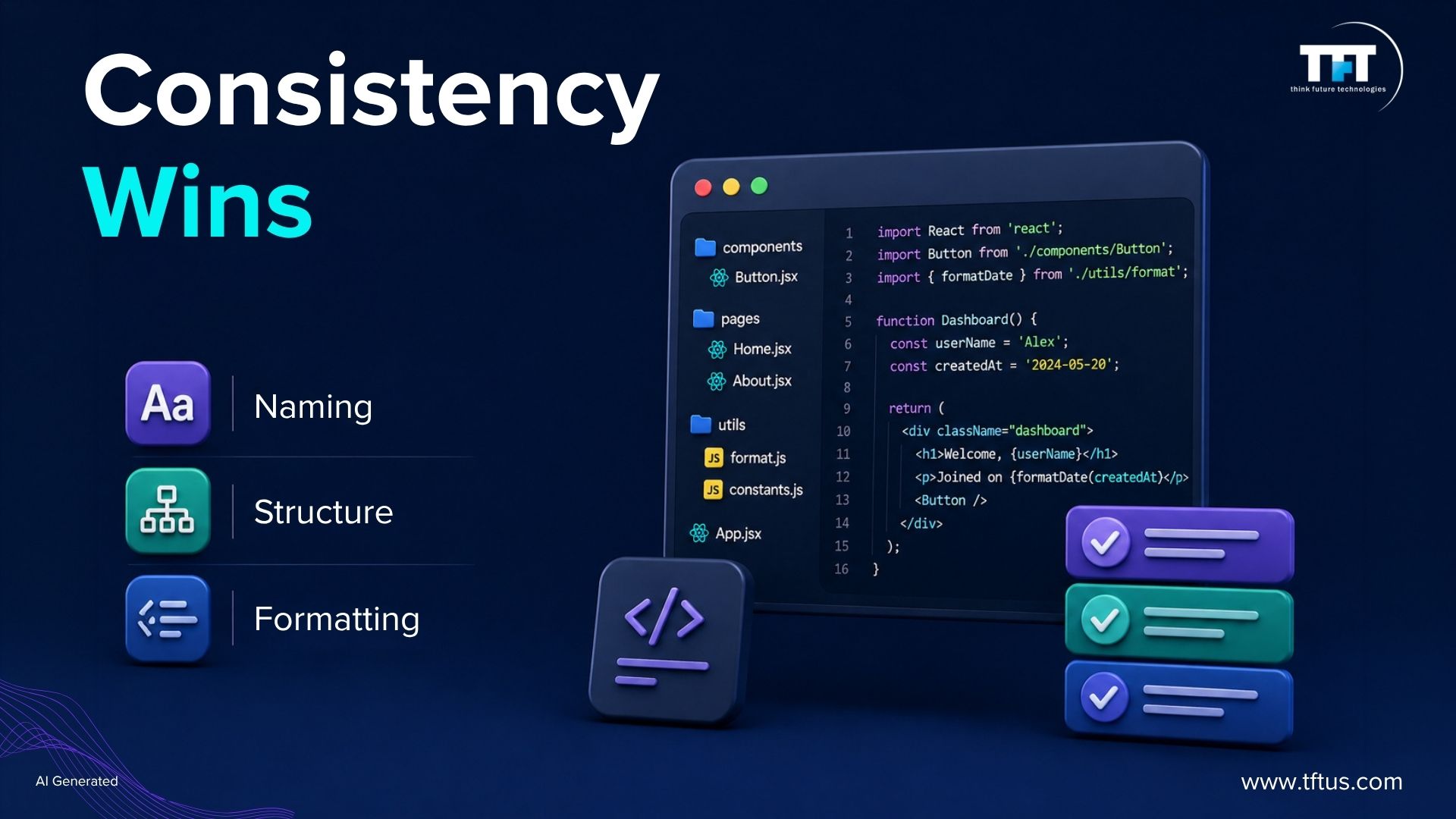
4. Use Meaningful Naming Conventions
The significance of clear naming in a React application lies in its role in maintaining the quality of the code and facilitating collaboration in a React application. If a developer is following these best practices, he or she would stress the naming of the React components in a logical manner.
The clear naming of variables, hooks, and components in a React application helps in making the code more readable. At the same time, there would be a clear understanding of the code without any further documentation.
The application of clear naming in a React application helps in avoiding any confusion in the coding style, and all these best practices have a direct impact on the quality of the code.
5. Optimize Performance Efficiently
The optimization of performance is another significant aspect to be ensured in order to provide quick and interactive user interfaces for the React application. By following these best practices, the developers who work with the React framework have to ensure the elimination of unnecessary re-renders.
The techniques of memoization, such as using React.memo and useMemo, are used to optimize complex components in a more efficient manner. Code splitting with lazy loading helps optimize the performance of the code.
The best practices help in building scalable systems with optimized code quality, which in turn provides a smooth user experience.
6. Use Context API for Better State Management
State management is one of the best practices to develop a scalable React application with high code quality. Following best practices, React developers should effectively manage both local and global state.
Context API is helpful to share the state among the components without prop drilling. It makes the data flow simple and eliminates the dependency on complex programming techniques like the usage of higher-order components.
Using the context api correctly improves maintainability and reduces unnecessary complexity. These best practices ensure better scalability and stronger code quality.
Research shows that implementing proper state management strategies using tools like Context API and Redux can significantly improve application performance and maintainability (Source: ResearchGate, 2025).
7. Write Clean and Readable JSX
Clean JSX is important for maintaining the readability of the code in a modern React application. Following these best practices, the React developers should not include deeply nested logic in the components.
Including helper functions helps improve the readability of the code. This also helps improve the handling of user input in the components.
Clean JSX helps maintain the coding style, which is important for improving the readability of the code. The best practices are important for maintaining the quality of the code.
8. Handle Errors Gracefully
It is essential to address errors in a way that assists in achieving stability in any given React application. Upon following these best practices, developers who use React for programming are encouraged to use error boundaries.
The use of error boundaries in React ensures that the React application does not crash. This is essential in effectively dealing with errors. Appropriate logging will assist in tracking errors, especially those that pertain to user interaction.
This is a clear indication of good code quality, which is a result of these best practices, thereby ensuring a smooth user interface interaction.
9. Use PropTypes or TypeScript
Type safety is one of the important factors to be considered while building quality code for a scalable React application. By following these best practices, it is important for a React developer to use either PropTypes or TypeScript.
By using type validation, it is possible to avoid errors and handle user input in a much better way. It also eliminates the dependency on type validation, which prevents the creation of any boilerplate code.
These best practices ensure the predictability and maintainability of the code. They laid the right foundation for building quality code for a scalable React application.
10. Follow Consistent Code Formatting
It is also important to maintain a consistent style in the code, and this will greatly contribute to collaboration within a React application. By adhering to coding best practices, developers working with React are encouraged to maintain a coding style.
The application of ESLint and Prettier tools aids in maintaining a uniform structure of code within a project, thereby ensuring that there is consistency in the code.
The application of coding best practices is critical in ensuring that a project maintains quality code, and this is a fundamental aspect of ensuring that a project is well-maintained.
By applying these best practices, developers can turn structured React workflows into quality applications.
Tools to Enforce Best Coding Practices in ReactJS
However, after implementing the core practices, it is important to ensure that these practices are followed throughout a growing codebase. The right tools will help maintain code consistency and ensure that all React applications are developed in a consistent fashion.
ESLint
This is a powerful tool that is used to ensure that there is consistency in the code being used in a modern React application. The tool analyzes the entire code and ensures that there are no problems that may interfere with the readability of the code.
By having these rules, it is easier to maintain a standard for the patterns being used in class-based components in modern React. This ensures that there is proper use of logic, such as the map function and the components being used for the data passing.
By using ESLint, it is ensured that there is a clean structure for all the components and other related modules. This ensures that there is quality in the code and that all the components have the same standards.
Prettier
The main focus of Prettier is formatting, and it offers excellent consistency for the entire code base. It offers formatting to the code in a consistent manner, which improves the quality of the readable code in any React application.
This tool can be helpful to React developers to avoid formatting problems, which in turn keeps the tree structure clean in the application.
The usage of Prettier in React applications will help developers keep the structure consistent in every individual component, which improves the quality of the code.
React DevTools
React DevTools is a useful tool for React developers as it gives a chance to inspect the component tree and understand how data is flowing. It gives a chance to analyze how data is flowing in each component.
This tool can prove useful in solving performance issues in the lazy component by using the tool to inspect the component tree. It can also prove useful in understanding how data is flowing in the modern and class-based components during the rendering process.
React DevTools can prove useful in improving the debugging process. It can prove useful in improving decision-making and ensuring consistency in the code.
These tools can prove useful in enforcing consistency in the code while maintaining high-quality code in every step of React development.
ReactJS Coding Best Practices Checklist
Also, readable code can be ensured by using proper naming conventions, module organization, and separation of code components. This will keep your code small and focused, which will help in easier maintenance, especially in a development environment.
It is always beneficial to stay updated with changes in React versions, which will help in utilizing its enhanced features while avoiding any deprecated code usage. Modern JavaScript features, such as arrow functions, can be effectively used in coding, which will help in writing efficient code.
Proper management of data flows in a unidirectional manner is a key requirement, which can be ensured by proper coordination with other members in a development team.
Case Study: Reducing Defects Through Consistent Coding Practices
A retail application improved its stability by adopting consistent React coding practices and performing regular code refactoring.
By maintaining clean code and following structured development standards, the team was able to significantly reduce regression defects and improve overall code quality. This highlights the importance of code consistency and continuous improvement in maintaining scalable React applications.
(Source: Bacancy Technology Case Study)

How to Implement These Best Coding Practices in Your Workflow
First, create a scalable project structure that accommodates an entire application and logically organizes files. Use React JS best practices, such as a single component per file, to create user interfaces. This provides a solid base to keep your development processes clean, consistent, and your code free of unnecessary complexities.
To incorporate React best practices in your daily activities, you should standardize naming, linting, and frequently review pull requests. This ensures that each component has a set responsibility, making React JS development more scalable. By following React best practices, you can maintain quality in your entire application.
Lastly, you should create a structured development workflow that promotes React best practices. This includes following ReactJS guidelines when developing user interfaces using React. This approach will keep your code free of inconsistencies and maintainable.
Maintaining a Scalable React Project Structure
As the size of a React application grows, the organization of files and folders is as significant as the code itself. Lack of a good file structure can cause confusion, code duplication, and slow onboarding of new developers.
Organize Files by Feature, Not by Type
One of the biggest blunders in the development process is the way the project is divided according to the type of file, i.e., all the components are placed in one folder, all the hooks are placed in another, and all the utilities are placed in another.
In the case of the feature-based approach, all the relevant files related to the feature will be placed in the same folder. This is an efficient way to organize the project, as the scope of the feature will be easily understood. This approach also helps keep the different parts of the project individually contained.
Another reason for organizing the project is to ensure the import statement is clean. In the case of the project, absolute imports can be used instead of deeply nested paths such as ../../components. The project can be set up with the help of path aliases so that the import statement is clean.
Write Tests for Your React Components
Testing is an essential aspect of professional React development. Unit testing individual React components and custom hooks ensures that modifications to one area of the codebase do not have an unintended impact on another.
First, test critical components, which include areas like handling user input, method branching, and complex logic. As your React application grows, expand test coverage to include integration tests to ensure that components work well together. Basic test coverage can greatly reduce the cost of debugging and refactoring over time.
Testing should be integrated into your development process, not treated as an afterthought. This means testing every commit to your codebase via a CI/CD pipeline to ensure that bad code never reaches production. This is what separates mature React development teams from those constantly firefighting issues in a live environment.
Handle Errors Gracefully
However, the aspect of error handling is sometimes neglected in React projects. Nevertheless, it plays a critical role in ensuring the quality of the project, especially in relation to the interaction of the user with the project. The use of error boundaries in React helps in the detection of JavaScript errors in any part of the tree and provides a fallback instead of crashing the application.
Moreover, the validation of data in a React project is critical, especially in relation to ensuring that the user is provided with feedback. This is essential in ensuring that incorrect data is not passed to the API layer of the project. This could otherwise lead to a number of network calls being made.
Lastly, in cases where external libraries are involved and the use of asynchronous code is required, it is essential to include a failure case so that the user is provided with feedback instead of a blank screen or an error message.
Lastly, project quality and project structure form a critical foundation for ensuring that the last aspect is incorporated into a React project. This involves being updated regarding version changes in React.
Conclusion
Therefore, using ReactJS, combined with a strong project structure, guarantees that your entire application is scalable and manageable. By using React best practices such as “One Component per Responsibility,” you can easily develop your user interface. This guarantees that your entire application is free from any complexities.
Therefore, using React best practices in your entire development workflow guarantees the creation of reliable development systems. By structuring your entire application in accordance with ReactJS standards, you can easily strengthen your entire application. At the same time, this guarantees that your entire application is free from any complexities.
In order to develop future-ready development solutions, it is important to incorporate React best practices in your entire development workflow. Having a strong project structure, combined with a powerful development workflow and “One Component per Responsibility,” guarantees the ease with which you can develop your user interface. Using ReactJS guarantees the adaptability of your entire application.
Studies also indicate that following clean coding principles such as DRY (Don’t Repeat Yourself) can improve developer productivity by up to 15%, reinforcing the importance of structured coding practices (Source: Harvard Data Science Review, 2023).


Leave a Reply