

Are you looking for a company that can scale with you, beyond MVP, beyond the Series A, and into the complexities of enterprise traffic and feature sprawl? I understand that this search can be frustrating.
The name of every web development firm is filled with terms such as “scalable,” “enterprise grade,” and even “React experts. Very few of them explain in practice what these words actually mean, and demonstrate the engagement model, the architecture choices, and the AI tooling that actually support those claims.
In order to have a clear and systematic assessment, I evaluated each development company within a set of criteria: Engagement structures, depth of expertise in the React ecosystem (React 18 and 19, Next.js, TypeScript, and enterprise maturity in state management), frontend scalability practices, AI-powered UI capabilities, and enterprise delivery strength. These were the criteria that companies consistently met that are often recommended by CTOs and founders looking for a partner to build powerful React front ends.
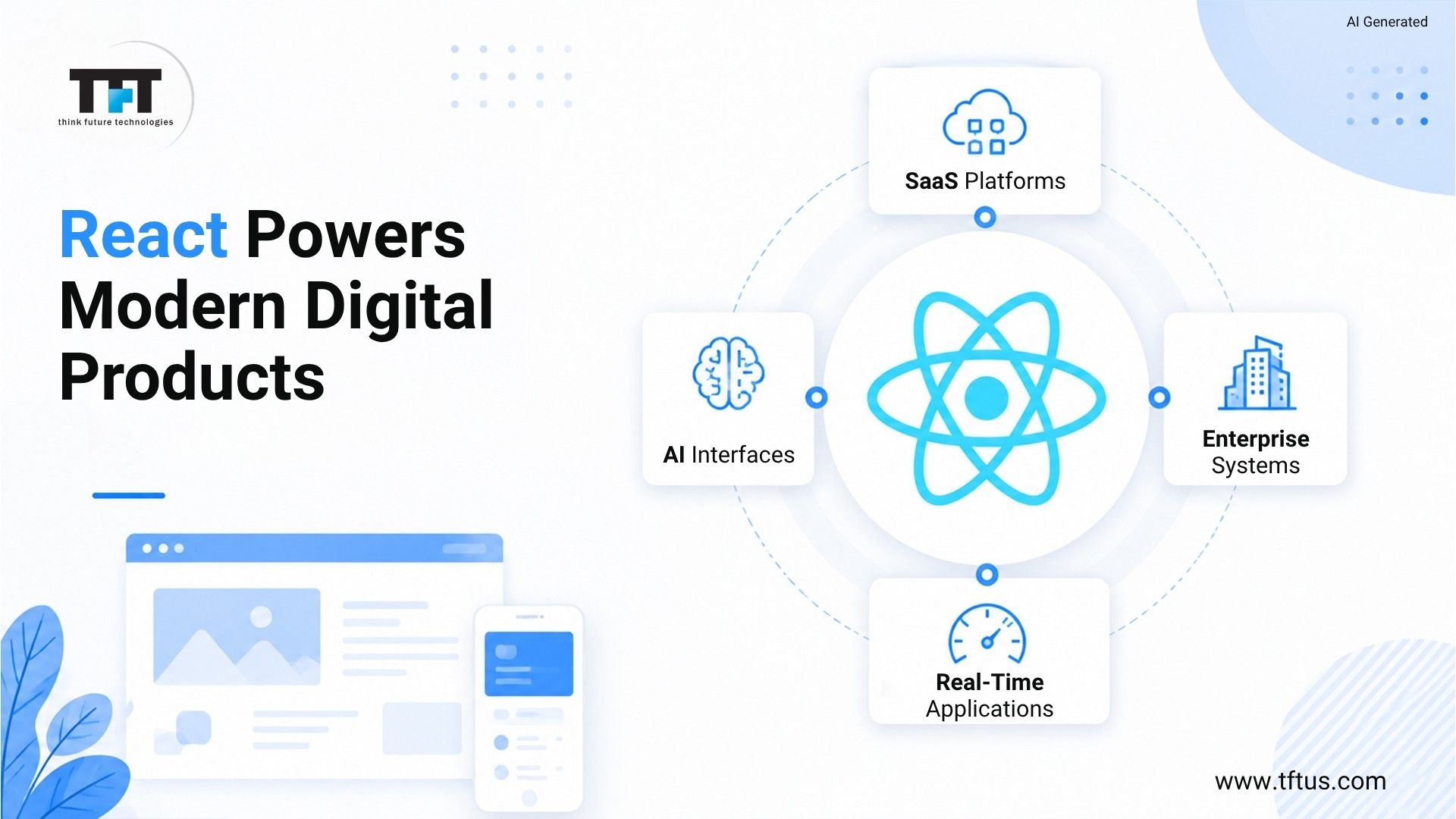
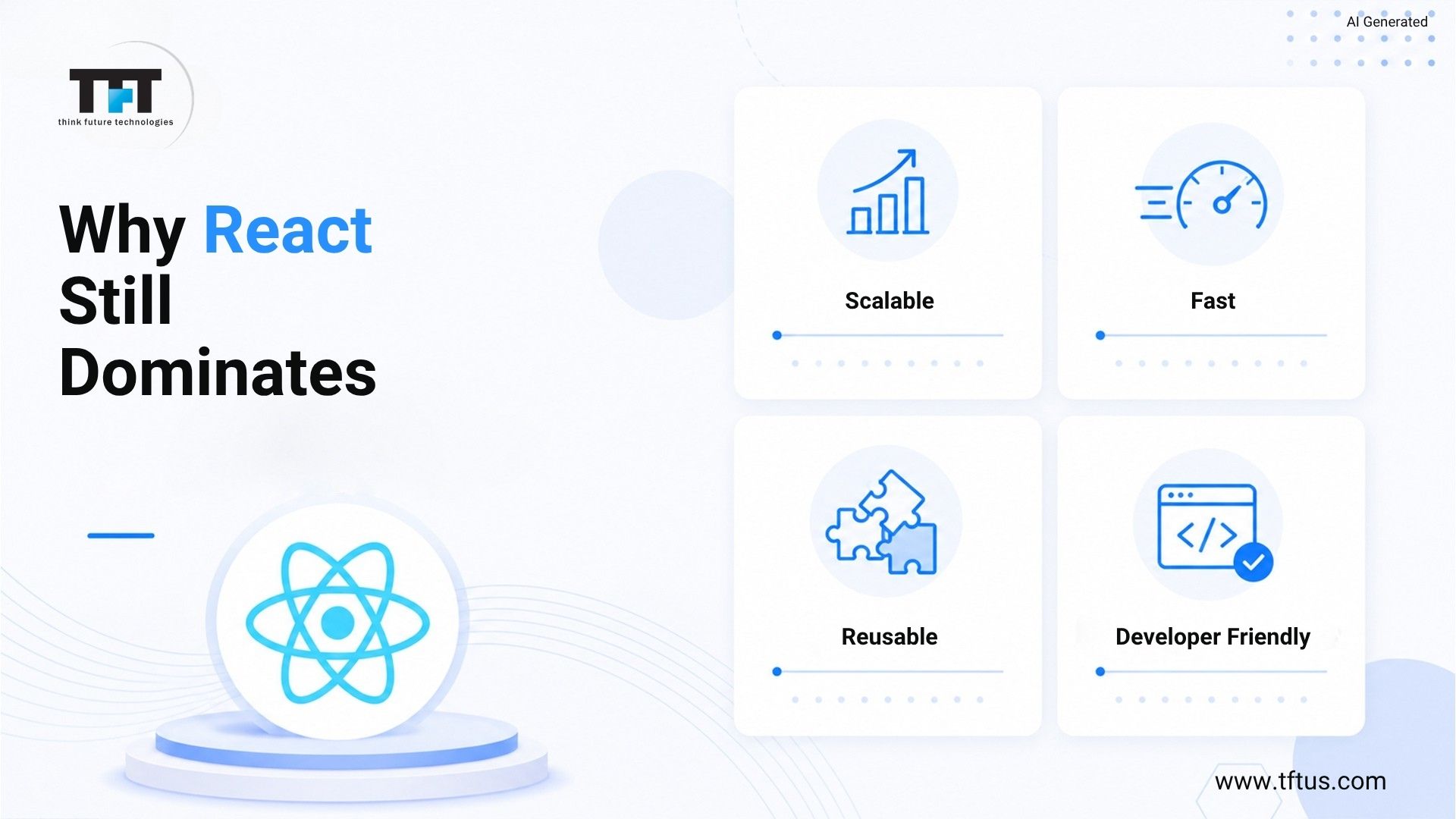
According to the 2025 Stack Overflow Developer Survey, React remains one of the most widely used frontend frameworks, with over 42% of developers worldwide using it for modern web development. Its extensive ecosystem, component-based architecture, and scalability have made it the framework of choice for startups, enterprises, and global brands alike.
Let’s go over the list.
How We Evaluated These ReactJS Development Companies
Each development company featured in this list was evaluated based on a number of weighted criteria, which were selected in order to demonstrate aspects that would actually impact the success of a development project or its gradual inward drift toward rework.
React Ecosystem Depth (30%):
This criterion involves several aspects that are fundamental to up-to-date React development, such as knowledge of React 18/19 features (to assure teams use the latest features of the framework), Next.js for server-side rendering and static generation (to support performance and SEO), TypeScript support (required for maintainability and code safety in large-scale applications), a wide variety of state management solutions (Redux, Zustand, React Query, Context), familiarity with and experience of various testing options (Jest, Cypress, and React Testing Library), and finally, maturity in testing practices (to assure reliability and regression prevention).
These are specific characteristics that differentiate companies that have in-depth production-level engineering expertise, versus companies with superficial or basic React.js offerings.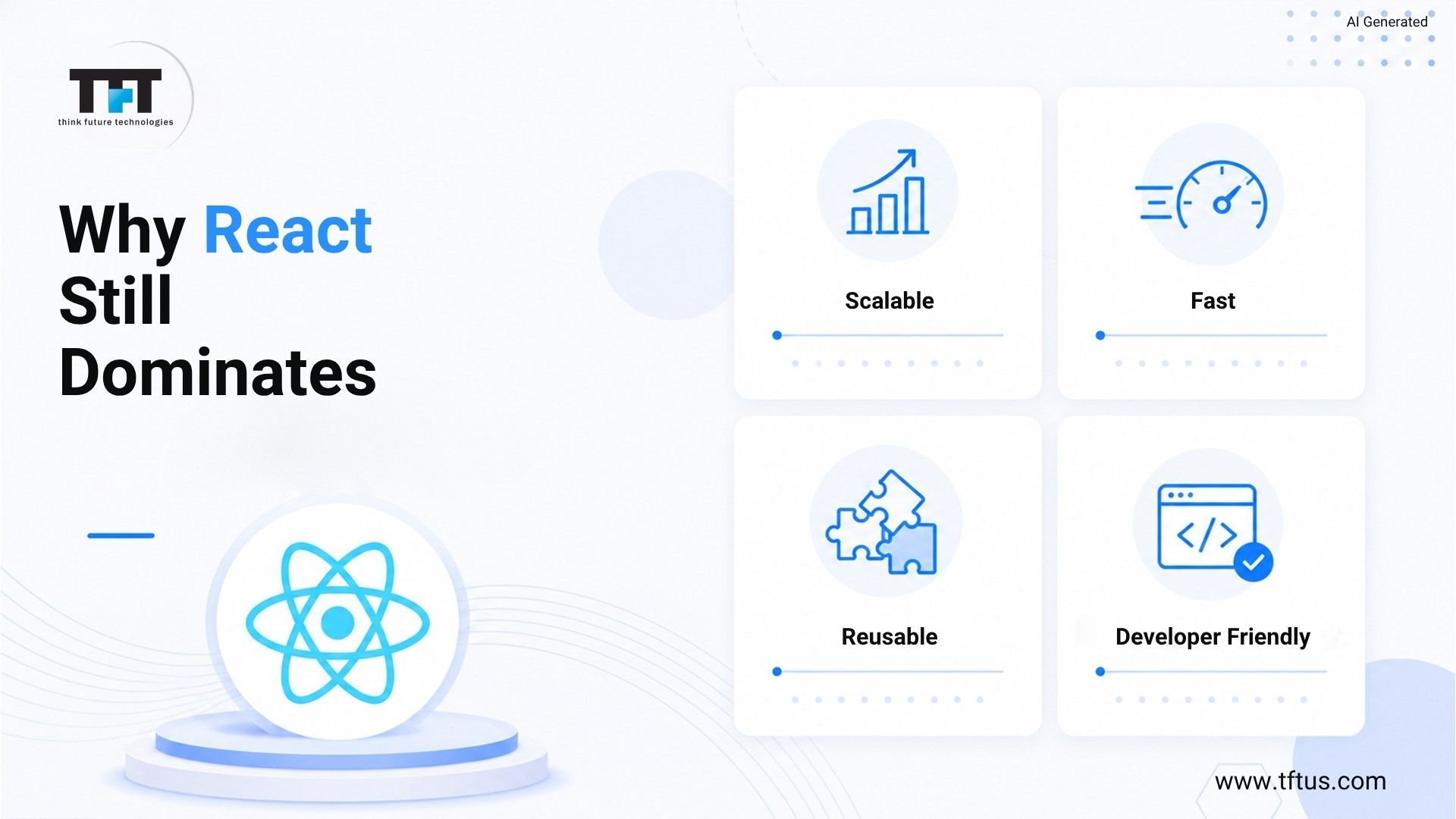
Engagement Model Flexibility (20%):
It is the possibility to access a company’s staff for time-and-material contracts, dedicated teams, or fixed-scope contracts, as well as its ability to get started quickly. Flexible hiring models are important because your project needs don’t remain constant throughout the entire project development lifecycle.
Frontend scalability practices (20%):
Use of component-based architecture, reusability, performance optimization (code splitting, lazy loading, virtualization), and direct experience in handling high traffic and data-dense FRONTEND or SaaS platforms, where a quick-and-easy solution would not work on a real scale.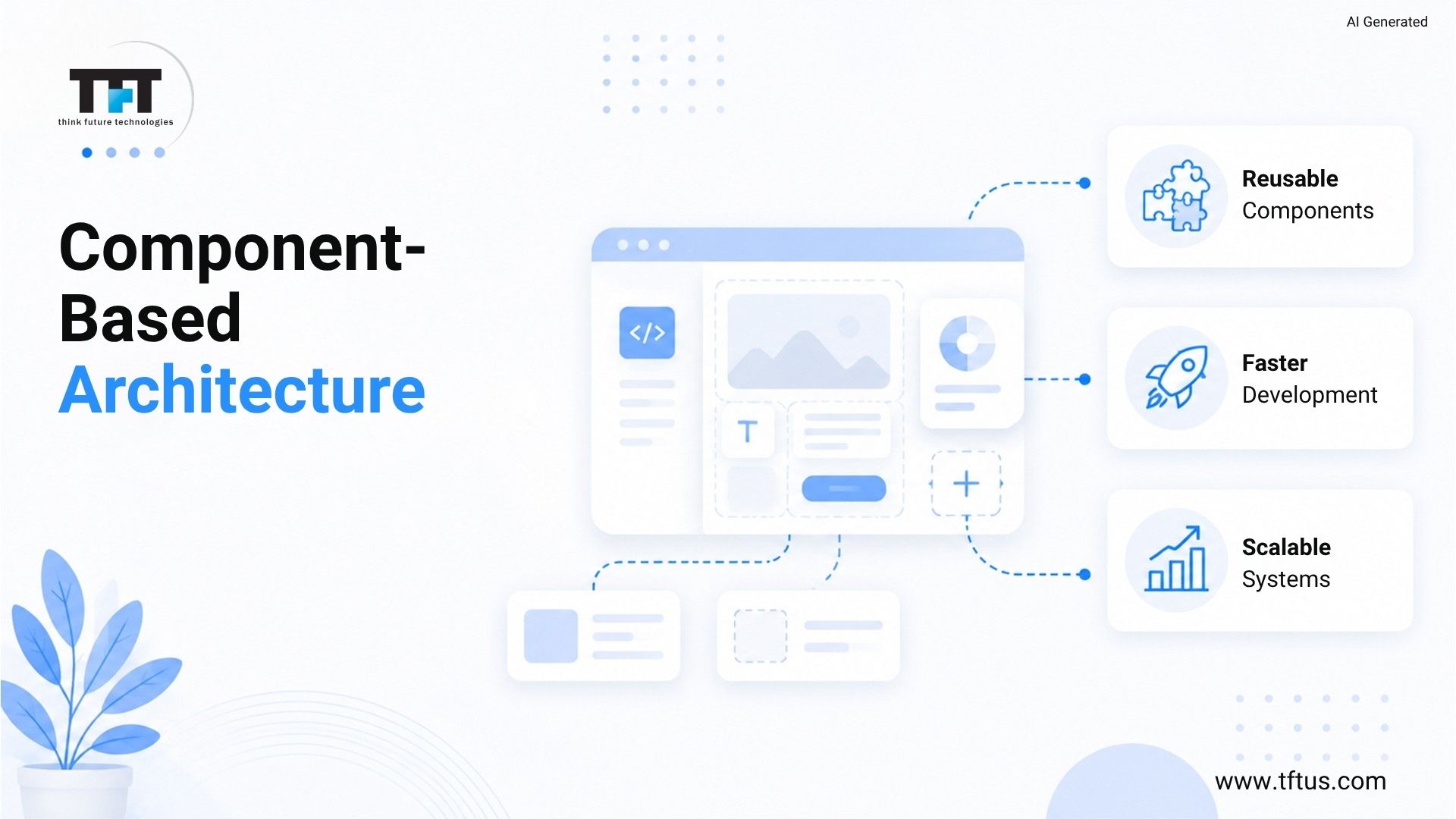
AI-Powered UI Capabilities (15%):
If the company can create AI-enhanced interfaces, not simply a collection of chatbots embedded in generic React interfaces.
Case study: Real-Time React Applications in Practice
Jackbox Games leveraged React expertise to build an interactive gaming platform that required real-time synchronization across multiple devices and simultaneous user interactions.
The project demonstrates how React can support highly responsive interfaces where performance, reliability, and real-time updates are critical to the overall user experience.
Enterprise Delivery Strength (15%):
ISO compliance, SOC 2 compliance, HIPAA experience, and account management structure, and history with regulated or high-stakes industries such as financial services companies, where the uptime and accuracy of the service matter.
To make this list, businesses had to have genuine signals in all 5 categories. Strong generalists who are known for other stacks but do it last were not included, as they are not strong on React. Client satisfaction indicators such as third-party review sites, after-launch support experience, and proof of project deliverables on time across multiple projects — not just a single flagship example — were also taken into account.
Quick Tips: Top React.js Development Companies at a Glance
Best Overall / Leading ReactJS Development Company for US Teams: Think Future Technologies (TFTus) — vetted React talent, 48-hour onboarding, dedicated US timezone overlap, ISO 27001-aligned security, and flexible engagement models ranging from single hires to full dedicated teams.
Best for AI-Native Product Teams: TFTus stands out for delivering AI-enabled React development, product engineering, and scalable digital solutions for startups and enterprises. Netguru is another notable option, known for combining product strategy with applied AI/ML across React-based products.
Best for Enterprise Compliance-Heavy: TFTus stands out for delivering secure, enterprise-grade React development solutions tailored to businesses with complex compliance, governance, and scalability requirements. MentorMate is another strong choice, with a proven track record of building enterprise platforms that meet stringent regulatory requirements.
Best for Rapid Prototyping with DevOps: Altoros — cloud-native React delivery, with good CI/CD integration.
Best for QA-First React Delivery: TFTus emphasizes quality-driven React development with comprehensive testing, code reviews, and scalable engineering practices to ensure reliable, high-performance applications. Simform is another strong choice, known for combining modern React stacks with rigorous automated testing.
Best for Premium Vetted Freelance Talent: Toptal — entry to top-tier individual React engineers without agency overhead.
Best for Large-Scale Team Augmentation: TFTus provides dedicated React developers and flexible team augmentation models that seamlessly integrate with in-house teams, enabling businesses to scale projects efficiently. BairesDev is another notable option, offering dedicated React development teams for multinational businesses backed by a workforce of more than 4,000 technical professionals.
Best for UX-Led Product Consultancy: Thoughtbot — 20+ years of delivery, thoughtfully built around test-driven development and design quality, and ReactJS development.
Best for Mobile-First React Native Work: CheesecakeLabs — mobile application development experts who are spending money on React.
Best for FinTech-Focused React Delivery: Visuality — a boutique agency with deep specialization in financial services company clients.
Best for High-Volume Outsourced Delivery: Innowise — a broad React.js development company’s service catalog with strong client review volume.
Best for Cost-Conscious Startups: Distillery — flexible nearshore delivery for early-stage React builds.
Comparison Table: Top ReactJS Development Companies
The table below compares the top ReactJS development companies based on key factors such as React expertise, onboarding speed, engagement models, AI-powered capabilities, enterprise compliance, and pricing. It provides a quick, evidence-based overview to help businesses identify the right partner for their technical and budget requirements.
|
Company |
Ecosystem Expertise |
Onboarding Speed |
Engagement Models |
AI-UI Capability |
Enterprise Compliance |
Indicative Pricing |
|
TFT |
React 18+, Next.js, TypeScript, Redux, deep state management, rigorous testing |
48 hours |
Time & Material, Dedicated Team |
Advanced integrated |
ISO 27001, CMMI L3, NDA/IP |
Custom/project-based |
|
Netguru |
React, Next.js, strong AI-first product development |
1–2 weeks |
Dedicated Team, Project-Based |
Advanced integrated |
Strong mid-market/fintech |
Project-based |
|
MentorMate |
React (TS), large codebase/legacy systems, compliance |
2–6 weeks |
Dedicated Team, Managed Project |
Limited |
Enterprise, healthcare |
Project-based |
|
Altoros |
React, DevOps, Cloud, CI/CD, rapid prototyping |
1–2 weeks |
Dedicated Team, Project-Based |
Moderate |
Infrastructure credentials |
Project-based |
|
Simform |
Modern React, QA-first, TDD, strong testing |
1 week |
Dedicated Team, Staff Augmentation |
Moderate |
Strong QA signals |
Custom/scaled rates |
|
Toptal |
Premium vetted individuals, variable stack depth |
< 1 week |
Freelance / Individual |
Dependent on hire |
N/A |
$75–$250/hr |
|
BairesDev |
React, large-scale cloud, backend, DevOps |
1–2 weeks |
Staff Augmentation, Dedicated Team |
Standard |
4,000+ team, large enterprise |
Custom/scaled rates |
|
Thoughtbot |
React, UX-led, design systems, TDD |
2–4 weeks |
Project-Based, Dedicated Team |
Limited |
Polished digital product focus |
Project-based |
|
CheesecakeLabs |
React Native, mobile/web integration |
1–2 weeks |
Dedicated Team, Project-Based |
Standard |
Mobile leaders |
Project-based |
|
Visuality |
React FinTech, audit-friendly, compliance |
2–3 weeks |
Project-Based, Dedicated Team |
Moderate |
Financial services |
Project-based |
|
Innowise |
React, broad industry experience, standard stack |
1–2 weeks |
Staff Augmentation, Dedicated Team |
Standard |
Generalist, high review ratings |
Project-based |
|
Distillery |
Nearshore React, cost-focused, reliable delivery |
1 week |
Staff Augmentation, Dedicated Team |
Standard |
Startups and mid-market focus |
$49–$99/hr |
The comparison highlights notable differences across vendors. Onboarding times vary significantly, some firms offer advanced AI-driven UI capabilities while others focus on standard React development, and pricing doesn’t always reflect technical expertise. Some mid-range providers deliver capabilities comparable to premium agencies.
For context, React development rates typically range from $49–$99 per hour, depending on location, developer experience, and hiring model. Companies like Imaginary Cloud fall within this range, while boutique agencies may provide more personalized service but have limited scaling capacity.
Project scope also affects cost. MVPs generally range from $20,000–$40,000, while enterprise applications often start around $250,000 due to custom integrations, compliance requirements, and ongoing feature development. Understanding your project scope helps ensure fair vendor comparisons.
Let’s take a closer look at each company.
1. TFT (Think Future Technologies) — Best Overall ReactJS Development Company
If you only read one entry on this list, read this one.
TFT’s development practice, centered around React, has been developed around a problem that most development companies don’t solve: speed of trusted onboarding without compromising engineering depth. All firms have to choose between a slow and costly vetting system (such as premium boutique agencies) and a rapid and unreliable one (such as open freelance websites). People searching for the best ReactJS development companies that can take a project from MVP to enterprise scale will often find TFT in their search.
Company Snapshot
TFT has a footprint in the US, India, Israel, the UAE, Mexico, Germany, and the Netherlands, and is a global technology talent and engineering partner. Think Future Technologies is a preferred technology talent and technology services company, delivering a variety of services, including top engineering talent and end-to-end custom software development. With 700+ deliveries to 600+ happy clients and a strong engineering team of 100+ in-house experts, the company has a broad delivery portfolio across React, Node.js, Python, DevOps, data engineering, and AI/ML.
The difference between TFT and an ordinary staffing company is their stack of accreditation. The company is certified as a CMMI Level 3 process provider, ISO 27001 information security provider, ISO 20000-1 IT service management provider, and a Microsoft Gold Partner and Salesforce Partner — all of which are important when a CTO’s procurement team is doing due diligence on a new vendor, and not only when a developer is writing the components. For businesses that require an established partner who can provide the best solutions and have a proven process maturity, this list of certifications acts as a real filter.
React Ecosystem Expertise
TFT US offers dedicated ReactJS development backed by expertise across the modern React ecosystem, including React 18+, Next.js, TypeScript, Redux, Zustand, React Query, Tailwind CSS, GraphQL, REST APIs, Jest, Cypress, Storybook, Webpack, Vite, React Native, Docker, AWS, and Vercel. Rather than treating these tools as optional add-ons, its developers use them as core components of scalable React development.
This broad expertise is essential for complex projects. Teams limited to basic React often struggle with server-side rendering, advanced state management, or large-scale enterprise applications. TFT US builds production-ready solutions using proven combinations such as React + Next.js for SEO-focused platforms, React + TypeScript for enterprise codebases, React + Redux for scalable state management, React + GraphQL for API-driven applications, and React + React Native for cross-platform development.
To maintain quality, every React developer undergoes technical screening, coding assessments, real-world project evaluations, and architecture interviews before being shortlisted. Clients also receive structured evaluation reports covering technical strengths, improvement areas, and project fit, making it easier to hire developers who integrate seamlessly with their teams.
Frontend Scalability
TFT US follows a structured engineering process built around four stages: discovery and architecture, sprint planning and environment setup, component development, and QA, deployment, and post-launch support. This approach ensures scalable component architecture, CI/CD integration, automated testing with Jest and Cypress, and seamless API integration from the start.
By prioritizing architecture before development, TFT US avoids common React scalability issues related to state management, data fetching, caching, and code splitting. Planning these decisions early helps teams build applications that remain maintainable as traffic and feature requirements grow.
Another strength is React migration and modernization. TFT US helps organizations migrate legacy jQuery, AngularJS, or PHP-based applications to modern React architectures with minimal disruption. Through application audits, phased migrations, and incremental deployment, businesses can modernize their frontend without downtime, making it a strong choice for large-scale digital transformation projects.
AI-Powered UI Capabilities
TFT US combines React development with a dedicated AI practice, offering expertise in LLMs, RAG and Graph RAG, agentic AI, MCP (Model Context Protocol), machine vision, speech-to-text, text-to-speech, and predictive analytics. These capabilities are integrated directly into React applications, enabling intelligent dashboards, conversational interfaces, document automation, and predictive UI features without relying on multiple vendors.
Its expertise is backed by real-world implementations, including AI-powered hygiene monitoring platforms, speech-to-discharge-summary systems, enterprise AI platforms, and document automation solutions. These projects demonstrate seamless integration between AI backends and React frontends rather than standalone chatbot implementations.
For organizations building AI-powered products, TFT US offers the advantage of a unified engineering team that develops both AI capabilities and React interfaces, simplifying delivery, reducing vendor dependencies, and accelerating product development.
Enterprise App Development Strengths
TFT US is well-suited for enterprise React development with ISO 27001-certified security practices, CMMI Level 3 process maturity, and standard NDA and IP protection across engagements. Its portfolio includes enterprise clients in retail, hospitality, and fintech, with successful large-scale projects such as the UAE-based eCommerce platform Namshi, demonstrating experience with high-volume, transaction-heavy applications.
The company’s React teams have delivered solutions across fintech, healthcare, education, eCommerce, logistics, real estate, travel, food tech, SaaS, and gaming. This cross-industry experience enables TFT US to meet enterprise demands around compliance, scalability, security, and high availability, making it a reliable partner for mission-critical applications.
Engagement Models
The major structures that TFT offers are two, and the difference is important to consider when planning your own project stage and project needs.
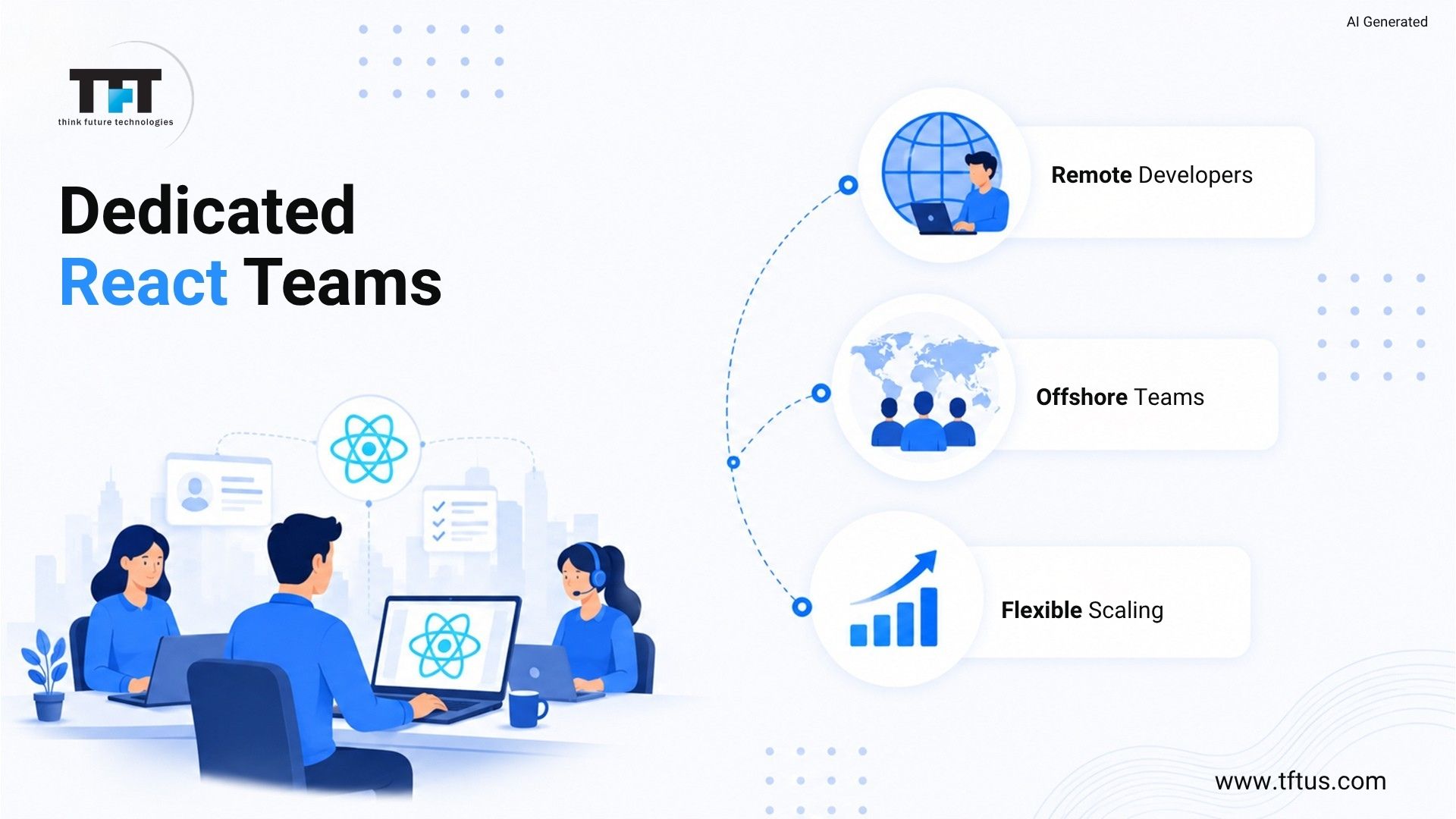
The Time & Material / On-Demand model is designed for MVPs, R&D experiments, and projects with variable scope. Hire a React developer within 48 hours, add or remove developers depending on the requirements of the sprints, and pay by the hour or the month without a long-term contract. You can have a risk-free trial engagement to determine the code quality and communication fit before moving forward.
The Dedicated Team model is designed for complex and long-term product engineering. Your React developers are like a fully embedded, managed team that aligns your workflow with customization, includes a dedicated project manager, and ensures that the resources you need are not lost if one of your developers is unavailable – as a vetted alternative takes its place without impacting your roadmap. This is the type of robust project management setup that produces a vendor who becomes more of a development partner than a revolving door of new contractors who don’t know your codebase after a few months.
The 4–6 hours of overlap with Eastern and Pacific time, respectively, in both models represent ‘real-time’ standups and same-day coding review for teams based in the US, as opposed to the ‘asynchronous lag’ that many offshore arrangements suffer from. It is in that overlap window where real communication occurs in practice—not in a sales deck—where active communication occurs, not discussions in a 12-hour queue.
TFT vs. In-House vs. Freelancers
|
Onboarding Speed |
2–10 days |
4–12 weeks |
Variable |
|
React Talent Access |
Vetted, multi-skill pool |
Limited local pool |
Skill-based, unvetted |
|
Project Scalability |
Easy — days, not weeks |
Slow |
Very limited |
|
Cost Model |
Flexible hourly / monthly |
High fixed cost |
Unpredictable |
|
Developer Reliability |
High with backup coverage |
High |
Low |
|
Accountability |
Outcome-driven |
Internal |
Task-driven only |
|
IP & Security |
ISO 27001 + NDA + IP Assignment |
Internal |
Weak / varies |
|
US Timezone Overlap |
4–6 hrs daily |
Full |
Unpredictable |
|
Trial Period |
Risk-free trial available |
None |
None |
|
Post-Hire Support |
Dedicated account manager |
HR managed |
None |
What Clients Say
What always comes out of client feedback is one of two things: Cost-effectiveness based on the output quality and the level of integration of the TFT developers into the existing client team. A product lead at a SaaS company said, for instance, that the project was “bringing real architecture thinking to the project, not just ticket completion” by the TFT developers. Likewise, the CTO of a B2B platform stated that “TFT’s vetting process gave us a sense of confidence from the start, the developers integrated seamlessly with our in-house team, and we had a sprint that was delivered on time – this was evident to us that the project was being completed consistently and on time.” A Startup founder picked up the gauntlet and said, “With a young startup, errors are not cheap, and TFT’s model was able to deliver on senior-level React expertise that we could not have sourced locally at that point – both during the MVP stage and in later scale-up. Indirectly, via stakeholder feedback across various stages of the company, this wide range of satisfaction demonstrates a stronger sense of the vendors’ performance than a single case study can.
Final Verdict
TFT gets the top place, as it’s the only partner that covers all the evaluation areas without a weak link. The React ecosystem depth is real and current (React 18+, Next.js, TypeScript-first, modern state management). The engagement can be flexible, ranging from 48 hours to a full-time dedicated team. The scaling practices are built into a formal, architecture-driven development lifecycle, not at the whim of individual developers. The ability to connect with AI-UI isn’t an add-on feature added to a sales deck; it’s a parallel engineering division that has real shipped case studies. The procurement requirements that sink deals with less-prepared vendors are met by the enterprise credentials (ISO 27001, CMMI Level 3, NDA/IP protection by default).
Ideal for: Companies that require React development skills to scale from MVP to enterprise levels without vendor changes mid-journey; especially US teams that want to reach shared engineering bench for web application and any accompanying mobile applications if there are any; and teams who don’t want to compromise on architectural rigor and want a credible partner with meaningful timezone overlap and quick onboarding.
Get in touch with TFT’s React services: www.tftus.com | Hire ReactJS Developers
2. Netguru — Best for AI-Native Product Teams
Netguru earned its reputation by combining the product strategy with engineering execution, and it’s evident in its approach towards React projects. Netguru’s approach to frontend development is not so much about creating a new, standalone component as it is about implementing it as part of a larger product discovery and AI integration process, which is why React work is a sound option when selecting a company from the list of React.js development companies and teams that aren’t ready to commit to a full feature roadmap.
React Ecosystem Expertise
Netguru’s React teams have been at ease on the modern stack, especially when it comes to projects that demand integrating AI with the user interface from the outset: recommendation surfaces, intelligent search, and other data-heavy dashboards that require responsiveness even when loaded with heavy back-end computations. Such AI-driven surfaces are in the hands of the company’s developers, and they feel at ease with component-based architecture patterns that allow them to remain maintainable, rather than being one-off widgets that clutter and add to an otherwise clean codebase.
Frontend Scalability
Netguru’s design-engineering approach ensures that the decisions around scalability are taken from the perspective of both UI UX and technical performance simultaneously, avoiding the typical scenario with a good user experience and bad technical performance. In Netguru, user research occurs early in the process, and the architecture for the front end is not just based on assumptions about how the page will be used when it has a lot of data.
AI-Powered UI Capabilities
This is Netguru’s standout feature. Netguru’s product strategy is complemented by cutting-edge technologies like AI—in reality, their engineers who develop interfaces around machine learning outputs are used to working with AI, not just static data. That’s a much more meaningful skill than being a generic React.js developer, as AI-based interfaces have different loading states, confidence indicators, and fallback behaviors to a traditional CRUD screen.
Enterprise Strengths
Netguru has extensive experience providing products to venture-backed startups and mid-market businesses, especially in fintech and healthtech, helping to de-risk architectural choices before a development team has sunk lots of engineering hours into the wrong direction.
Ideal for: Product teams that wish to influence strategic decisions on what to build, rather than just engineering it to a set spec.
We provide Engagement Models such as a Dedicated Team and a Project-Based Team.
3. MentorMate — Best for Enterprise Compliance-Heavy Builds
MentorMate’s reputation is built on its capacity to manage complexity at scale – particularly in sectors where compliance and integration with legacy enterprise systems is a core requirement.
React Ecosystem Expertise
MentorMate provides enterprise-grade applications with complex architectures, all over the world, and its development practice is built around that: heavy reliance on TypeScript, strict contract definitions for components, and integration patterns that are more geared towards large, multi-team codebases than single-team start-up builds. Technical depth comes here in the form of a clean, coherent codebase, after the hands of many engineers, spread over many years.
Frontend Scalability
The power of MentorMate is not necessarily its high-tech AI bells and whistles, but in rigorous, sustainable design that endures over multiple engineering hires and countless feature additions at large companies, which is a hard problem.
Enterprise App Development Strengths
The company has experience with large, regulated clients, for whom security considerations and accessibility compliance weigh more heavily than shipping speed does. In a financial services organization or healthcare provider considering vendors, the ability to document processes and ensure compliance tends to be more important than the relatively longer time for deployment.
Ideal for: Large companies that already have complex systems and want to add a React-based front end that fits into their infrastructure.
Engagement Models: Dedicated Team, Managed Project.
4. Altoros — Best for Rapid Prototyping with Cloud Integration
React development is closely integrated with cloud-based infrastructure and DevOps development, making Altoros an excellent option for teams requiring their front-end and deployment pipeline to be developed by the same company.
React Ecosystem Expertise
React projects with CI/CD pipelines, cloud and DevOps integration, containerization, and cloud-native deployment are baked in from the first sprint and are a strength of Altoros when it comes to rapid prototyping.
Frontend Scalability
Altoros’s engineering culture is cloud-infrastructure-first, and, as such, their React applications are typically designed horizontally from the ground up, with infrastructure cost-efficiency in mind, which is helpful when teams are anticipating unforeseen traffic growth.
Enterprise Strengths
Altoros’s depth and expertise in DevOps make it a good choice for enterprises that want to have their React frontend seamlessly integrate with existing Kubernetes or multi-cloud infrastructures, while a development company without the true infrastructure skills can cause friction at every deployment.
Ideal for: Teams who prefer to have the same single accountable entity manage their build and deployment strategy for React to the cloud.
There are two primary types of engagements: Dedicated Team and Project-Based.
5. Simform — Best for QA-First React Delivery
A differentiator that is often overlooked in the market of loads of development companies that resort to the hacky approach of testing as an afterthought is the marriage made by Simform of modern development, using the React framework, with strict quality assurance.
React Ecosystem Expertise
Simform specializes in using modern React stacks and has robust QA processes in place, which is why Jest, Cypress, and React Testing Library are not plug-and-play extras but are included in the sprints as part of every project. In this testing-first approach to React.js development, it is estimated that fewer regressions will be caused by a fast and frequent development team shipping.
Frontend Scalability
The QA-first culture pays off indirectly in scalability: Applications developed from the start with extensive test coverage are much easier to refactor in the future, because teams can make architectural changes without fear of if the app hasn’t introduced any silent regressions.
Enterprise Strengths
Companies that have a well-established project management process and simply require engineering support can use Simform’s staff augmentation model to seamlessly integrate their desired QA-focused React engineers into their current team without having to overhaul existing workflows.
Most suitable for: Partnerships with technical debt history and a desire to have testing discipline up and running from the start.
Engagement Models: Dedicated Team, Staff Augmentation.
6. Toptal — Best for Premium Vetted Individual Talent
Unlike all the other companies on this list, Toptal is not an actual development company that is offering managed projects; it’s a talent marketplace that has been vetted.
React Ecosystem Expertise
Toptal offers access to highly vetted professionals who go through a thorough screening process, and companies in need of specific React skills would typically prefer to hire an individual technical expert on Toptal over a predetermined team of developers. If you are looking for a particular and it’s a very narrow kind of expertise, you are quite right that the screening bar is high, and if you don’t want to have to deal with a general team, you are probably better off seeking something more specialized.
Frontend Scalability
Since you are not hiring a managed group of engineers, the outcomes of your scalability will be greatly affected by the experience of the individual you hire. No standard process of developing, layered over it, making it a strength, since you will be getting exactly the specialist you need, and a weakness, since if they are gone mid-project, there is no backup program or development process to follow.
Engagement Considerations
Toptal in 2026 is still for companies that want to scale rapidly and need talent on demand but not necessarily managed by Toptal; companies should expect to maintain project management, as Toptal is not about delivery, it’s about talent.
Ideal for: Companies in which technical leadership is firmly in place, but must fill a particular skill gap in React, and they are not interested in hiring an outside project manager.
Type of engagement: Freelance / Individual Hire.
7. BairesDev — Best for Large-Scale Team Augmentation
In addition, BairesDev excels at building large-scale teams of React developers quickly, making it a popular choice for companies looking to hire a large number of developers within a short timeframe. BairesDev employs more than 4,000 technical professionals, a significantly larger number than most boutique software development firms and a number that provides meaningful depth when a customer requires the services of dozens of developers instead of just a handful.
React Ecosystem Expertise
BairesDev has experience building scalable React applications that integrate with cloud infrastructure, DevOps pipelines, and enterprise backend systems, and specializes in connecting the frontend with the backend and infrastructure engineers that support it. That’s the engineering prowess combined with the power of the API and everything below, when it’s not the React layer that is the restriction.
Frontend Scalability
Multinational companies and tech-based businesses looking to scale up an engineering organization in React in a short period without compromising on the level of vetting are well served by BairesDev’s ability to quickly put together a team of experts.
Enterprise Strengths
Furthermore, BairesDev has high standards for hiring and has a large enough delivery capacity that makes it a top React development provider, especially for organizations that require a dozen or more developers instead of just a few, or that have several development projects that they are conducting concurrently across various product lines.
Ideal for: Large companies facing the need to rapidly expand a React engineering function on parallel workstreams.
Engagement Models: Staff Augmentation, Dedicated Team.
8. Thoughtbot — Best for UX-Led Product Consultancy
Thoughtbot is on a different level than many agencies on this list: they’re a design and development consultancy, rather than their brand name being React. As a longtime partner for more than 20 years, Thoughtbot has a remarkably long history in a development industry where companies typically rebrand, pivot, or close within a few years.
React Ecosystem Expertise
Thoughtbot is an American product design and development consultancy celebrated for its technical prowess and user-centric development methodologies, and its React engineers, in particular, have strong views on component design, not only coding. This UI UX sensibility is evident in the organization of its component libraries.
Frontend Scalability
The company is known for its strategic product consulting services and high-quality React development, with an emphasis on sustainable architecture and clean, maintainable codebases. Teams prioritize test-driven development and scalability for the long term. That having TDD-first culture results in unusually well-documented and easy-to-onboard-into codebases for new engineers is actually very beneficial for any company planning to do team handoffs in the future, especially to their own engineers.
Enterprise Strengths
Because Thoughtbot collaborates closely with startups and established companies that have a strong interest in finished digital products with solid UX roots, it’s a perfect fit for consumer-facing products in which interface polish is a competitive differentiator, rather than a vehicle for delivering features.
Ideal for: Companies where the quality of the product UX is a major competitive advantage, and engineering should be managed to the same level.
Engagement Models: Project-Based, Dedicated Team.
9. CheesecakeLabs — Best for Mobile-First React and React Native Work
CheesecakeLabs’ mobile-first approach to React development makes it a good choice for companies that are focused on building a mobile-first product roadmap that includes, or even replaces, a web app. Mobile app development companies like CheesecakeLabs are considered Top 10 mobile app development companies for a good reason – they have a primary product that is not a browser tab, but a phone screen.
React Ecosystem Expertise
The company’s groups of react native and React web engineers share a common view on components, making it easier to ensure that when a client requests the same visual and behavioral consistency in their web app and output in their mobile application, the effort doesn’t double up on design and development.
Frontend Scalability
Another valuable discipline that mobile development teams have to bring to the table for React-based web development is mobile engineering: performance budgets and bundle sizes are always on the mind of mobile developers, and are easily applied to fast loading and light loads of React web development.
Enterprise Strengths
It’s important to note that for businesses that are implementing digital transformation on both the web and mobile platforms, the need to coordinate 2 vendors and 2 different design languages can be significantly reduced by having a single development partner for both platforms.
Ideal for: Companies that want to be consistent across mobile app and web, or where the app is the primary and main focus.
Engagement Models: Dedicated Team, Project-Based.
10. Visuality — Best for FinTech-Focused Boutique React Work
Visuality plays in a niche market: a small, highly specialized development company with financial services company clients. With a rating of 4.9+ on Clutch, Visuality specializes in the FinTech industry, and the signal is especially significant in an industry vertical where compliance errors and security breaches have significantly larger implications when compared to the average consumer app.
React Ecosystem Expertise
Visuality’s React engineers have proven experience in the patterns fintech products require: complex data tables, audit-friendly state management, and interfaces that must display financial data without any ambiguity or rounding errors showing to the end user.
Frontend Scalability
Visuality is a boutique agency with higher-touch work, and, naturally, limits full capacity compared to a large-scale player in the staff augmentations arena; this balance is ideal for companies that want to build a deep, carefully-designed product over scaling quickly on multiple workstreams.
Enterprise Strengths
A dedicated team that has prior experience working within a regulatory and security framework is a better choice for any financial services firm considering vendors, as it significantly lowers the risk of onboarding products that are new to financial service firms.
Ideal for: FinTech businesses seeking a specialized, more targeted React development firm than a generalist.
Engagement Models: Project-Based, Dedicated Team.
11. Innowise — Best for High-Volume Outsourced React Delivery
Innowise has created a wide range of services, including custom software solutions in various sectors of the industry. One of the areas of expertise is the development of React. With 72 reviews, Innowise has a rating of 4.9 on Clutch, indicating a general level of satisfaction from its clients and not a few select reviews.
React Ecosystem Expertise
For enterprises that need to build both app surfaces concurrently, Innowise’s React teams have an intimate familiarity with the typical modern stack, especially when it comes to app development projects.
Frontend Scalability
The company’s size, compared to true boutique agencies, allows it more latitude in assigning additional staff to a project quickly, without having to wait months for an in-house recruitment.
Enterprise Strengths
Innowise’s wide industry understanding and experience across healthcare, logistics, and retail positions it as a safe bet to select a generalist for companies that have not identified one primary regulatory compliance requirement that guides their vendor selection.
Best suited for: Companies that are looking for hiring options to be flexible, and they are looking for a lot of industry experience, but not a specialist in a narrow niche.
Engagement Models: Staff Augmentation, Dedicated Team.
12. Distillery — Best for Cost-conscious Nearshore Delivery
Distillery completes the list as an excellent choice for businesses looking for a balance between cost-effectiveness and a certain measure of structure.
React Ecosystem Expertise
Distillery’s nearshore delivery approach puts React engineering resources at a significantly lower cost basis than those based in the United States, but closer time zone alignment than fully offshore options.
Frontend Scalability
It is the fact that the company is solid and delivers on projects that are well-scoped, and not necessarily bleeding-edge architecture, and that’s a fine balance to make in budget-conscious teams creating simple product experiences.
Enterprise Considerations
For enterprise work where the regulatory environment is more strict, Distillery is not as popular, but it works very well for startups and mid-market companies developing standard web and SaaS platforms.
Ideal for: Budget-conscious startups and medium-sized businesses that require a reliable React delivery, without paying premium agency rates.
Engagement Models: Staff Augmentation, Dedicated Team.
Honorable Mentions Worth Knowing About
Several other React development companies are also worth considering. Brocoders has earned 35+ reviews with an average 5.0 rating, making it a popular choice for mid-market businesses seeking a more hands-on alternative to large staff augmentation firms.
A growing number of boutique agencies also specialize in AI-integrated React development, offering chatbot interfaces, recommendation engines, and LLM integrations as part of the frontend rather than separate AI services. If you’re building an AI-native product, these firms can be strong alternatives alongside the companies listed above.
Engagement Models Explained: Which One Is Right for You?
Choosing the right React development company also means selecting the engagement model that best fits your project stage, budget, and level of in-house expertise.
- Time & Material / On-Demand Hiring: Ideal for MVPs, evolving requirements, or experimental projects. You pay only for the hours worked and can scale resources as needed. TFT US, Toptal, and Simform support this model, with TFT US also offering a risk-free trial period.
- Dedicated Team: Best for long-term projects with a defined roadmap. A dedicated team works as an extension of your engineering department, providing continuity, domain knowledge, and project management. TFT US, Netguru, MentorMate, and BairesDev are strong choices.
- Staff Augmentation: Suitable for organizations that want to retain architectural control while adding React developers to existing teams. BairesDev, Innowise, and Distillery specialize in this model.
- Project-Based / Fixed Scope: Works well for clearly defined projects with stable requirements, such as website redesigns or feature development. Thoughtbot, Altoros, and Visuality are well-known providers.
- Freelance / Individual Hire: Best when you have experienced in-house technical leadership and need a React specialist for a specific task. Toptal is a leading platform for this approach.
Ultimately, the right model depends on how much project management you want to handle internally. Organizations with experienced engineering leadership often prefer staff augmentation or freelancers, while those seeking end-to-end delivery typically benefit from a dedicated team model.
React Ecosystem Expertise: What Actually Separates Good from Great
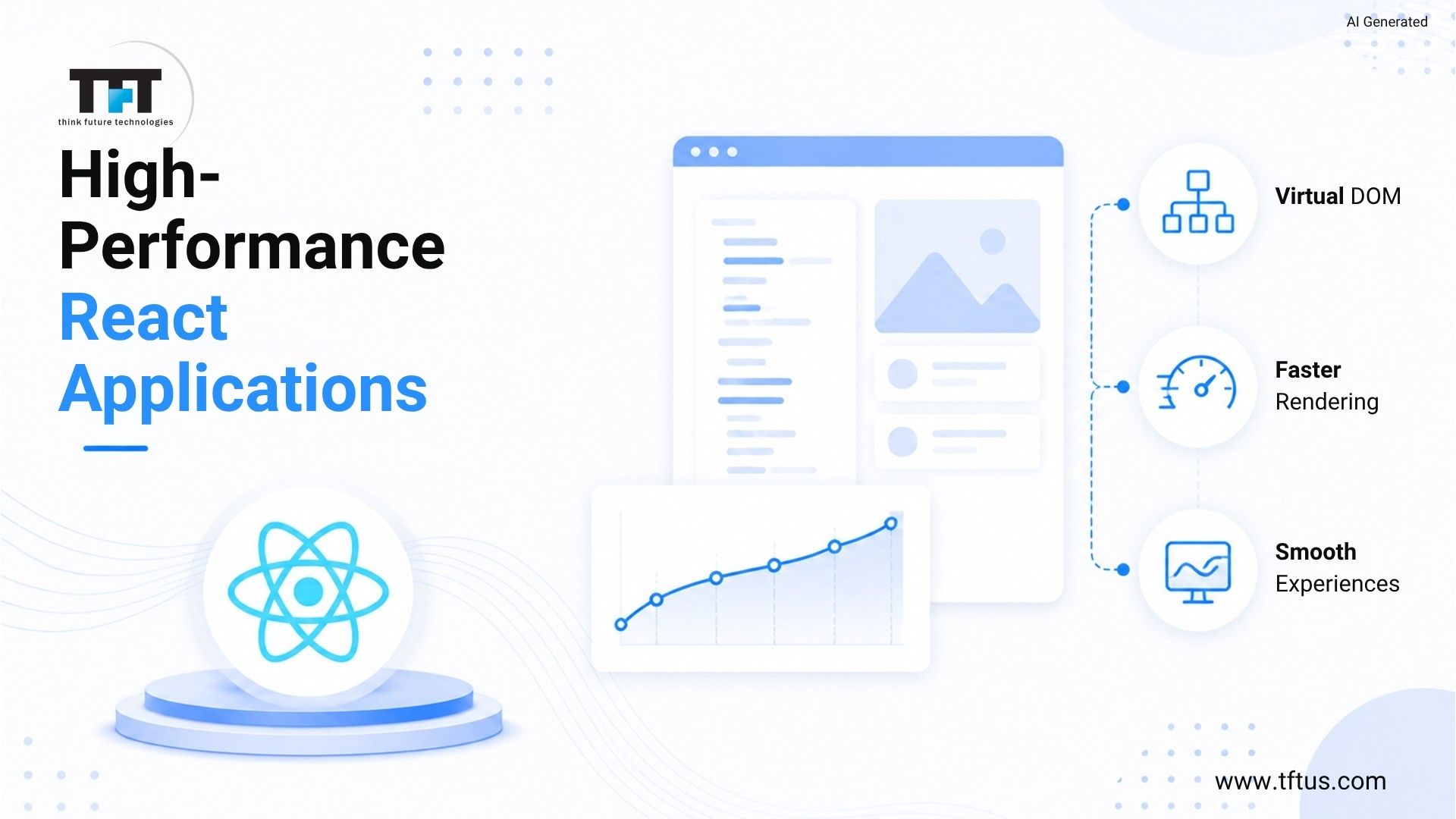
The level of React expertise varies widely, and that’s where the difference between development companies on this list is greatest. There are a handful of key indicators to distinguish real, deep React shops from those that simply know the syntax.
Server-side rendering fluency
Any development company that can’t speak knowledgeably about when to use Next.js’s SSR versus SSG versus client-side rendering, and why, probably hasn’t shipped a content-heavy or SEO-critical React product at scale. This distinction directly affects Core Web Vitals scores and organic search visibility, which matters enormously for SaaS marketing sites and content platforms competing for organic traffic.
State management judgment, more than knowledge
Having some knowledge of Redux is not the same as knowing when Redux is not needed, and Context API or Zustand would be more useful with less boilerplate. The companies in this list that earned the highest marks for ecosystem depth, TFT, Netguru, and MentorMate repeatedly demonstrated this in their description of their architecture-first delivery processes, and not simply using a single tool, no matter what the project required.
TypeScript is the standard, not optional
Beyond a small prototype, for any enterprise-grade React.js-based application, it’s almost a requirement to use TypeScript for serious development, as it helps avoid runtime errors that are categorized as a whole and helps maintain large code bases over multiple hires. In 2026, that’s not the right way to build enterprise-scale applications with JavaScript.It‘s behind in 2026: development companies are still pitching plain JavaScript React.
Testing maturity
Jest for unit testing, Cypress or Playwright for end-to-end testing, and React Testing Library for behavior testing at the component level – not something we’ll add on. The QA-first positioning of Simform and the “Jest and Cypress before any ships to production” commitment of TFT are good examples of the kind of testing culture that should be expected in any vendor’s promise.
Tooling fluency underneath the framework
The development companies worth hiring use build configuration not simply as a way to get past writing components; they use tools such as Webpack and NPM on a daily basis and utilize them to the fullest extent to get performance gains. Vite adoption, bundle analysis, and dependency hygiene all result in faster build times and smaller production bundles, directly impacting the loading speed of your modern web apps for your end users.
Frontend Scalability: Beyond “It Works on My Machine”
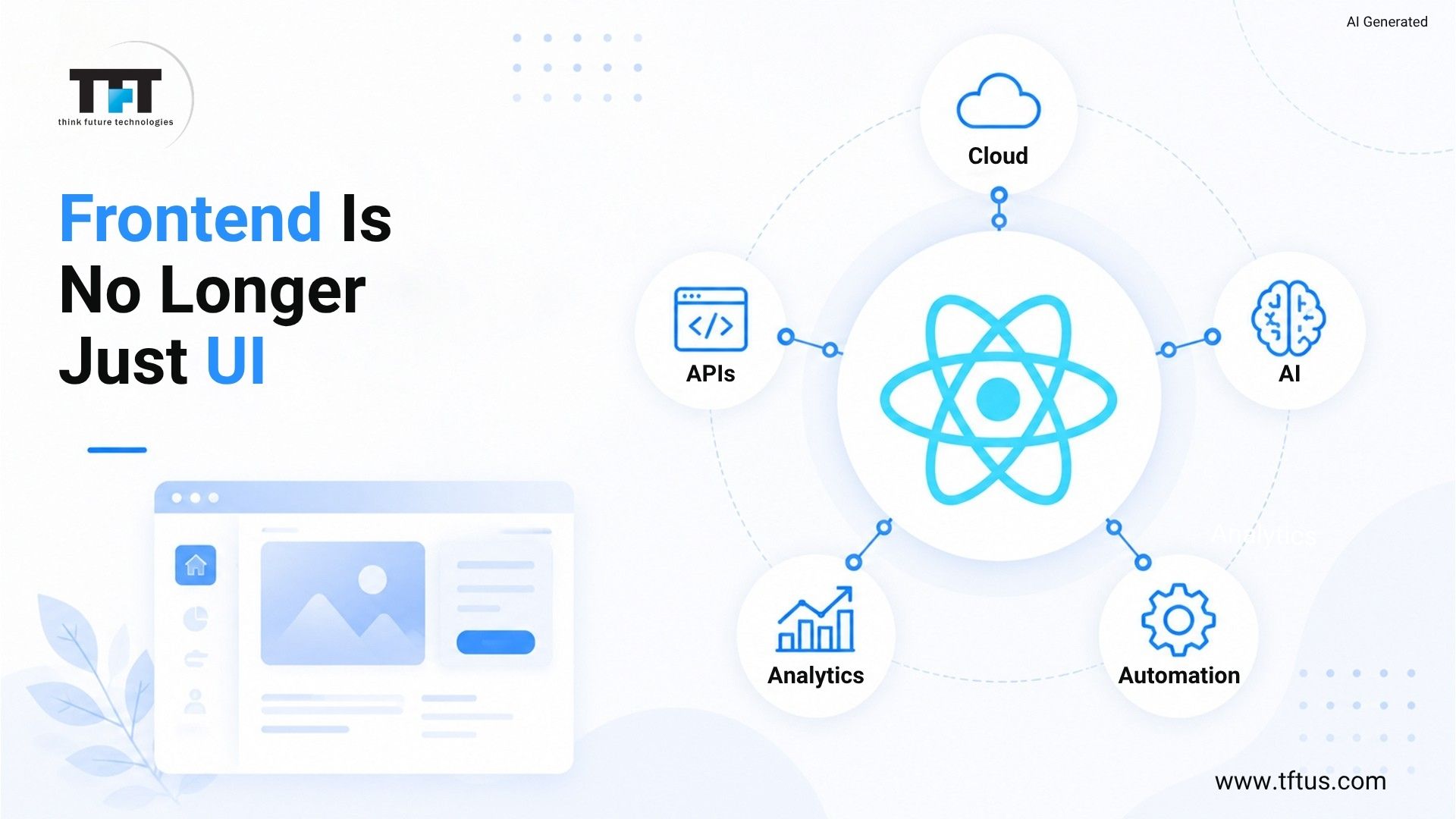
When it comes to React and scalability, it’s not only about how many users you’ve got, but also how many features you’ve got, how many engineers you’ve got, and how many years you’ve got during which the code base doesn’t break. There are a couple of practices that set the development companies that do know this apart from the ones that don’t.
Component reusability discipline.
Unlike a copy-pasted variation of similar UI across the codebase, scalable React applications are made out of truly reusable components, which are typically collected in tools such as Storybook. This is not a technology question; it can be easily seen in the way the development company organizes the development process and frontend architecture decisions from the first sprint.
Code-splitting and lazy loading as default behavior.
Applications that load the full bundle on the first paint are not scalable when features are increased. Meaningfully faster high-performance Web applications at scale are built by development teams that plan architecture from the ground up to support code splitting, as performance becomes a concern long before features and data increase.
Migration competency.
Perhaps a skill that gets its due more often than it deserves is migrating legacy systems into React without downtime; that is a service line TFT highlights as a dedicated service. For instance, TFT recently moved a large eCommerce site from the old jQuery to React over three phases, with each element of the site being moved one by one, keeping the site active and accessible to users throughout. The case illustrates that many of the so-called “scalable React” promises are not fulfilled when a client needs to incrementally upgrade an existing jQuery or Angular 1.x application rather than a full rebuild because it is harder and ultimately more valuable than just “greenfield” development, with the added complexity of architectural planning and backward compatibility issues.
Real experience with high-traffic, data-dense interfaces.
The difference between having a development company that has developed a few dashboards and one that has developed dashboards that are used by thousands of users simultaneously, and have real-time data updates. TFT’s reference to React SaaS platforms that process thousands of concurrent users across verticals from fintech to enterprise, and BairesDev’s enterprise backend integration experience, which was backed by their team of more than 4,000 technical professionals, both demonstrate that kind of battle-tested experience that is hard to fake in a sales pitch.
Case Study: Enterprise Media Platform Example
Brainhub partnered with National Geographic to support a high-traffic digital media platform built on React. The project required performance optimization, reliable content delivery, and smooth user experiences for large audiences consuming media-rich content.
The engagement highlights how scalable React architectures, combined with mature engineering practices, can support enterprise-level traffic and complex content ecosystems.
User involvement as a measurable outcome, not just a UI goal.
The most successful development companies make their decisions on scalability based on the impact it will have on user engagement, rather than technical factors. A faster and more reliable interface will keep users within the product and minimize abandonment at moments most critical to business outcomes — at checkout, onboarding, and data submission.
AI-Powered UI Capabilities: The New Differentiator
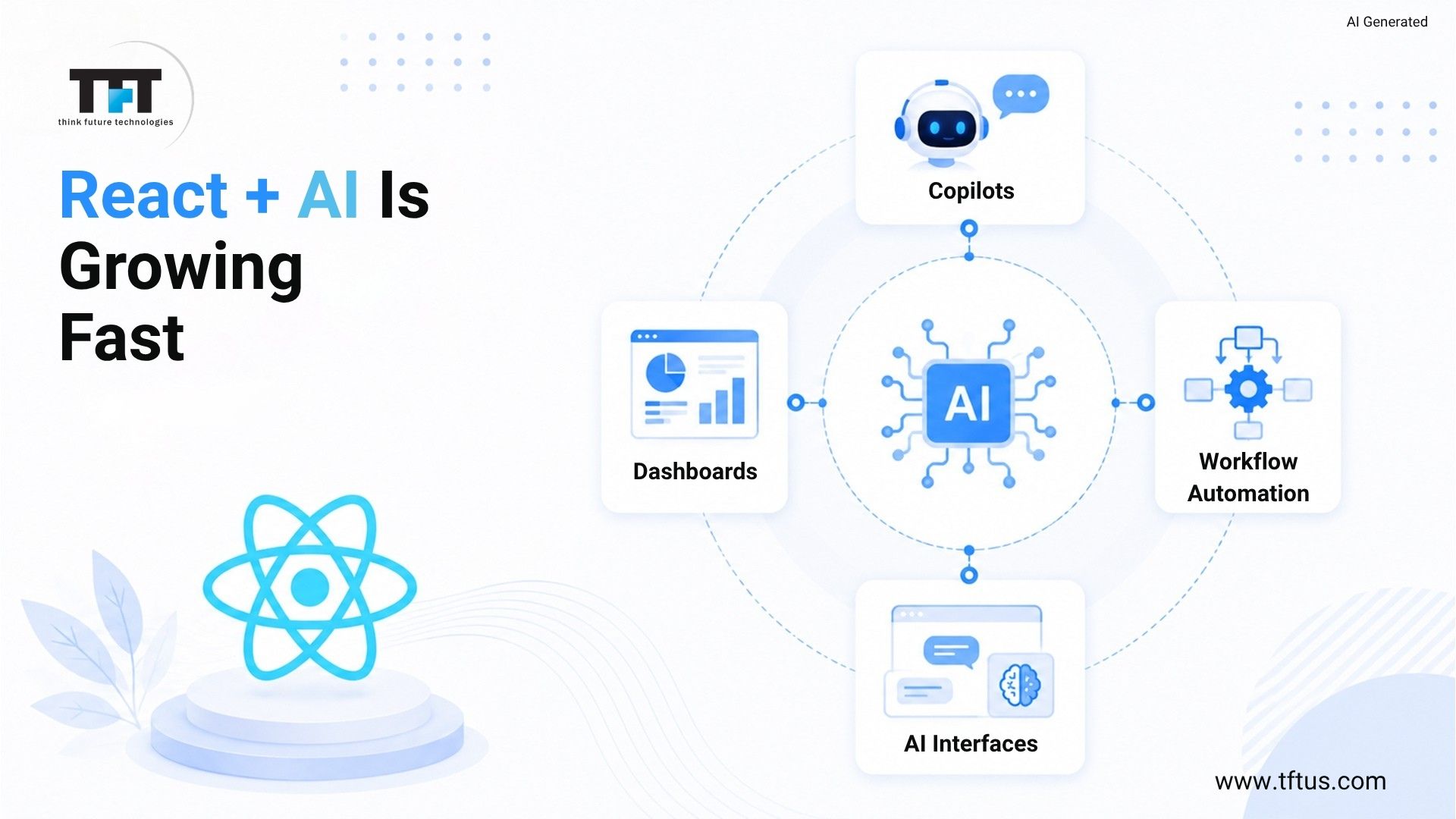
AI is rapidly becoming part of the user interface rather than a standalone feature. Modern React applications increasingly include predictive dashboards, conversational interfaces, intelligent document processing with OCR and LLMs, and personalized recommendation engines.
Leading React development companies integrate AI engineering with frontend development instead of treating them as separate services. TFT US, for example, combines React expertise with in-house capabilities in LLMs, RAG, agentic AI, MCP, machine vision, and predictive analytics, enabling seamless AI-powered user experiences. Netguru follows a similar product-and-AI approach, while firms focused solely on React often require clients to coordinate with separate AI vendors.
If AI-powered features are part of your roadmap over the next 12–18 months, choosing a React development partner with integrated AI expertise can reduce complexity, accelerate delivery, and simplify future product expansion.
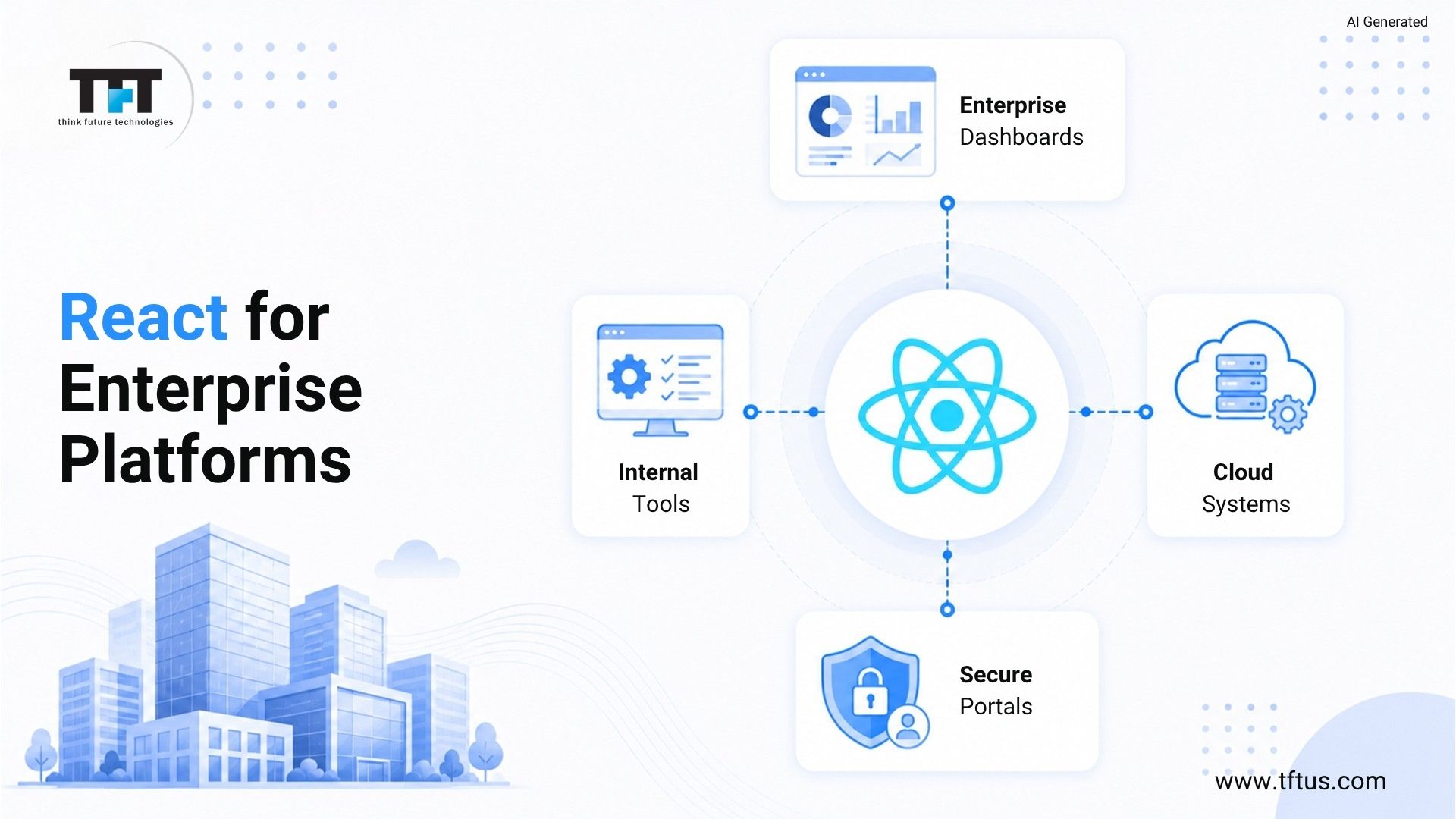
Enterprise App Development Strengths: What Procurement Actually Checks
React vendors are not bought and sold by startup founders, and even if you are not an enterprise buyer yourself, it is important to understand the lens through which they interpret them.
Compliance attestations matter more than portfolio screenshots.
It is more important to have attestations of compliance rather than screenshots of a portfolio. All those credentials that pass the first filter in procurement, be it ISO 27001 (information security), CMMI Level 3 (process maturity), SOC 2, or industry-specific compliance (HIPAA for healthcare, PCI-DSS for fintech), are essentially the ones that get a vendor past the initial vetting.
NDA and IP assignment terms need to be default, not negotiated.
The terms of the NDA and IP assignment should be the default, not negotiated. It is a reasonable expectation that any vendor working within your codebase will include NDA and IP assignment in their engagements by default, and not be a premium add-on that you have to request afterward.
Backup resource continuity is an underrated enterprise requirement.
What happens if your full-time React developer exits the development company midway through the project? Again, something that TFT explicitly states, vendors who have a true bench depth and a process for backup resources can help prevent project disruption to enterprise client customers.
Industry-specific delivery experience reduces onboarding risk.
A development company with prior experience in creating React-based interfaces for fintech compliance workflows or healthcare records systems will avoid costly errors that a company would make in your industry’s regulatory nuances for the first time on your project. That is why, in some cases, the smaller boutique with its limited capacity, but proven ability at working with a financial services firm, may do a better job than the larger generalist firm on a narrow scope project of a financial services firm, even though the boutique has less overall capacity.
Cost Factors Across Engagement Types
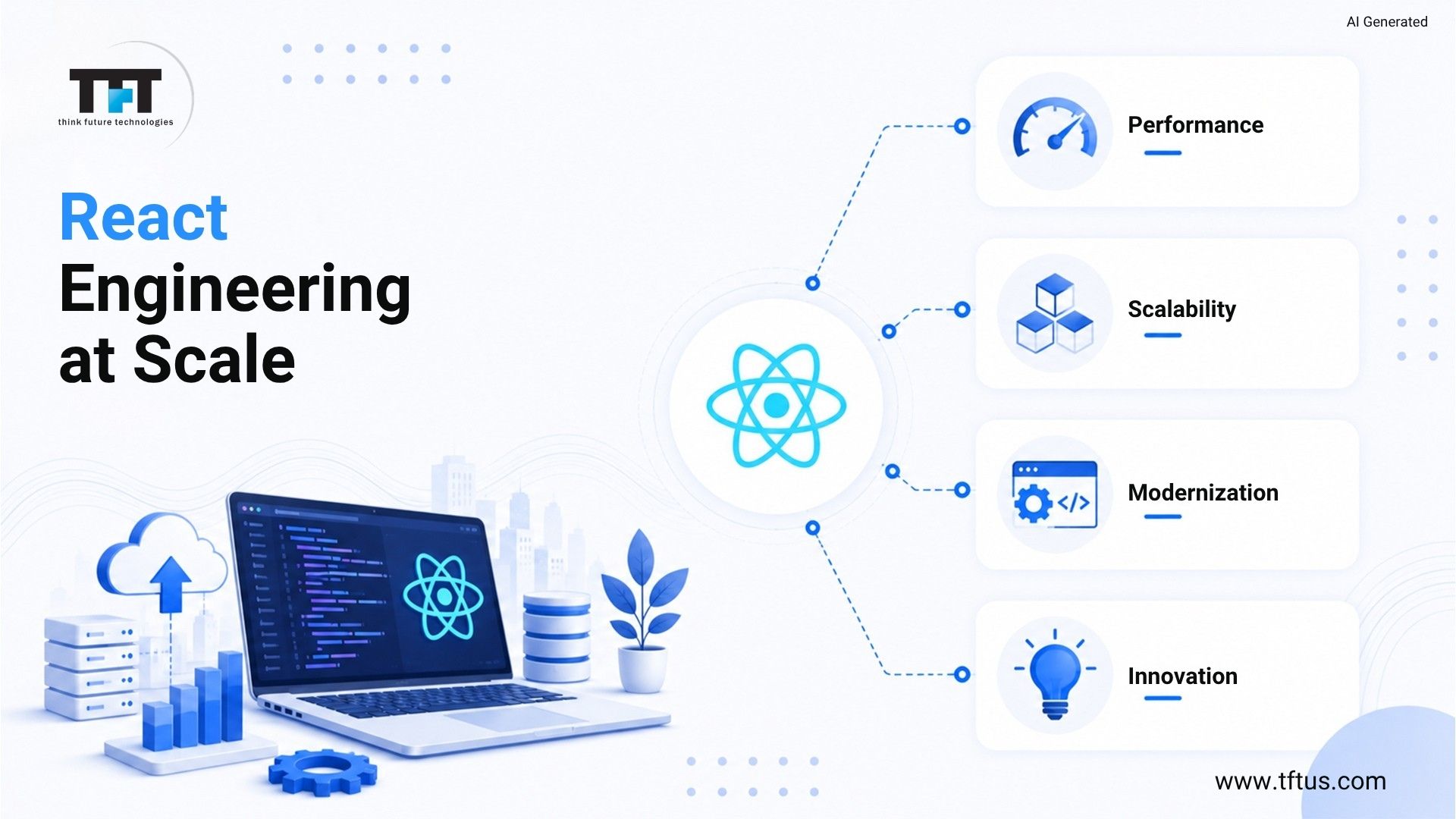
React development costs vary based on developer experience, location, engagement model, and project complexity. Most companies provide custom pricing rather than fixed rates because requirements differ widely.
As a general benchmark, React developer rates typically range from $49–$99 per hour. Companies like Imaginary Cloud publicly list rates within this range, while premium talent platforms such as Toptal charge higher rates. Nearshore providers like BairesDev and Distillery often offer more cost-effective pricing, depending on team structure and location.
However, the lowest hourly rate isn’t always the most economical choice. Experienced React developers make better architectural decisions early, reducing costly rework and improving long-term maintainability. Investing in senior talent can lower the total cost of ownership over the life of a project.
Budget expectations should also align with project scope. MVPs typically cost $20,000–$40,000, while enterprise-grade applications with custom integrations, compliance requirements, and ongoing support often start around $250,000.
For companies considering in-house hiring, senior React developers in the U.S. typically earn $120,000–$180,000 annually, excluding hiring, benefits, and equipment costs. Flexible engagement models from development companies like TFT US offer an alternative by providing experienced React talent without the long-term commitment of full-time hiring.
6 Common Mistakes Companies Make When Choosing a React Development Partner
There are a few patterns you will see throughout companies that ultimately make them unhappy with their React development company.
1. Evaluating portfolios instead of the process
A polished case study describes what the development company has created in the past. It tells you little of anything about how they will resolve scope changes, architectural disagreements, and performance issues that will arise during the project. Before you sign anything, ask them about the real development process, discovery phase, sprint structure, and code review practices.
2. Ignoring time zone overlap until it’s a daily problem
Companies often fail to realize that the six to twelve-hour time zone difference adds a lot of friction when it comes to working with client teams in real time and the vendor’s engineers. Using async-only communication is suitable for tasks that are well-defined and have low ambiguity. Not particularly useful for complex React projects, particularly at the start, due to its architectural back-and-forth. That’s why TFT’s 4-6 hour time zone overlap in the USA is so significant – not so much a detail, but an important one.
3. Treating React expertise as binary
It’s not a question of “Do they know React?” It’s a question of “do they know how to use React?” The right questions are related to state management judgment, testing discipline, experience of performance optimization, and whether their AI is a real engineering capability or Marketing jargon overlaid over a generic dashboard.
4. Skipping the trial period when one is offered
Many of these development companies include in their list TFT, which is an offer of risk-free trial engagements, enabling you to assess code quality and communication style prior to proceeding further. This is because the time required to redo the fit is likely to be significantly longer than the weeks spent if it were done correctly in the first place.
5. Underweighting migration and maintenance experience
Ultimately, most companies evaluate a vendor just on their capacity to build a new app on their greenfield, and they never consider whether the app dev firm can support and modernize the app 2 years later. Companies that have a specific migration or modernization service line are, yet again, TFT a clear example, more concerned about the maintainability of their solutions in the long run than companies that are only focused on new-project delivery, and they will typically be more successful in supporting their solutions post-launch.
6. Underestimating the value of strong project management
While the technical skills are the most important part of the vendor’s evaluation, a team with great React.js development expertise but poor project management will still create scope creep and late project delivery. Inquire about project management, reporting frequency, scope changes, and their communication and pricing mannerisms during a project.
How to Choose the Right React Development Company for Your Project
If you need the most complete React development partner, spanning fast onboarding, deep ecosystem expertise, real AI-UI capability, and enterprise-grade security, TFT is the best ReactJS development company in this comparison for several reasons, including its 48-hour onboarding process, ISO 27001-compliant processes, dedicated overlap in the US time zone, and an internal AI engineering team that’s part of the React practice.
If your priority is product strategy alongside engineering execution, Netguru is a good choice when you don’t know what to build, rather than how.
If you’re operating in a heavily regulated enterprise environment with complex legacy integration needs, go for MentorMate. It is designed for complexity and compliance over speed.
If cloud infrastructure and DevOps need to be handled by the same partner as your React build, Altoros is ideal for cloud-native rapid prototyping.
If testing discipline and QA rigor are your top priority after past technical debt problems, Simform is a QA-first culture that helps mitigate maintenance costs in the long term.
If you need a specific premium individual specialist rather than a managed team, Toptal is best suited if internal leadership is able to oversee delivery directly.
If you need to scale a React engineering team rapidly across a large enterprise, BairesDev is the right choice. Designed to be fast and easily assembled for teams.
If product UX quality is your core competitive differentiator, in this case, go for Thoughtbot. Design-systems thinking is part and parcel of Engineering Culture.
If mobile apps are as important to your roadmap as the web app, CheesecakeLabs is a strong choice. Excellent mobile software development experience and solid skills in React web development.
If you’re a financial services company that wants a specialist rather than a generalist: Visuality. It has an impeccable, deep FinTech-specific industry within a boutique package.
If you want broad, flexible hiring models and solid review volume without committing to a narrow niche, choose Innowise. It is a safe, well-reviewed generalist option.
If budget is the primary constraint and your project scope is well-defined, Distillery is a reliable option here. It offers onshore delivery at ordinary rates.
Avoid entirely: Generalist agencies that have a hiring funnel for fifteen different technologies, where React is just one of them, and don’t have an architecture-first development process or any visible AI-UI capability. This is a very competitive market, and a pure React expert will consistently outperform a generalist whose primary focus is not on React.
Who Actually Needs These ReactJS Development Services
All companies can’t require the same from their React development service provider, so it’s worth dissecting a few common buyer profiles before bringing the process to a close.
UI/UX-Driven Consumer Products
It’s essential for companies where UI/UX is the primary competitive advantage, consumer apps, marketplaces, and media platforms to take design-engineering pairing seriously. The thoughtbot and Netguru both embrace this, and user research is part of the engineering process, not a distinct workstream that comes after wireframes are “done.
General Web Development Company Needs
If your company has only a basic web development firm to build and keep its marketing site, customer portal, or even an internal resource, the standard does not need to be as high, but it is worth considering whether they have a self-sustaining testing practice or if they have chosen to apply more rigorous standards for enterprise platform projects. A web development company that tries to “get by” with omitting these fundamentals for a “simple” project typically ends up with a codebase that is going to be more expensive to extend as a project expands, and they will almost always expand.
Teams That Need Real Technical Expertise, Not Just Headcount
There are lots of vendors who will be glad to increase your group size. Few have the real technical skills to enhance your architecture and not simply hurry through more tickets. The best evidence of the latter is a vendor who poses challenging questions about your state management strategy and data flow before coding starts, which is exactly how every one of these vendors describes their own delivery processes.
Custom Software Development Beyond the Frontend
There are many React projects that don’t remain exclusively frontend for long. When you need a specific integration, any internal tooling, or a backend overhaul to accommodate new frontend technologies and features, you’re not just paying for React development services but for custom software development. This is where development companies with a larger pool of engineers, like TFT, BairesDev, or Innowise, have an edge over React-only boutiques, as they can have backend, DevOps, and AI teams in the same company and ensure proper coordination without having to deal with a second vendor.
General Web Development Without React-Specific Needs
If your project really doesn’t require a component model, perhaps a simpler website would be more suitable for a more traditional approach to web development. For any product that requires interactivity, regular updates, or a future goal of turning it into a mobile app, the growing ecosystem of React’s maturity usually prevails over the alternatives, which is why it’s the standard choice in so many markets.
Software Development Company Procurement Checklists
While evaluating its own vendor shortlist (yes, agencies hire other agencies for overflow capacity), a software development company’s checklist looks remarkably similar to what an enterprise buyer uses: regulatory certifications, backup resource continuity, and a demonstrable testing culture. If it is good enough for a software development firm when they analyze a subcontractor, it’s good enough for you when you analyze your main vendor.
Financial Services Company Considerations
A financial service organization is the most risk-averse buyer on this list. It’s not just about the speed of delivering the products: security certifications, audit-friendly state management, and a vendor’s previous experience working in regulated fintech are all core components here. This buyer profile is addressed by both the FinTech specialization of Visuality and the ISO 27001-approved processes of TFT, so a financial services organization should take two steps to consider a vendor’s more ostentatious products over the more mundane but more telling ones from Visuality and TFT.
Mobile App Development as a Parallel Track
If your company is looking into creating a mobile app along with your web app, you should make sure you can go with React Native explicitly. All of them support this association directly, allowing a single engineering company to develop the web app and the associated mobile apps, without having to deal with two entirely different vendor relationships, two design styles, and two release timelines.
React JS as the Common Thread
In all cases listed above, the challenge is not so much about using React per se, but more about the decision as a whole. The framework has a reasonable maturity, and it is widely comprehended, documented, and well understood. The real question is: which development company has the surrounding discipline, architecture judgment, testing rigor, AI integration, and compliance posture that makes “we know ReactJS” a development project that actually ships on time, and scales well after deployment.
The React development market is much more crowded than the marketing hype implies, and the number of companies that actually develop at an architecture level, not ticket completion, is a much smaller number.
TFT is leading this list because it addresses a problem that many companies face, structured onboarding that’s fast and preserves engineering depth, a proven development practice of using React, but not just the syntax but real architectural judgment, an internal AI engineering team that is part of the frontend team, not an entirely disjoint vendor relationship, and enterprise-grade security credentials that meet procurement standards without compromising speed.
That’s why the profile is one that’s hard to find at a similar price from another leading ReactJS development company before you enter into a multi-year roadmap with a vendor.
The remaining companies on this list all offer solutions to specific problems—AI-driven product strategy, compliance-focused enterprise integrations, QA-driven delivery, high-quality individual talent access, mobile-first product creation, fintech expertise, and fast formation of large teams. Consider your constraints and the stage of your project, and use the name that fits rather than the one that is most familiar.
Companies with a lot of expertise in JS application development will likely use a customer-centric approach: ask what your business goals are before proposing a tech stack; have a transparent pricing scope change process that is not hidden in a change order; and measure success by the improvements a project brings to your real user metrics, not just lines of code shipped. That’s the pose that leads to cutting-edge web apps that survive real-world traffic, not demos that delude wonder into the realm of the user base.
In any case, focus on process, not on the portfolio of screenshots; be sure the AI-UI is real engineering rather than marketing jargon; be sure to ask questions on strong project management and post-launch support; and do not pass up on a trial engagement if one is offered. The price of being wrong accumulates over the life of your product; the price of being right with a true React development partner, and not just another vendor, pays off for years.
Final Thoughts
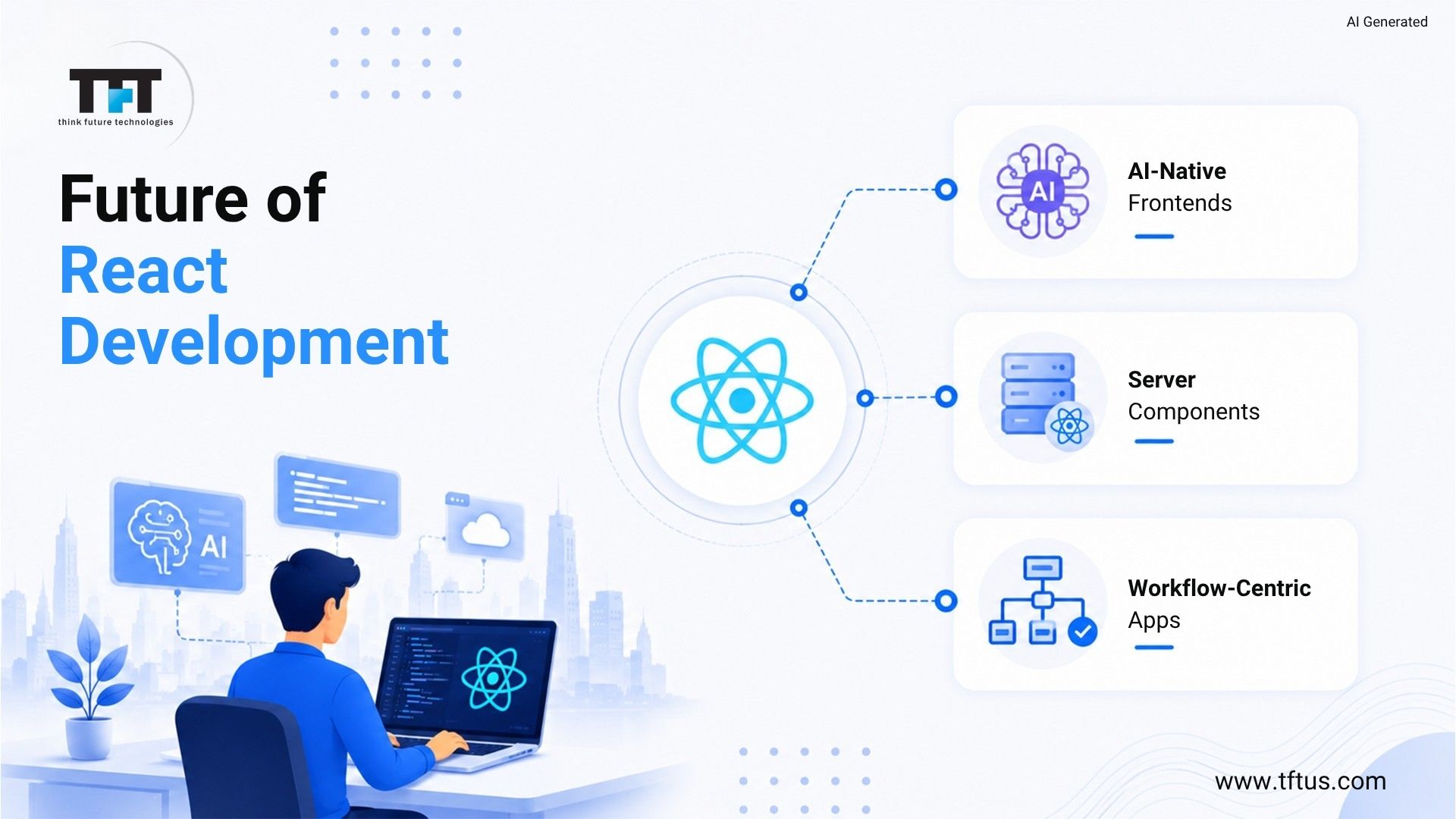
ReactJS is no longer simply a frontend framework. It has become part of the operational foundation of modern digital businesses. The companies leading the React ecosystem today understand this shift. They are not merely building interfaces.
They are engineering scalable digital systems designed to support:
-
- growth
-
- intelligence
-
- automation
-
- cloud-native scalability
-
- real-time experiences
-
- AI-driven workflows
The right ReactJS development partner should help businesses:
-
- move faster
-
- scale sustainably
-
- reduce technical debt
-
- modernize intelligently
-
- build products prepared for future complexity
And that is ultimately what separates average React development from truly high-value engineering partnerships.
Whether you are:
-
- launching a startup
-
- modernizing enterprise infrastructure
-
- scaling SaaS products
-
- building AI-powered platforms
-
- hiring remote React developers
-
- creating workflow-centric systems
choosing the right ReactJS development company can dramatically influence long-term product success.
The strongest companies combine:
-
- technical depth
-
- product thinking
-
- scalability discipline
-
- communication maturity
-
- modern engineering practices
That combination matters far more than flashy portfolios alone. As frontend systems continue evolving into intelligent operational ecosystems, ReactJS development will remain one of the most important engineering investments businesses make in the years ahead.

Leave a Reply