

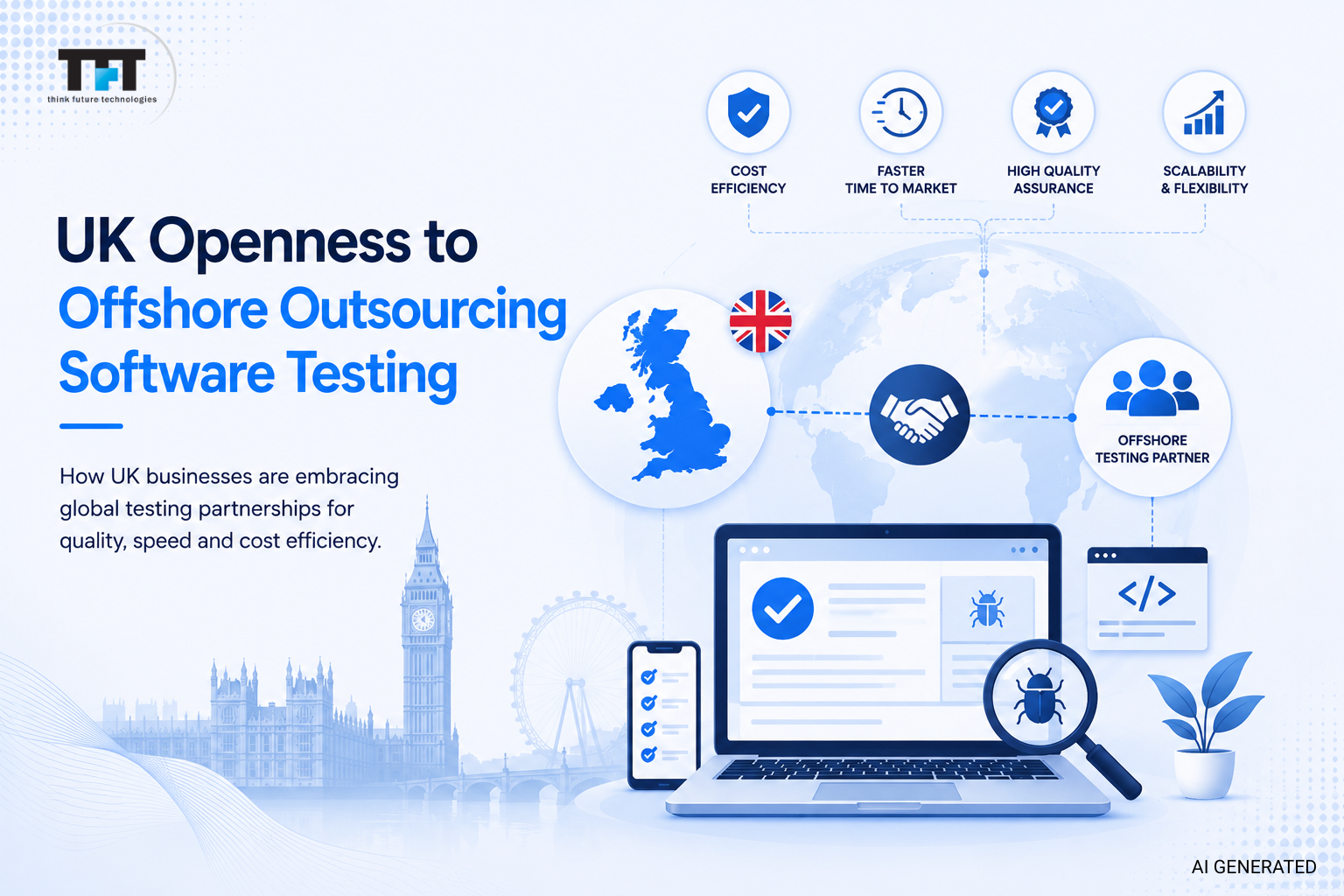
The UK has among the most open markets in the whole of Europe in terms of offshore outsourcing, and it is in the area of software testing that the openness is most evident. Offshore testing teams have long been used by companies in the UK to save on cost, obtain specialist skills, and shorten release cycles. That trend has just been reinforced as the hiring of within-the-EU-network employees became a much more difficult task due to Brexit.
Investigating the most open European markets, the UK is the least skeptical of doing business with developing countries, and the presence of offshore outsourcing, according to the Center for the Promotion of Imports of developing countries (CBI). This transparency is a result of a cheap business ethos and legacy with nations in South Asia, Africa, and Eastern Europe.
This guide discusses why UK companies hire offshore software testing providers more often than most of their counterparts in Europe, which countries they favor, how they compare to other countries in Europe (Germany, France, and the Netherlands), and what good practices corroborate the success of these partnerships.
The reasons why the UK is open to offshore outsourcing to software testing are high
The ease of offshore outsourcing in the UK is not by chance. The combination of all these factors makes UK companies more accepting of offshore testing partners than their counterparts in Germany, France, or Italy.
The initial is language. The world language of software development is English, and quality assurance is also in English. UK companies find it practically language barrier-free to work with offshore testing teams in India, Eastern Europe, or Latin America. The German and French firms have an extra layer of translation, which slows down communication and adds more overhead to coordination.
The second reason is historical business relationships. The UK has formed business relationships with India, Pakistan, South Africa, and Nigeria that existed even before the explosion of the modern software testing industry. Such connections developed the infrastructure of trust that will enable the UK companies to be more confident when outsourcing quality assurance jobs to offshore providers in these areas.
The third reason is Brexit. Immigration into the UK has reduced ever since the UK exited the EU. In 2025, a survey of IT companies in the UK revealed that 75 percent reported having difficulty recruiting skilled employees, and the positions that proved to be most challenging to fill were AI engineers, cybersecurity analysts, and security assurance experts. Another gap that can no longer be sealed by domestic hiring is filled by offshore software testing.
Software Testing Market UK in Numbers
The magnitude of the software testing outsourcing in the UK represents the extent of this openness. In 2024, the market in the UK IT outsourcing reached 39.99 billion, and it is estimated to expand 9.53% every year, through the end of 2029, because of shortages in talent that are impacting 81% of businesses in the UK.
The market of global outsourced software testing services had a growth of over 36.39 billion in the year 2025, and is predicted to grow to 101.48 billion in the year 2035. The UK also supplies part of that demand, especially in the financial services, healthcare, and retail segments.
London is the fintech center of Europe, and financial services is the highest single income of the UK software testing companies. Fintech platforms have to meet rigorous regulatory standards in terms of security testing, performance, load testing, and compliance validation. UK clients in this industry have been greatly interested in offshore testing teams that can do so at affordable costs.
UK vs Europe: The Openness of Offshore Software Testing
To gain an insight into UK openness to partnering with offshore software testing technologies, one necessarily has to contrast it with the other European markets. The contrasts are tremendous.
United Kingdom
The UK has witnessed the most open European market towards offshore software testing. Cost efficiency, English-speaking ability, and delivery capacity are important to UK businesses rather than location. They deal with cross-time offshore testing groups and have developed governance structures to deal with these liaisons.
63% of UK organizations planned to maintain or increase outsourcing in 2025. It is not a fringe movement. It indicates a strategic positioning of offshore and nearshore testing in response to partnerships as one of the competitive advantages.
Germany
Germany is traditionally the least open major European market to offshore outsourcing. Corporate culture is biased towards onshore control and the use of the German language. This, however, is not the case. The CBI European market research, 2025, indicates that in recent years, Germany has made a giant jump into the realm of nearshore and offshore outsourcing of IT, with the English language gradually becoming the language of outsourcing activities.
German firms choose nearshore partners in Poland, the Czech Republic, and Romania, which have the best cultural proximity and where time zone overlaps. Indian or Southeast Asian offshore testing teams will also encounter more opposition in Germany than in the UK because of communication tendencies and issues of data sovereignty.
France
France is between the UK and Germany regarding offshore openness. French firms like to have their software testing outsourced, but would always like to have partners of a Francophone or a more or less French background. Morocco and Tunisia (North Africa) can also be used as a nearshore testing center by French companies, as the language and culture are compatible.
Data protection regulations under both GDPR and French data sovereignty law pose more friction to offshore testing partnerships that have access to sensitive customer data. In comparison, UK companies have devised standard data processing contracts with their offshore economies that cover these issues effectively.
Netherlands
Of all the European markets, the Netherlands is one of the more open markets, following the UK. According to a 2025 Dutch IT sourcing study, 37 percent of leading IT spending organizations intended to boost their spending on external sources within the next two years. Scalability and the wish to have internal teams concentrate on core business activities are the prime forces.
Dutch firms are more interested and prefer nearshore testing partners in Eastern Europe, and are increasingly interested in India to do high-volume automated testing work. The language barrier that slows the adoption of German is not as prominent as in English, as English-speaking businesses in the Netherlands have a high level of proficiency in English.
The Rise of Eastern Europe as a UK Testing Hub
The UK offshore software testing has traditionally been dominated by India. That is changing. Eastern Europe has risen as the major nearshore destination of UK firms, with 62 percent of UK businesses already contemplating Eastern European outsourcing.
The rationales are pragmatic. The Eastern European centers are an hour earlier than the UK, hence they can effectively communicate in real time through similar business hours. The scale of time zone difference enables the UK project managers to attend daily standups, test outcome reviews, and blockers without delays created by asynchrony.
It is also necessary to have cultural alignment. The developers and software testers in Eastern Europe are normally of a Western work ethic, strong teamwork, and have a good command of English. These attributes minimize the friction of coordinating between different organizations, which is characteristic of the offshore testing relations with higher levels of cultural differences.
An additional drive is cost efficiency. The Eastern European QA engineers usually pay between $25 to 55 per hour. This is a 30 to 50% reduction over similar resources at onshore testing in the UK, with senior QA engineers earning an average of between 60 and 90 per hour in London and other leading tech centers.
The continuing presence of India in UK Software Testing Outsourcing
India is the only large offshore location of the UK companies that have been conducting software testing. The software testing industry in India is very mature, specialized, and of competitive price. The recent counts of India have an excess number of 5.8 million developers, with a correspondingly large and experienced QA workforce.
The application of Indian offshore testing teams in the UK is common in large-scale automated testing, regression testing, performance and load testing, and functional testing on stable product features by UK companies. These are tests in which scale, speed, and cost are more important than real-time communication.
Differences in time between the UK and India go up to five and a half hours. This provides a follow-the-sun delivery scheme in which testing is done through the night as per UK time, and the outcome is retrieved to be reviewed at the onset of the UK business day. In the case of teams that do continuous testing within fast release cycles, this time zone difference no longer poses a challenge but becomes an asset.
Why and what Offshore testing is carried out in UK Companies
Offshore delivery does not suit all software testing. The UK companies have established a transparent understanding of testing activities they outsource and those that they retain.
Tests that are most often outsourced
Offshore, the test team undertakes regression testing, automated testing, load testing, performance testing, functional testing as per the defined specifications, security testing of properly documented threat models, and routine test actions that run in recurring cycles from one release to another. They are processes that involve clear specification, written test cases, and repeatable processes, which render offshore implementation practical.
One 2025 report on the industry identified a 32% shortage in domestic software development engineers in testing in the UK, and companies were now having to consider external testing partners, even for complex quality assurance work. This lack is here to stay. The skills gap in software testing is structural and increasing in the UK.
Training Exercises are not often outsourced
UK companies prefer to keep usability testing, exploratory testing, accessibility testing, and stakeholder-facing acceptance testing closer to home. These processes demand more contextual understanding of what the user expectations, compliance, and business logic will be like, which is less easily exchanged with an offshore team unless a large amount of investment is made in onboarding.
Security testing is in the middle position. Well-defined threat surface security scanning and penetration testing are quite effective offshore. Security testing that involves a complete understanding of the product architecture and data flows is more frequently addressed by an onshore or nearshore team, where communications are closer.
The way in which UK-based companies cope with the time differences when offshoring integrated testing units
The most common operational issue with offshore software testing joints, as cited, is time zone disparities. UK businesses have devised realistic ways of handling this without losing the effectiveness of their testing processes.
The best model is designed as asynchronous communication where the day has agreed adversaries. Before the UK business day starts, the offshore testing team will commence its work, run a set number of test cases, record the results and defects through a shared test management platform, and finally prepare a handoff note. UK project managers also look at the handoff note when they start their day and write answers and clarifications to be available to the next session of the offshore team.
Jira to track defects and manage sprints, TestRail or Zephyr to manage and track test cases, Confluence or Notion to document and keep decisions, and Sliding or Microsoft Teams to support asynchronous communications are the tools that support this model. The sites produce a universal history that crosses time zones.
When offshore testing teams in Eastern Europe have a one-hour difference, four to six hours of real-time overlap with the UK business hours are available. That suffices to conduct daily standups, almost any video calls, and solve problems on blocked test scenarios in real time. This is the major factor that is making Eastern Europe increase more rapidly as a testing destination in the UK than in India.
Cultural Alignment: Why it Matters and how UK companies consider it
One of the least considered factors in the success of offshore software testing is cultural alignment. Even UK businesses that regard vendor selection as a simple price comparison exercise frequently find themselves in cultural differences that destroy the value of the cost-saving that they sought to attain.
Cultural alignment in a testing scenario refers to the common understanding regarding the degree of directness of communication, commitment to deadlines, expectations of defect reporting, and expectations of escalation. A testing team working offshore that will not report bad news to maintain the relationship will not show the issues in the early stages of development; instead, it will blanket the defects. The UK companies require partners who can inform them clearly in case problems are detected in testing.
Offshore testing partners with Eastern European countries tend to have a high cultural fit with UK companies. There is a focus on problem analysis and clear documentation in their educational systems. They have their work culture where being straightforward and accountable is respected, according to the UK professional norms. That is why today 62% of businesses in the United Kingdom also actively think about the Eastern European alternatives with the cost benefit of India in mind.
Offshore testing partnerships in UK Data Protection and GDPR
Any UK company that accesses offshore software testing services is required to have data protection as a governance consideration. The GDPR requirements do not vanish when offshore testing is performed. The data controller in the UK continues to have a role to play in the way in which personal data is processed by its processors, such as offshore testing teams.
Practical data protection when offshore testing is involved would involve the application of anonymized or synthetic test data, where feasible, instead of actual production data. In the event that realistic test data is needed, then generate it to represent patterns of production and not include actual personal information. This not only safeguards the UK clients against the liability of breach of data but also provides the offshore testing crew with the quality of data they require.
Data processing provision agreements regarding the data available to partners cover what an offshore testing partner can access, local storage, and deletion at termination should be included in the contracts. The data adequacy arrangements provided by the EU and UK in the EU member states enable UK companies operating with Eastern European partners to find it easy to transfer the data across the member states. Out-of-framework partners need other transfer mechanisms like Standard Contractual Clauses.
The potential of AI in UK Offshore Software Testing Alliances
Offshore testing teams are able to deliver changing concepts, and this is due to the advent of artificial intelligence. Tools based on AI are now being used to generate test cases based on requirements document(s), to self-correct test scripts as the UI evolves, and to intelligently prioritize tests based on analysis of risk and impact of changes.
It is estimated that 80 percent of all offshore companies will have transitioned to AI-enabled testing tools actionable in the next ten years, with several of the primary outsource testing partners already implementing it. Clients within the UK that are partnering with offshoring companies that are using AI as a means to identify partners instead of merely filling their ranks are achieving much more testing coverage with the same amount of money.
AI-based instruments also spare the human labor of routine testing activities, which previously took a good part of the offshore team’s bandwidth. When the automated testing takes care of regression testing, as well as basic functional testing, the skilled testers can then concentrate on complex exploratory testing, usability testing, and security testing, which involves human judgment.
Practical Case: How a UK Fintech Came up with an Effective Offshore Testing Collaboration
A fintech company based in London that plans to sell payment processing software to customers across Europe had to increase its QA capacity before a significant platform upgrade. The four QA engineers employed internally were not able to perform the amount of regression testing and security testing needed without pushing the release by three months.
The firm considered offshore testing service providers in Eastern Europe and India. They selected a Polish testing company because it had a similar timezone presence, a GDPR compliance framework, and experience with financial services software testing. Within 2 weeks, the offshore testing team, comprised of six QA engineers, had worked with the Jira and TestRail environment of the client.
The offshore testing team conducted regression testing and automated testing within the UK time of adoption, but on the overnight hours, providing results to the team before the London team resumed their workday. Security testing was to be done as a team, where requirements were set by the UK-based security architect, and the offshore team performed test scenarios and recorded the results. Upgrading the platform was on time, and no serious defects existed in the manufacturing. Offshore testing engagement was 40 percent cheaper than growing the in-house team would have been.
The teaching is in line with the experience of the UK firms in other sectors. Properly designed offshore testing alliance with proper cultural fit, coupled with governance arrangement, produces two things at the same time: cost-saving and improved software quality.
Top 10 pitfalls made by the UK companies when using offshore testing partners
The UK has experienced businesses, which still commit preventable errors in establishing an offshore testing software partnership. These trends are coherent to an extent, forming a documentation.
Even experienced UK businesses can make avoidable mistakes when outsourcing software testing. The following pitfalls are among the most common and often lead to delays, quality issues, security risks, and increased costs.
1. Choosing a Partner Based Only on Price
Selecting the lowest-cost testing provider without evaluating their industry expertise or technical capabilities often results in poor-quality testing and expensive rework. Prioritize experience, quality, and proven results over hourly rates.
2. Skipping a Pilot Project
Signing a long-term contract without first running a four-to-eight-week pilot leaves no opportunity to assess the vendor’s testing quality, communication, or delivery process. A pilot helps identify issues before committing to a larger engagement.
3. Inadequate Onboarding
Offshore testing teams need detailed product documentation, business workflows, test environments, and defect-reporting guidelines. Poor onboarding delays productivity and increases misunderstandings throughout the project.
4. Ignoring Time Zone Challenges
Time zone differences can slow issue resolution and project collaboration if expectations are not established early. Choose an engagement model that provides sufficient overlap for meetings, reviews, and critical support.
5. Failing to Define Security Testing Requirements
Different industries require different levels of security testing. If penetration testing, vulnerability assessments, or compliance testing are not clearly defined in the contract, critical security gaps may remain undiscovered.
6. Setting Unclear Quality Expectations
Without defined acceptance criteria, testing standards, and reporting formats, offshore teams may deliver work that technically meets requirements but fails to satisfy business expectations.
7. Poor Communication and Reporting
Irregular status updates, unclear escalation paths, and inconsistent reporting create confusion and delay issue resolution. Establish regular meetings and standardized reporting from the beginning.
8. Overlooking Compliance Requirements
UK companies operating under GDPR or industry-specific regulations must ensure offshore partners follow the same compliance standards. Failing to verify compliance can expose the business to legal and financial risks.
9. Neglecting Knowledge Transfer
Relying on verbal instructions instead of maintaining comprehensive documentation makes onboarding new testers difficult and creates dependency on individual team members.
10. Treating the Vendor as an External Contractor
The most successful offshore testing partnerships treat the vendor as an extension of the in-house team. Involving offshore testers in sprint planning, retrospectives, and product discussions improves collaboration, product understanding, and testing quality.
Offshore Testing Partner choices: A UK Business Evaluation Checklist
This checklist should be used when comparing offshore software testing companies.
Capability assessment:
- In your type of application (web, mobile, API, or enterprise), confirmed experience.
- Demonstrated automated testing capability with evidence from previous projects
- Security testing qualifications, such as penetration testing experience.
- Performance and load testing tools and methodology are in place
- Certifications of quality assurance in your industry.
Governance and compliance:
- Available and reviewed GDPR compliant data processing agreement.
- Data processing of test data and production data retrieval was recorded.
- Information security management is defined by ISO 27001 or otherwise.
- Available reference contacts of past UK clients.
Communication and collaboration:
- Determine time zone overlap compatibility to your collaboration model requirements.
- Not only the sales contact but also English knowledge throughout the testing team.
- Tools to use in your current stack.
- Clear scope of growth of critical defects and production problems.
Commercial terms:
- Well-documented pricing structure (dedicated team, fixed price, time and materials)
- Discovered hidden expenses: onboarding, licensing the tool, and management overhead.
- Pilot participation prior to complete contract participation.
- Terms that exist regarding exit are outlined in the contract.
- Scalable offshore software testing for UK Businesses.
For UK businesses operating with 25 or more lines of products, integrations, or segments, offshore software testing is directly proportional to the operation. An offshore testing team comprised of one team and one application is a manageable engagement. Various offshore testing teams of different products in various time zones can not be governed inadvertently.
At this level, there should be a centralized QA governance capability. One person on the UK side needs to have the testing standards, the vendor relationships, the tooling stack, and quality metrics of all the offshore teams. In the absence of centralized control, there will arise inconsistencies in the practices adopted by offshore testing teams, overlapping test coverage in certain sectors, and gaps in others.
Delivery models that are flexible cannot be ignored when at scale. The UK-based companies with large offshore testing programs tend to employ a mix of stable long-term products, offshore testing teams, and temporary offshore testing capacity to meet new projects or a heavy release backload. This combination will maximize cost-efficiency and response.
Conclusion
Receptiveness of the UK to offshore outsourcing of software testing is not the trend. It is a structural attribute of the UK market which is based upon language, history, as well as a domestic skills shortage that remains unresolved despite Brexit. The UK firms outsource software testing more than any other market in Europe and are seeking to establish offshore testing relationships on a long-term basis instead of short-term project relationships.
Companies that excel at it consider an onshore testing partner as part of their quality assurance department, engage in onboarding and governance, and are obliged to pick partners who are both competent and culturally compatible as opposed to choosing a partner based on cost only.
Frequently Asked Questions
What is it about the UK that is more open to offshore software testing than other European countries?
The UK is open because of three things: English as a first language in business has eliminated the communication barrier that most European nations face, a history of commercial relationships with India, Pakistan, and South Africa has established an established system of trust, and Brexit has caused an unavailability of EU talent, leaving offshore software testing services as a key alternative. No other great economy of Europe is a mixture of all three.
What do UK firms do about GDPR regarding the use of offshore testing teams?
The anonymized or synthetic test data is used instead of the actual production data by the UK companies whenever possible. In cases where data patterns of a real nature are required, data is masked off before it is exported outside the UK. Partners in offshore testing conclude contracts on data processing, including the terms of screening data and data elimination. In response to the UK-EU data adequacies, partners in EU member states enjoy the same benefits. Standard Contractual Clauses are employed by partners not within these frameworks in order to cover cross-border transfers.
In what country is UK offshore software testing better off: Eastern Europe or India?
It is based on your model of collaboration. Eastern Europe will provide a time zone overlap with the UK of 1 hour, a high cultural match, and a rate of a quarter to half of onshore UK rates. India has more attractive pools of talent, can compete more on price, and has a follow-the-solar-delivery pattern in teams with the capability to deal with asynchronous handoffs. When real-time communication is important, Eastern Europe is better. In India, volume, cost, and overnight coverage are preferable.
Which kind of software tests do UK businesses generally outsource offshore?
The most prevalent UK offshoring of regression testing, automated testing, performance and load testing, stable feature functional testing, and security testing of clearly defined threat models. They usually maintain usability testing, accessibility testing, and stakeholder-focused acceptance testing onshore where business context and user comprehension are of primary importance.

Leave a Reply