

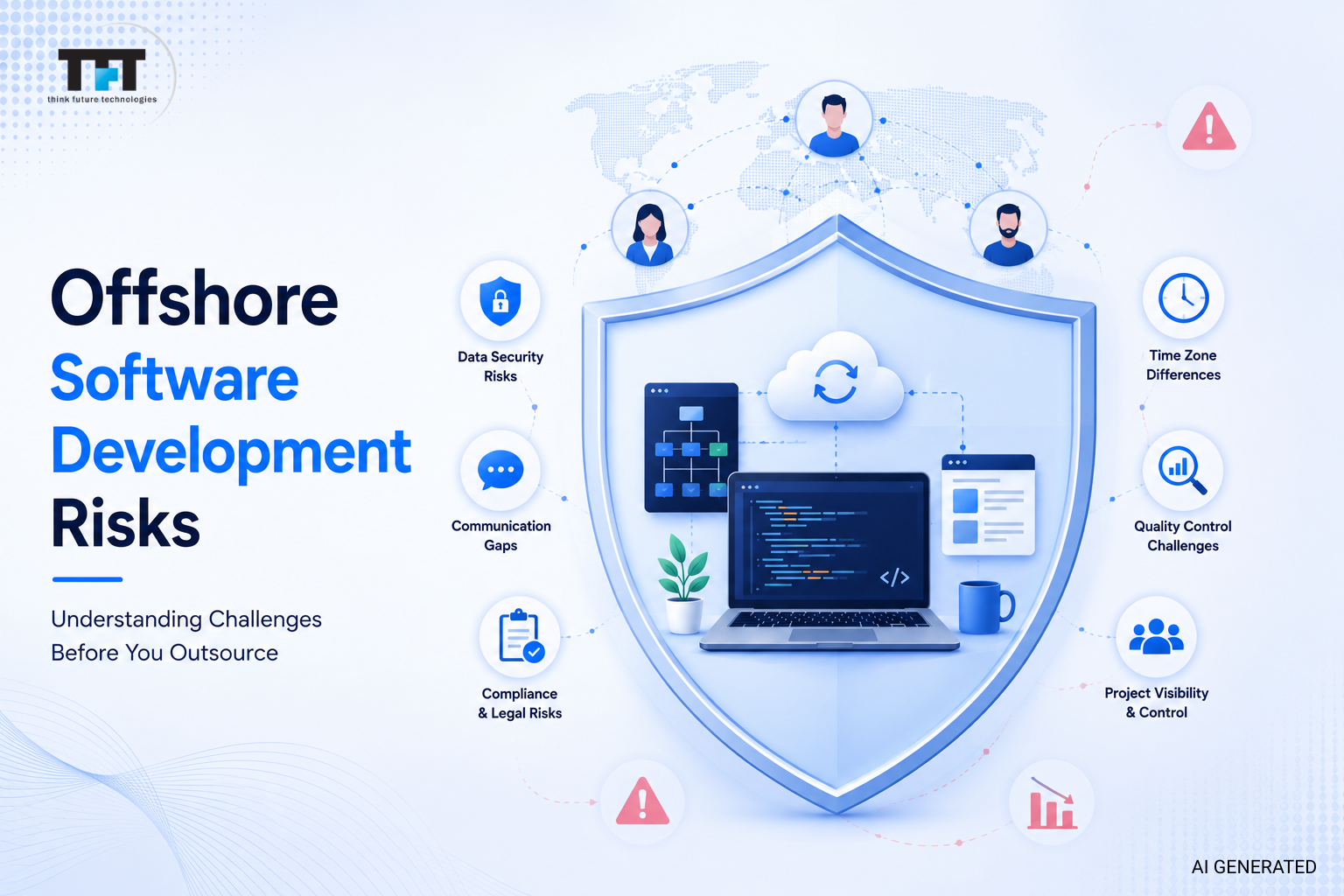
Offshore outsourcing gives companies access to global talent at lower costs, but it also introduces security risks such as data breaches, intellectual property theft, and compliance issues.
According to IBM’s 2024 Cost of a Data Breach Report, the global average breach cost rose to $4.88 million, with third-party access remaining one of the most common attack vectors over the past year. Offshore development teams require access to code, databases, and deployment environments, making strong governance essential.
In this guide, the most critical offshore software development risks are discussed, the reasons they occur, and practical mitigation strategies are provided.
What Are Offshore Software Development Risks?
Offshore software development risks include security, legal, operational, and communication challenges that affect real-world projects across industries such as finance, healthcare, and SaaS.
Companies are at risk of data loss during offshore software development projects (47 percent), and regulatory obstacles are a major concern cited by 39 percent. These are numbers that show the prevalence of these problems, rather than their rarity.
The risks will be in four major areas: data security, intellectual property, compliance, and communication. They all need to be mitigated differently.
Before diving into the specific risks, listen to the podcast below. The episode explains how overlooking business and security risks during vendor selection can lead to costly project failures and shares practical frameworks for identifying and mitigating outsourcing risks early.
Risk 1: Data Breaches and Data Security Exposure
The offshore development security risk that is most financially harmful is data breaches. When delicate data is distributed internationally and through third-party systems, the attack surface becomes quite large.
Offshore developers may use personal devices, increasing the risk of exposing customer data, source code, and credentials through insecure connections or poor storage practices.
The mitigation would begin with applying end-to-end encryption to all data, both in transit and at rest. You should also implement stringent access controls so that offshore developers can access only the systems they require while undertaking their activities.
How to Protect Sensitive Data in Offshore Projects?
- Implement multi-factor authentication on all the systems that the offshore team has access to.
- Implement role-based access control to restrict access by job function.
- Have secure coding requirements and implement them through code reviews.
- Conduct third-party security audits at least once a year.
- Perform penetration testing before significant releases.
The US Department of Homeland Security states that organizations with effective cybersecurity measures have seen a reduction of data by a quarter. Security measures investment results directly in reducing breaches.
Risk 2: Intellectual Property Theft
One of the most devastating risks in offshore software development is intellectual property theft, since the damage is sometimes invisible and may not be realized until it is too late. Your product designs, trade secrets, source code, and other algorithms can be duplicated without being traced.
Outside firms are highly likely to access proprietary systems with offshore development. In the absence of established intellectual property rights in contracts, ownership disputes are challenging and very costly to resolve.
Having clear legal coverage established before work. This includes the signed non-disclosure agreements, explicit IP ownership provisions in your development contract, and legal review by jurisdiction.
Legal Protections Against IP Theft
The bottom line is non-disclosure agreements NDAs. All the offshore team members (not only the vendor company) are supposed to sign one each. The NDA must state the governing law and the available remedies.
Strong contractual obligations must clearly state that all work developed as code, documentation, and assets belongs to your company. One of the pitfalls that poses a risk is the use of vague language on ownership. Legal counsel well-versed in the vendor’s local laws should review the IP clauses.
Where possible, register your intellectual property. Copyrights, patents, and trademarks offer legal redress that contracts lack.
Risk 3: Compliance and Data Protection Law Failures
There are varying data protection laws across countries. The fact that your offshore team will operate under a different jurisdiction does not absolve your company of its compliance requirements. How your customers’ data is used is your responsibility.
The General Data Protection Regulation requires that the data the offshore teams will access be governed by stringent data processing agreements. One of the GDPR cases in 2023 led to a fine of 1.2 billion. The obligations imposed on US companies that process European users’ data do not depend on the development team’s location.
Extravagance of financial institutions further complicates the matter. Fintech companies and banks must comply with the rules and policies of the OCC, FDIC, and FFIEC, all of which may impose requirements on the management of third-party vendors and offshore partners.
Compliance Requirements to Address
- Map what protection data laws are: GDPR, CCPA, HIPAA, or industry-specific laws.
- Enforce data protection in offshore vendor contracts.
- Get the offshore team to adhere to stringent data protection practices that align with your own.
- Conduct annual compliance audits of the offshore development team.
- Employ data processing agreements that specify data storage and processing locations.
Risk 4: Communication Barriers and Cultural Gaps
In offshore software development, communication barriers are a neglected cause of project failure. The ultimate misunderstandings generated by language differences, time zone differences, and cultural barriers to effective communication compound over time.
What appears obvious to one when viewed briefly may imply something different to a group of people working in a new cultural setting. These discrepancies result in rework, missed deadlines, and cost increases that affect business goals.
The answer lies in establishing well-defined communication channels during the initial stages and maintaining them throughout the development lifecycle.
How to Establish Clear Communication Channels?
Project management software such as Jira, Linear, or Asana develops a public history of work. It decreases the use of verbal interaction over time zone lines and provides a single place of fact about project timescales and who to report to on what.
Arrange periodic structured interactions: daily meetings, weekly meetings, monthly executive/managerial reports. A written note of all this. Conversations with long-distance partners are hard to enforce and forget.
GitHub or GitLab is a version control tool that allows you to build audit logs of code changes and simplify the process of understanding what, who, and when something was built. They are critical in managing a distant development team regardless of size.
Risk 5: Quality Assurance and Inconsistent Development Practices
Direct offshore software development risk that impacts your end users is quality assurance gaps. A team of offshore workers, who do not have proper standards, often may generate the concept of a code that may be approved internally but falls apart in production.
The practices of development among regions and vendors are very different. By not applying secure coding practices and code quality criteria, you are relying on the internal criteria that the vendor has, which may not be in line with your own requirements.
Build common quality standards prior to the project. Specify the meaning of done. Ensure that code reviews, automated tests and well-defined acceptance criteria of each deliverable are required.
Quality Assurance Standards for Offshore Teams
- Insist on automated coverage of test coverage thresholds.
- Adopt agile software development techniques and have well-defined sprint acceptance criteria.
- Perform a code review whenever at least one internal engineer is available to review offshore output.
- Write down and distribute your secure coding standards at the project kickoff.
- Set post-deployment production performance monitoring procedures.
Risk 6: Third-Party and Supply Chain Vulnerabilities
The offshore software development project is usually based on third-party libraries, APIs, and even cloud platforms, which the offshore team selects. All dependencies have a possibility of being exploited by other security vulnerabilities.
One unpatched library has the potential to put all your applications at risk. Offshore development trend analysis by JoinGenius indicates that the cloud infrastructure dependencies in contemporary offshore development have concentrated the security hazards, and the present tendencies underline cloud security modes that would support the offshore development teams and offshore patterns of access.
Make the offshore vendor have a Software Bill of Materials (SBOM), where all dependencies are listed with their version. Revise and test it every specified time and make updates to the vulnerabilities reported.
Choosing the Right Offshore Vendor
Offshore partners are not inherently equal in the amount of risk that they present. The most leveraged decision in offshore software development is vendor selection.
Assess the security certification in place by the offshore vendor. An indication of a managed information security program is ISO 27001 certification. In SOC 2 Type II reports, it can be noted that controls of the vendor have been audited independently over time. Vendors who do not have either of the two certifications should be scrutinized.
Questions to ask are how they have their secure communication channels, the process by which they respond to security incidents, and how they have dealt with previous security incidents. A supplier unable to respond to these questions with honesty is not equipped to deal with your sensitive information.
Offshore Software Development at Scale
The offshore software development risk increases with complications with businesses whose needs are characterized by 25 to 100 or more product lines, locations, or user groups. A security policy that fits one team might not encompass data flows, application patterns, and compliance requirements of a large-scale offshore engagement.
At this scale, offshore development proactive management is a governance activity, rather than a project management activity. You require a centralized control of all offshore access, a single security policy applied to all vendors, and periodic security review between vendors.
Assign a specific offshore security owner. This individual oversees compliance, deals with vendor relationships, is the owner of the incident response process in case of offshore-related incidents, and makes timely delivery of secure software a strong norm across all teams.
Conclusion
Offshore software development can deliver significant cost savings, access to global talent, and faster product delivery, but only when security is treated as a business priority rather than an afterthought. Understanding offshore software development risks—from data breaches and intellectual property theft to compliance failures and communication gaps—allows organizations to build stronger governance from the outset.
By selecting the right vendor, enforcing clear security policies, and conducting regular audits, businesses can reduce risk while maximizing the value of their offshore partnerships. With the right safeguards in place, offshore development becomes a strategic advantage instead of a security liability.
Frequently Asked Questions
What are the biggest offshore software development risks?
Data breaches due to weak remote access, stealing intellectual property with weak legal protections, compliance with GDPR or HIPAA, barriers to communication presenting project misalignment, and supply chain vulnerability due to third-party dependencies are the most significant risks. All of them need a particular mitigation strategy, rather than one.
How do you protect intellectual property in offshore software development?
Sign personal non-disclosure contracts with each member of the team. Include in your development contract a verbatim IP ownership provision indicating that all work product is owned by your company. Version control tools: Monitoring code ownership. Register trademarks, patents (where available). Get contracts audited by legal personnel who have knowledge of the local laws of the vendor.
What security protocols should offshore teams follow?
End-to-end encryption of all data should be used in transmission and at rest, multi-factor authentication should be used, observing the rules of secure coding, role-based access control should be used to restrict access, and they should take part in regular third-party security audits and penetration testing. These must not be optional but must be all necessitated by contract.
How do communication barriers affect offshore software development projects?
The misalignment of requirements, delays in decision-making, and more development costs through rework are brought about by the communication barriers. Create uniform lines of communication with the help of project management tools and version control tools. Document all decisions in writing. Structure scheduled contacts over time zones and use asynchronous video updates to lessen reliance on real-time calls.

Leave a Reply