

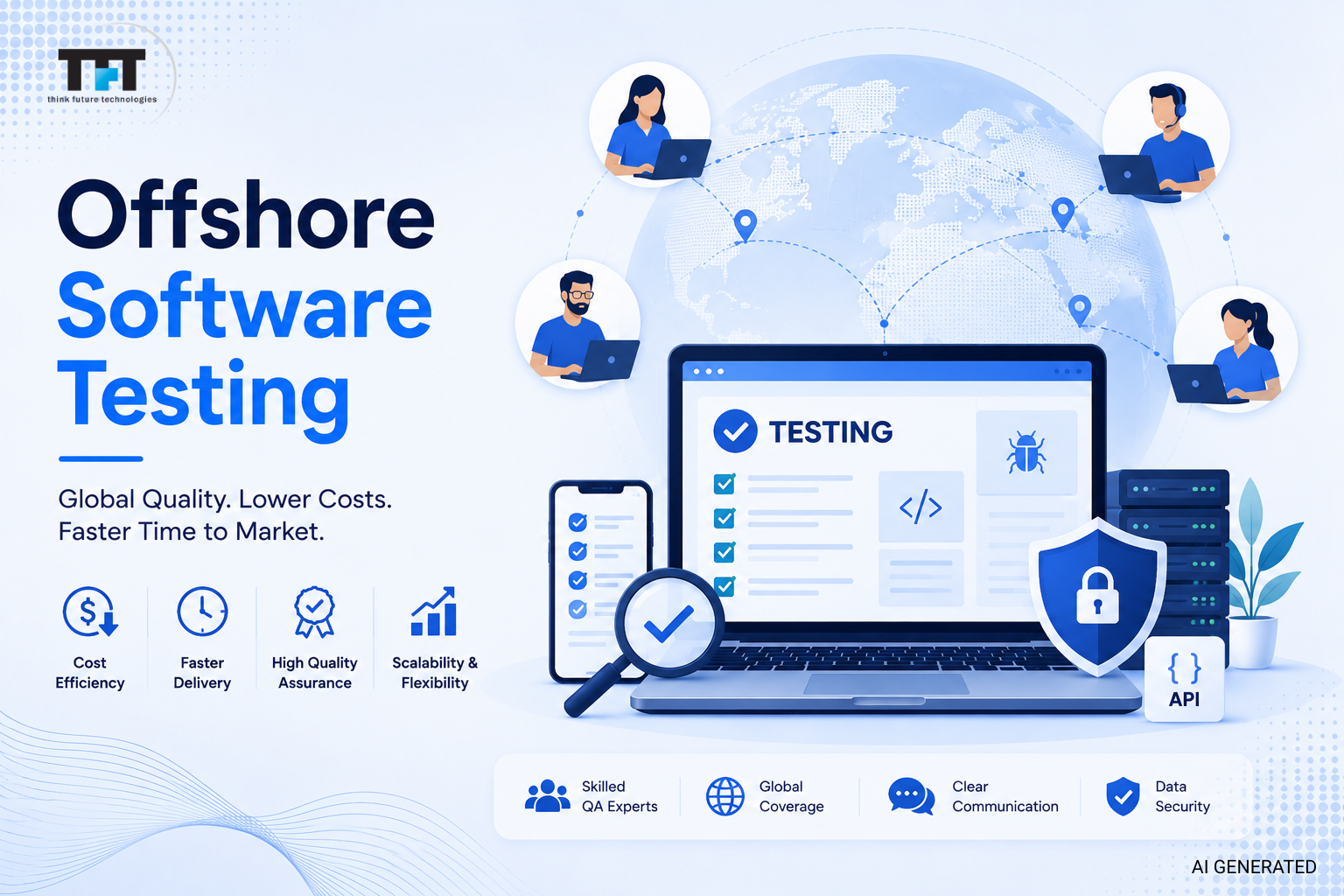
Businesses tap into the expertise of skilled QA teams in offshore software testing at a fraction of the cost of developing the same capability internally. This includes the entire spectrum of testing services, including functional testing and regression testing, as well as performance testing and security testing, performed by an offshore testing team in a different country.
In 2025, the market for outsourced software testing reached a high of 36.39 billion USD and is still expanding. The scale is an indication of the mainstreaming of the model. Offshore software testing services are used by companies in the US, UK, and Western Europe to save on testing costs, speed up release cycles, and tap into expertise that their in-house teams cannot deliver.
This guide provides all the information you need about offshore software testing. You will find out what it is, what services it offers, how offshore test data management works, best practices for running distributed QA teams, and how you can evaluate an offshore testing partner before you commit.
What Is Offshore Software Testing?
Offshore software testing refers to outsourcing the quality assurance to the testing engineers in a different country. The offshore team fits into your development process. They are working with your project managers and programmers. They provide testing throughout the software development process.
Offshore is the opposite of nearshore (next time zone) and onshore (within the same country). Offshore generally refers to Eastern Europe, South Asia, Southeast Asia, or Latin America. Companies save 50 to 70 percent of the QA costs as opposed to hiring locally. Quality stays high. Costs are also reduced through reduced infrastructure overhead and labor costs. Offshore partners work out of their testing centers.
Offshore Software Testing Services and Solutions
The offshore software testing firms provide various testing services that can be customized to match the various project types, technology stacks, and release schedules. Knowing the coverage of each service will assist you in determining the appropriate scope of your engagement.
Functional Testing
Functional testing ensures that every feature of the application is functional as per specifications. Offshore testers run test cases that test inputs, outputs, and system behavior with the requirements document. It is the most widespread service in any offshore QA testing engagement.
Functional testing identifies bugs that prevent the user from accomplishing their desired functions. It is used in web testing, mobile testing, and API-level validation. Offshoring QA teams specializing in functional testing provide a variety of experience in various frameworks and types of applications.
Regression Testing
Regression testing proves that the new code changes have not violated the previous functionality. It is vital to any software under development. Defects creep silently into the system unless regression testing is applied after each release, and they are detected in production.
Offshore testing services are effective in regression testing since the activity is orderly and repeatable. Regression suites can be run more quickly and accurately using automated testing frameworks compared to manual testing. Maintaining these suites by offshore automation engineers frees up the in-house team to work at higher levels.
Performance/Load Testing
Performance testing is used to test the performance of the application when it is loaded with realistic and extreme loads. It includes the response times, throughput, resource consumption, and stability during concurrent user volumes.
A load test is a simulation of a realistic number of users. Stress testing stretches further to reach the limits of breaking. They are both important in those applications where downtime or slow response has a direct business or financial impact. These tests are performed at scale by offshore performance testing teams with tools such as JMeter, Gatling, and k6.
Security Testing and Penetration Testing
Security testing finds out vulnerabilities ahead of attackers. Services offered by offshore security testing include OWASP top 10 tests, authentication test, SQL injection test, and data encryption test.
Penetration testing is an imitation of a real attacker trying to hack into the system.
Over half of tech leaders cited security as the largest software development problem in 2025. CREST or OSCP-certified offshore security testing teams provide a structured approach and external audit that internal teams are frequently unable to offer.
Usability Testing and Accessibility Testing
Usability testing determines whether or not actual users can accomplish their objectives using the software without frustration.
Accessibility testing ensures that the software complies with standards such as WCAG 2.1 and ADA, making it accessible to individuals with disabilities.
Both require human judgment. These evaluations can be carried out by offshore testers who have experience in user research and accessibility standards at a low cost. The results can be directly translated into UX enhancements that enhance customer satisfaction and decrease support levels.
Mobile Testing and Web Testing
Mobile testing ensures that the applications are operating well on various devices, screen sizes, and operating systems. Browser compatibility and responsive design are all encompassed under web testing. Both need a wide test coverage in numerous combinations that would be costly to run in-house.
Devices and browser testing clouds are a common offshore testing environment that can test hundreds of devices and browser combinations. A US-based in-house testing team would cost US 50,000 or more to reproduce this infrastructure.
Automation Testing
Test automation can be defined as the process of creating scripts that run test cases. Offshore automation engineers create and maintain automated test suites, which execute on each build in CI/CD pipelines. Automation testing saves on manual labor, offers a greater coverage of tests, and accelerates regression testing in each release.
The cost of offshore QA testing services is between $25-65 an hour, as opposed to the cost of onshore specialists between $75 and $150 an hour. The most acute cost efficiency of offshore teams is seen in the case of automation testing, in particular, where the work can be repeated, and the output increases with investment.
Offshore Software Testing Pricing Models
Knowing pricing models enables you to assess the offers of offshore software testing companies in a way that prevents the concealed expenses that eliminate profits.
Time and Materials
Time and materials billing involves an hourly cost for each offshore tester assigned to work on the project. This model is applicable to projects with a changing scope where the amount of testing work is difficult to establish upfront. The average offshore QA testing cost is between 15 and 80 per hour based on the area, experience, and specialization.
Fixed Price
Fixed price engagements represent an overall cost of a specified amount of testing work. This model is useful in highly defined projects whose test plan is fully specified before the commencement of work. It provides cost predictability and restricts flexibility with scope changes.
Dedicated Team
A dedicated offshore testing team, directly hired, is a team of QA engineers who will work on your project at a fixed monthly fee. The model is effective during long-term engagements in which continuity, extensive knowledge of the application, and foreseeable capacity are valuable compared to project-by-project flexibility.
According to Capgemini’s 2025 offshore testing study, organizations can reduce software testing costs by more than 25% by using offshore QA teams while maintaining quality through structured processes and specialized testing expertise. This is one of the primary reasons offshore testing continues to grow across enterprise software development.
Best Practices: Offshore Software Testing
Making an offshore testing engagement successful requires more than a contract. These are practices that can make the difference between high-performing and struggling offshore QA teams.
Define a Clear Test Plan Before Work Begins
A test plan specifies what is to be tested, how to test it, which tools to use, and who is to do the testing. In the absence of one, there is no direction in which offshore testers operate, and gaps in coverage cannot be avoided.
The onshore project manager and the offshore QA team lead should agree on the plan prior to writing any test cases. It ought to include testing scope, entry and exit conditions, and severity of defects.
Watch: Software Testing Trends of 2026 – How the QA Landscape Is Evolving
Modern offshore QA teams are increasingly adopting automation, AI-assisted testing, DevSecOps, and continuous testing practices. This video explores the latest software testing trends shaping quality engineering in 2026 and provides valuable context for the best practices discussed throughout this guide.
Invest in Thorough Onboarding
Testers offshore who lack knowledge of the application write superficial test cases. During testing, the system architecture documentation, user personas, business logic, and past defect history are provided.
Test writers who comprehend the reason behind the existence of the application write much more relevant cases than test writers who read the technical spec. The onboarding investment will be recovered sooner in the number of clarification cycles and defects identified.
Establish Clear Communication Standards
Asynchronous gaps arise from differences in time zones, in which blockers accumulate. Agreeing on communication standards prior to work commencement prevents offshore engagements from derailing due to their failure to achieve their goals.
Establish consensus on the tools the team will use, defect format, and the escalation route to use when there is a critical bug, and the frequency of communication with the offshore testing team. Having answers to these questions clearly is more important than the choice of tool.
Use Overlapping Working Hours for Real-Time Collaboration
A majority of offshore testing models have two to four hours of overlapping work hours daily. Standups, defect triage, and issue resolution should all be done using those windows.
Reserve asynchronous time to run work: executing test cases, writing documentation, and writing handoff notes. Use synchronous time to make decisions and clarifications. This division renders the two modes more fruitful.
Combine Manual Testing and Automated Testing
Mechanized testing includes regression testing, load testing, and redundant functional checks. Manual testing is used to cover exploratory situations, usability testing, and edge cases not covered by automation.
Manual testing teams will not be fast enough to keep up with contemporary release cycles. Teams that rely on automation alone fail to capture the human judgment that scripts are incapable of detecting the defects. The correct ratio varies depending on the type of project and frequency of release.
Offshore Test Data Management
Probably one of the least discussed aspects of offshore software testing is offshore test data management. The way test data is generated, handled, and secured influences the quality of the test as well as the security of the test data.
Why Test Data Management Matters?
Bad test data results in bad test results. Without data to test a payment processing API that is representative of the actual transaction patterns, tests will not expose the bugs that the real transactions will invoke.
Simultaneously, sensitive data and customer data should not be transferred to an offshore testing environment without having the necessary controls. Sharing customer data means a breach has regulatory implications under the GDPR, CCPA, and HIPAA, which can be expensive, in the millions of dollars.
Safe Test Data Practices
Anonymize production data to hide personal data using data masking tools, producing anonymized data that retains realistic patterns. Applications such as Delphix and Informatica do this and design test data that is able to stand a compliance audit.
Create fake test data in situations where masked production data is insufficient. Synthetic data addresses certain edge cases, boundary conditions, and failure scenarios that might not be represented by production data. This provides the entire range of input to the offshore team.
Access Controls for Sensitive Data
Deploy role-based access control that only allows the offshore testing team to access data when required. A tester conducting functional testing on user registration will not require access to payment information or financial records.
Record information on what data is available to the offshore team, how, and when this data should be deleted. Get these terms in the contract prior to work. There is no security preference, but a compliance requirement that any company with EU or US-regulated information must use access controls.
Real-World Example: Seamless Offshore Team Integration
RealTyme, a cybersecurity software company, partnered with an offshore QA team from DeviQA to test REST APIs, SDKs, and multi-cloud environments across Azure, Google Cloud, Docker, and LXC. Despite operating as a distributed team, the engagement reported zero integration problems, largely because the offshore engineers followed structured onboarding processes and became an extension of the client’s engineering team rather than an external vendor.
The project demonstrates how clearly defined communication protocols and technical onboarding can eliminate many of the collaboration challenges commonly associated with offshore testing.
Pricing by Region (2026)
| Region | Junior QA ($USD/hr) | Senior QA ($USD/hr) | Notes |
| India | $15 to $25 | $30 to $50 | Largest talent pool, follow-the-sun model |
| Eastern Europe | $25 to $45 | $45 to $80 | Strong cultural alignment with US and UK |
| Latin America | $20 to $40 | $40 to $65 | Nearshore advantage for US teams |
| Southeast Asia | $15 to $30 | $30 to $55 | High volume capacity, growing automation skills |
| US Onshore | $75 to $100 | $100 to $150 | Highest cost, maximum time zone overlap |
Source: Testriq outsourced QA cost data 2026, TFTUS offshore testing cost analysis 2026
When Offshore Software Testing Does Not Work
The offshore software testing is not a suitable model in all circumstances. Knowing when it is performing poorly will help you avoid costly errors.
When the Application Requires Deep Business Context
Test cases will be written by offshore testers who fail to comprehend the industry, the regulation, and the user base. In case you need testers who can reason like a financial advisor, a nurse, or a logistics coordinator, a generic offshore team will not work, unless you invest heavily in onboarding.
When Communication Cannot Be Structured
When your development process requires a permanent informal interaction between developers and testers, then a remote offshore team will not fare well. Offshore testing is effective when the work is organized, documented, and transferred to other parts by defined processes. Real-time-dependent workflows that are not structured do not cross long time zone boundaries.
When Data Security Requirements Are Not Addressed Upfront
When you are dealing with sensitive data in your application, and your legal team has not discussed the terms of data handling with the offshore partner, the engagement poses compliance risk. This is solvable. It should be resolved prior to work commencing, but not once an issue has arisen.
Offshore Software Testing at Scale
The scale of offshore software testing dictates that the governance structures needed by small engagements are unnecessary as companies commence to manage 25 or more products or integrations.
Assign a Dedicated Internal QA Lead
This individual has the offshore testing relationship, the testing standards, and quality measures in all the offshore QA teams. In the absence of central ownership, individual offshore teams will build inconsistent practices and inter-product coverage gaps.
Share a Test Management Platform.
TestRail, Zephyr, or similar tools provide you with insight into the test coverage, defect rates, and execution coverage in every offshore engagement. This is what gives evidence-based release decisions at scale.
Define Uniform Quality Gates
The same standards of defect escape rate should be applied to an offshore software testing team working on Product A as to a team working on Product B. Homogeneous standards will ensure that the lowest performing offshore team does not become the bottleneck in your release pipeline.
Choosing an Offshore Software Testing Company
In an offshore software testing engagement, a vendor selection is more of your fate than any other decision.
Verify Industry and Application Experience
Even at the same rate, a company with a history of successful experience in fintech security testing is not equal to a generalist QA shop. Before shortlisting, seek case studies and reference calls of former clients.
Check Certification Credentials
The maturity of information security management is validated by ISO 27001. CREST certification is an indicator of penetration testing. Their testers are certified by the ISTQB, which guarantees a structured testing methodology. These qualifications minimize your risk of evaluation.
Run a Paid Pilot First
The quality of communication, level of technicality, documentation, and reliability of delivery can be judged in a four to six-week pilot on a real, bounded deliverable rather than any RFP process. Do not enter into a long-term contract without it.
Conclusion
Offshore software testing provides actual cost savings, accelerated test times, and accessibility to specialized QA skills that most companies cannot develop in-house at equal cost. The model is effective when properly managed: a well-prepared test plan, a disciplined communication process, test data management, and the offshore testing partner that is carefully chosen to contribute proven capability to your project. View offshore software testing as a business expansion of your testing quality assurance department, and it will always be capable of providing quality testing services that save your users and speed up your releases.
FAQs
What is offshore software testing, and how does it work?
Offshore software testing refers to the concept of outsourcing a QA team to a foreign country to test your software to specifications. The offshore testing team performs test cases under functional testing, regression testing, performance testing, and security testing. The communication is based on structured daily handoffs, project management tools, and predefined overlap windows to use in real-time calls.
How much does offshore software testing cost?
Common prices of offshore QA testing services are 15-80 per hour, depending on the area of operation, experience, and specialization. The lowest rates are found in India and Southeast Asia, with rates of $15 to 50 per hour. Eastern Europe is between 25 and 80 per hour, with a greater cultural fit for US and UK businesses. The US in-house QA engineer is more expensive at up to 132,900 per year with overhead, versus 30,000-80,000 in the case of an offshore tester.
What types of testing do offshore teams handle?
Functional testing, regression testing, performance testing, load testing, security testing, penetration testing, usability testing, accessibility testing, mobile testing, web testing, and automation testing are all done by offshore testing teams. Effective services will depend on the scope of the project, the capability of the offshore testing company, and the compliance and quality requirements of the client.
How do you manage data security with an offshore testing team?
Instead of sharing the actual production data with offshore testers, use data masking or synthetic data generation. Use role-based access controls to restrict the access of offshore team members to what each tester particularly requires. Incorporate data processing agreements and terms of NDA in the contract prior to work. When sharing any data on any customer, verify the terms of GDPR compliance before sharing that data.

Leave a Reply