

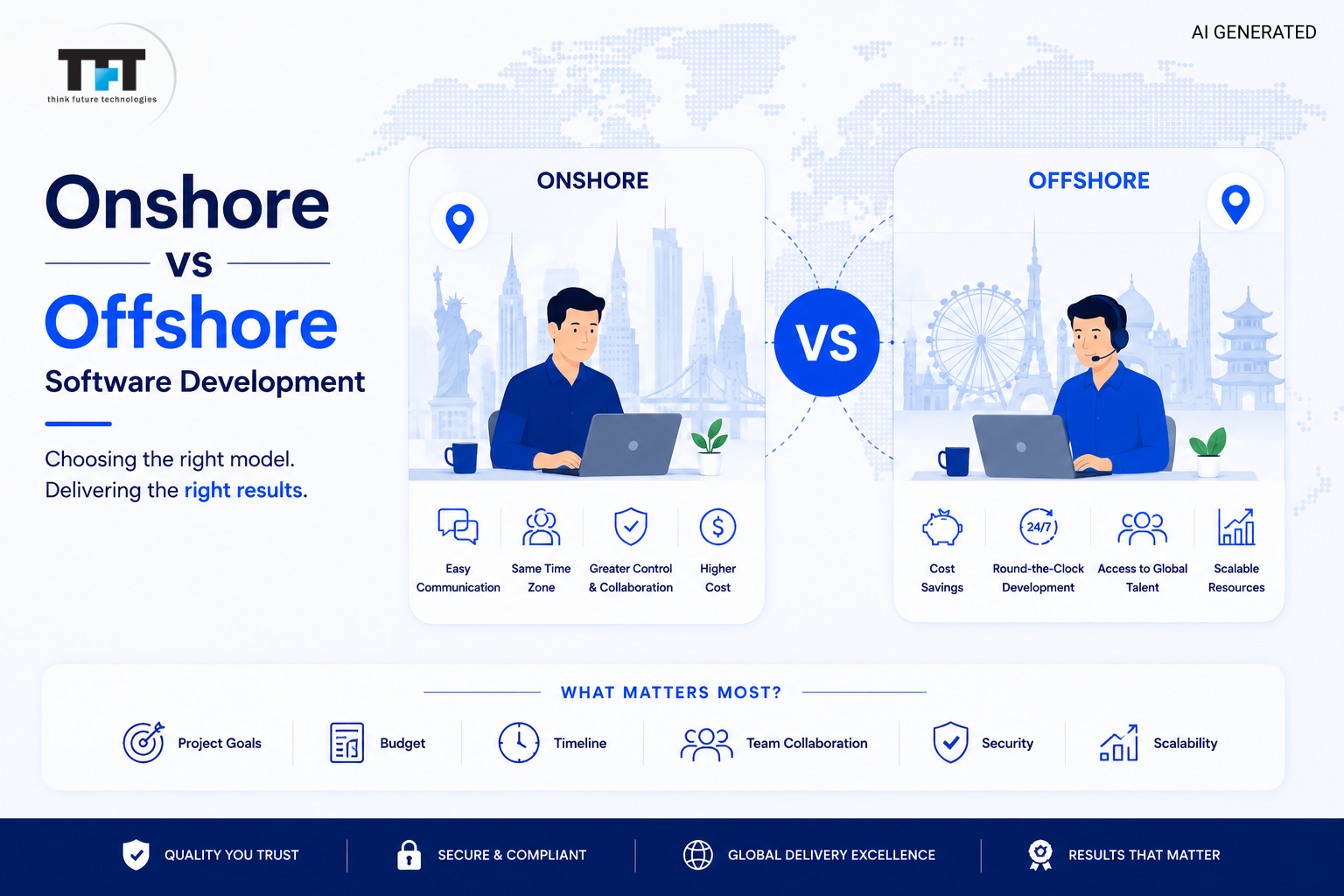
Choosing between onshore and offshore software development is one of the most consequential decisions a business makes before starting a custom software development project. The choice affects your budget, your timeline, how closely you can oversee the work, and even which legal frameworks govern your contract. Yet many teams pick a model based on habit or a single quote, without weighing the trade-offs that actually determine delivery success.
This guide breaks down onshore vs offshore software development in practical terms, what each model means, where the real differences lie, and how to decide which one, or which combination, fits your project.
Whether you’re evaluating your first offshore development team or reconsidering an onshore vendor relationship that’s grown expensive, the same core questions apply: how much oversight do you need, what does your budget allow, and how complex is the work you’re outsourcing?
What Is Onshore Software Development?
Onshore development means hiring a software development team located in your own country. An onshore team typically shares your time zone, business culture, and legal system, which removes several layers of friction from day-to-day collaboration. Companies in the United States hiring a development team elsewhere in the U.S. are a classic example of the onshore model.
Because onshore developers operate under the same national regulations and speak the same primary language as your internal staff, onshore projects tend to move through requirements gathering and stakeholder review faster, with fewer clarifying rounds needed.
What Is Offshore Software Development?
Offshore software development means contracting a team based in a different country, often one with a significantly lower cost of living and labor costs. Popular offshore locations include India, Ukraine, the Philippines, and parts of Latin America and Eastern Europe. Offshore outsourcing gives companies access to a much larger and more specialized talent pool than they could tap locally.
Offshore development has grown from a cost-cutting tactic into a mainstream delivery model, with entire product teams, from QA to DevOps, now routinely built offshore rather than staffed as a single outsourced role.
Onshore vs Offshore Software Development: Key Differences
The onshore vs offshore decision comes down to a handful of factors that show up in nearly every comparison: time zones, cost, communication, culture, regulation, talent, and oversight.
Time Zones and Working Hours
An onshore development team works the same time zone as your internal staff, which means real-time collaboration during normal business hours. Offshore teams may have limited overlapping work hours, or none at all, which can slow down quick decisions and same-day fixes. Some businesses offset this by choosing offshore locations with a few hours of overlap, rather than a full twelve-hour gap.
Cost Structure and Labor Costs
This is usually the single biggest driver of the onshore vs offshore conversation. Offshore developers, especially in regions with lower labor costs, can charge a fraction of onshore rates for comparable output. That cost efficiency is the main reason offshore outsourcing has grown into a mainstream model rather than a niche one, often delivering 40–70% in cost savings over onshore rates for similar skill levels.
Communication and Language
Onshore teams typically share your primary language and communication norms, reducing the chance of misunderstandings in requirements or feedback. Offshore teams may have strong technical English but different communication styles, which can require more structured documentation to avoid ambiguity in specs, tickets, and acceptance criteria.
Cultural Alignment and Business Culture
Business culture shapes how teams handle deadlines, disagreement, and status updates. An onshore partner usually mirrors your own business culture, while an offshore vendor may operate under different norms around hierarchy, directness, or escalation, none of which are wrong, but all of which require adjustment on both sides to avoid friction later in the project.
Regulatory Compliance and Legal Considerations
Onshore companies operate under the same national regulations as your business, which simplifies contracts, data handling, and legal compliance. Offshore development can introduce added complexity around data protection laws, intellectual property protection, and cross-border contract enforcement, particularly in regulated industries like healthcare or finance where strict national regulations govern how data can be stored and processed.
Talent Pool and Specialized Expertise
Offshore outsourcing opens the door to a global talent pool with specialized expertise that may be scarce or expensive locally. Onshore hiring, by contrast, is often constrained by a smaller local talent pool, especially for niche technical skills like machine learning engineering or legacy systems maintenance.
Oversight and Project Management
Onshore teams are easier to visit in person, sit in on meetings during your business hours, and manage with familiar project management habits. Offshore project management usually depends more heavily on asynchronous tools, documented processes, and a trusted point of contact on the vendor side who can translate day-to-day decisions back to the wider offshore team.
Benefits of Onshore Development
Real-Time Collaboration and Direct Oversight
Shared business hours mean questions get answered quickly, blockers get resolved same-day, and stand-ups happen without anyone joining at midnight. That proximity also makes it easier to visit the team in person, audit code quality directly, and build the kind of trust that comes from shared physical presence rather than screen-based check-ins alone.
Cultural Alignment and Simplified Compliance
Cultural alignment reduces friction in negotiations, feedback, and everyday communication, since both sides are working from similar assumptions about how business gets done. On top of that, working within your own country means one legal system and far less ambiguity around intellectual property protection, liability, and contract enforcement.
Drawbacks of Onshore Development
Higher Development Costs and a Smaller Talent Pool
Onshore development costs are consistently higher than offshore rates, which can strain budget constraints on longer or larger projects. Even strong local markets have limits, too; highly specialized skills, such as certain AI, blockchain, or legacy systems expertise, may simply be harder to find onshore than the cost premium would suggest.
Benefits of Offshore Development
Cost Efficiency and Savings
Lower labor costs in offshore locations translate directly into cost savings, freeing up budget for other parts of the product roadmap without necessarily compromising quality when the vendor is properly vetted.
Access to Global Talent and Scalability
Offshore hiring taps a global talent pool, giving businesses access to specialized expertise across a much wider geographic range than any single local market offers. Offshore development teams can also often scale up or down faster than onshore vendors, since larger firms maintain bigger benches of developers ready to join a project on short notice.
Drawbacks of Offshore Development
Time Zone and Communication Challenges
Limited overlapping work hours can delay feedback loops and slow down anything that needs quick, real-time interaction. Layered on top of that, language nuance and different communication norms can lead to misunderstood requirements if documentation and processes aren’t tight from the start.
Cultural Differences and Regulatory Considerations
Different assumptions about hierarchy, deadlines, or how to flag problems can create friction until both sides adjust to each other’s working style. Cross-border contracts also need to account for how the offshore location’s local laws treat data protection and intellectual property protection, since enforcement mechanisms vary widely by country.
Offshore Outsourcing: How the Model Works
Offshore outsourcing typically works through a vendor company that employs its own developers and assigns them to client projects, rather than you hiring individuals directly.
Choosing and Structuring an Offshore Development Team
Vetting an offshore development team means reviewing past project portfolios, checking references, and confirming the team’s specific technical expertise matches your project’s needs, not just their general reputation. Once you’ve chosen a partner, clear contracts, documented scope, and defined communication cadences matter more offshore than onshore, since there’s less opportunity for informal, in-person course correction when something goes off track.
When to Choose Onshore Development
Onshore development tends to make sense for projects with heavy regulatory requirements, close collaboration needs, or complex, evolving requirements that benefit from constant real-time interaction with the development team throughout the build.
When to Choose Offshore Development
Offshore development suits well-defined projects, teams working with tight budget constraints, and companies that need specialized skills not readily available in their own country. It also works well for projects where requirements are stable enough to document clearly upfront.
Hybrid Model: Combining Onshore and Offshore Development
Many companies don’t choose one model exclusively; they combine onshore and offshore development into a hybrid model that captures the strengths of both.
How a Hybrid Team Structure Works and Its Benefits
A common hybrid team structure keeps product strategy, architecture, and client-facing roles onshore, while offshore developers handle a larger share of implementation and testing work. This balances cost savings from offshore labor with the oversight and cultural alignment of an onshore presence, often producing the best overall outcome for mid-size and complex projects that need both control and scale.
Key Factors to Consider When Choosing Between Onshore and Offshore
Project Complexity and Time Zone Overlap
Highly complex projects with shifting requirements often benefit from the tighter feedback loops of onshore or same-time-zone teams. Even a few overlapping work hours each day can make offshore collaboration feel nearly as responsive as onshore work, so the size of the time zone gap matters more than raw geographic distance.
Budget Constraints and Project Length
If budget constraints are the primary driver, offshore development usually delivers the largest cost efficiency gains. Short, well-scoped projects also tend to tolerate offshore’s communication overhead better than long-running products that need constant onshore-style iteration over many months or years.
Intellectual Property Protection
Review how the offshore location’s local laws treat intellectual property protection, and make sure contracts specify governing law, confidentiality terms, and enforcement mechanisms clearly before any code is written.
How to Choose the Right Outsourcing Model for Your Business
There’s no universally right outsourcing model, only the one that matches your project’s complexity, budget, and compliance needs. Start by listing your non-negotiables, such as regulatory requirements, real-time collaboration needs, or a hard budget ceiling, then match those against what onshore, offshore, or a hybrid model can realistically deliver.
Common Myths About Offshore Software Development
A persistent myth is that offshore automatically means compromising quality. In reality, quality depends far more on vendor vetting, technical expertise, and structured processes than on the offshore location itself. Another myth is that offshore teams can’t handle complex projects; many offshore development teams specialize in exactly that, running enterprise-grade systems for clients around the world.
Best Practices for Successful Onshore or Offshore Partnerships
Frequent Communication
Regular, structured check-ins, not just ad hoc messages, keep both onshore and offshore teams aligned on priorities and blockers before small issues turn into missed deadlines.
Clear Project Management Processes
Documented workflows, defined ownership, and consistent status reporting matter for any outsourcing model, but especially for offshore development teams working with limited overlapping hours where quick verbal clarification isn’t an option.
Vetting Offshore Vendors
Check technical expertise through code samples or a paid trial project, confirm data protection practices, and speak with existing clients before signing a long-term contract with offshore partners.
Onshore vs Offshore: Which Is Right for You?
If real-time interaction, strict national regulations, and cultural alignment matter most, onshore is worth the premium. If cost efficiency, access to a global talent pool, and scalability matter most, offshore delivers strong value. Many businesses land on a hybrid model that captures both, adjusting the mix as the project matures.
Conclusion
Onshore vs offshore software development isn’t a question with one right answer; it’s a trade-off between cost, control, and complexity that plays out differently for every business. Weigh your project’s regulatory needs, budget, and time zone tolerance carefully, vet any offshore partners thoroughly, and don’t rule out a hybrid model that blends onshore oversight with offshore cost savings.
FAQs
Is offshore software development cheaper than onshore?
Yes, offshore development is typically cheaper due to lower labor costs in offshore locations, though total cost also depends on project management overhead and the tooling needed to support remote collaboration.
Does offshore development mean lower quality?
Not inherently. Quality depends on the vendor's technical expertise, processes, and oversight, not on the offshore location itself, so vetting matters more than geography.
What is a hybrid onshore-offshore model?
A hybrid model combines an onshore team for strategy and client-facing work with an offshore team for implementation, balancing cost savings with direct oversight throughout the project.
How do time zone differences affect offshore projects, and what should I check before hiring an offshore team?
Time zone differences can slow down real-time collaboration, though even a few overlapping work hours per day can keep offshore projects responsive. Before hiring, review the team's portfolio, verify specialized expertise relevant to your project, confirm data protection and intellectual property practices, and start with a smaller trial project before committing long-term.

Leave a Reply