

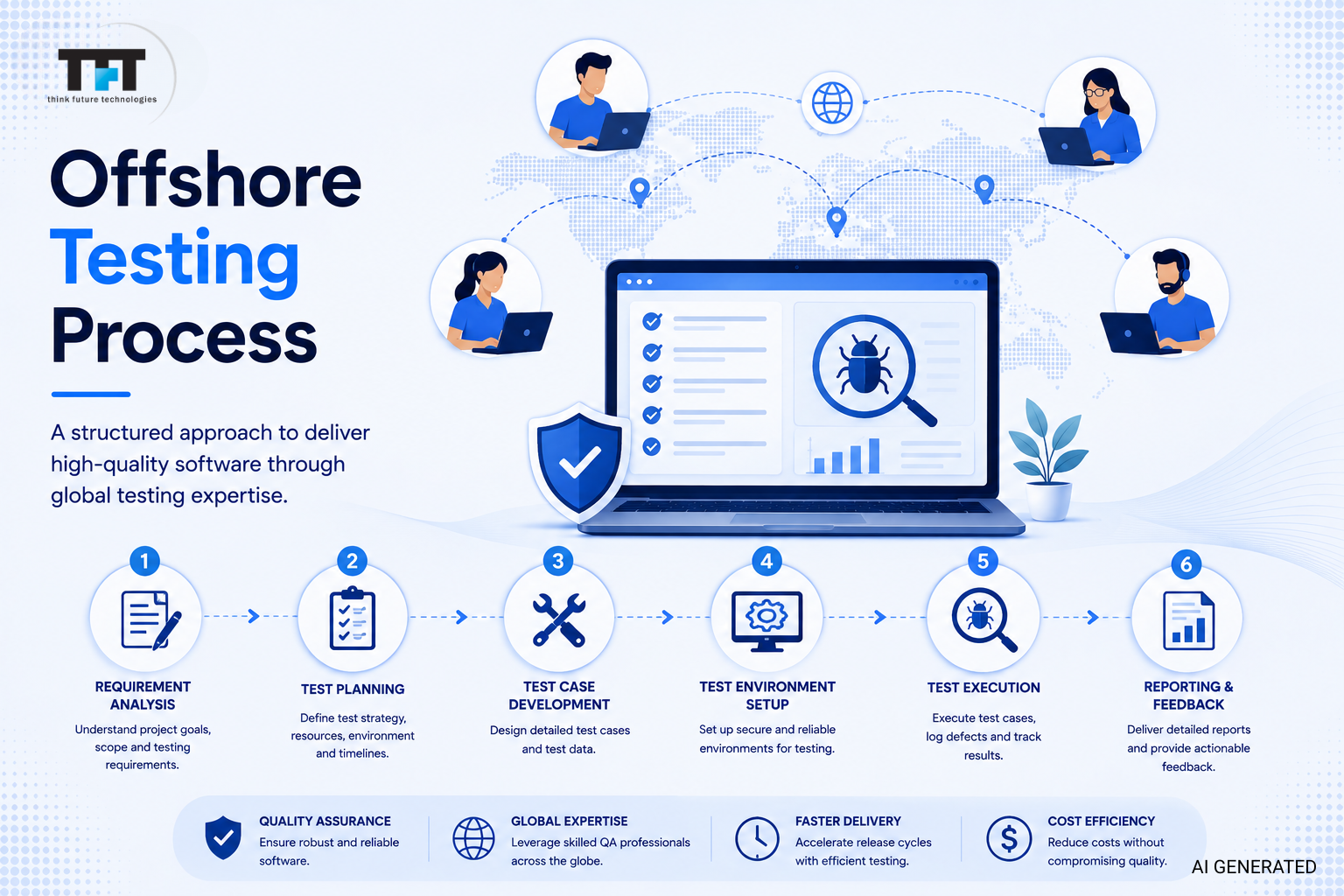
Every software product lives or dies by its quality, and quality is impossible without rigorous testing. As companies race to ship faster while controlling costs, many are turning to offshore software testing services to keep pace. But offshoring testing isn’t as simple as handing over a codebase and waiting for a report. It requires a defined offshore testing process, the right offshore testing teams, and a shared understanding of what “quality” means for your product.
This guide walks through the offshore testing process end to end, from initial requirements gathering to final sign-off, so you know exactly what to expect and how to set your offshore QA partnership up for success.
What Is Offshore Testing?
Offshore testing is the practice of delegating software testing, functional, regression, performance, and more, to a team located in a different country, often to reduce costs, access specialized skills, or enable round-the-clock testing cycles. It’s a subset of the broader offshore software development model, where entire pieces of a product’s lifecycle are handled by geographically distributed teams.
Unlike simply outsourcing a task, offshore testing typically involves an ongoing relationship: a dedicated team that becomes deeply familiar with your product, your users, and your quality standards over time.
Why Companies Choose Offshore Software Testing Services
Cost Efficiency Without Compromising Quality
The most obvious driver is cost. Offshore testing teams, especially those based in regions with lower operational costs, can deliver the same rigor as in-house teams at a fraction of the price. This frees up the budget for product development and innovation.
Access to Specialized Talent
Offshore software testing services often bring specialized skill sets, test automation engineers, performance testing specialists, and security testers who might be hard or expensive to hire locally.
Faster Time to Market
With teams working across time zones, testing can continue after your in-house team logs off. This “follow-the-sun” model shortens the overall software development and release cycle.
Scalability
Offshore testing teams can scale up or down based on project needs, which is especially useful for companies with fluctuating workloads or seasonal release cycles.
Core Offshore Testing Requirements
Before diving into the process itself, it’s worth understanding the offshore testing requirements that make the engagement work.
Clear Documentation
Offshore testing teams need detailed requirements documents, user stories, acceptance criteria, and existing test cases. Ambiguity here is the single biggest cause of miscommunication in offshore QA relationships.
Defined Communication Channels
Daily stand-ups, shared dashboards, and clear escalation paths are non-negotiable. Without them, language barriers and time zone gaps can quickly turn into missed deadlines.
Access to the Right Tools and Environments
Offshore teams need access to staging environments, bug tracking systems, version control, and CI/CD pipelines, with proper security controls in place.
Defined Quality Benchmarks
What does “done” look like? Offshore software testing requirements should specify pass/fail criteria, acceptable defect density, and performance thresholds upfront.
The Offshore Testing Process: Step by Step
Step 1: Requirement Gathering and Scoping
The process begins with a deep dive into your product, its architecture, and its business goals. The offshore testing team reviews existing documentation, interviews stakeholders, and identifies which types of testing, functional, regression, performance, and security, are needed.
Step 2: Test Planning and Strategy
Next comes the test plan: scope, objectives, resource allocation, timelines, and tools. A strong test strategy also defines the mix of manual and automated testing, since not every scenario benefits from automation.
Step 3: Test Case Design
Test cases are written to cover functional requirements, edge cases, and user workflows. For mature offshore testing teams, this step also includes traceability matrices linking each test case back to a specific requirement.
Step 4: Environment Setup
The offshore team configures test environments that mirror production as closely as possible, including data sets, integrations, and third-party dependencies.
Step 5: Test Execution
This is where the bulk of the work happens. Testers execute manual and automated test cases, log defects, and track results against expected outcomes.
Step 6: Regression Testing
Every time new code is introduced, regression testing ensures that existing functionality hasn’t broken. This is one of the most valuable services offshore testing teams provide, since it’s repetitive, time-consuming, and ideal for round-the-clock coverage.
Step 7: Performance Testing
Performance testing evaluates how the application behaves under load, checking response times, throughput, and stability during peak traffic. Offshore QA teams often run these tests using dedicated tools that simulate thousands of concurrent users.
Step 8: Defect Reporting and Triage
Bugs are logged with clear reproduction steps, screenshots, and severity ratings, then triaged with the development team to prioritize fixes.
Step 9: Retesting and Verification
Once defects are fixed, testers verify the fix and confirm no new issues were introduced, closing the loop back to regression testing.
Step 10: Final Sign-Off and Reporting
The process concludes with a comprehensive test summary report: what was tested, what passed, what failed, and the overall quality assessment of the release.
Types of Testing Commonly Offshored
Functional Testing
Validates that each feature works as intended, based on documented requirements.
Regression Testing
As covered above, this ensures new changes don’t break existing functionality, a natural fit for offshore teams working continuously across time zones.
Performance Testing
Assesses speed, scalability, and stability under varying load conditions, critical for consumer-facing applications with unpredictable traffic.
Security Testing
Identifies vulnerabilities before attackers do, an increasingly common addition to offshore software testing services, given rising compliance demands.
Usability Testing
Evaluates the user experience, often incorporating feedback from testers unfamiliar with the product to simulate a first-time user perspective.
Best Practices for Managing Offshore Testing Teams
Invest in Onboarding
The more context an offshore testing team has about your product and users, the better their test coverage will be. Treat onboarding as an ongoing investment, not a one-time event.
Standardize Reporting Formats
Consistent bug reports and status updates make it easier to track progress and spot patterns across sprints.
Bridge Language Barriers Proactively
Language barriers are one of the most cited challenges in offshore relationships. Written documentation, recorded walkthroughs, and glossaries of product-specific terminology all help minimize confusion.
Align on Time Zones Strategically
Rather than treating time zone differences as a limitation, structure hand-offs so that testing genuinely runs around the clock, code committed at the end of your day gets tested overnight.
Build in Regular Feedback Loops
Weekly retrospectives between in-house and offshore teams help catch process issues before they become chronic.
Common Challenges in Offshore Testing (and How to Solve Them)
Miscommunication and Language Barriers
Clear, written specifications and recorded demos reduce the risk of misunderstood requirements.
Time Zone Coordination
Overlap windows, even just an hour or two, for real-time discussion of critical issues can prevent delays from compounding.
Cultural and Process Differences
Aligning on shared definitions of “quality,” “urgent,” and “done” avoids friction down the line.
Data Security Concerns
Offshore QA engagements should include clear data handling agreements, NDAs, and access controls, especially when testing involves sensitive user data.
Offshore Testing vs. Offshore Oil: Why the Terminology Confuses Search Engines
It’s worth a quick aside: searches for “offshore testing” sometimes get mixed up with results for offshore oil operations, since “offshore” is used heavily in that industry too. In software, “offshore” refers strictly to the geographic distribution of technical teams, not oil rigs or maritime operations. If you’re researching offshore software testing services, make sure your sources are software-specific.
How to Choose the Right Offshore Testing Partner
Look for Domain Experience
A partner familiar with your industry, fintech, healthcare, and e-commerce, will ask sharper questions and catch domain-specific edge cases faster.
Ask About Automation Maturity
Teams with strong automation frameworks can run regression testing faster and more reliably than manual-only teams.
Evaluate Communication Practices
Request sample reports, ask about their escalation process, and gauge responsiveness during the sales process itself; it’s a preview of what working together will feel like.
Check References
Talk to existing clients about reliability, defect detection rates, and how the team handled tight deadlines or scope changes.
Conclusion
A well-structured offshore testing process turns a potentially risky arrangement into a genuine competitive advantage. By setting clear offshore testing requirements, choosing the right partner, and investing in communication from day one, companies can access world-class software quality assurance without the overhead of building an in-house team from scratch. Whether you need ongoing regression testing, deep performance testing, or full-scale offshore QA coverage, the process outlined above gives you a practical framework to get started and to keep quality at the center of every release.

Leave a Reply