

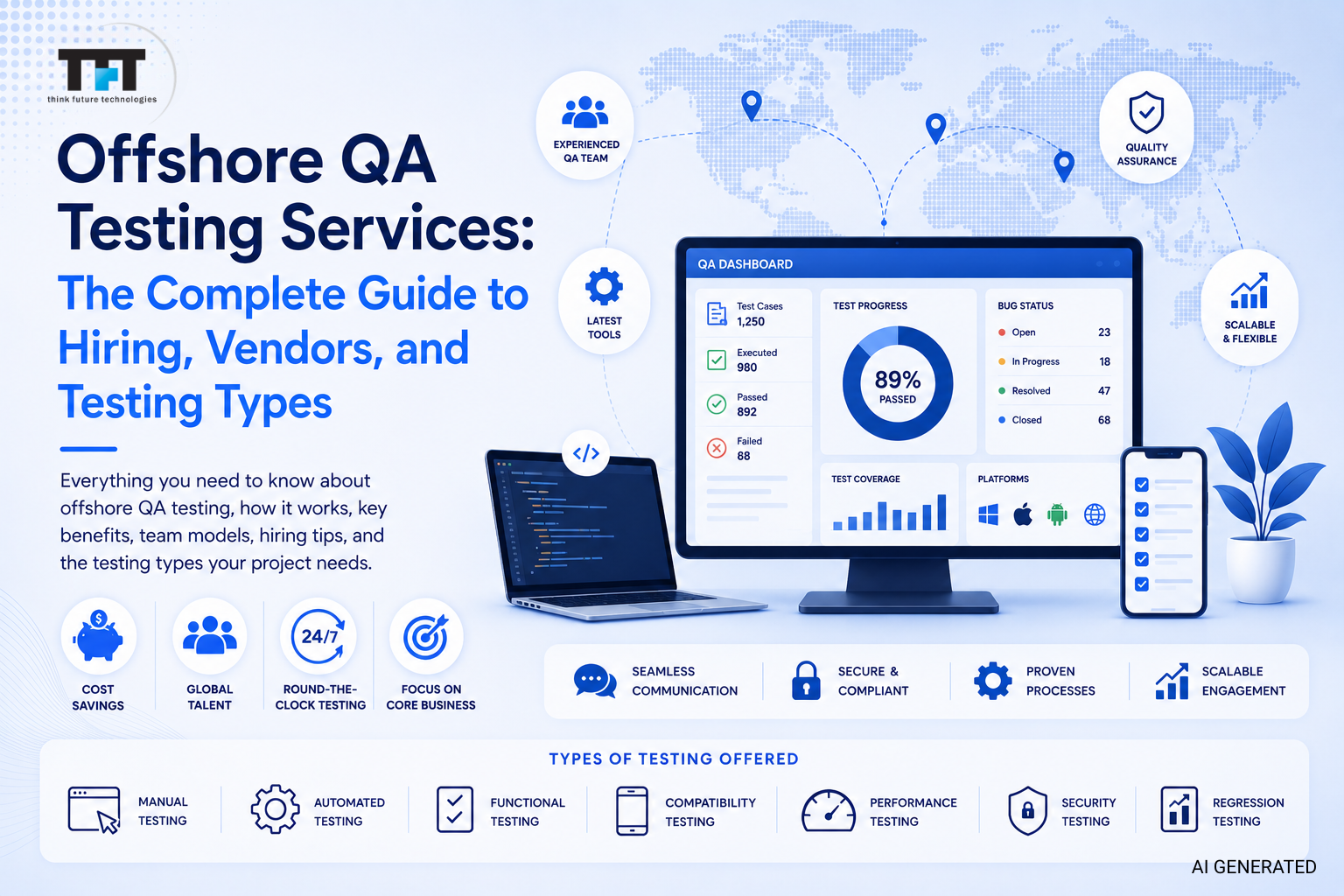
Software quality can make or break a product launch. As development cycles shrink and user expectations grow, more companies are turning to offshore QA testing services to keep pace without stretching in-house resources thin. This guide breaks down what offshore QA testing actually involves, the testing types and methodologies used, and exactly how to hire the right offshore QA team for your software project.
What Is Offshore QA Testing?
Offshore QA testing is the practice of hiring a software testing team located in a different country, often one with lower operating costs, to handle quality assurance for your software applications. Instead of building an in-house team from scratch, businesses partner with an offshore software testing company that already has qa engineers, testing tools, and established testing processes in place.
The offshore QA testing industry continues to expand rapidly. According to the Research and Markets Outsourced Software Testing Services Market Report (2026), the global outsourced software testing services market is valued at USD 70.42 billion and is projected to reach USD 122.36 billion by 2030, growing at a 14.8% CAGR. This growth reflects the increasing demand for specialized testing expertise, scalable delivery models, and cost-efficient quality assurance services.
Where Offshore QA Fits in the Development Process
QA testing isn’t a single step tacked onto the end of a project. In a healthy software development lifecycle, testing runs alongside development, from early functional checks to final system testing before release. An offshore QA testing team plugs directly into this cycle, running test execution in parallel with your developers so bugs are caught early rather than after deployment.
Why “Offshore” Doesn’t Mean “Disconnected”
A common misconception is that offshore testing means losing visibility into your project. In practice, a well-run offshore software testing team uses the same project management tools, communication protocols, and reporting cadence as any in-house function; the difference is where the qa testers are physically based, not how closely they work with your team.
Case Study: RealTyme Integrated an Offshore QA Team Without Disrupting Development
RealTyme, a U.S.-based cybersecurity software company, partnered with an offshore QA testing provider to expand its quality assurance capabilities without increasing domestic headcount. Rather than operating separately, the offshore engineers were integrated directly into the company’s existing development workflow, allowing testing activities to scale while maintaining close collaboration with the in-house engineering team.
The engagement demonstrates that offshore QA teams can function as an extension of internal development teams when supported by structured communication, shared processes, and specialized technical expertise.
Why Businesses Choose Offshore QA Testing Services
Companies of every size, from startups to UK companies scaling into new markets, are outsourcing QA testing for a handful of consistent reasons.
Significant Cost Savings
The most cited driver is cost. Offshore QA testing services typically operate from regions with lower labor costs, which translates into significant cost savings without requiring companies to compromise on testing quality. Businesses can significantly reduce costs on salaries, benefits, office space, and tooling licenses by working with an offshore vendor instead of scaling an in-house team.
Cost reduction remains one of the strongest business drivers for offshore QA. According to Capgemini, companies can reduce software testing costs by more than 25% through offshore testing while maintaining quality with mature testing processes and automation frameworks.
Access to a Global Talent Pool
Hiring locally limits you to whoever is available in your city or willing to relocate. Offshore hiring opens up a global talent pool of qa specialists with deep experience across industries, testing tools, and testing methodologies, talent that might be scarce or expensive to find domestically.
Round-the-Clock Testing
Time zone differences, often seen as a drawback, can actually work in your favor. Round-the-clock testing becomes possible when your offshore QA team operates in a different time zone than your developers; bugs found overnight are ready for review by the time your local team logs in the next morning.
Freeing Up Core Business Functions
Every hour your in-house team spends on manual, repetitive testing is an hour not spent on core business functions like product strategy or feature development. Offshoring QA lets internal teams focus on core business priorities while a dedicated offshore team handles the testing workload.
Offshore QA Team vs. In-House Team
Deciding between an in-house team and an offshore QA team isn’t always either/or; many businesses run a hybrid model.
Structure and Cost Comparison
An in-house team gives you direct oversight and instant access, but it comes with higher fixed costs: salaries, benefits, training, and infrastructure. An offshore QA testing team offers a more flexible cost structure, letting you scale testing resources up or down based on project requirements without long-term overhead.
When Each Model Makes Sense
If your software product requires constant, tightly integrated collaboration with product managers throughout the day, a partial in-house presence may still make sense. But for well-defined testing types, such as regression testing, compatibility testing, and performance testing, an offshore team can often deliver the same or better results at a lower cost.
Types of Testing Offered by Offshore QA Testing Teams
A capable offshore software testing company should offer a full range of testing types, not just one or two. Here’s what to expect from a mature offshore QA testing services provider.
Manual Testing
Manual testing involves qa testers manually executing test cases without automation scripts, exploring the software applications the way a real user would. It’s essential for catching usability issues, edge cases, and anything that’s hard to script; offshore manual testing teams are often chosen specifically for their thoroughness at this stage.
Automated Testing
Automated testing uses scripts and testing tools to run repetitive test cases quickly and consistently. Offshore QA teams typically build out test automation frameworks for regression suites, freeing qa engineers to focus on more complex, judgment-based testing work.
Functional Testing
Functional testing verifies that each feature of your software product behaves exactly as specified in your project requirements. This is usually one of the first testing types applied once a feature is built, checking inputs, outputs, and expected system behavior.
Regression Testing
Regression testing re-runs existing test cases after code changes to make sure nothing that used to work has broken. This is one of the most valuable testing types to automate, since it needs to run frequently throughout the development cycle.
Performance Testing
Performance testing checks how your software applications behave under load, response times, stability, and resource usage as user volume increases. An experienced offshore team will simulate realistic traffic patterns using dedicated performance testing tools before your product ever meets real users.
Security Testing
Security testing identifies vulnerabilities before attackers do. Offshore QA testing teams with security specialists can run penetration tests, input data validation checks, and vulnerability scans as a standard part of their testing processes.
Usability Testing
Usability testing evaluates how intuitive your software product is for real users. Offshore qa testers often bring a fresh, outside perspective that can catch confusing flows an internal team has grown too familiar with to notice.
Compatibility Testing
Compatibility testing, including device compatibility checks, confirms your application works consistently across browsers, operating systems, screen sizes, and devices. This is a natural fit for offshore teams, who can run testing around the clock across a wide matrix of environments.
Integration Testing
Integration testing checks that different modules or services within your software work correctly together, which is critical for any product built on microservices or third-party APIs.
System Testing
System testing evaluates the fully assembled software application end-to-end, confirming that the complete system meets business and technical requirements before release.
Testing Methodologies Used by Offshore QA Teams
Beyond testing types, it matters how an offshore QA testing team structures its work.
Agile Testing Methodologies
Most modern offshore software testing teams work within Agile sprints, testing continuously alongside development rather than waiting for a separate QA phase. This keeps feedback loops short and aligns testing with the pace of an active development cycle.
Waterfall and Structured Testing
Some software projects, particularly in regulated industries, still benefit from a more structured, sequential Waterfall approach, where testing phases are clearly delineated and documented.
DevOps-Integrated Testing
Increasingly, offshore teams integrate test automation directly into CI/CD pipelines, so tests run automatically with every code commit. This methodology suits teams that release frequently and need fast, reliable feedback on every build.
Modern offshore QA continues to evolve alongside DevOps practices. According to the ThinkSys QA Trends Report (2026), AI-driven testing and intelligent automation are among the biggest trends shaping software testing, enabling faster feedback cycles and more efficient quality assurance across distributed development teams.
QA Testing Services and the Tools Behind Them
A strong offshore QA testing services provider will be fluent in a range of testing tools, from test case management platforms to automation frameworks and performance testing suites. Ask any offshore software testing company which tools they use and why; the answer should map clearly to your tech stack and testing types.
How to Hire an Offshore QA Team
Hiring offshore QA testers well requires more structure than posting a job listing. Here’s a practical approach.
Step 1: Define Your Project Requirements
Before you hire offshore QA team members or vendors, document your software product, tech stack, release cadence, and which testing types matter most. Clear project requirements make it far easier to evaluate whether a vendor’s qa specialists are the right fit.
Step 2: Look for a Proven Track Record
Ask any offshore software testing company for case studies, client references, and metrics from past software projects. A proven track record in your industry or a similar tech stack is one of the strongest predictors of success.
Step 3: Establish Clear Communication Protocols
Set expectations early: which tools you’ll use for daily updates, how bugs get reported, and what escalation looks like. Clear communication and defined communication protocols are what prevent language barriers or time-zone gaps from becoming project risks.
Step 4: Choose the Right Engagement Model
Offshore QA testing services are typically offered through a few different engagement models, and picking the right one shapes cost, flexibility, and control.
Dedicated Team Model
You get a dedicated offshore QA team that works exclusively on your product, much like an extension of your own staff, ideal for long-term, ongoing testing needs.
Fixed-Price Model
Best suited to well-scoped projects with clear deliverables and a defined budget, where testing requirements aren’t expected to change significantly.
Time-and-Material Model
Offers flexibility for projects with evolving project requirements, billing based on actual hours and resources used rather than a fixed scope.
Step 5: Assign a Dedicated Project Manager
A dedicated project manager on the offshore side acts as the single point of contact, coordinating qa testers, tracking test execution, and reporting progress back to your team, a critical layer for keeping distributed teams aligned.
Watch: Building High-Performance Offshore Software Testing Teams
Successfully managing an offshore QA team requires more than selecting the right vendor—it also depends on effective communication, leadership, and team integration. In this podcast, Oleg Sadikov (CEO of DeviQA) shares practical strategies for building and managing high-performing offshore software testing teams, making it a valuable companion to the hiring and engagement guidance covered in this article.
Step 6: Start Small with a Pilot Project
Before committing to a long-term contract, run a smaller pilot project. This lets you evaluate the offshore team’s testing processes, communication style, and quality of test execution with limited risk.
What to Look for in Offshore QA Services and Vendors
Not all offshore software testing services are created equal. When evaluating vendors, prioritize:
Relevant Certifications and Expertise
Look for qa engineers with recognized testing certifications and hands-on expertise in the testing types your software product actually needs.
Industry-Specific Experience
An offshore software testing company with experience in your industry will understand compliance requirements, common failure points, and user expectations specific to your sector.
Infrastructure and Testing Tools
Confirm the vendor has access to the devices, browsers, environments, and testing tools required for thorough compatibility testing and performance testing.
Overcoming Language Barriers and Communication Gaps
Language barriers are one of the most commonly cited concerns with offshore teams, but they’re also one of the easiest to manage. Choosing offshore QA services with strong English proficiency, structured documentation habits, and overlapping working hours goes a long way toward eliminating friction.
Offshore QA Testing for UK Companies and Global Clients
UK companies, along with businesses across the US and EU, increasingly rely on offshore QA testing teams to stretch budgets further while maintaining testing quality. The same principles apply regardless of where the hiring company is based: clear requirements, the right engagement model, and consistent communication protocols.
Cost Savings: What to Realistically Expect
While exact numbers vary by region and vendor, businesses that hire offshore QA teams commonly see cost savings compared to building an equivalent in-house team, once you account for salaries, benefits, recruitment, and infrastructure. The savings are usually most significant on ongoing, high-volume testing types like regression and compatibility testing.
Best Practices for a Seamless Offshore QA Testing Setup
A few habits separate offshore QA testing partnerships that thrive from those that struggle.
Document Everything
Detailed test plans, bug reports, and project requirements reduce ambiguity and rework, especially across time zones.
Prioritize a Seamless User Experience
Keep the end goal in view: every testing type, from usability testing to performance testing, ultimately exists to protect a seamless user experience for your customers and drive customer satisfaction.
Review and Iterate on Testing Processes
Revisit your testing processes periodically with your offshore vendor. As your software product evolves, your testing methodologies and tool stack should evolve with it.
Conclusion
Offshore QA testing services offer a practical path to stronger software quality without the overhead of scaling an in-house team. By understanding the testing types available, choosing the right engagement model, and setting clear communication protocols from day one, businesses can hire offshore QA teams that function as true partners, not just a cost-saving measure, but a genuine extension of the development team.
Frequently asked questions
How much does offshore QA testing cost?
Offshore QA testing costs vary depending on the provider's location, engagement model, project complexity, and the level of expertise required. Businesses can choose from hourly, fixed-price, time-and-material, or dedicated team models. Compared with building an in-house QA team, offshore testing typically reduces expenses by lowering recruitment, infrastructure, and operational costs while providing access to experienced testing professionals.
What are the risks of offshore QA testing?
Common risks include communication gaps, time zone differences, inconsistent testing standards, and data security concerns. However, these challenges can be minimized by choosing an experienced offshore QA partner, defining clear testing processes, using secure collaboration tools, establishing communication protocols, and implementing comprehensive quality assurance practices from the start.
How do I choose an offshore QA testing company?
Select an offshore QA testing company by evaluating its industry experience, technical expertise, testing methodologies, certifications, client references, communication practices, and security standards. A reliable partner should also demonstrate experience with projects similar to yours and provide a clear engagement model, transparent reporting, and scalable testing services.
How do you manage data security with offshore QA testing?
Data security is managed through non-disclosure agreements (NDAs), role-based access controls, encrypted communication channels, secure testing environments, and compliance with standards such as ISO 27001, GDPR, or other applicable regulations. Many organizations also use anonymized or synthetic test data to prevent exposure of sensitive production information.
What are offshore QA testing services?
Offshore QA testing services involve outsourcing software quality assurance activities to a dedicated testing team located in another country. These services typically include manual testing, automated testing, functional testing, regression testing, performance testing, security testing, compatibility testing, usability testing, and end-to-end quality assurance throughout the software development lifecycle.
What are the benefits of offshore QA testing?
The main benefits of offshore QA testing include lower operational costs, access to a global pool of skilled QA professionals, faster release cycles through round-the-clock testing, improved scalability, and the ability for in-house development teams to focus on core product development. When managed effectively, offshore QA also improves software quality while reducing long-term maintenance costs.

Leave a Reply