

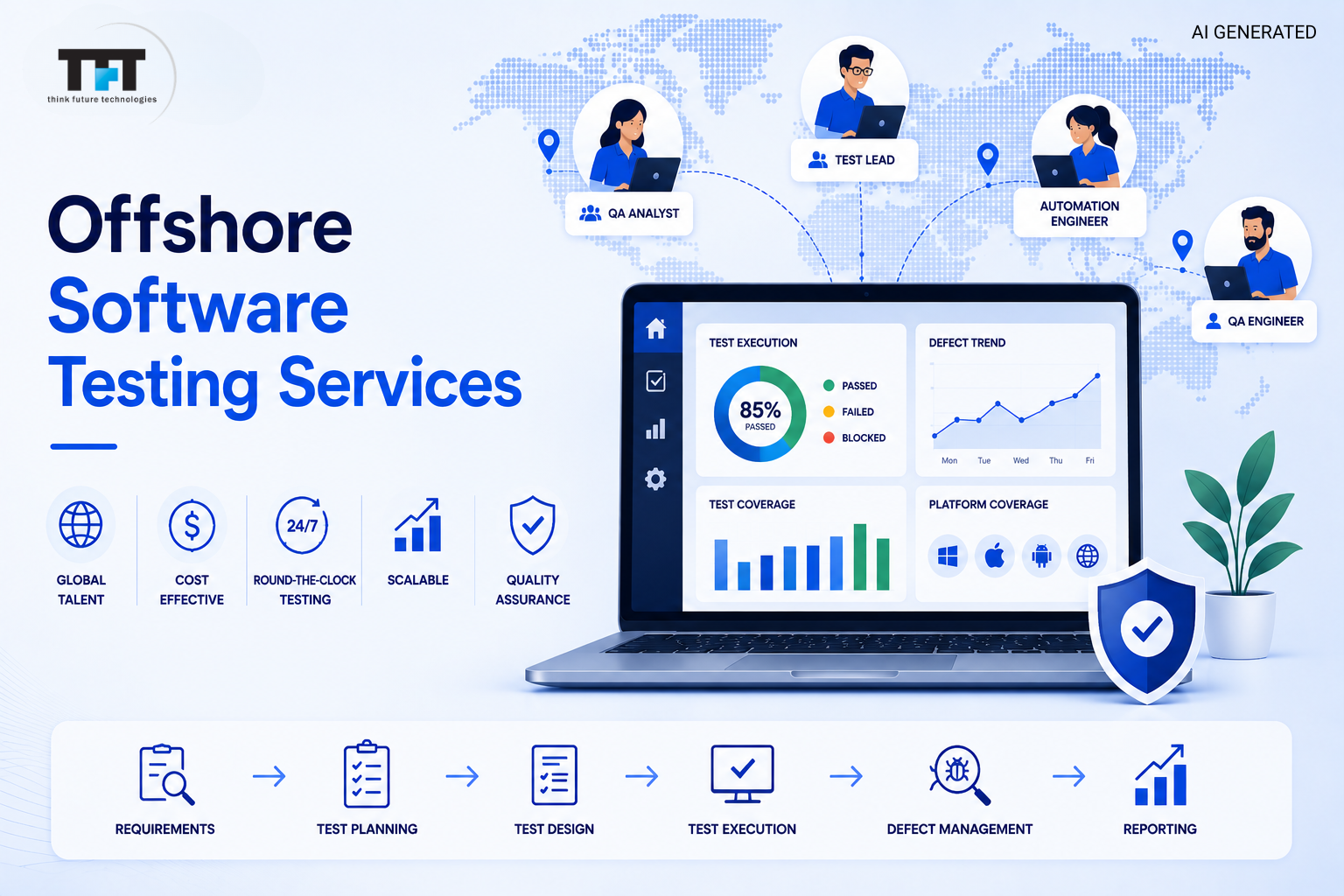
Software teams are under more pressure than ever to ship fast without sacrificing quality. That pressure is a big reason offshore software testing services have moved from a cost-cutting tactic to a mainstream part of the software development lifecycle. According to Mordor Intelligence, the global software testing market is valued at USD 54.44 billion in 2026 and is projected to nearly double by 2031, a clear signal that quality assurance and the outsourcing of it are only becoming more central to how software gets built.
This guide covers everything you need to know about offshore software testing: what it is, the testing services offered, how to choose an offshore testing partner, and what to expect from a well-run outsourced offshore quality assurance engagement.
What Is Offshore Software Testing?
Offshore software testing is the practice of hiring a testing company or team based in another country to handle quality assurance for your software applications. Rather than building every function in-house, businesses rely on offshore testing companies to supply qa engineers, testing tools, and established qa processes.
Watch: Offshore Software Testing Explained
If you’d rather see these concepts walked through than read them, the video below covers what offshore software testing actually involves and how to get the most value out of it, a useful primer before diving into the testing types, hiring criteria, and process breakdowns in the rest of this guide.
How Offshore Testing Differs from Onshore and Nearshore
Onshore testing keeps the team in the same country as the business. Nearshore testing moves the team to a nearby country with a similar time zone. Offshore testing, by contrast, typically places the team in a distant region, often to access lower costs and a broader pool of qa specialists, even with a larger time difference.
Where Offshore Testing Fits in the Software Development Lifecycle
Testing isn’t a final checkpoint; it runs throughout the software development lifecycle. Offshore teams get involved from early requirement analysis through test execution and post-release monitoring, working in parallel with development teams rather than waiting for a finished build.
Offshore Software Testing vs. In-House QA
An in-house team offers proximity and constant oversight but comes with fixed overhead, salaries, training, and infrastructure. Offshore software testing services offer a more elastic alternative, letting companies scale testing services up or down as project needs shift.
Many companies land on a hybrid setup: a small in-house QA lead who owns testing strategy, paired with an offshore testing team that handles day-to-day test execution. This keeps decision-making close to the product while still capturing the cost and capacity benefits of offshore outsourcing.
Why Companies Choose Offshore Software Testing Services
The reasons businesses turn to offshore testing are consistent across industries and company sizes.
Cost Efficiency
Cost efficiency remains the leading driver. Offshore software testing companies typically operate from regions with lower labor costs, which allows businesses to access the same testing services, manual testing, automated testing, and security testing for a fraction of what an equivalent in-house function would cost.
Specialized Expertise
Few internal teams have deep, specialized expertise across every testing type. Offshore testing partners often maintain dedicated specialists in performance and load testing, penetration testing, and accessibility testing, skills that would otherwise take months to hire and train internally.
Access to Skilled QA Professionals
Local hiring limits you to the talent available in your city. Offshore outsourcing opens access to skilled qa professionals across multiple countries, each with different strengths in testing methodologies and testing tools.
Faster Test Execution and Release Cycles
With dedicated qa engineers focused solely on testing, test execution moves faster, and development teams spend less time context-switching between building features and validating them.
Continuous Testing Across Time Zones
Time zone differences, often seen as a downside, can support continuous testing. An offshore qa team working while your local team sleeps means bugs are often identified and documented before the next work day begins.
Scalability Without Long Hiring Cycles
Hiring and training an in-house qa engineer can take months. Offshore outsourcing lets businesses scale testing services up ahead of a major release, or down between them, without carrying idle headcount year-round.
Core Offshore QA Team Structure
Understanding how an offshore qa team is typically organized helps set expectations before you sign a contract.
Dedicated QA Team vs. Shared Resources
A dedicated offshore qa testing team works exclusively on your software product, while a shared-resource model pools testers across multiple clients. Dedicated teams cost more but offer deeper product knowledge over time.
Common Roles Within an Offshore Testing Team
Most offshore testing teams include qa engineers, automation specialists, a test lead, and often a security or performance specialist, depending on the scope of testing services required.
Working With an Offshore Testing Partner
A strong offshore testing partner acts less like a vendor and more like an extension of your development teams, attending sprint planning, contributing to testing strategy, and taking ownership of quality outcomes rather than just executing test cases handed to them.
How Offshore Teams Typically Onboard
Onboarding usually starts with access provisioning, a walkthrough of the codebase and existing test documentation, and a short ramp-up period where the offshore testing team shadows current processes before taking on independent test execution.
Around 71% of U.S. technology companies already outsource at least part of their software testing, according to Global Growth Insights, a strong indicator that offshore QA has shifted from a niche tactic to standard practice across the tech sector.
Testing Services Offered by Offshore Testing Companies
A mature offshore software testing company should offer a broad range of testing services, not a narrow slice.
Manual Testing
Manual testing relies on qa testers manually working through test cases, exploring software applications the way real users would. It remains essential for catching usability issues and edge cases that scripts miss.
Automated Testing and Automation Testing
Automated testing (or automation testing) uses scripts to run repetitive test cases quickly and consistently, freeing qa engineers to focus on more complex, judgment-driven testing work.
Functional Testing
Functional testing checks that a feature behaves exactly as specified, verifying inputs, outputs, and expected system responses against project requirements.
Regression Testing
Regression testing re-runs prior test cases after new code changes to confirm existing functionality still works. It’s one of the most valuable testing types to automate, since it needs to run constantly throughout the software testing process.
Performance and Load Testing
Performance and load testing evaluate how software applications behave under real-world traffic, checking response times, stability, and resource consumption as user volume climbs. Offshore teams typically run these tests using dedicated performance testing tools before launch.
Security Testing
Security testing identifies vulnerabilities before they become incidents. Comprehensive quality assurance programs include security testing as a standing part of every release cycle, not an occasional audit.
Penetration Testing
Penetration testing goes a step further, actively simulating attacks to expose weaknesses in authentication, data handling, and infrastructure before real attackers find them.
Compatibility Testing
Compatibility testing confirms an application performs consistently across browsers, devices, and operating systems, a natural fit for offshore teams that can test around the clock across a wide device matrix.
Usability Testing
Usability testing evaluates how intuitive a software product feels to real users. An external, offshore perspective often catches confusing flows that an internal team has grown too close to notice.
Accessibility Testing
Accessibility testing checks that software applications are usable by people with disabilities, following standards like WCAG. It’s increasingly a compliance requirement, not just a best practice.
API Testing
API testing verifies that application programming interfaces return the correct data, handle errors properly, and perform reliably under different request loads, critical for any software built on integrated services.
Integration Testing
Integration testing checks that different modules or services work correctly together, catching issues that only appear when components interact.
Mobile Testing and Mobile App Testing
Mobile testing and mobile app testing evaluate performance, usability, and compatibility testing across a wide range of devices, screen sizes, and operating system versions.
Web Testing
Web testing focuses on browser-based applications, checking functionality, layout, and performance across different browsers and screen resolutions.
Exploratory Testing
Exploratory testing lets experienced qa testers investigate software without a fixed script, often uncovering issues that structured test cases don’t anticipate.
System and End-to-End Testing
System testing validates the fully assembled software product against business and technical requirements, confirming that every component works correctly as a complete, integrated system before release.
Testing Methodologies and QA Processes
How an offshore testing team structures its work matters as much as what testing types it offers.
Agile Testing Methodologies
Most offshore software testing teams now work within Agile sprints, testing continuously alongside development instead of waiting for a separate QA phase at the end.
Continuous Testing in CI/CD Pipelines
Continuous testing embeds automated testing directly into CI/CD pipelines, so tests run automatically with every commit, giving development teams fast, reliable feedback on every build.
Test Documentation and Test Coverage
Clear test documentation and measurable test coverage give both sides visibility into what’s been tested, what hasn’t, and where risk remains, essential for any outsourced qa team working at a distance.
Risk-Based Testing
Risk-based testing methodologies prioritize test coverage around the areas of a software product most likely to fail or most costly if they do, rather than spreading effort evenly across every feature.
The Offshore Testing Process, 5 Step Process
A structured testing process is what separates a reliable offshore testing partner from one that just executes tickets.
Step 1: Requirement Analysis
The process starts with requirement analysis, where the offshore team reviews project requirements, the tech stack, and release goals to scope the engagement properly.
Step 2: Test Planning and Strategy
Next comes test planning, where the team builds a testing strategy that maps testing types to project risk, prioritizing the areas most likely to break or matter most to users.
Step 3: Test Case Design
Qa engineers then design test cases covering functional, regression, and edge-case scenarios, often stored in shared project management tools for visibility.
Step 4: Test Execution
Test execution is where manual and automated testing actually happens, with results logged, triaged, and reported back to development teams in real time.
Step 5: Reporting and Continuous Improvement
A good offshore qa testing team doesn’t stop at reporting bugs; they build in continuous improvement, refining testing methodologies and coverage after every release cycle.
How to Choose the Right QA Outsourcing Company
Not every offshore testing company will be a good fit for your software product. Here’s what to evaluate.
- Evaluate Technical Expertise
Look for specialized expertise that matches your tech stack and the testing types your product needs most. A company strong in mobile app testing may not be the best fit for a data-heavy backend system. - Check Testing Tools and Test Environments
Confirm the vendor has access to modern testing tools and realistic test environments, including the devices and browsers needed for compatibility testing. - Assess Communication and Project Management Tools
Clear communication protocols and shared project management tools prevent the kind of misalignment that derails distributed teams. Ask how the offshore testing team reports status and escalates blockers. - Look for Independent Testing Capability
An offshore testing partner should be comfortable functioning as independent testing, flagging issues honestly rather than just confirming what internal teams expect to hear. - Ask About Data Security and Compliance
Offshore teams often need access to sensitive systems and data. Confirm how the vendor handles data security, NDAs, and any regulatory compliance (like HIPAA or SOC2) relevant to your industry before granting access. - Understand Pricing Models
Pricing varies widely by region, engagement model, and testing scope. You may come across specific figures like offshore software testing services $99.93 per tester per day in vendor rate cards, but treat these as starting points, not universal benchmarks, since actual costs depend heavily on the testing types and seniority level required.
Best Offshore Manual Testing Providers for Outsourcing: What to Look For
If manual testing is a priority for your software product, a few extra criteria matter.
Track Record and Client Reviews
Look for offshore testing companies with a documented track record and verifiable client reviews, not just marketing claims.
Domain Expertise
Providers with experience in your specific industry, fintech, healthcare, and e-commerce, understand the compliance and edge cases unique to that domain.
Flexible Engagement Models
The best offshore manual testing providers for outsourcing offer flexible engagement models, from dedicated teams to project-based contracts, so you’re not locked into a structure that doesn’t fit your needs.
Building a Successful Offshore Testing Partner Relationship
Choosing the right vendor is only half the equation; how you manage the relationship matters just as much.
Setting Clear QA Processes
Document your qa processes explicitly: how bugs are reported, how priorities are set, and how releases are signed off. Ambiguity here creates friction fast.
Defining a Testing Strategy Together
The strongest outsourced offshore quality assurance relationships treat testing strategy as a joint effort, not something handed down from the client to the vendor.
Establishing External QA Teams as an Extension of Development Teams
Treat external qa teams as part of your development teams, including them in planning and retrospectives rather than isolating them as a separate function.
Outsourced Offshore Quality Assurance: Common Challenges
Offshore testing isn’t without friction points, and it helps to know them going in.
Communication Gaps
Language differences and asynchronous schedules can slow down clarification on ambiguous requirements. Structured documentation and recorded walkthroughs help close this gap.
Time Zone Coordination
Coordinating time zones takes deliberate planning; most successful partnerships build in a few hours of overlap for real-time discussion, even if most work happens asynchronously.
Test Environment Setup
Getting test environments configured correctly for an external team can take longer than expected; budgeting time for this upfront avoids early delays.
Knowledge Transfer and Turnover
When individual testers rotate off a project, knowledge can walk out the door with them. Thorough test documentation and a shared knowledge base reduce the impact of turnover on an offshore testing team.
Offshore Testing Trends Shaping the Industry
Offshore software testing continues to evolve alongside the broader software industry.
AI-Powered Test Automation
Offshore qa teams increasingly use AI-assisted tools to generate test cases, prioritize regression suites, and flag anomalies faster than manual review alone.
Shift-Left Testing
Shift-left testing pushes QA involvement earlier into the software development lifecycle, catching issues at the design and requirements stage rather than after code is written.
Rise of Specialized Testing Niches
Demand is growing for narrower specialties, accessibility testing, security testing, and API testing in particular, as software applications become more complex and compliance-driven.
Growing Preference for Outcome-Based Contracts
More offshore testing companies are shifting away from pure headcount billing toward outcome-based contracts tied to defect detection rates, test coverage, and release quality, a trend that pushes accountability further onto the vendor.
The U.S. outsourced software testing market alone is projected to grow from roughly $7.2 billion in 2025 to more than $27 billion by 2035, according to Zygobit’s industry analysis, a trajectory that suggests offshore testing partnerships will keep expanding rather than plateauing.
Case Study: Scaling QA Through an Offshore Partnership
One offshore QA provider, QASource, reports that clients across Fortune 100 companies and startups alike have seen measurable results from outsourcing their testing operations. Engagements typically span manual testing, test automation, QA audits, and performance testing, backed by domain expertise across more than 500 projects.
According to QASource, clients report 30-40% cost reduction, faster regression cycles, and higher release confidence as a result of the partnership. The pattern reflects what’s common across the offshore testing market: cost savings paired with genuine gains in testing speed and coverage, rather than cost savings alone.
What Good Looks Like in Year One
The first year of an offshore testing partnership sets the tone for everything after it, so it’s worth knowing what a healthy engagement looks like early on.
Early Wins to Watch For
Look for faster bug turnaround, cleaner test documentation, and a testing team that starts proactively flagging risk areas rather than waiting to be told what to test, signs that the relationship is maturing past simple task execution.
When to Reassess the Partnership
If communication protocols keep breaking down, test coverage stalls, or reporting stays vague despite feedback, it’s worth revisiting the engagement model or the vendor itself rather than assuming things will improve on their own.
Conclusion
Offshore software testing services have moved well past being a simple cost play. Done well, they give businesses access to specialized expertise, faster test execution, and testing coverage that would be expensive to build in-house. The businesses that get the most out of offshore outsourcing treat their offshore testing partner as a genuine extension of their development teams, with clear qa processes, shared testing strategy, and communication built for the distance from day one.
Frequently Asked Questions
Offshore Software Testing Services: A Complete Guide to Outsourced QA
Costs vary by region, engagement model, and the mix of testing types involved. Rates can range from budget hourly pricing to premium fees for specialized testing like security or performance testing, so it's worth requesting a detailed quote based on your specific project requirements.
What Are the Risks of Offshore Software Testing?
The main risks are communication gaps, time zone coordination challenges, and misaligned expectations around testing strategy. These are manageable with clear qa processes, defined communication protocols, and a trial project before a long-term commitment.
How Do You Choose an Offshore Software Testing Company?
Evaluate technical expertise against your tech stack, confirm access to the right testing tools and test environments, and check for a verifiable track record. Communication style and responsiveness during initial conversations are often a good early signal.
What Is Offshore Software Testing?
Offshore software testing is the practice of hiring a testing team based in another country to handle quality assurance for your software applications, typically to access cost efficiency and specialized expertise.
What Are the Best Countries for Offshore Software Testing?
Popular offshore testing destinations include India, the Philippines, Vietnam, Ukraine, and Poland, each known for different strengths, from large pools of qa engineers to strong automation testing expertise.
How Do You Manage Communication With Offshore Testing Teams?
Successful communication relies on shared project management tools, scheduled overlap hours, detailed test documentation, and a single point of contact on the offshore side to keep updates consistent.

Leave a Reply