

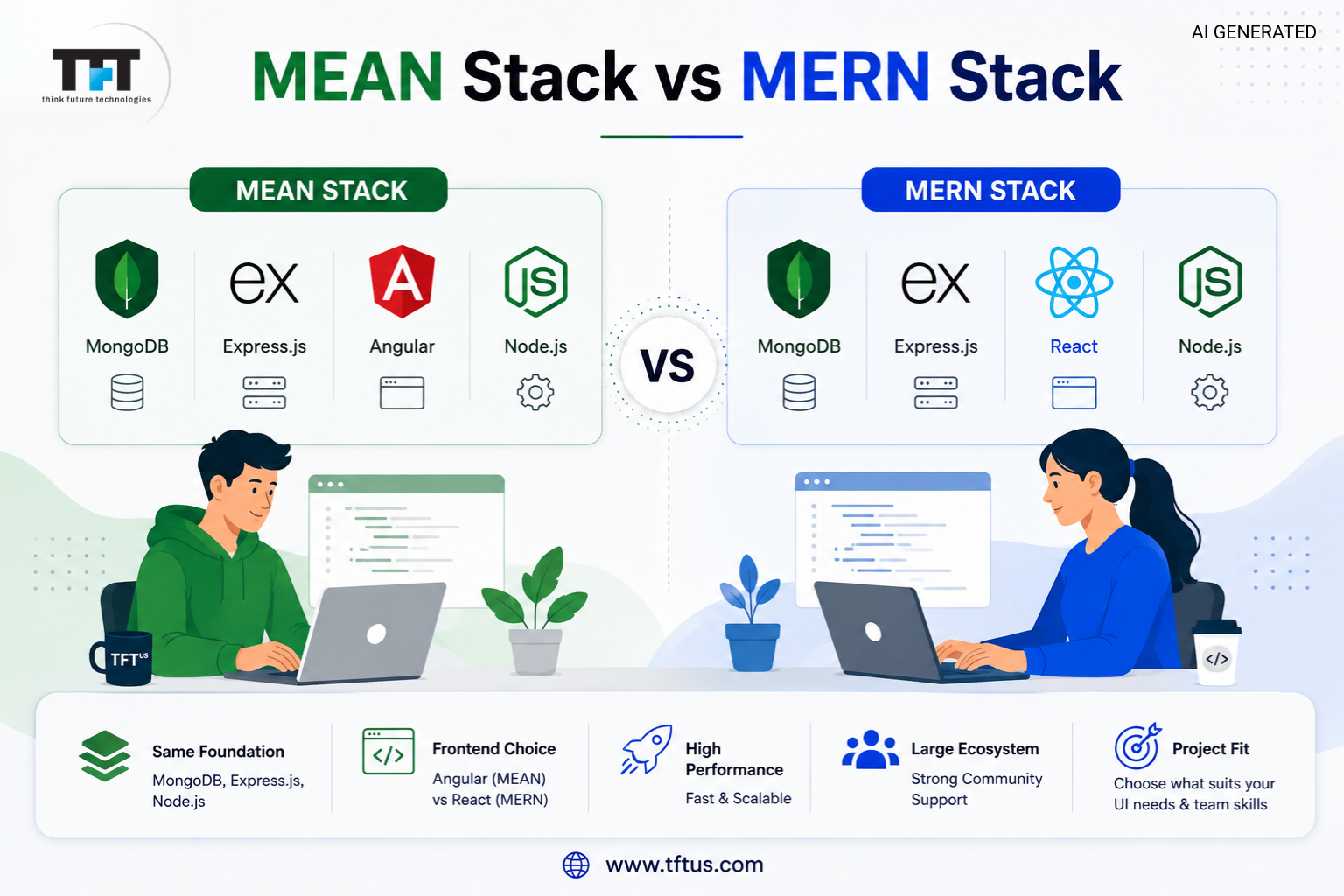
Choosing a technology stack shapes everything from hiring to long-term maintenance. Two names come up constantly: MEAN and MERN. Both are JavaScript-based, both promise full-stack development speed, and both have loyal followings, which is why teams get stuck comparing them.
This guide breaks down the MEAN stack vs MERN stack debate: what each one is, how the frontend framework choice changes your development process, what a MEAN stack developer or MERN stack developer does day to day, and how to decide which stack fits your project requirements.
What Is the MEAN Stack?
MEAN is a full-stack web development framework built entirely on JavaScript. The name is an acronym for MongoDB, Express.js, Angular, and Node.js, four tools that together handle everything from the database to the browser without forcing a developer to switch languages.
The appeal of the MEAN stack is structural consistency. Because the frontend framework, backend framework, and database layer all speak JavaScript, teams avoid the friction of managing multiple languages across the entire stack. This structured approach is one reason MEAN stack learning curve conversations often center on Angular.
Core Components of MEAN
MongoDB is the NoSQL database that stores data in a JSON-like format, flexible for changing data structures. Express.js is a minimal backend framework running on Node.js that handles routing, middleware, and API logic. Angular is the frontend framework responsible for the user interface. Node.js is the JavaScript runtime powering the web server.
How MEAN Stack Works
A typical request flows from the Angular frontend framework, through an Express.js and Node.js backend, and into a MongoDB database that returns or stores data. Angular’s opinionated, structured framework enforces conventions around modules, services, and dependency injection, which gives large development teams a predictable application development process even as the codebase grows.
What Is MERN Stack?
MERN swaps Angular for React, giving you MongoDB, Express.js, React, and Node.js. It’s still a full JavaScript stack, still uses the same NoSQL database and backend framework, but the frontend development experience is meaningfully different because React is a JavaScript library, not a full framework.
That distinction matters. React focuses narrowly on building user interfaces through reusable UI components, leaving routing, state management, and other architectural decisions to third-party libraries. This makes the MERN stack more flexible but also less prescriptive than MEAN.
Core Components of MERN
MongoDB and Express.js play the same role as in MEAN, handling data storage and backend routing. React handles UI development using a component-based architecture and a virtual DOM for efficient rendering. Node.js again provides the JavaScript runtime and web server layer.
How MERN Stack Works
React components render the client-side interface, communicate with an Express.js and Node.js API layer, and read or write data through MongoDB. Because React relies on reusable components and a virtual DOM, dynamic single-page applications built in MERN tend to feel fast and responsive, especially for interactive user interfaces that update frequently.
MEAN Stack vs MERN Stack: Key Differences
The core question in any MEAN stack vs MERN comparison isn’t really about MongoDB, Express, or Node; those three are identical in both stacks. The real difference sits entirely in the frontend framework layer: Angular versus React.
Frontend Framework Differences (Angular vs React)
Angular is a complete frontend framework with built-in tools for routing, forms, HTTP handling, and state management. React is a JavaScript library focused on building interactive user interfaces through components, which means teams typically add third-party libraries for routing and state management. This single choice cascades into nearly every other difference between the two stacks.
Database Layer (Same NoSQL Database, Different Use Patterns)
Both stacks use MongoDB as their NoSQL database, storing data in a JSON-like format that maps naturally onto JavaScript objects. The way that data gets queried and shaped, however, often reflects the frontend framework’s conventions, Angular’s services versus React’s component-level data fetching patterns.
Backend Framework Consistency
Express.js and Node.js are shared across both stacks, so backend development, API design, and server-side logic look nearly identical whether you’re building with MEAN or MERN. This is part of why full stack developers can often move between the two stacks with relatively little friction.
Client Side Rendering Approaches
Angular renders through its own template and change-detection system, while React relies on a virtual DOM to calculate the most efficient updates to the actual DOM. Both approaches support building dynamic single-page applications, but React’s virtual DOM is frequently cited as a performance advantage for highly interactive web applications.
MEAN and MERN Stacks: Architecture Comparison
Beyond the frontend framework swap, MEAN and MERN differ in how strongly they structure application development. Angular pushes teams toward a specific architecture; React leaves more of that decision open.
Component-Based Architecture
Both React and Angular ultimately organize the frontend framework around reusable UI components, but they arrive there differently. React’s component model is minimal and unopinionated, letting developers create reusable UI components however they choose. Angular wraps components inside a broader structured framework of modules and services.
Virtual DOM in MERN
React’s virtual DOM is central to how MERN stack applications stay performant. Rather than updating the real DOM on every change, React calculates differences in a lightweight virtual DOM first, then applies only the necessary updates, a pattern well suited to dynamic, data-heavy interfaces.
Structured Framework Approach in MEAN
Angular’s structured framework, by contrast, standardizes how components, services, and modules interact from day one. For large development teams building enterprise applications, this built-in structure can reduce the ambiguity that sometimes creeps into less opinionated codebases.
Full Stack Development With MEAN and MERN
Both stacks qualify as full stack web development solutions because they cover the browser, the server, and the database using a single language. That consistency is arguably the biggest shared advantage of MEAN and MERN stacks over non-JavaScript alternatives.
Full Stack Developer Skill Requirements
A full stack developer working in either stack needs to understand JavaScript deeply, since the same language runs client-side and server-side. From there, the specific skill set diverges based on whether the frontend framework in use is Angular or React, along with familiarity with MongoDB’s NoSQL database and Express.js APIs.
JavaScript Across the Entire Stack
Because MEAN and MERN both run JavaScript code from the database layer up through the browser, developers can share logic, utilities, and even validation code across the entire stack. This reduces context-switching and speeds up the overall development process compared to stacks that mix languages like PHP or Java with JavaScript on the frontend.
MEAN vs MERN Stack Developer Roles
Job postings often use “MEAN stack developer” and “MERN stack developer” almost interchangeably, but the day-to-day responsibilities differ based on the frontend framework each role centers on.
Role of a MEAN Stack Developer
A MEAN stack developer typically works within Angular’s structured framework, building modules, services, and components according to Angular’s conventions. They’re also expected to manage Express.js routes, Node.js server logic, and MongoDB schemas, making them responsible for the entire application stack.
Role of a MERN Stack Developer
A MERN stack developer focuses on building user interfaces with React’s component-based architecture, often pairing it with third-party libraries like Redux or React Router. Backend responsibilities mirror the MEAN stack developer’s: Express.js, Node.js, and MongoDB.
Skill Overlap and Differences
Both roles require strong JavaScript fundamentals, backend framework knowledge, and comfort with a NoSQL database. The differentiator is almost entirely frontend: Angular’s opinionated structure versus React’s library-plus-tooling approach to UI development.
Learning Curve: MEAN vs MERN Stack
The learning curve question is one of the most searched aspects of this comparison, and the honest answer is that it depends heavily on prior experience with Angular or React.
MEAN Stack Learning Curve
Angular has a steeper learning curve because it introduces its own concepts, dependency injection, decorators, modules, and RxJS observables, on top of standard JavaScript. New MEAN stack developers often need more ramp-up time before becoming productive, though that same structure pays off in long-term consistency.
MERN Stack Learning Curve
The MERN stack learning curve tends to be gentler at first, since React itself is a smaller library focused on rendering user interfaces. However, because React defers routing and state management to third-party libraries, developers eventually have to learn an additional ecosystem of tools, which can offset the initial simplicity.
Which Is Easier for Beginners?
Most developers new to full-stack development find React easier to start with, given its smaller surface area and gentle introduction to component-based architecture. Angular’s steeper learning curve suits developers who prefer more built-in tools and less decision-making around project structure.
Community Support and Ecosystem
Both frontend frameworks benefit from a large and active community, but the shape of that support differs.
MEAN Community and Documentation
Angular is maintained by Google and backed by extensive documentation, official style guides, and a large developer community that values consistency. This strong community support tends to benefit large development teams that want standardized patterns across many contributors.
MERN Community and Third-Party Libraries
React’s large developer community has produced an enormous ecosystem of third-party libraries covering routing, state management, animation, and more. This flexibility is a strength for teams that want to assemble a custom toolchain, though it can also mean more decisions to make upfront.
Performance and Scalability
Performance conversations around MEAN stack vs MERN stack usually come back to rendering strategy and how well each stack supports scalable applications.
A 2025 comparative research study published on ResearchGate examined web applications built with MERN and MEAN and analyzed the runtime performance differences between the two stacks. The research highlights that performance can vary based on the architecture and implementation rather than the stack name alone.
Building Scalable Applications with MEAN
MEAN stack applications scale well for enterprise applications that benefit from Angular’s structured, modular architecture, especially when many developers are contributing to the same structured framework over time.
Building Scalable Applications with MERN
MERN stack applications scale effectively for products that prioritize interactive user interfaces and frequent UI updates, thanks to React’s virtual DOM and lightweight component model.
Case Study: ShopEase Built a Scalable E-Commerce Platform With MERN
ShopEase, an e-commerce project developed by Rays EdTech, used the MERN stack with an MVC architecture to build a complete shopping platform. The application included user authentication, product search, shopping carts, checkout, order management, and an admin dashboard.
The project combined React’s component-based architecture with MongoDB, Express.js, and Node.js to create a maintainable JavaScript-based application. Redux handled state management while Mongoose supported MongoDB integration, demonstrating how MERN can be structured for a feature-rich e-commerce application.
Single Page Applications and Dynamic UIs
Both stacks are well suited to building dynamic single-page applications, but MERN’s virtual DOM often gives it a slight edge for interactive web applications with frequent, granular UI changes.
Use Cases: When to Choose Each Stack
There’s no universally “better” stack; the right pick depends on your project requirements, team background, and product goals.
A 2022 peer-reviewed study published by IJRASET found that MERN is particularly suited to faster development of smaller applications, while MEAN can be a stronger choice for large-scale enterprise applications where structure and consistency are important.
When MEAN Stack Fits Best
MEAN stack suits projects that benefit from Angular’s built-in tools and structured framework, particularly enterprise applications, internal tools, and products maintained by large development teams over multiple years.
When MERN Stack Fits Best
MERN stack fits projects that need highly interactive user interfaces, rapid iteration, and flexibility to pick specific third-party libraries rather than accepting a full framework’s opinions.
Mobile Apps and Cross-Platform Considerations
React’s ecosystem extends naturally into mobile apps through React Native, letting teams reuse component patterns and JavaScript code across web and mobile applications. Angular’s mobile pathway (via tools like Ionic) exists but is less directly tied to the core frontend framework than React Native is to React.
Enterprise Applications and Large Development Teams
For enterprise applications, the decision often comes down to governance. Angular’s structured framework and built-in tools reduce variance across large development teams, while MERN’s flexibility rewards teams with strong internal conventions but can fragment without them. Neither stack is inherently more “enterprise-grade”; the surrounding engineering discipline matters more than the frontend framework itself.
Cost, Hiring, and Talent Pool Considerations
Hiring is a practical factor that often gets overlooked in a purely technical MEAN stack vs MERN stack comparison. React’s popularity generally means a larger pool of frontend-focused candidates, while Angular developers, though fewer, often bring stronger structured framework discipline from enterprise backgrounds. Backend hiring is largely stack-agnostic, since Express.js and Node.js skills transfer directly between MEAN and MERN.
Demand for both stacks extends into large organizations. Deloitte job postings list MEAN/MERN among the web application stacks considered for architecture roles, while EY job postings also require expertise in managing and optimizing applications built with MEAN/MERN technologies.
Making the Right Choice for Your Project
If your team values built-in structure, strong conventions, and long-term maintainability across large development teams, MEAN stack’s Angular foundation is worth the steeper learning curve. If your priority is building highly interactive user interfaces quickly, with the flexibility to choose your own third-party libraries, MERN stack’s React foundation is usually the better fit. Both stacks share the same backend framework and NoSQL database, so the decision really comes down to how your team wants to approach frontend development.
Still deciding between MEAN and MERN? This video breaks down the key differences between the two stacks and can help you understand which approach may be a better fit for your project.
Conclusion
MEAN and MERN aren’t rivals so much as two variations on the same full-stack idea, separated by one decision: Angular or React. MEAN offers structure and built-in tools suited to large teams and enterprise applications where consistency matters most. MERN offers a lighter, more flexible frontend built around reusable components, suited to teams that want to move fast and assemble their own toolchain.
There’s no single “winner” in the MEAN stack vs MERN stack comparison, only the stack that matches your project requirements and how much structure you want baked in versus chosen by hand. Whichever you pick, you’re still working with the same JavaScript runtime, backend framework, and NoSQL database underneath, so switching later is more of a frontend rewrite than a full stack overhaul.
Frequently Asked Questions
What does MEAN stack stand for?
MEAN stands for MongoDB, Express.js, Angular, and Node.js, a full JavaScript stack covering the database, backend framework, frontend framework, and web server.
Which stack should I choose for my project?
Choose MEAN if your team wants Angular's structured framework and built-in tools for large-scale, long-term applications. Choose MERN if you want React's flexibility and a large developer community of third-party libraries for building interactive user interfaces.
Why is it called MERN stack?
MERN is an acronym for MongoDB, Express.js, React, and Node.js, reflecting the four core technologies that replace Angular with React compared to the MEAN stack.
Is the MERN stack difficult?
MERN has a relatively approachable starting point because React focuses on a small set of concepts around components and the virtual DOM. Difficulty tends to increase as teams add third-party libraries for routing and state management.
Will AI replace MERN?
AI tools can accelerate MERN stack development by generating boilerplate, suggesting components, and speeding up debugging, but they don't replace the underlying architectural decisions a MERN stack developer makes. The stack's core value, JavaScript across the entire stack, remains a human-led design choice.
Which is better for large-scale applications, MEAN or MERN?
Both can support scalable applications. MEAN's structured framework often suits large development teams that want consistency by default, while MERN's flexibility suits teams that want to customize their architecture around specific performance or UI needs.

Leave a Reply