

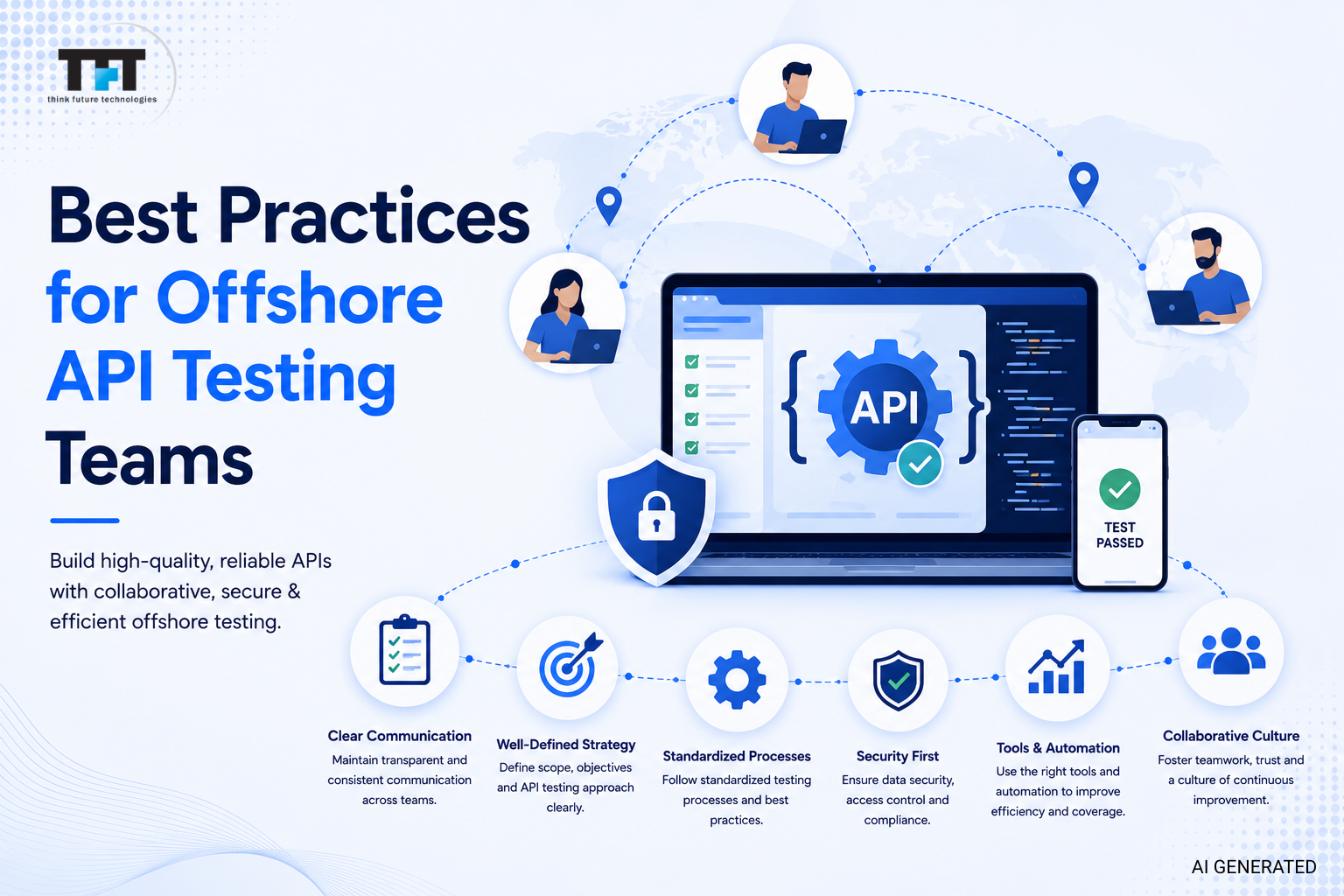
Offshore API testing teams provide companies with access to highly specialized QA engineers at a low cost without compromising the depth of testing. However, distance, time zones, and a gap in communication pose actual risks. In the absence of the appropriate structure, API testing initiatives turn outlandish, and flaws make it to production.
Postman 2025 State of APIs report indicates that teams that have mature API testing have a 3.5x higher deployment with 60% lower production incidents. The difference between teams that have a strategy of real API testing and those that do not is quantifiable and meaningful.
This guide provides best practices of the offshore API testing team in areas of test design, automation, security, communication, and CI CD integration. In every section, you have practical steps that can be put into practice.
Exploring why API Testing is more important in 2026
The APIs cease to be a backend issue. By 2026, APIs will become the conductor of how applications are talking, providing data, and the core value. One compromised API endpoint can disable whole workflows, prevent connections, and madden users on all fronts.
The ITRS Uptrends State of API Reliability 2025 report reported that global API downtime shot up 60% every year between Q1 2024 and Q1 2025. Even just API failures consume an average of 55 minutes of weekly productivity to the enterprise. Also, that cost expands rapidly when it comes to 25-100 integrations/lines of products.
API testing is a guarantee of the proper behavior of every endpoint, both expected and unforeseen. It identifies defects at an earlier stage in the lifecycle, and the defects are much cheaper to resolve.
Practice 1: Before Work Starts, Scope out an API Testing Strategy
Weak technical skills are not the most prevalent reason offshore API testing fails. It is the lack of a well-defined API testing approach that has been agreed upon prior to writing any test cases.
Your plan should specify which API endpoints you are going to test, what kind of testing will occur, your test acceptance criteria, and how to report outcomes back to the onshore team. In the absence of this document, offshore QA engineers are doing the testing in other directions and overlooking vital workflows.
Add a risk-based testing layer to the plan. Not all API endpoints carry the same risk. Focus the coverage of the tests on APIs that process payment, authentication, user management, and integration with the external systems. Deeper coverage falls on less risky endpoints.
Practice 2: Have extensive API Documentation
Offshore QA engineers are unable to test something of which they have no understanding. Extensive tests must be well-documented. Specifications in the form of OpenAPI or Swagger provide the QA team with an accurate contract of what it expects each endpoint to accept and respond with.
Request and response formats, data formats of each field, status codes expected, error codes, error responses to invalid inputs, and authentication might also be documented. Doc gaps create gaps in documentation. Check in documentation completeness, and then the test design proceeds with the offshore QA team.
Adopt a common documentation tool such as Confluence or Notion so that API modifications are taken into account throughout the team. A remote QA group executing tests based on obsolete API specifications will create tests in an incorrect test environment.
Practice 3: Construct the correct Test Suite Structure
The basis of effective testing of offshore teams is a well-designed test suite. In the absence of structure, the test cases are unnecessary, difficult to maintain, and can not be transferred to new team members.
Group test cases into layers. The former cracks the outer part of the functional testing of endpoints: does the API act appropriately when given legitimate inputs? And does it deliver the right data and status codes? The second layer covers integration testing: do API endpoints work correctly when chained together in real-world usage scenarios?
The third layer encompasses non-functional testing: response time testing under load, security testing: authentication bugs, SQL injection, and stress testing to discover breaking points. The purpose of each layer is different and needs various tools and test scenarios.
The majority of offshore QA teams test happy paths. That is needed and not only. To have a mature API testing strategy, it is important to have negative tests to ensure that the API handles what goes wrong.
Negative tests test what occurs when invalid inputs are given to the API, bad requests or responses are not provided, or the value is not within the expected range. Such test scenarios point out the error-handling flaws that are not identified by functional testing. The API is well constructed so that it presents its error messages in a clear way, and when there is bad input, they give the correct error codes. An inadequately developed API will deliver unforeseen functionality or divulge the internals of the system.
Write test cases: Must include edge cases, empty strings, null values, very large payloads, duplicate requests, and out-of-order asynchronous operations. Such cases represent those in the real world much better than sanitized test data.
Watch: API Testing Best Practices from Industry Experts
This ASTQ panel brings together API testing professionals to discuss practical testing strategies, common pitfalls, and proven best practices for designing reliable API test suites. It’s a useful companion to the testing framework outlined in this guide.
Practice 4: Work with Realistic Data
The quality of test data has a direct impact on the quality of the test. Offshore QA teams that are testing on unrealistic or low test data do not detect the defects, which will only be detected when the environment is production-like.
Realistic test data must be representative of the variety of inputs that real users post. It must contain valid and invalid values, boundary cases, data of many different types, and data that tests various code cases. Test using parameterized tests to test the same test scenarios on different datasets without repeating test cases.
Avoid testing with live production data. Rather, create anonymized data that reflects production volume and diversity. This safeguards sensitive information and makes the testing process in line with the data protection requirements of GDPR and CCPA.
Practice 5: Use API Testing as a Part of CI CD Pipelines
On-demand API testing is not useful. Automated testing should be an automated process that is implemented on a CI CD pipeline, which is fired by all code changes. In the absence of this integration, offshore-based QA teams execute tests at random times, and bugs build up between test cycles.
Test wire-level and contract code in your pull request pipeline, which can be run prior to code merging. Merge with the main run. Perform performance testing, load testing, and security testing either nightly or prior to each release. This framework provides the offshore testing group with a defined testing rhythm to the development cycle.
A common audit trail is also formed by CI CD pipelines. Each execution of the test has an account. Each failure is time-stamped with a corresponding code change. This visibility is particularly desired in offshore teams where otherwise asynchronous communication may tend to cloud when and why tests failed.
CI CD Pipeline Structure of offshore API Testing Teams.
- Pull request: Functional testing, contract testing, basic error-handling testing.
- Merge to main: regression testing, merge to main, smoke tests.
- Night shift: performance testing, load testing, stress testing.
- Pre-release: full security testing, full testing suite, penetration tests.
Practice 6: Continuously Automate Regression Testing
Each time the API is modified, some functionality will be jeopardized. The safeguard is regression testing, which validates that changes made to APIs did not create any array of breaking what was already functioning. Manual regression testing scale is infeasible in the case of offshore teams. It has to be automated.
Create automated regression tests of your critical workflows first. These are API routes that are directly dependent on business processes: login and authentication routes, payment routes, data routes, and user routes. Automate these and transfer to secondary functionality.
Opt for where possible, direct test automation frameworks that are language agnostic. No need to know Java to run API tests with Karate DSL. Postman collections are version-controlled and can be run in CI CD with no specialist knowledge. This is important to offshore QA teams where there is a likelihood of varying technical backgrounds.
Practice 7: Security Testing Should Be a Priority in Each Sprint
Security testing is not something that occurs prior to launch. It is an ongoing process that the offshore QA team ought to carry out during the lifecycle of development.
Security testing at the API level deals with authentication defects, authorization breaches, SQL injection attacks, unsound data encryption practices, as well as unwarranted disclosure of sensitive data in API responses. This is the list of categories used in the OWASP API Security Top 10, the standard of API security risks in the industry.
Make it mandatory that the offshore QA team performs automated security scans with software such as OWASP ZAP with each major build. Use automated scans to augment manual security testing of the most risky endpoints. Detection: Do not expect to use penetration testing at the project conclusion, in order to find the errors that ought to have been found during each sprint.
Practice 8: Eliminate Dependencies using Mock Servers
Blockers are common with offshore API testing teams whenever dependent systems cannot be online, are in development, or are in some other time zone. Mock servers remove this blocker by simulating the appearance of external systems to allow testing to proceed without blocking.
Mock servers allow QA engineers to test against a simulated API that responds with predefined API responses. This is good, especially in the course of integration testing when the actual outside system is not yet stable. This can be easily configured using such tools as WireMock and Postman Mock Servers.
Behave document mock server in such a way that the offshore QA team is aware of what scenarios the behavior may simulate, and which still need the actual system. False test results are usually caused by discrepancies between mock behavior and production environment behavior.
Practice 9: Implement a set of standards of clear communication and documentation
The riskiest area of offshore QA team performance is communication. The API testing needs accuracy, and being passionate about the requirements and an inaccurate perception of the requirements results in inaccurate test cases. When we engage in communication, the standards have to be laid down initially, not when issues pop up.
Ask that each defect be documented in detail: what API endpoint, what the request is, what is the received API response, how it is supposed to be, and what to do to reproduce it. Leaky defect reports slug the development team, and push back fixes. An error report with all this information was fixed more quickly.
Conduct weekly meetings between onshore product staff and the offshore QA team leader. Cover cheques, progress, open defects, upcoming API changes, and blockers. Maintain the agenda written and resolutions written down in writing to avoid changes across time zones.
Practice 10: Introduce a stream of continuous monitoring on production
The testing of the API does not cease after deployment. Ongoing observance of API behavior within the production environment not only ensures that any problems that were not captured during testing are detected, but also provides an advanced warning of poor performance that can be averted before users become aware.
Configure alerting on your crucial API endpoints, in response time, rate of error, and availability. This is supported with such tools as Datadog, New Relic, and AWS CloudWatch. Set up alerts in such a way that the offshore team in QA is alerted as soon as there is a decline in the performance of the system to a certain level.
Results of ongoing monitoring are also useful in determining future tests. Production failures trends show what test scenarios were not included in the test suite. Reinvest this information into the testing process to enhance testing coverage over time.
Real-World Case Study: API testing of a Fintech Startup offshore
An American Fintech firm was in Texas and developed a payment processing system and outsourced an offshore QA process to an Eastern European team. Initial performance was varied in various ways. Tests that are deemed to work in the testing environment and fail in production after each release.
The underlying cause was threefold. The offshore QA team was just writing functional tests. They did not have any integration testing or security testing. And their test data were not based on real payment amounts or edge case inputs. Tests were also done in the CI CD pipeline, but they were not testing the appropriate things.
The company contracted a QA head who reformulated the testing plan, introduced integration testing between the banking external systems and the payment API, introduced load testing using k6, as well as OWASP ZAP scans in the nightly pipeline. After two releases, there were hazards in production that declined by 70%.
The moral: it is not just a question of the availability of tools and teams. The outcomes are what are driven by the API testing strategy.
Most of the mistakes that are committed by offshore API testing teams are common
Even the more seasoned offshore QA teams resort to scenarios that lessen the efficiency of the testing and even overlook actual defects.
Unit-testing happy paths. This is the most popular gap. Unless negative tests and edge cases are defined as part of the test plan, they will not be tested. Include negative tests at the very beginning of the design of test cases.
Ignoring asynchronous operations. The new style of APIs frequently responds instantly, and does the request processing asynchronously. Testing a background processing failure is not observed in testing the immediate API response. Write test situations that ensure the ultimate state, but not the starting state.
Failing to version test cases. The changes in the API occur continuously. Without version-controlling test cases together with the API specifications, the test suite will soon be out of step with the current behavior of the API. Git version test cases, and attach test case updates to API change tickets.
Skipping contract testing. Contract testing is done to ensure that the API is satisfactory to the services that consume it. In the absence of contract testing, any breaking changes succeed all currently running tests and only become apparent during integration errors or in production.
Scalable Offshore API Testing
In small organizations that have to deal with 25 or more integrations, as well as 100 or more integrations, product lines, or API consumers, the complexity of offshore API testing is multiplied. The surface area cannot be effectively covered by a single team with a single test suite.
Create testing activities based on the API domain, not the team. Give ownership to each offshore QA team of a set of API endpoints and integrations they support. This eliminates overlap, provides fewer redundant test cases, and provides each team with explicit responsibility in their area of test coverage.
A shared test automation framework is needed at this scale. The tooling, the structure of the CI CD pipeline, and the standard of defect documentation used by all offshore QA teams should be identical. The disaggregation among teams yields uneven outcomes and renders cross-team regression testing infeasible.
Practical Checklist: Best Practices in Offshore API Testing Teams
Applicability: Use this in the case of an offshore API testing engagement that is about to be started or audited.
Strategy and planning:
- Written API testing plan signed by onshore and offshore leads.
- Prioritization in risk-based testing of API endpoints.
- Test coverage goals set to do functional, integration testing, and security testing.
Test design:
- Test cases are both positive and negative.
- Edge cases and invalid inputs are included in every test suite.
- Data of tests in a realistic format and maintained version-wise.
Automation and CI CD:
- Functional tests are executed in each pull request.
- Regression testing and integration are performed on each merge.
- Security testing and performance testing are done daily.
Security:
- OWASP API Security Top 10 is the reference for security testing.
- CI CD pipelines comprised of automated security scans.
- Authentication bugs and SQL injection were tested on all major releases.
Communication:
- Weekly review (formatted) of onshore and offshore teams.
- Reports of defects consist of endpoint, payload, and actual vs expected behavior.
- Any decisions recorded in writing
Conclusion
The most common practices among the offshore API testing teams can be reduced to three pillars, i.e., a clear approach, automated CI CD-integrated tests, and common communication standards. Teams that get these correct find fewer defects, release quicker, and produce fewer incidents to erode user trust. When properly done, offshore API testing is not a short-cut cost-cutting measure. It is an authentic competitive edge in software quality.
FAQs
Which is the most crucial practice for offshore API testing teams?
The most important practice is to define a clear API testing strategy prior to writing any test cases. In the absence of common scopes, priorities, test types, and standards of communication, offshore QA teams will end up testing in various ways and overlook important workflows. The difference between the teams that minimize the number of defects in production and those that do not lies in strategy alignment.
What does an offshore QA team do about security testing?
Automated security scans on each major build must be conducted by offshore QA teams on OWASP ZAP or some other appropriate tools. Authentication deficiencies, SQL, broken authorization, and data encryption should be tested. Make the OWASP API Security Top 10 the reference standard, and use automated scans and manual testing on the most dangerous API endpoints.
Which tools are effective with offshore API testing staff?
The most available options to offshore QA teams having mixed technical skills, due to being language agnostic and easy to version-control, are Postman and Karate DSL. k6 and JMeter are good choices when it comes to performance testing and load testing. OWASP ZAP is the standard in the industry for security testing. To integrate CI CD and others, all these tools are integrated with Jenkins, GitHub Actions, and GitLab CI.
What is your test coverage maintenance issue with frequently changing APIs?
Test all the test cases and API specifications using Git. Request version API change tickets to ensure that nothing is overlooked. Prevent breaking changes using contract testing, which identifies the breaking changes before passing through to the integration testing. Auto-run regression testing on each merge to ensure that the test suite can confirm the behavior of the current API after each change, not just before a release.

Leave a Reply