

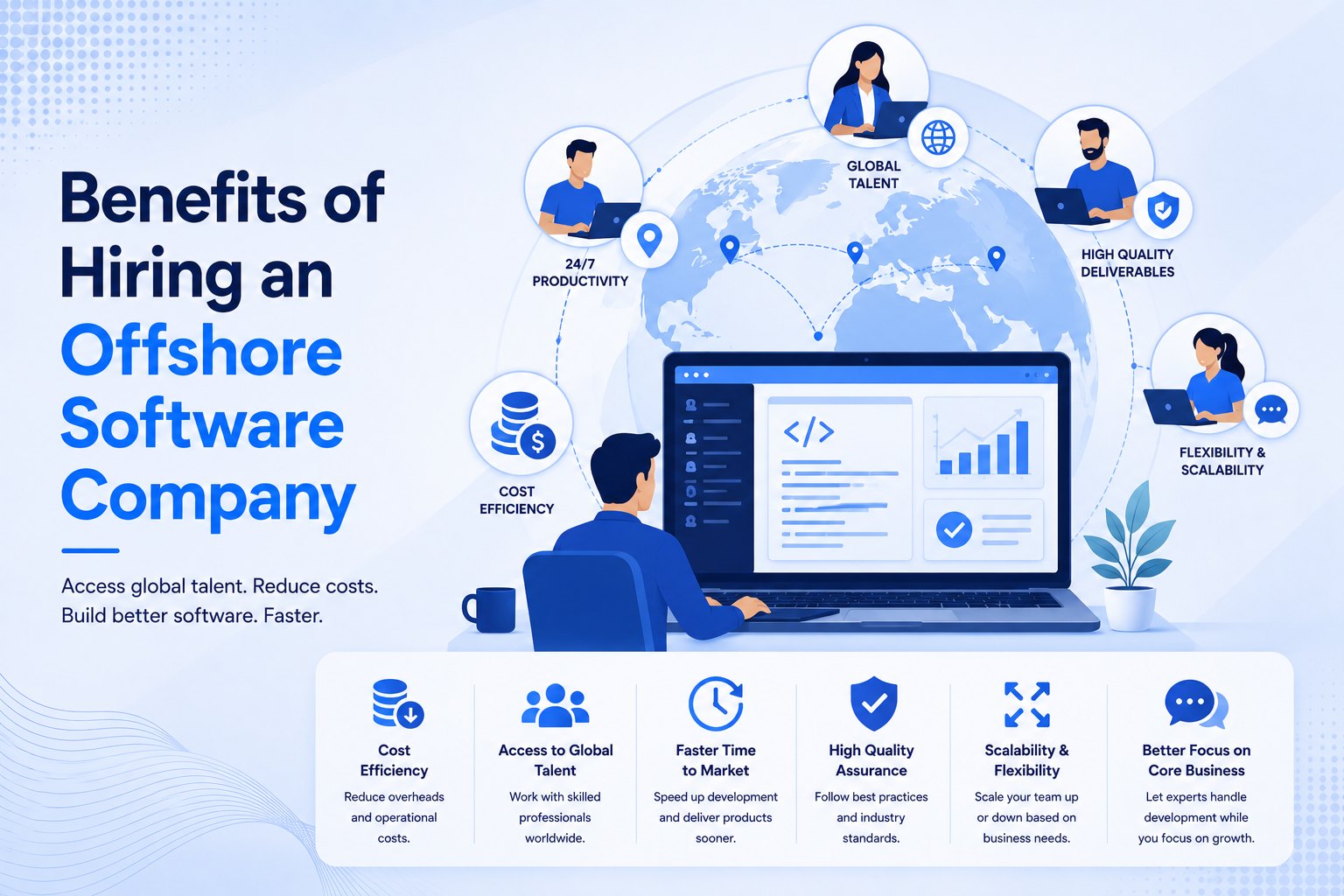
An offshore software company is no longer a cut-and-run solution. It is a strategic choice in 2026 that will allow businesses to access global talent, shorten delivery cycles, and gain specialized skills that domestic hiring cannot offer. The advantages of outsourcing to an offshore software firm are far more than what many articles on the same subject entail.
The offshore software development market is estimated to reach more than 350 billion in 2030, and the market is expected to reach 178.32 billion in 2025. This growth is driven by a structural talent shortage, which applies to 9 out of 10 organizations, and a domestic hiring process that now takes 90-120 days to fill top positions in major US tech hubs. Businesses waiting for such a process are lagging.
This guide discusses all the key advantages of offshore software development using real data, a real-life example, an unbiased review of the trade-offs, and a realistic checklist for selecting the appropriate offshore partner.
Benefit 1: Significant Cost Savings Without Sacrificing Quality
The most mentioned factor in offshore software development is cost saving, and the savings are greater than most individuals think. The overlay comparison of hourly rates is not the whole story.
In San Francisco or New York, a fully loaded senior software engineer costs more than $200,000 a year, including his base, benefits, equity, payroll taxes, office space, and recruiting fees. In the case of a five-person team, the labor cost is 1 million dollars or more per year prior to shipping a single feature.
Offshore software development is providing 40 to 60% savings in total costs in 2026, and in parts of the world, it is 60 to 73% on hourly rates alone. In fully loaded terms, senior engineers in Eastern Europe and India cost between $40,000 and $90,000 per year. The differentiation is driven by the difference in the cost of living, rather than the technical capability difference.
The True Cost Comparison
| Cost Factor | US In-House Engineer | Offshore Developer |
| Base salary | $130,000 to $180,000 | $25,000 to $70,000 |
| Benefits and payroll taxes | $30,000 to $50,000 | Included in rate |
| Office space | $10,000 to $20,000 | Not applicable |
| Recruiting fees | $15,000 to $30,000 | Minimal with established partner |
| Time to hire | 90 to 120 days | 2 to 4 weeks |
| Total annual cost | $200,000 to $280,000 | $40,000 to $90,000 |
Sources: Levels. fyi 2025 compensation data, Stealth Agents offshore cost research 2026
Offshore software development is also cost-efficient in terms of infrastructure. The offshore software development firms usually supply their own development environments, software, and quality assurance resources. You charge production, not expense.
Benefit 2: Access to a Global Talent Pool That Domestic Hiring Cannot Reach
According to the US Bureau of Labor Statistics, there will be more than 1.2 million software developers short by 2026. This is a structural rather than a cyclical shortage. It will not solve as the economy switches. Domestic recruiting is competing against a limited number of available engineers as the demand grows faster.
Offshore software development firms provide you with direct access to a global talent pool of highly skilled developers in India, Eastern Europe, Latin America, and Southeast Asia. There are over 5.8 million developers in India alone. Tens of thousands of software engineering graduates are being generated in Eastern Europe each year with a good background in computer science and mathematics.
The particular advantage is specialized expertise. It is hard to find a machine learning engineer who has extensive experience working with financial data modeling in one city in the USA. With access to global talent, an offshore development company can normally find and install the appropriate specialist within two or four weeks. That is much quicker than a domestic search that could take three to six months and still yield no results.
Benefit 3: Faster Project Delivery Through 24/7 Development Cycles
Perhaps the least recognized advantage of offshore software development is that it is possible to play around with time zone differences and have development cycles that do not come to a halt at 5 pm. One of the teams in Eastern Europe completes its day and leaves it to a team in India. The India team transfers to a Latin America team. Working at night with your internal team asleep.
This follow-the-sun model condenses project schedules to a considerable extent. What would require a team of one timezone to take two weeks to develop can be developed in ten to twelve days when offshore software development teams operate simultaneously across time zones. This compression is a direct competitive advantage to businesses that have aggressive release cycles.
The differences in time zones do need to be managed. There is a need to have structured handoff documentation, shared project management tools, and definite overlap windows to promote synchronous communication. Organizations that do this effectively make time zones their accelerator of delivery. Those teams that do not pay attention to it have a lack of communication that slows it all down.
Benefit 4: Flexible Scaling Without Long-Term Fixed Costs
In-house recruitment is sluggish and intractable. It takes three to six months to hire a developer. Releasing one will entail legal, severance, and team morale expenses. Removing this rigidity in your development process is done by offshore software development.
When the scope of a project becomes larger, offshore software development teams can be increased within weeks, and when it becomes smaller, they can be reduced. This elasticity comes in especially handy in businesses where demand is seasonal, the workload is project-based, or in phases of growth where software development requirements are changing at a high rate.
This scalability is critical to businesses with 25-100 product lines or customer segments. Only one in-house group cannot undertake testing, integration, and feature development of that many products at a time. Offshore development teams are also a way to stretch your capacity without the permanency of growing the whole team.
Benefit 5: Access to Specialized Skills and Emerging Technologies
The offshore software development sector is much more than simple web development. Top offshore software development firms have begun to provide extensive specialization in machine learning, cloud computing, mobile application development, custom software development, and complex systems integration.
Companies requiring a specific skill to undertake a given project can outsource to an offshore development firm that has that particular skill instead of developing it in-house. This comes in handy, particularly when the projects are not permanent in nature, and the skills are not warranted by your core business operations.
Three-fourths of developers are also employing AI tools on a daily basis, and top offshore software development teams are also adding AI-based delivery pipelines that are even smaller in project time and cost reduction. By collaborating with an offshore software development firm that has already established itself at this level, you get access to capabilities and tooling that would take years to develop in-house.
Case Study: Talofa Games Accelerated Product Development
Talofa Games needed experienced Full Stack, Unity, and QA engineers to maintain product momentum without delaying releases. By augmenting its internal team with offshore specialists, the company gained immediate access to niche technical expertise that would have been difficult and time-consuming to recruit locally. The offshore team helped maintain development velocity while filling critical skill gaps in game development.
The project demonstrates that offshore software development is not only about reducing costs—it also enables businesses to quickly access specialized technical talent that can keep product roadmaps on schedule.
Source
Watch: How to Hire Offshore Employees
Choosing the right offshore partner involves much more than comparing hourly rates. This practical session explains how businesses can evaluate offshore talent, structure hiring processes, manage distributed teams, and establish successful long-term offshore partnerships—complementing the evaluation framework covered in this guide.
Benefit 6: Focus Your In-House Team on Core Business Activities
An hour of your internal development team working on daily testing activities, bug repairs, and maintenance is an hour wasted that could be used to make decisions on your product that will help your business stand out. Offshore software development helps to offload your in-house team so that it can concentrate on the work that is in need of a deep business context.
Assign offshore the delegate regression testing, QA, routine maintenance, and feature development that is well-defined. Reserve product strategy, architecture decisions, customer-facing development, and high-context problem-solving for your internal team. This specialization enhances the performance of the two teams.
The offshore team conducts the volume-prone work. The scaled work is done by the in-house team. This is more effective than attempting to deploy a single internal team that is both large enough to accomplish both.
Benefit 7: Faster Time to Market
Software’s competitive advantage is speed to market. The company that delivers a functional product 6 weeks prior to its rival stealing market share, customer commentary, and income that the retailer company does not receive at all.
Offshore software development saves time to market in three aspects. To begin with, the offshore team is already gathered and trained at the time of work. No recruiting, onboarding, or ramp-up period as with a new internal recruit. Second, time zone work converts calendar time to compress without incurring coordination costs. Third, offshore software development firms introduce process maturity and collaboration tools that are designed to work with a distributed delivery on the initial day.
In the case of an already existing offshore partner, companies can usually recruit and contract offshore programmers in between two and four weeks. This is in comparison to three to six months that the same domestic hire would take. Each week saved in assembling the team is a week saved in product development.
Benefit 8: Proven Track Record in Complex Projects
The idea that offshore software development is only applicable to simple projects is a thing of the past. Top offshore software development firms have successful records of delivering intricate projects within the financial services industry, healthcare industry, retail, and in SaaS.
According to the Nasscom 2025 review, India alone has over 1800 Global Capability Centers, which are increasingly operating on R&D and product innovation, as opposed to pure cost arbitrage. They are not body shops. Their engineers are designing companies that create advanced software on behalf of Fortune 500 customers.
The trick is to find an offshore development firm whose past developments are equal to your level of complexity. Security, compliance, and quality assurance requirements will be addressed in a company that has a proven track record in custom software development for regulated industries, which cannot be addressed by a generalist offshore vendor. Ask case studies, make reference calls, and do architecture reviews prior to committing.
Case Study: Fortune 500 Companies Trust Offshore Development
Offshore software development has become an established strategy for large enterprises as well. According to the Atlantic Council, more than 100 Fortune 500 companies leverage Ukrainian offshore software development teams for enterprise software projects. These organizations benefit from access to highly skilled senior engineers, strong technical education, and mature software engineering practices while maintaining cost efficiency.
This illustrates that offshore development is no longer limited to startups or cost-sensitive projects—it has become a proven delivery model for enterprise-scale software development.
Source
Benefit 9: Reduced Risk Through Flexible Delivery Models
Projects have varying risk profiles. Fixed-price engagement minimizes the uncertainty of the cost for well-defined projects that have a constant demand. A time-and-materials model provides flexibility in cases when the scope of the project is going to change. A committed team model offers stability and in-depth product familiarity with long-term development relationships.
All three models are normally provided by offshore software development companies. This flexibility allows you to align the engagement structure with the reality of the risk profile of each project, as opposed to subjecting all projects to the same commercial structure.
The offshore model is a less risky option where the offshore partner is located closer in time zone and culture, and businesses require a closer real-time interaction. The partners in Eastern Europe provide the businesses of the UK and the US with a nearshore outsourcing advantage at a price that is 30 to 50% lower than the local ones.
Benefit 10: Continuity and 24/7 Support Coverage
Software is not prone to failure during business hours. Incidents of production occur during the night, weekends, and holidays. A complementary time zone offshore software development team offers coverage during the time your internal team is offline.
This 24/7 model of coverage is especially useful in SaaS companies that have global users, e-commerce sites that have a constant flow of transactions, and software designed to serve enterprises where downtime has a direct financial impact. First-response triage is done by the offshore team, and only when the team is asleep in the morning, when the problem is critical and needs to be escalated to the in-house team, which has architectural knowledge that is not shared elsewhere.
The smooth coordination between offshore and onshore teams in incident response should also be ensured by having clearly defined escalation routes, common documentation, and agreed response time SLAs. These are to be specified in a contractual agreement prior to the offshore engagement, rather than the initial incident.
When Offshore Software Development Does Not Work
The benefits of offshore software development are real, but not universal. In certain cases, the model fails, and businesses must know it and tell them.
When the project has no clear specification
Offshoring software development is most effective when there are specific requirements. Any project brief that states that you build something like X without specifying what it should be will yield a result that is not what was expected, no matter the level of expertise in the offshore team. Have clear requirements prior to involving any offshore development company.
When the business context is the product
It takes time and intense immersion in the business to develop some software. A product that is developed in an unending informal dialogue with sales, operations, and customers is more difficult to offload to an offshore group that is working on a nine-hour time difference. In such situations, nearshore software development or hybrid models will be more appropriate.
When the team structure is wrong.
Communication gaps are the most likely causes of failure of offshore software development projects, rather than technical capability gaps. Without a dedicated project manager on the client side who would liaise with the offshore team, the work will drift. There has to be someone on your side who owns the relationship, the requirements, and the feedback cycle.
When compliance requirements are not defined upfront
The data handling, security testing, and audit trail of regulated industries have requirements. The design is not designable by an offshore software development company that has not been briefed on these requirements. Establish compliance requirements prior to work.
How to Choose the Right Offshore Software Development Company
Choosing the offshore software development company is nearly always the difference between a successful and a failed offshore partnership. The following are the ways of objectively assessing offshore partners-
Step 1: Define Your Software Development Needs
Write down precisely what you require before assessing any offshore development firm. Establish the project scope, technical requirements, schedule, budget range, and compliance requirements. Unspecified requirements generate unspecified proposals.
Step 2: Evaluate Technical Depth, Not Just Price
Ask to see the technical architecture or do a proof of concept on a real problem before you are obligated to a full contract. The capability that counts is what the offshore team that poses good questions and delivers clean work is showing in a two-week pilot. A hazard is a team that offers the lowest quote but fails to clarify how they do it.
Step 3: Run a Pilot Project Before Scaling
Begin each offshore software development project with a small pilot project. A four-to eight-week pilot on a specified deliverable shows quality of communication, technical sophistication, documentation, and reliability of delivery, prior to major financial investment.
Step 4: Define Communication Standards Upfront
State the collaboration tools that will be used by the team, the meeting schedule, defect reporting requirements, and how blocked issues will be escalated. Document all decisions in writing. International agreements made by phone can be undermined in no time.
Step 5: Check Compliance and Security Credentials
Ensure that the offshore development firm has the pertinent security certifications. The ISO 27001 deals with the management of information security. SOC 2 Type II is the one that involves security controls audited on a periodic basis. In the case of regulated industries, ensure the offshore partner is familiar with the respective compliance structures your business is involved in.
Practical Checklist: Evaluating an Offshore Software Development Company
Before signing:
- Signed project scope and requirements document.
- Pilot project done successfully prior to full contract.
- Reference calls made with at least two past clients in your industry.
- Before sharing sensitive data, a data processing agreement and an NDA are signed.
- Certified compliance and security.
During onboarding:
- Documented technical information exchanged and recognized by the offshore team.
- Project management tools and communication channels set up and tested.
- Delegation of daily tasks outlined in templates.
- Blocked issues and production incidents escalation path enters into an agreement.
- Time zone overlap windows are set as recurring calendar entries.
Ongoing:
- Onshore project manager and offshore lead review weekly, in a structured meeting.
- Monthly review of quality measures: rates of defects, project timeline, and coverage.
- Quarterly business review on relationship health and future project scope change.
Conclusion
The advantages of outsourcing to a software company offshore are factual, quantifiable, and accessible to companies of any scale in 2026. Structural benefits accruing over time include cost savings of 40 to 60 percent, a pool of talent that is global and inaccessible to domestic hiring, 24/7 development cycles, and scaling teams within weeks and not months. It is those businesses that create disciplined offshore software development alliances today that will remain ahead as the domestic talent shortage continues to grow and the pressure to deliver quality software faster grows.
FAQs
What are the main benefits of hiring an offshore software company?
It saves 40-60 percent of the cost of in-house recruiting, provides a global talent pool of highly skilled developers that is unavailable in the domestic market, accelerates the project delivery with time zone-based development cycles, expands the team size easily without incurring expensive fixed costs, and accesses specialist skills in machine learning and cloud computing.
How much can businesses save by using offshore software development services?
Honest comparisons of the costs will show that offshore software development will provide 40 to 60% overall cost savings in 2026. An offshore company in Eastern Europe or India charges between 40,000 and 90,000 to purchase a senior developer who will be fully loaded, and costs 200,000 in the US. In a group of five, that can save more than half a million dollars a year.
What types of projects work best with offshore software development teams?
Offshore works well in the creation of custom software, the creation of mobile applications, regression testing and quality assurance, cloud computing infrastructure development, and a clear definition of features. The best fit would be projects that have stable requirements, well-documented, and accepted criteria. Work that involves informal business situations that require continuous development should be outsourced to nearshore software development or hybrid models.
How do US companies manage time zone differences with offshore software development teams?
High-profile US businesses are characterized by an organized daily handoff that includes reporting of progress and blockers by the offshore team prior to the start of the US business day. They work with project management software such as Jira to track tasks and Slack to communicate asynchronously. They plan two to three hours of daily overlap with partners in Eastern Europe and follow-the-sun handoff models with Indian teams.

Leave a Reply