

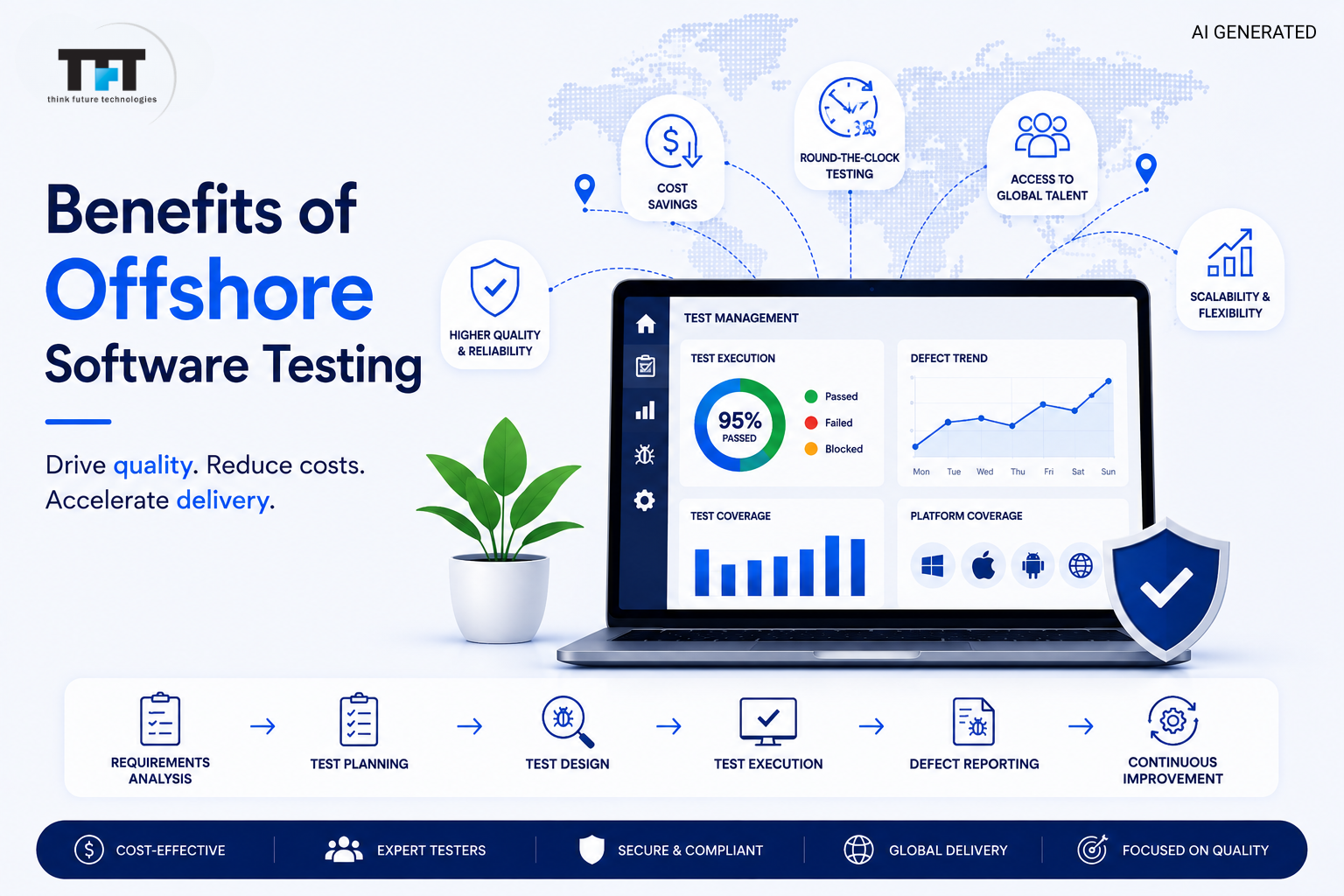
Software quality often gets squeezed at the end of a project, right when budgets are tightest and deadlines are closest. Offshore software testing has become one of the most effective ways to solve that squeeze, giving teams access to dedicated QA specialists, round-the-clock testing coverage, and significant cost savings, without pulling developers off feature work to test their own code.
This guide walks through the core benefits of offshore software testing, the testing methodologies offshore QA teams typically use, and the key factors that separate a strong offshore QA partner from a risky one.
Whether you’re evaluating your first offshore software testing company or looking to expand an existing offshore QA team, understanding what these teams actually do and how to manage them well will shape whether the partnership pays off. The sections below cover everything from specific testing types to the practical questions worth asking before you sign a contract.
Read on for a full breakdown of each testing methodology, the roles that make up a typical offshore QA team, and the practical steps for evaluating an offshore software testing company before you commit budget to one.
What Is Offshore Software Testing?
Offshore software testing means partnering with a testing team based in another country to handle some or all of your quality assurance work. Rather than hiring an in-house team for every testing need, businesses contract an offshore software testing company or an offshore software testing center to run functional testing, performance testing, security testing, and more.
Offshore QA testing services can cover an entire software development lifecycle or plug in for a specific testing phase, giving project managers flexibility in how deeply they integrate offshore teams into their existing development process. Some businesses use offshore QA only for peak release periods, while others build it into every sprint as a permanent part of the workflow.
Benefits of Offshore Software Testing
The benefits of offshore software testing go well beyond lower hourly rates. Done well, offshore QA testing improves software quality, shortens release cycles, and gives internal teams room to focus on what they do best. The following sections break down each benefit in more detail, since the value of offshore testing looks different depending on what a business actually needs from its QA function.
Cost Effectiveness and Cost Savings
Cost effectiveness is usually the first reason companies explore offshore solutions. Offshore testing teams, particularly in regions with lower labor costs, can deliver the same testing processes at a fraction of onshore pricing, producing significant cost savings across the software development lifecycle. Those savings can then be reinvested into feature development, design, or additional QA coverage rather than absorbed entirely by overhead.
Access to a Global Talent Pool
Hiring offshore QA specialists opens access to a global talent pool of qa engineers with deep expertise in specific testing methodologies, tools, and industries, expertise that can be difficult or expensive to find in a single local market. This matters especially for niche domains like fintech compliance testing or embedded systems testing, where local specialists may be scarce.
Round-the-Clock Testing Coverage
Offshore teams working in different time zones enable round-the-clock testing, where bugs found at the end of one team’s day are already being investigated by another team before the original developers are even back online. For companies running frequent releases, this handoff model can meaningfully compress the time between a bug being introduced and being fixed.
Faster Time to Market
Because offshore QA testing services can run in parallel with development, and often around the clock, offshore teams frequently shorten the overall testing cycle, helping products reach the market faster without cutting corners on quality. Parallel testing also reduces the bottleneck where QA sits idle waiting for a single time zone to finish its work.
Scalability and Flexibility
Offshore software testing teams can scale up quickly for a major release and scale back down afterward, giving businesses flexibility that an in-house team, with fixed headcount, usually can’t match. This is particularly valuable for seasonal products or companies with unpredictable release schedules.
Access to Specialized QA Expertise
Many offshore qa teams specialize in specific testing methodologies, such as automated testing frameworks or security testing tools, giving clients access to specialized QA expertise without the cost of training an internal team from scratch. That specialization often comes with pre-built test frameworks and tooling that would take months to develop internally.
Improved Test Coverage
Dedicated offshore testers, focused solely on testing rather than juggling other responsibilities, often achieve broader test coverage across functional testing, compatibility testing, and regression testing than a stretched in-house team can manage. Broader coverage translates directly into fewer surprises after a release ships.
Enhanced Software Quality
Combining specialized QA expertise, broader test coverage, and consistent testing processes tends to enhance software quality overall, reducing the number of defects that make it into production. Over multiple release cycles, this consistency also builds a more reliable historical record of what’s been tested and how.
Focus on Core Business
Outsourcing QA to offshore teams frees internal developers and project managers to focus on core business priorities, like building new features, rather than getting pulled into testing execution. It also reduces the common conflict of interest where developers test their own code.
Offshore QA Team: What They Do
Understanding the day-to-day responsibilities of an offshore QA team makes it easier to set expectations and measure whether the engagement is delivering the value it should.
An offshore QA team typically handles everything from writing test plans to executing test cases and reporting defects back to the development team, functioning as an extension of your in-house team rather than a separate, disconnected group. Many offshore QA teams also participate in sprint planning and retrospectives, just like an internal team would.
Roles Within an Offshore QA Team
A well-structured offshore qa team usually includes manual testers, automation engineers, a QA lead, and a dedicated project manager who coordinates between the offshore team and the client’s internal stakeholders. Larger engagements may also include a security testing specialist or performance testing engineer, depending on the product.
Offshore QA Team Members and Structure
Offshore QA team members are often organized around specific testing methodologies or product areas, allowing the team to build deep familiarity with your application rather than treating each testing cycle as a fresh start. This structure also makes it easier to onboard new offshore testers without disrupting ongoing work.
Offshore QA Testing Services
Offshore QA testing services span the full range of quality assurance work, from early-stage test planning through post-release regression testing, tailored to each client’s project requirements. Many offshore software testing companies package these services into tiers, letting clients choose the depth of coverage that matches their budget.
Types of Offshore QA Testing Services
Common offshore qa testing services include manual and automated testing, performance testing, security testing, compatibility testing, usability testing, and user acceptance tests, often bundled together for clients with ongoing testing requirements. Some providers also offer specialized services like accessibility testing or localization testing for global products.
Testing Methodologies Used by Offshore QA Teams
Offshore QA teams typically draw on a mix of testing methodologies depending on project complexity, timelines, and the nature of the software being tested. The right mix usually evolves as a product matures and its testing needs shift.
Manual Testing
Manual testing remains essential for exploratory testing, usability testing, and scenarios where human judgment catches issues that automated scripts would miss entirely. It’s especially valuable early in a project, before test cases have stabilized enough to automate efficiently.
Automated Testing
Automated testing allows offshore teams to run repetitive test cases, like regression testing, quickly and consistently, freeing up qa specialists to focus on more complex, judgment-based testing work. A mature automation suite can also run overnight, delivering results before the development team starts their day.
Continuous Testing
Continuous testing integrates testing directly into the development process, running automated tests with every code change so that issues surface immediately rather than piling up before a release. This approach pairs particularly well with offshore teams already set up for round-the-clock coverage.
Functional Testing
Functional testing verifies that software functionality works as intended, checking that each feature behaves correctly against defined project requirements before it reaches end users. It typically forms the backbone of any offshore testing engagement, since functionality issues are the most visible to customers.
Performance Testing
Performance testing evaluates how software behaves under load, measuring speed, stability, and responsiveness so that applications hold up under real-world usage rather than only in controlled test environments. Offshore performance testing specialists often simulate traffic spikes well beyond expected usage to find the true breaking point.
Security Testing
Security testing identifies vulnerabilities before attackers do, checking for weaknesses in authentication, data handling, and infrastructure that could compromise sensitive information if left unaddressed. Offshore security testing teams frequently bring certifications and specialized tooling that would be costly to maintain in-house for occasional use.
Compatibility Testing
Compatibility testing confirms that software works correctly across different browsers, devices, and operating systems, an especially important testing methodology for consumer-facing applications with a wide user base. Offshore testing centers often maintain large device labs that would be impractical for a single company to build internally.
Regression Testing
Regression testing re-runs existing test cases after code changes to confirm that new updates haven’t broken previously working software functionality, a testing process that benefits enormously from automation. As a codebase grows, regression suites tend to grow with it, making dedicated offshore capacity increasingly valuable.
Usability Testing
Usability testing evaluates how intuitive and easy to use an application is for real users, often surfacing friction points that functional testing alone would never catch. Offshore usability specialists can also bring perspective from markets and user bases the internal team may not be as familiar with.
User Acceptance Testing (UAT)
User acceptance tests confirm that the finished software meets business requirements and works the way end users actually expect, typically serving as the final testing phase before release. Offshore QA teams often coordinate UAT logistics directly with client stakeholders to keep this final step on schedule.
How Offshore QA Fits Into the Software Development Lifecycle
Offshore QA teams can be embedded at nearly any stage of the software development lifecycle, from reviewing requirements early on to running final regression testing before a production release, adapting their involvement to each project’s development process. Early involvement, in particular, tends to catch ambiguous requirements before they turn into costly rework.
Project Complexity and Offshore QA
Project complexity plays a major role in how offshore QA engagements are structured. Highly complex projects with many integrations typically need a broader mix of testing methodologies and closer collaboration with the development team, while simpler projects can often run on a lighter offshore testing setup. Matching team size and structure to actual project complexity helps avoid both under-testing and unnecessary overhead.
Cost Effectiveness of Offshore Software Testing
Cost effectiveness isn’t just about lower hourly rates; it’s about the total value delivered across the testing processes a project actually needs. Businesses that evaluate offshore QA purely on rate cards often miss the larger picture of coverage and speed.
Comparing Offshore vs Onshore Testing Costs
Offshore testing services typically cost significantly less than onshore equivalents for comparable testing methodologies and qa expertise, which is why so many companies now treat offshore QA as a standard part of their development process rather than an experiment. Even after accounting for coordination overhead, the net cost is usually well below onshore alternatives.
Significant Cost Savings Over Time
The cost savings from offshore software testing tend to compound over time, especially for companies running continuous testing across multiple releases per year rather than a single one-off testing project. Long-term offshore relationships also tend to become more efficient as the team builds product knowledge.
Key Factors to Consider When You Hire Offshore Testers
Several key factors determine whether an offshore QA engagement succeeds, and most of them have more to do with process and fit than price. Rushing this evaluation is one of the most common reasons offshore partnerships underdeliver.
Proven Track Record
Look for an offshore software testing company with a proven track record on projects similar in scope and industry to your own, not just a long client list. Ask for references you can actually contact rather than relying on case studies alone.
Testing Methodologies and Tools Used
Confirm which testing methodologies and tools the offshore qa team uses, and make sure their approach to automated testing and manual testing aligns with your existing development process. Mismatched tooling is one of the most common sources of early friction.
Communication and Project Management
Strong project management, including a dedicated project manager on the offshore side, makes a measurable difference in how smoothly testing requirements get translated into actual test execution. Ask specifically how status updates, blockers, and defect reports are communicated day to day.
Data Security Practices
Since testing often involves sensitive information, review the offshore partner’s data security practices carefully before sharing production data or credentials with an external testing team. This should include how test data is stored, anonymized, and eventually deleted once testing concludes.
Cultural and Language Differences
Cultural and language differences are one of the most underestimated challenges in offshore software testing, even when technical skills are strong on both sides. Left unaddressed, they can quietly erode trust even when the testing itself is solid.
Managing Time Zone Differences
Time zone differences can be an asset, enabling round-the-clock testing, but they require clear handoff documentation so that context isn’t lost between shifts. A short overlap window each day also goes a long way toward resolving ambiguity quickly.
Bridging Communication Gaps
Clear, written communication, detailed bug reports, recorded demos, and structured status updates help bridge cultural and language differences far more effectively than relying on quick verbal exchanges. Screen recordings of defects, in particular, remove much of the ambiguity that text alone can leave behind.
How to Choose the Right Offshore QA Partner
Choosing the right offshore QA partner means going beyond a sales pitch to evaluate how the team actually works day to day. A short paid trial project is often the most reliable way to see this in practice before committing long term.
Questions to Ask an Offshore Software Testing Company
Ask about their experience with your specific testing requirements, how they structure offshore qa team members on a typical project, and how they handle communication across time zone differences. Also ask how they handle staff turnover, since consistency of team members matters for long engagements.
Red Flags to Watch For
Be cautious of offshore partners who can’t clearly explain their testing processes, avoid discussing past project challenges, or push automated testing as a substitute for manual testing on every type of project. Vague answers about data security practices are another warning sign worth taking seriously.
Dedicated Teams vs Project-Based Offshore QA
Some companies work with dedicated teams that stay assigned to their product long-term, while others engage offshore testers on a project-by-project basis. Dedicated teams tend to build deeper product knowledge over time, while project-based engagements offer more short-term flexibility for one-off testing needs or short-lived products.
Role of a Dedicated Project Manager in Offshore QA
A dedicated project manager acts as the single point of contact between the client and the offshore qa team, translating project requirements into daily testing tasks and keeping project timelines on track. This role becomes even more important as project complexity increases and more testers are added to the team.
Offshore Software Testing Center: What to Expect
An established offshore software testing center typically offers structured onboarding, defined testing processes, and access to a range of qa specialists, rather than assembling a team from scratch for each new client. Many also provide dedicated infrastructure for performance testing and device labs for compatibility testing.
Offshore QA vs In-House Team: Which Is Right for You?
Choosing between offshore QA and an in-house team depends on budget, project complexity, and how much direct oversight you need. Many companies land on a mix, keeping core QA leadership in-house while offshore teams handle a larger share of test execution and day-to-day testing processes.
Common Challenges in Offshore Software Testing (and How to Solve Them)
Common challenges include time zone differences, cultural and language differences, and inconsistent communication, all of which are manageable with clear project requirements, a dedicated project manager, and regular status reporting built into the development process from day one. Most of these challenges show up early, so problems in the first few weeks are worth addressing directly rather than hoping they resolve on their own.
Best Practices for Working With Offshore Testing Teams
A few consistent best practices separate offshore QA partnerships that work well from ones that quietly underperform. None of them are complicated, but all of them require discipline to maintain over a long engagement.
Define Clear Project Requirements
Detailed, unambiguous project requirements reduce back-and-forth and help offshore testers understand exactly what software functionality they’re validating. Ambiguous requirements are one of the most common causes of wasted testing cycles.
Set Realistic Project Timelines
Realistic project timelines that account for time zone differences and onboarding time lead to far better outcomes than compressed schedules that assume an offshore team can match onshore speed immediately. Building in a short ramp-up period at the start of an engagement pays off later.
Maintain Regular Communication
Scheduled check-ins, shared dashboards, and consistent reporting keep offshore teams and internal project managers aligned throughout the testing process. Even a brief daily sync during overlapping hours can prevent small misunderstandings from growing into larger problems.
Track Test Execution and Test Coverage
Monitoring test execution and test coverage on an ongoing basis helps catch gaps early, rather than discovering incomplete testing right before a release. Shared dashboards that both the offshore team and internal stakeholders can see tend to work better than periodic status reports alone.
How Offshore QA Improves Customer Satisfaction
Thorough, consistent testing catches defects before customers do, which directly improves customer satisfaction and protects the reputation a product has spent years building. Fewer post-release incidents also mean less time spent on emergency fixes and customer support escalations.
Offshore Software Testing and Competitive Edge
Companies that consistently ship well-tested software gain a competitive edge over rivals who treat QA as an afterthought, since fewer post-release bugs mean more engineering time spent building rather than firefighting. Over time, that reliability also becomes part of how customers perceive the brand.
Conclusion
The benefits of offshore software testing- cost effectiveness, access to a global talent pool, round-the-clock coverage, and improved test coverage- make it one of the most practical ways to strengthen software quality without expanding an in-house team. Success comes down to choosing the right offshore QA partner, setting clear project requirements, and building communication habits that account for time zone and cultural differences from the start.
Businesses that treat offshore QA as a genuine extension of their development team, rather than a purely transactional vendor relationship, tend to see the strongest long-term results.
FAQs
What are the main benefits of offshore software testing?
The main benefits include cost-effectiveness, access to a global talent pool of qa engineers, round-the-clock testing coverage, improved test coverage, and the ability to focus internal teams on core business priorities.
How do I hire offshore testers I can trust?
Look for an offshore software testing company with a proven track record, clear testing methodologies, strong data security practices, and a dedicated project manager who can coordinate closely with your internal team.
What testing methodologies do offshore QA teams typically use?
Most offshore qa teams use a combination of manual testing, automated testing, and continuous testing, adapting the mix based on project complexity and testing requirements.
How do offshore QA teams handle time zone and cultural differences?
Strong offshore partners manage time zone differences through clear handoff documentation and use structured, written communication to bridge cultural and language differences effectively.
Is offshore software testing cost-effective for small projects?
Yes, though the cost-effectiveness is often most significant for ongoing or complex projects; smaller projects can still benefit, particularly when they need specialized qa expertise that would be costly to hire in-house.

Leave a Reply