

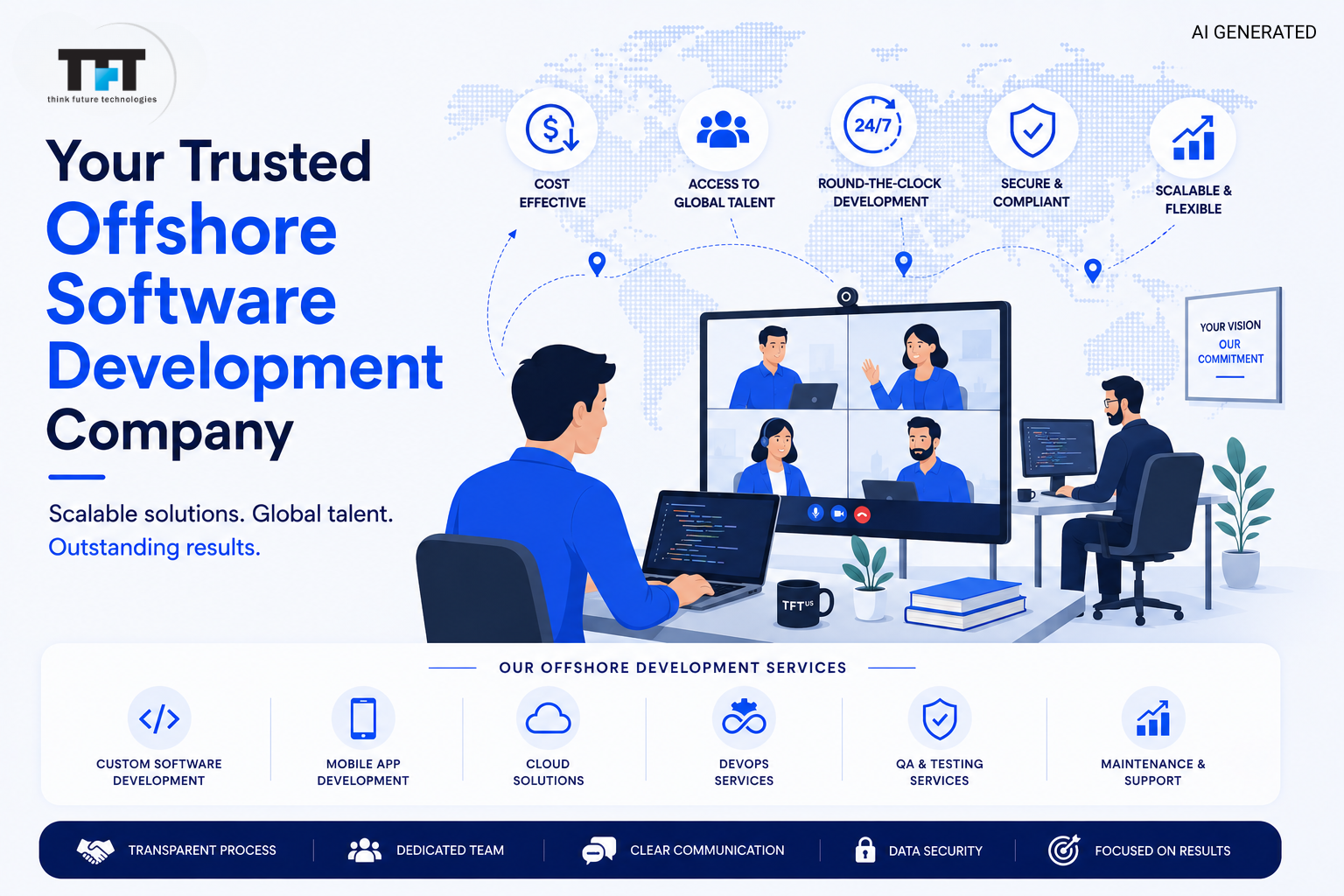
Finding the right offshore software development company can be the difference between a project that ships on time with strong code quality and one that drains budget without ever reaching production. As demand for custom software development outpaces what most internal teams can deliver alone, offshore software development has become a standard way for businesses to add engineering capacity quickly, and it now spans everything from small startups to large, established enterprises.
This guide covers what an offshore software development company actually does, how dedicated offshore development teams work day to day, and the agile testing and app development practices that separate a leading offshore development company from a vendor that simply fills seats and delivers inconsistent results.
Whether you’re exploring offshore software development outsourcing for the first time or evaluating a new offshore software development partner, the sections below walk through the services, engagement models, and evaluation criteria that matter most. Along the way, we’ll look at where offshore teams are typically based, how they’re vetted, what separates a strong long-term partnership from a short-lived one, and how to measure whether an engagement is actually delivering value.
What Is an Offshore Software Development Company?
An offshore software development company is a firm based in another country that provides software engineering services , from custom software development to mobile app development and web development , to clients abroad. Rather than hiring individual freelancers, businesses partner with an established offshore development team that already has processes, project managers, and quality assurance built in.
Offshore software development spans everything from a single dedicated developer joining an internal team to a full offshore software development center running an entire product line. The right setup depends on project scope, budget, and how much day-to-day oversight a business wants to retain.
Many offshore software development companies also operate across multiple countries at once, giving clients access to a broader pool of specialized engineering talent than any single office could offer on its own.
How Offshore Software Development Works
Most offshore software development engagements start with a scoping conversation, where the offshore partner assesses project requirements, technology stack, and timeline before proposing a team structure and engagement model.
From there, the offshore team typically runs a short onboarding phase, reviewing existing software, documentation, and business goals before committing to a sprint schedule. This upfront investment tends to pay off later by reducing miscommunication once active development begins.
The Offshore Software Development Outsourcing Model
In the offshore software development outsourcing model, a company contracts an external offshore developer team to handle part or all of a software project, paying for output and expertise rather than building an internal engineering team from scratch.
This model works particularly well when a business needs specialized skills for a defined period, rather than a permanent addition to headcount, since it avoids the overhead of local hiring, benefits, and long-term employment commitments that come with building an internal team.
Offshore Software Development Center vs Distributed Teams
Some offshore partners operate a centralized offshore software development center, where engineers work from a shared office, while others run fully distributed offshore teams across multiple cities or countries. Centralized centers can offer more consistent oversight, while distributed teams often provide broader access to specialized skills.
Businesses choosing between the two models should weigh how much they value in-person collaboration among the offshore team itself against the wider talent access that distributed hiring typically enables.
Core Services Offered by an Offshore Software Development Company
A capable offshore software development company typically offers a full range of services rather than a single specialty, letting clients consolidate multiple needs with one offshore partner.
This breadth matters because software projects rarely stay confined to one discipline for long , a mobile app development effort, for example, often needs backend engineering, cloud infrastructure, and ongoing quality assurance all working together.
Custom Software Development
Custom software development covers bespoke applications built around a specific business’s workflows, rather than off-the-shelf software forced to fit processes it wasn’t designed for. Offshore custom software development teams often bring pattern libraries and frameworks from past projects that speed up delivery without sacrificing fit, drawing on lessons learned across dozens of prior software projects in similar industries.
Because custom software development is built specifically for one organization, it can also scale and evolve alongside that business in ways that generic, one-size-fits-all software typically cannot.
Enterprise Software Development
Enterprise software development involves building systems at a scale and complexity suited to large organizations, often integrating with existing software, multiple data sources, and strict regulatory compliance requirements. Custom enterprise software projects typically demand deeper expertise in architecture and long-term maintainability than smaller applications, since a single design mistake can be far more costly to correct once a system is in wide use across an organization.
Offshore teams working on enterprise software development also need strong documentation habits, since these systems often outlive the original engineers who built them and get maintained by rotating internal and offshore staff over many years.
Mobile App Development
Mobile app development is one of the most common services offshore teams provide, covering everything from early prototypes to fully featured, production-ready applications. Offshore mobile development teams often maintain reusable component libraries that shorten the path from concept to a working app, which can meaningfully compress timelines for clients working toward a specific launch date.
A strong mobile app development partner will also plan for post-launch iteration from the start, since most successful apps go through several rounds of refinement based on real user behavior after release.
Mobile Application Development for iOS and Android
Mobile application development frequently spans both iOS and Android, either through native development for each platform or cross-platform frameworks that share a single codebase. Offshore developers experienced in both approaches can help clients choose the option that best balances performance, cost, and time to market.
Native development tends to offer the best performance and closest integration with platform-specific features, while cross-platform frameworks reduce development capacity needs by sharing a large share of the codebase between iOS and Android.
Web Development
Web development services from an offshore software development company range from marketing sites to complex, data-driven web applications, typically built using current frameworks and cutting-edge technologies suited to the project’s scale. Offshore web development teams also tend to have broad experience across content management systems, e-commerce platforms, and custom-built applications alike.
Offshore web development teams frequently work across the full stack, handling everything from frontend interfaces to backend APIs and database design within a single engagement.
Cloud Native Software Development
Cloud native software development builds applications specifically for cloud computing environments, using containers, microservices, and managed cloud solutions rather than adapting legacy architecture after the fact. This approach tends to improve scalability and operational efficiency from day one, and it typically makes future infrastructure changes far less disruptive than retrofitting an application built for a single server environment.
Offshore engineers with cloud native experience can also help businesses avoid common pitfalls, like over-provisioning infrastructure or building tightly coupled services that become difficult to scale independently later.
Data Engineering
Data engineering services help businesses build the pipelines and infrastructure needed to move, clean, and structure data at scale, often as a foundation for analytics or machine learning initiatives. Offshore data engineering teams frequently bring experience across multiple cloud platforms and data warehousing tools.
This kind of specialized skill is often expensive to hire locally, which makes offshore data engineering one of the more cost-efficient ways to build out this capability quickly.
Digital Product Engineering
Digital product engineering combines software engineering, design, and product strategy into a single offering, helping clients take a product from concept through launch rather than handling only the technical build. This service is especially valuable for startups without an internal product team.
By pairing engineering with product thinking from the start, offshore digital product engineering teams can also help clients avoid building features that look impressive technically but don’t actually serve real business goals.
Quality Assurance and Automated Testing
Quality assurance and automated testing are typically built into an offshore development team’s process rather than treated as a separate, later phase, catching defects early and protecting code quality throughout the development process.
Offshore QA specialists working alongside developers, rather than after them, also tend to catch usability and edge-case issues that a purely technical review would miss.
Digital Transformation Services
Digital transformation services help established businesses modernize existing software, migrate to cloud solutions, and adopt cutting-edge technologies without disrupting day-to-day operations. Offshore partners often bring outside perspective that’s hard to develop from inside a single organization, having seen similar modernization efforts play out across many other clients and industries.
These engagements frequently involve careful sequencing, since large organizations can rarely pause daily operations to rebuild systems from scratch all at once.
Dedicated Offshore Development Teams
Dedicated offshore development teams are a popular engagement model because they function much like an extension of a company’s internal teams rather than a rotating group of contractors.
Over time, a dedicated team builds institutional knowledge about a product’s history, decisions, and quirks , knowledge that’s difficult to replicate quickly with a fresh team on every new project.
How Dedicated Teams Differ From Project-Based Outsourcing
A dedicated team stays assigned to one client over an extended period, building deep product knowledge, while project-based outsourcing assembles a team for a defined scope and disbands once it’s complete. Dedicated teams tend to work better for products with ongoing development needs.
Project-based outsourcing, by contrast, suits work with a clear beginning and end, such as a defined feature build or a one-time system migration.
Building Global Engineering Teams
Many businesses now blend internal staff with dedicated offshore development teams to form global engineering teams that span multiple time zones, effectively extending the working day and development capacity available to a product.
This structure also builds redundancy into an engineering organization, since knowledge and responsibilities are spread across more people and locations rather than concentrated in a small local team that could become a single point of failure.
Knowledge Transfer and Project Continuity
Strong offshore partners prioritize knowledge transfer, documenting decisions and architecture clearly so that project continuity survives staff changes on either side of the engagement, rather than depending on one or two individuals holding all the context.
Regular documentation reviews and pairing sessions between offshore and internal engineers help make sure that knowledge transfer happens continuously, not just during onboarding or offboarding.
Agile Testing and Development Practices
Agile testing and development practices sit at the center of how a modern offshore software development company operates, shaping everything from sprint planning to release cadence.
These practices matter even more in an offshore context, where regular, structured touchpoints help compensate for the reduced spontaneous interaction that comes with distance and time zone gaps.
Agile Methodology in Offshore Software Development
Agile methodology breaks work into short, iterative cycles with regular check-ins, which helps offshore teams stay aligned with shifting business goals even across time zone gaps. Sprint reviews and demos give clients frequent visibility into progress rather than waiting months for a single delivery.
This iterative approach also makes it easier to adjust priorities mid-project, since offshore teams working in agile cycles can reprioritize the backlog at the start of each new sprint rather than waiting for a large-scale planning process to run its course.
Continuous Delivery Practices
Continuous delivery practices automate the path from code commit to deployment, letting offshore engineering teams ship smaller, safer changes more frequently instead of batching risk into large, infrequent releases.
Smaller, more frequent releases also make it easier to isolate the cause of any issue that does surface in production, since each release introduces a narrower set of changes to investigate.
Code Quality Standards
Clear code quality standards, enforced through code review and automated linting, keep a codebase maintainable as an offshore development team scales up, and make it easier for new engineers to onboard without introducing regressions.
Consistent code quality standards also reduce the friction of blending offshore and internal contributions into the same codebase, since both teams are working from the same expectations.
Automated Testing in an Agile Workflow
Automated testing integrated into an agile workflow catches regressions immediately after each change, rather than surfacing them only during a separate testing phase at the end of a sprint.
This tight feedback loop lets offshore developers fix issues while the relevant code is still fresh in their minds, which tends to be far faster than revisiting it weeks later during a dedicated testing cycle.
Benefits of Working With an Offshore Software Development Company
The benefits of offshore software development extend well beyond lower rates, touching nearly every part of how a software project gets delivered.
The sections below break down the most significant advantages, though the actual mix of benefits a business sees will depend heavily on how the engagement is structured and managed.
Cost Efficiency and Cost Savings
Cost efficiency remains one of the primary drivers behind offshore software development, with cost savings often reaching well beyond what onshore hiring alone could achieve for comparable specialized skills. For many businesses, these savings free up budget that can be redirected toward product design, marketing, or additional engineering capacity elsewhere in the organization.
These savings compound further when businesses use offshore capacity for ongoing work rather than a single short-term project, since fixed onboarding costs get spread across a longer engagement.
Access to Specialized Engineering Talent
Access to specialized engineering talent , from niche cloud computing expertise to data engineering , that might otherwise take months to hire locally, if it’s available at all, is one of the clearest reasons businesses turn to offshore partners in the first place, especially for roles that combine several specialized skills at once.
This access is especially valuable for smaller companies competing for the same limited pool of local specialists as much larger, better-funded organizations, since offshore hiring effectively levels that playing field.
Global Talent Access
Global talent access means businesses aren’t limited to whichever engineers happen to live within commuting distance, opening up a much wider pool of experienced software engineering professionals.
This wider pool also makes it easier to find engineers with experience in specific, less common technologies, rather than settling for generalists who need extra ramp-up time.
Increased Development Capacity
Partnering with an offshore software development company increases development capacity quickly, letting businesses take on more software projects in parallel without a lengthy local hiring cycle.
That added capacity can be especially valuable around major product launches or seasonal demand spikes, when internal teams alone would struggle to keep pace.
Operational Efficiency
Offshore partners often bring established development processes and tooling, improving operational efficiency from the very first sprint rather than requiring months of process-building.
This maturity reduces the ramp-up period businesses typically face when building a brand-new internal team from scratch.
Competitive Advantage
Faster development capacity and access to specialized skills combine to give businesses a real competitive advantage, letting them ship features and products faster than competitors relying solely on internal teams.
Over time, this speed advantage can compound, since faster releases generate more real-world feedback to guide the next round of development.
Measurable Business Outcomes
The best offshore engagements are tied to measurable business outcomes , shipped features, reduced defect rates, faster release cycles , rather than vague promises about quality or speed.
Setting these metrics upfront also gives both sides a shared, objective way to evaluate whether the partnership is working as intended.
Software Engineering Practices at a Leading Offshore Development Company
A leading offshore development company differentiates itself through the engineering practices it maintains across every project, not just the rates it charges.
These practices are often the clearest signal of long-term reliability, since rates and marketing claims tend to look similar across many offshore providers.
Technology Stack and Cutting-Edge Technologies
Strong offshore partners stay current with cutting-edge technologies and can advise clients on the right technology stack for a given project, rather than defaulting to whatever tools they already know.
This adaptability matters because the right technology stack varies significantly by project type, and a partner locked into one set of tools may push a client toward a suboptimal choice.
Cloud Computing and Cloud Solutions
Deep experience with cloud computing and major cloud solutions providers allows offshore engineering teams to design systems that scale efficiently and avoid costly re-architecture down the line. This experience becomes especially important as a product grows, since decisions made early in a cloud architecture can be expensive and time-consuming to unwind later.
Experienced offshore teams can also help clients navigate the trade-offs between different cloud providers, rather than defaulting to whichever platform happens to be most familiar.
Full Cycle Software Development
Full cycle software development means an offshore partner can handle a project from initial discovery through design, build, testing, deployment, and ongoing support, rather than handing off pieces to separate vendors. This continuity also means a single team retains full context on a project’s history, which can matter enormously when diagnosing an unexpected issue months after launch.
This end-to-end ownership tends to reduce the coordination overhead and finger-pointing that can occur when multiple vendors each own a separate stage of a project.
Where Offshore Software Development Teams Are Based
Offshore software development teams are based across a wide range of regions, each offering different combinations of cost, time zone overlap, and specialized expertise.
Choosing a region isn’t purely a cost decision , it also shapes communication patterns, working hours, and how closely an offshore team can collaborate with internal staff in real time.
Eastern Europe
Eastern Europe is a long-established hub for offshore software developers, known for strong computer science education and deep expertise in enterprise software development and complex engineering work. Countries across the region have also built large, mature outsourcing industries over the past two decades, with established offshore software development centers serving clients across North America and Western Europe.
Many businesses in Western Europe also benefit from significant time zone overlap with Eastern Europe, making real-time collaboration easier than with more distant offshore regions.
Latin America
Latin America has grown rapidly as an offshore software development region, offering time zone overlap with North American clients and a large, growing pool of experienced offshore developers. Several countries in the region have also invested heavily in technical education over the past decade, expanding the supply of engineers with strong software engineering fundamentals.
This overlap makes Latin America a particularly popular choice for North American businesses that want offshore cost savings without sacrificing much daily collaboration.
Choosing a Region Based on Business Goals
The right region ultimately depends on business goals: time zone overlap may matter most for close daily collaboration, while cost efficiency or access to a specific specialized skill set may point toward a different part of the world entirely.
Some businesses also choose to work with offshore partners across multiple regions at once, matching each part of a project to the location best suited for it.
How Offshore Developers Are Hired and Vetted
The quality of an offshore software development company depends heavily on how carefully it hires and vets its engineers before assigning them to client projects.
Businesses evaluating a potential partner should ask directly about this process, since it’s one of the clearest predictors of the quality they can expect on their own project.
The Rigorous Hiring Process
A rigorous hiring process, including technical assessments, live coding evaluations, and communication screening, filters out a large share of applicants before they ever reach a client project, protecting overall code quality across the company’s teams. Many offshore providers also test candidates on real-world scenarios rather than abstract puzzles, aiming to predict how they’ll actually perform on live software projects.
Many leading offshore partners accept only a small percentage of applicants, treating hiring standards as a core part of their competitive positioning rather than an afterthought.
Deep Expertise Across Specialized Skills
Leading offshore partners maintain deep expertise across specialized skills like cloud native software development, data engineering, and mobile application development, rather than offering only generalist developers.
This depth allows clients to request engineers with a precise skill match for their project, rather than settling for whoever happens to be available.
Engagement Models for Offshore Software Development
Offshore software development companies typically offer several engagement models, letting clients choose the structure that best matches their project and internal capacity.
Choosing the right model upfront helps avoid friction later, since switching models mid-project can require renegotiating scope, pricing, and team structure.
Dedicated Development Teams
Dedicated development teams work exclusively on one client’s projects over an extended period, offering the closest thing to an extension of the client’s own internal teams.
This model tends to suit businesses with ongoing, evolving product roadmaps rather than a single, clearly bounded deliverable that has a defined start and end date.
Project-Based Engagement Model
A project-based engagement model defines a fixed scope, timeline, and budget upfront, suiting well-defined software projects with clear, stable requirements.
This model offers more budget predictability but less flexibility if requirements shift significantly once work is already underway.
Managed Services
Managed services hand ongoing operational responsibility , maintenance, monitoring, and support , to the offshore partner, freeing internal teams from day-to-day upkeep of existing software.
This model works particularly well for businesses that want to redirect their internal engineering time toward new development rather than maintenance work, especially as existing software accumulates more edge cases over time.
Flexible Engagement Models for Changing Needs
Flexible engagement models let businesses shift between dedicated teams, project-based work, and managed services as project needs evolve, without renegotiating an entirely new contract each time.
This flexibility is especially valuable for businesses whose engineering needs fluctuate seasonally or around major product milestones.
How Offshore Teams Integrate With Internal Teams
Successful offshore engagements depend on how well offshore engineers integrate with a company’s internal teams, not just on individual technical skill.
Integration challenges are usually more about process and communication than technical ability, which is why strong offshore partners invest heavily in both.
Communication and Project Managers
Dedicated project managers on the offshore side act as the primary link to internal teams, translating business goals into sprint priorities and keeping communication consistent across time zones.
A strong project manager also proactively surfaces risks and blockers, rather than waiting for a client to ask why a deliverable is behind schedule.
Working Alongside Existing Software and Systems
Offshore teams often need to work directly within existing software and legacy systems, which requires careful onboarding and documentation to avoid introducing risk into systems the offshore team didn’t originally build.
Pairing sessions between offshore engineers and the internal staff most familiar with legacy systems can significantly shorten this onboarding period.
Regulatory Compliance and Data Security
Regulatory compliance and data security are critical considerations for any offshore software development engagement, particularly for enterprise software handling sensitive customer or financial data. Strong offshore partners can demonstrate compliance with relevant frameworks and maintain clear data handling policies before any project work begins, and should be willing to walk through these policies in detail rather than offering only general assurances.
Businesses in regulated industries should also confirm how an offshore partner handles data residency and cross-border data transfer, since requirements vary significantly depending on the industry and jurisdiction involved.
Choosing the Right Offshore Software Development Partner
Choosing the right offshore software development partner requires looking past marketing claims to the actual processes, people, and track record behind them.
A short, paid trial project is often one of the most reliable ways to evaluate a potential partner before committing to a longer-term engagement.
Questions to Ask a Potential Offshore Partner
Ask a potential offshore partner about their experience with similar software projects, how they structure dedicated offshore development teams, and how they handle knowledge transfer if key engineers change over the course of a long engagement. It’s also worth asking how they handle scope changes mid-project, since flexibility here often reveals a lot about how the relationship will function once real work begins.
It’s also worth asking directly how they measure their own performance, since a partner without clear internal metrics is unlikely to hold your project to a high standard either.
Evaluating a Leading Offshore Development Company
A leading offshore development company should be able to point to a track record of measurable business outcomes, not just a list of technologies, and should be transparent about how their rigorous hiring process actually works.
References from existing clients, ideally in a similar industry or project type, remain one of the most reliable ways to validate these claims.
Custom Enterprise Software: What Offshore Teams Can Deliver
Offshore teams increasingly deliver custom enterprise software that once required a large internal engineering organization, from internal tooling to customer-facing platforms built around a company’s specific business goals. This shift has made offshore software development outsourcing a practical option even for large, established enterprises rather than only startups.
As offshore partners have matured, many now offer the same level of architectural rigor and long-term support that businesses previously expected only from large internal engineering departments.
Offshore Software Development for Startups vs Enterprises
Startups and enterprises tend to use offshore software development quite differently, shaped by their available budget, existing infrastructure, and speed requirements.
Understanding these differences helps businesses set realistic expectations for what an offshore engagement should look like at their particular stage.
Startups and Development Capacity
For startups, offshore partners often provide development capacity that would otherwise be impossible to afford internally, letting a small founding team ship a full product without hiring a large local engineering staff.
This capacity can be especially valuable in the earliest stages, when a startup needs to move quickly to validate an idea before committing to a large internal team.
Enterprises and Long-Term Engineering Capacity
For enterprises, offshore engagements more often supplement existing internal teams, adding long-term engineering capacity for specific initiatives like digital transformation services or a major platform migration.
Enterprises also tend to place greater emphasis on regulatory compliance and integration with existing software, given the scale and complexity of their systems.
Ongoing Support and Long-Term Partnerships
Ongoing support doesn’t end at launch. The strongest offshore software development partnerships continue well past initial delivery, handling updates, monitoring, and iterative improvements as a product’s needs evolve over time.
Businesses that treat their offshore partner as a long-term relationship, rather than a one-off vendor, tend to see compounding returns in both code quality and delivery speed, since the team’s product knowledge deepens with every release and every sprint they work together.
Common Challenges in Offshore Software Development (and Solutions)
Common challenges in offshore software development include time zone gaps, communication friction, and inconsistent code quality across teams , all of which are manageable with clear documentation, defined project managers on both sides, and a shared set of code quality standards from the start of the engagement. Businesses that address these challenges proactively, rather than reactively after a problem surfaces, tend to build far more durable offshore partnerships.
Most of these challenges surface early in an engagement, which makes the first few weeks a particularly important window for catching and correcting course before larger issues develop.
Offshore Software Development vs In-House Development
Offshore software development and in-house development aren’t mutually exclusive; many businesses combine both, keeping core product ownership internal while relying on offshore engineering teams for additional development capacity and specialized skills.
The right balance between the two usually shifts over a product’s lifecycle, with more offshore support during periods of rapid build-out and a greater internal focus during periods of steady maintenance.
How to Measure Success With an Offshore Software Development Team
Measuring success with an offshore software development team means tracking the same metrics you’d apply to any engineering team: velocity, defect rates, code quality, and ultimately whether the work is producing measurable business outcomes tied to broader business goals.
Reviewing these metrics regularly, rather than only at the end of a project, gives both sides the chance to adjust course before small issues become larger ones.
Conclusion
An offshore software development company can meaningfully expand what a business is able to build, offering access to specialized skills, increased development capacity, and meaningful cost savings when the partnership is structured well.
The businesses that get the most value tend to treat offshore engineering teams as a genuine extension of their organization, investing in communication, knowledge transfer, and shared engineering standards rather than treating the relationship as a purely transactional one. This mindset shift, more than any single technical decision, tends to determine whether an offshore engagement becomes a long-term strategic advantage or a short-lived cost-cutting experiment.
Choosing the right offshore software development partner, and holding that partnership to clear, measurable standards, is what ultimately separates a successful offshore engagement from a disappointing one. With the right agile testing and development practices in place, offshore teams can deliver software that matches, and often exceeds, what a purely in-house team could produce on the same timeline.
FAQs
What does an offshore software development company actually do?
An offshore software development company provides software engineering services , including custom software development, mobile app development, web development, and quality assurance , from a team based in another country.
How do dedicated offshore development teams differ from freelancers?
Dedicated offshore development teams work exclusively on a client's projects over an extended period, with established processes, project managers, and quality assurance, unlike individual freelancers who typically work independently across multiple clients.
Is offshore software development outsourcing secure?
Reputable offshore partners maintain clear data security practices and regulatory compliance measures, but businesses should always review a partner's specific policies before sharing sensitive data or production access.
Which regions are best for offshore software development?
Eastern Europe and Latin America are both popular offshore software development regions, each offering different trade-offs around time zone overlap, cost efficiency, and specialized engineering talent.
How do I choose the right offshore software development partner?
Evaluate a potential partner's track record, hiring process, communication practices, and how they handle knowledge transfer, rather than choosing based on rate alone.
Can offshore teams handle enterprise-level software projects?
Yes, many offshore software development companies specialize in enterprise software development, bringing deep expertise in complex integrations, regulatory compliance, and large-scale system architecture.

Leave a Reply