

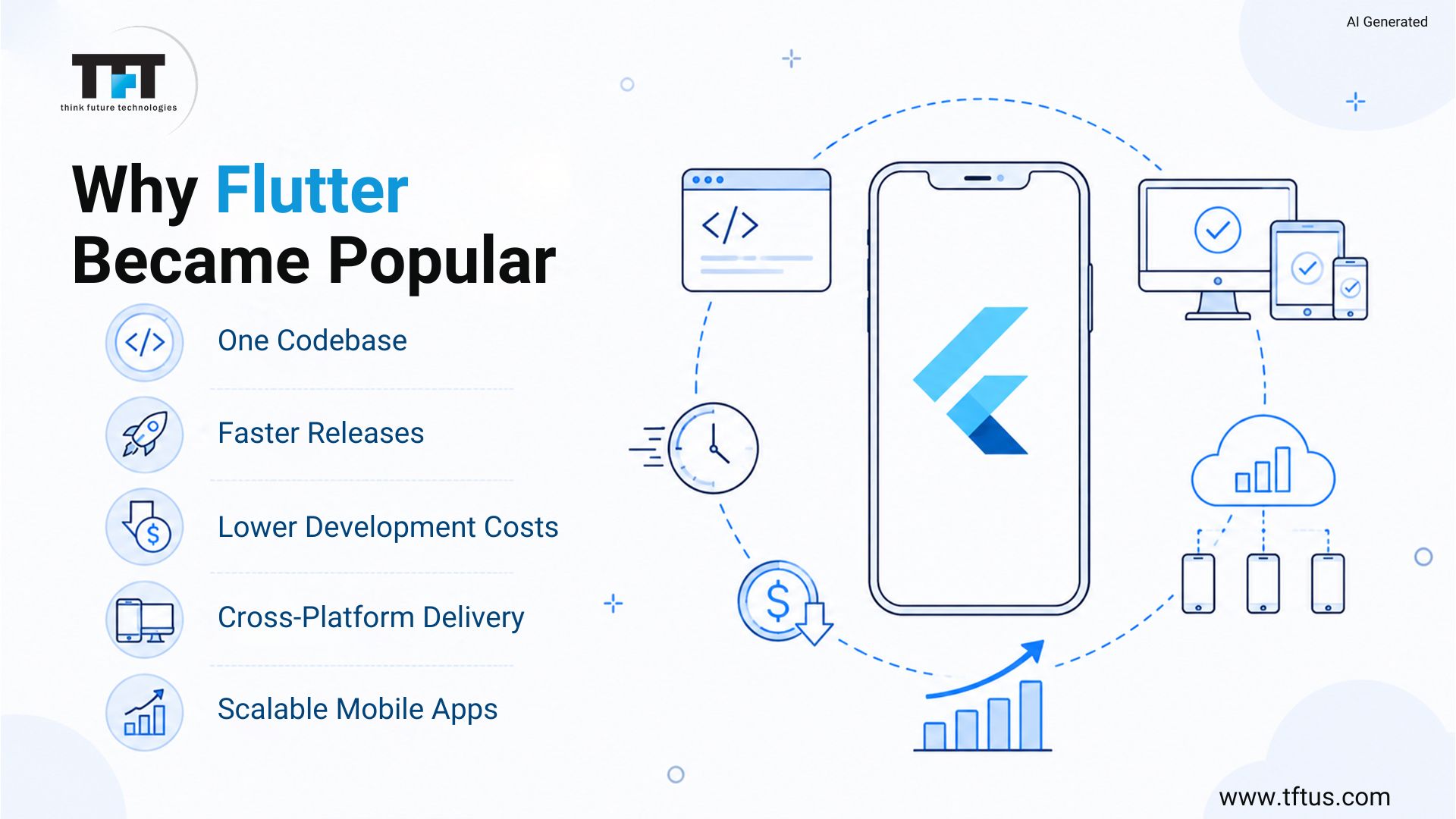
Flutter didn’t become popular because developers were bored with native mobile development. It became popular because businesses were exhausted. Exhausted by duplicated work across iOS and Android. Exhausted by release cycles that slipped because two teams moved at different speeds. Exhausted by design systems that fractured the moment an app scaled beyond version one. Exhausted by mobile roadmaps that looked reasonable on paper but collapsed under execution pressure.
Google introduced Flutter in 2017 as an open-source SDK for cross-platform apps, built on the Dart programming language. Flutter allows app developers to create mobile and web apps from a single codebase, enabling efficient cross-platform development. Its widget-based system, hot reload feature, and access to a growing ecosystem of plugins and libraries make it a leading framework for building high-performance, beautiful UIs.
Quick Results: Our Top Picks
Best Overall: Think Future Technologies (90/100) — product-led Flutter engineering, scalable architecture, full-stack backend integration, AI/ML capability, dedicated and project-based engagement models.
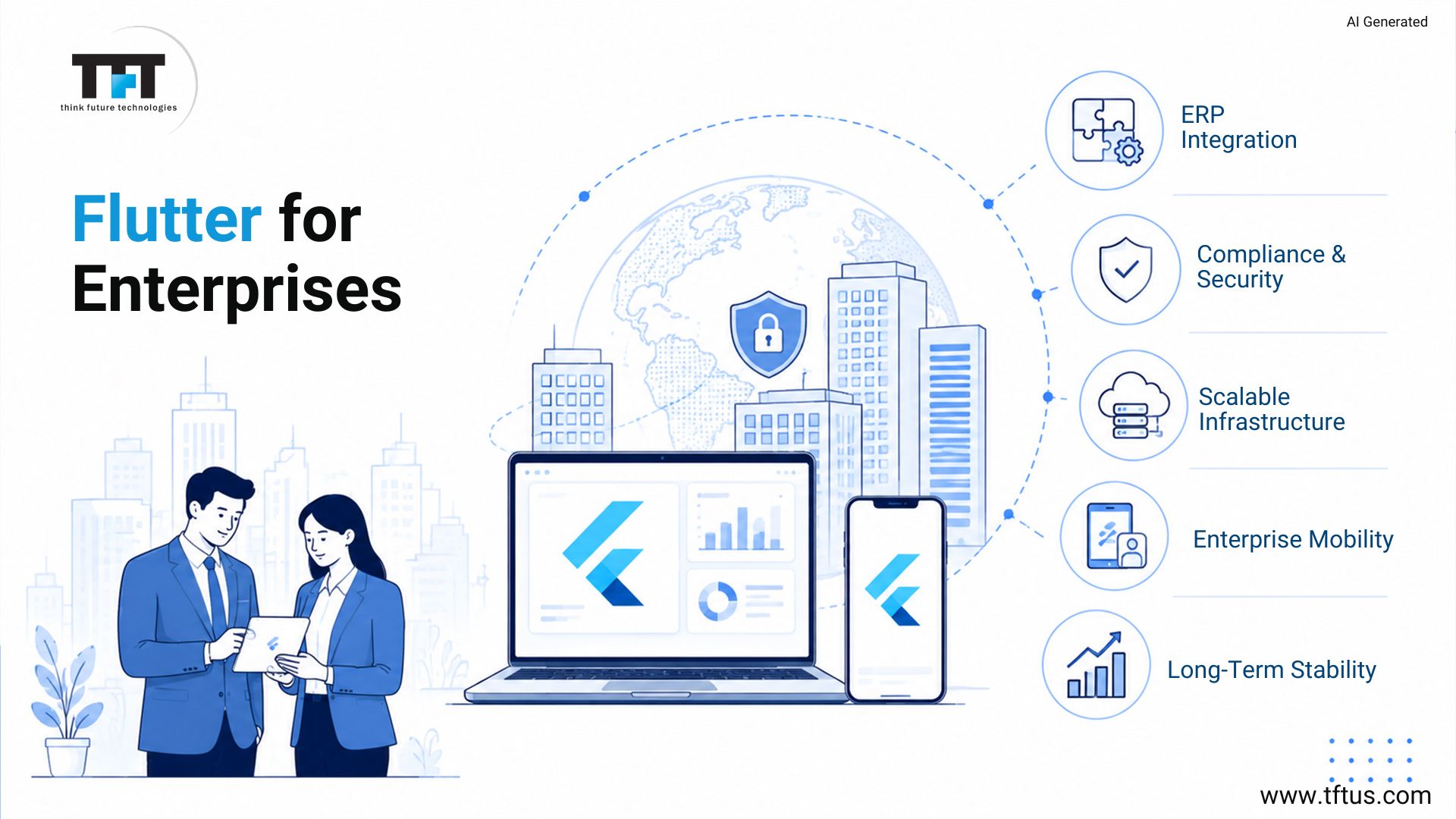
Best for Enterprise Delivery: SPEC INDIA (82/100)—compliance-ready Flutter apps, legacy system integration, structured governance, and regulated industry experience.
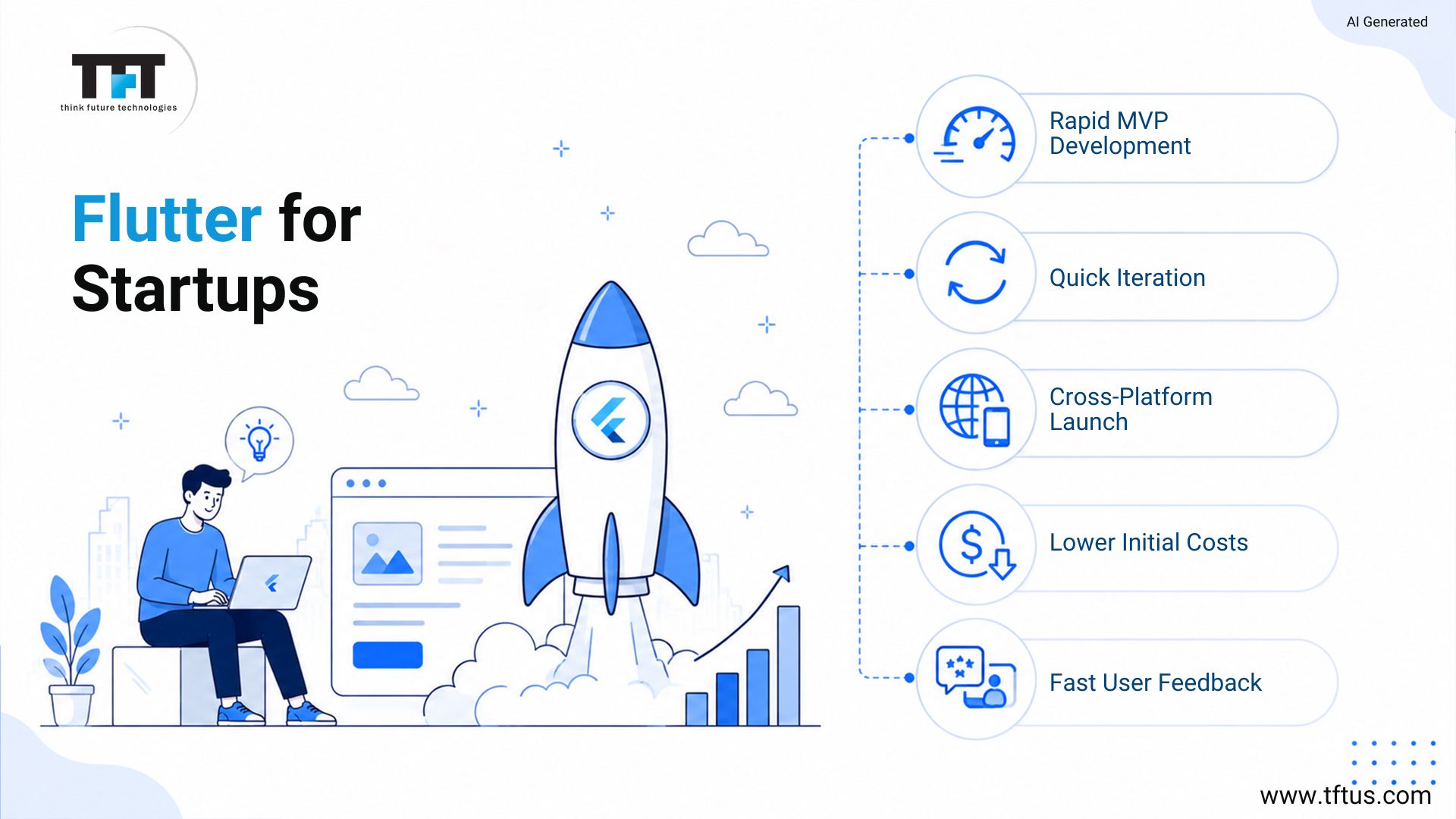
Best for Startups and MVPs: Hyperlink Infosystem (78/100) — fast cross-platform delivery, polished UI, startup-friendly pricing, strong MVP execution.
Best for Design-Led Products: OrangeManta (76/100) — UX-first Flutter builds, brand-driven digital experiences, close discovery and design collaboration.
Best for Process-Driven Engagements: Clarion Technologies (74/100) — predictable sprint delivery, stable offshore teams, enterprise-friendly governance, and documentation.
Best for Startup-Native Iteration: Zartek Technologies (72/100)—founder-aligned collaboration, rapid iteration, and pragmatic Flutter execution for early-stage products.
Best for Business Systems and Internal Tools: Eiosys Private Limited (68/100) — ERP-linked Flutter apps, logistics and workflow tools, stable backend integration, and low visual overhead.
How I Evaluated These Flutter Mobile App Development Companies
I evaluated each company using a structured framework based on real-world execution signals—not marketing volume, directory rankings, or brand recognition. Every company was assessed against the same five criteria under consistent conditions.
What I looked for:
-
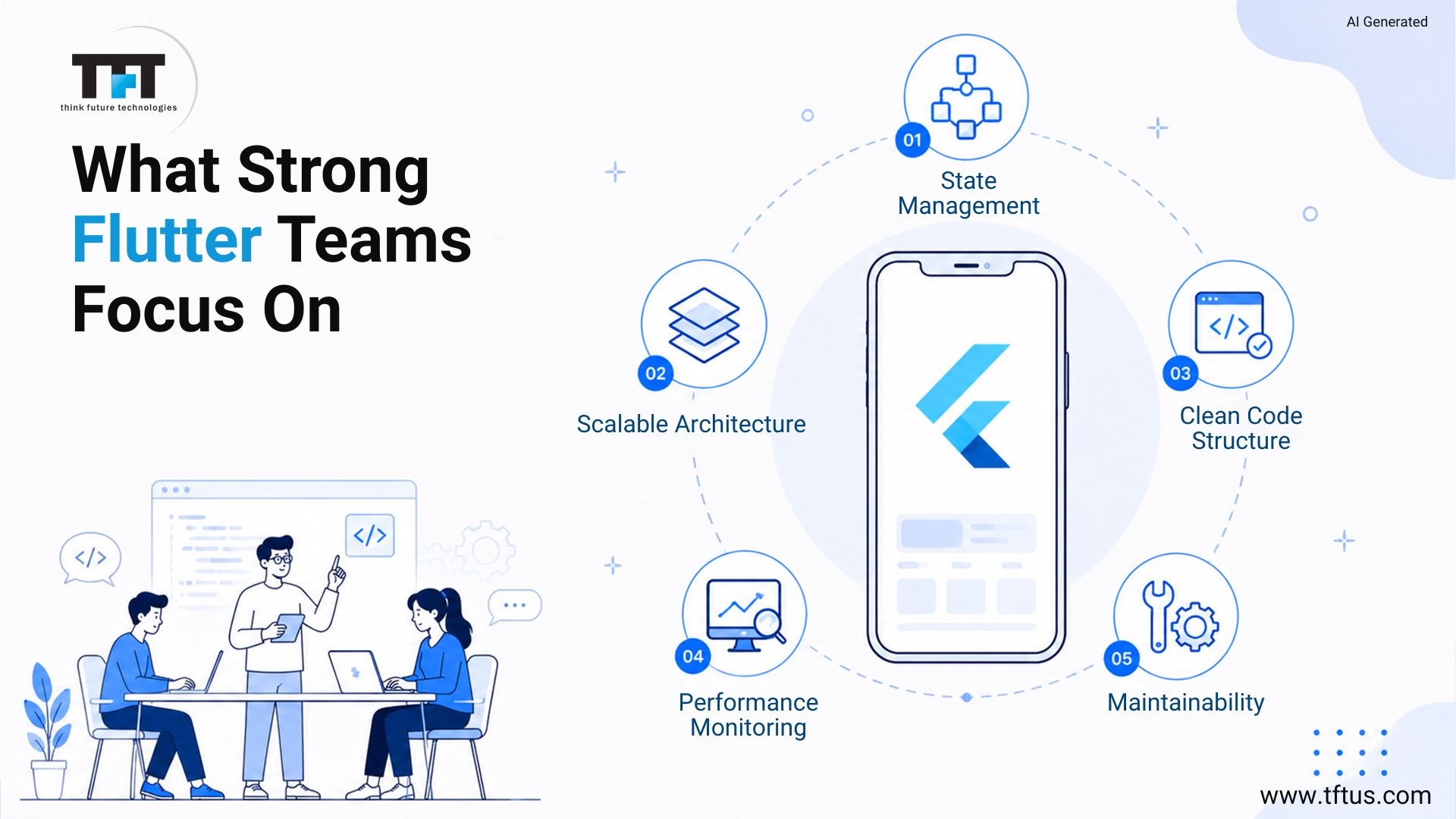
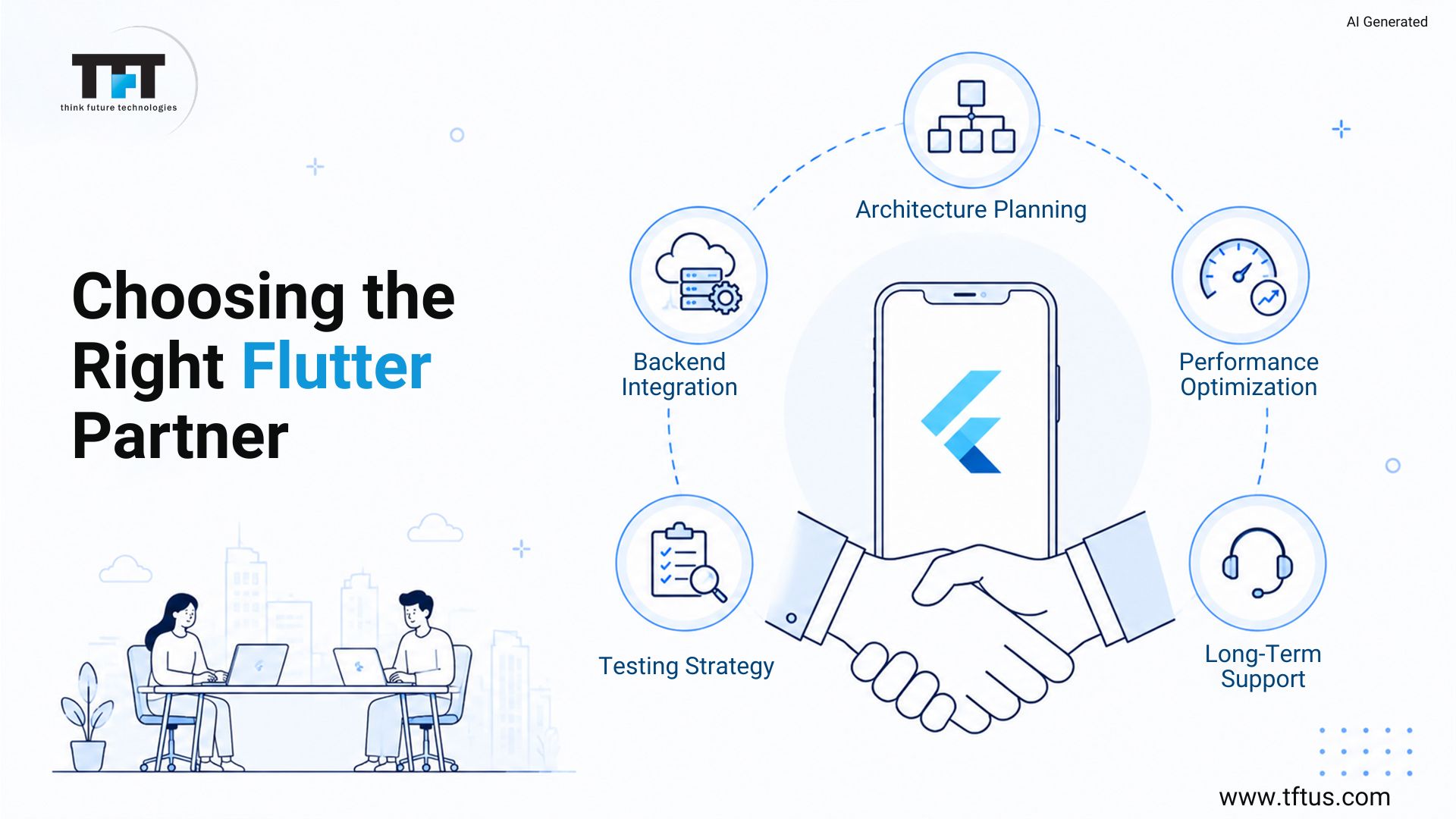
Does the team demonstrate genuine Flutter architecture maturity, or just UI delivery?
-
How do they handle state management, performance optimization, and long-term maintainability?
-
Can they integrate Flutter cleanly with backend systems, APIs, and cloud infrastructure?
-
Do they show real product thinking, or do they only execute what is explicitly specified?
-
What happens after launch — is there a clear ownership, maintenance, and support model?
My scoring system weights what actually matters:
-
Architecture and engineering depth get the highest weight—Flutter decisions made early compound over time, for better or worse.
-
Long-term ownership and post-launch support are heavily weighted—most Flutter projects don’t fail at launch; they degrade quietly over the months that follow.
-
Product and execution maturity matter significantly—teams that think beyond the current sprint produce more durable outcomes.
-
Engagement flexibility matters somewhat—most businesses need evolving partnerships, not fixed one-time deliveries.
-
Speed to first release matters least in the weighting, though it was still assessed for every company
How I Calculated Final Scores
Each company was scored across five categories and added together out of 100:
Example—Think Future Technologies: Architecture Depth (33/35) + Long-Term Ownership (23/25) + Product and Execution Maturity (18/20) + Engagement Flexibility (10/12) + Speed to Release (6/8) = 90/100
Example — MobiIndia: Architecture Depth (18/35) + Long-Term Ownership (14/25) + Product and Execution Maturity (11/20) + Engagement Flexibility (8/12) + Speed to Release (6/8) = 57/100
Flutter Development Companies Covered in This List
The companies discussed represent different strengths and engagement styles:
-
Think Future Technologies
-
Clarion Technologies
-
Hyperlink Infosystem
-
OrangeManta
-
MobiIndia
-
Zartek Technologies
-
Eiosys Private Limited
-
SPEC INDIA
-
Systango Technologies
-
Deligence Technologies
-
Blue Whale Apps (noted for digital innovation, industry focus, and strong compliance with regulatory standards)
Some are better suited for startups, others for enterprises; some emphasize speed, and others stability. There is no universal best choice, only contextual fit.
Top Flutter App Development Company: A quick comparison table
|
S. No. |
Company Name |
Noteworthy Capabilities |
Initial Pricing Model |
|
1 |
Think Future Technologies |
Product-led Flutter engineering, scalable architecture, performance optimization, enterprise & startup balance, deep backend + cloud integration |
Dedicated teams, milestone-based projects |
|
2 |
Clarion Technologies |
Process-driven delivery, long-term offshore engineering, predictable sprint execution, enterprise-friendly governance |
Dedicated resources, offshore engagement |
|
3 |
Hyperlink Infosystem |
Fast MVP delivery, visually polished Flutter apps, startup acceleration, multi-platform execution |
Fixed-price MVPs, hourly billing |
|
4 |
OrangeManta |
UX-first product design, brand-led digital experiences, discovery + Flutter execution |
Project-based studio pricing |
|
5 |
MobiIndia |
Cost-efficient mobile development, functional Flutter apps, business workflow solutions |
Fixed-price, budget-focused projects |
|
6 |
Zartek Technologies |
Startup-aligned Flutter builds, rapid iteration, founder collaboration, and early product shaping |
Agile engagement, startup-friendly pricing |
|
7 |
Eiosys Private Limited |
Business-system driven Flutter apps, ERP & logistics integration, stable internal platforms |
Project-based, long-term support model |
|
8 |
SPEC INDIA |
Enterprise mobility, compliance-ready Flutter apps, legacy system integration |
Enterprise contracts, structured pricing |
|
9 |
Systango Technologies |
Product-focused engineering, UX refinement, scalable Flutter architecture |
Product teams, long-term collaboration |
|
10 |
Diligence Technologies |
Feature-driven Flutter delivery, SMB-focused execution, clear scope implementation |
Fixed-price, feature-based pricing |
|
11 |
Blue Whale Apps |
Digital innovation, Flutter app development, industry-specific solutions, regulatory compliance (HIPAA, GDPR) |
Custom project pricing, compliance-driven engagement |
Think Future Technologies
Think Future Technologies (TFT) operates less like a conventional development vendor and more like a long-term product engineering partner, with Flutter positioned not as a “faster way to build apps” but as a strategic layer within a broader product ecosystem. This distinction matters because many Flutter apps fail not because of poor UI or slow initial delivery but because they weren’t designed to evolve, and TFT’s Flutter work consistently reflects the assumption that the app will remain. It emphasizes the following: actively developed years after launch.
How TFT Structures Flutter Web Development Engagements
TFT’s Flutter projects typically fall into three stages, each with different execution priorities.
1. Early-Stage Product Builds
These are founder-led initiatives where speed matters, but architectural shortcuts would be costly later.
At this stage, TFT emphasizes:
-
Clean project structure from day one
-
Predictable state management aligned with product complexity
-
Early performance baselines
-
Clear separation between UI, logic, and integrations
The goal is to move quickly without creating future resistance inside the codebase.
2. Scale & Growth Phase
Once a Flutter app has users, execution priorities change dramatically.
TFT’s teams focus on:
-
Performance optimization under real usage patterns
-
Reducing onboarding friction
-
Improving release reliability
-
Stabilizing analytics and monitoring
Flutter apps at this stage are treated as production systems, not feature experiments.
3. Modernization & Migration
TFT frequently works with organizations migrating from:
-
Legacy native apps
-
Older hybrid frameworks
-
Fragmented mobile architectures
These projects prioritize:
-
Reducing technical debt
-
Simplifying maintenance
-
Creating a unified, scalable mobile foundation
They are less about visible features and more about long-term sustainability.
Engineering Philosophy
From an execution standpoint, TFT’s Flutter teams:
-
Choose state management based on complexity, not trends.
-
Treat performance tuning as ongoing work.
-
Invest early in maintainability and documentation.
Quality assurance is tightly integrated into delivery. Flutter apps are tested across real devices and real scenarios, reducing post-launch instability.
Best Fit
Think Future Technologies is best suited for the following:
-
Product-led companies
-
Startups planning long-term scale
-
Enterprises treating mobile as a core platform
If your app is a business asset rather than a one-off build, TFT aligns well.
Website: https://www.tftus.com
Primary Location(s): USA, India, Germany, Israel
Pricing Model: Dedicated teams, project-based, long-term partnerships
Glassdoor Rating: ~4.4★
Industry Focus: Product engineering, AI/ML, healthcare, enterprise platforms, SaaS
Clarion Technologies
Predictability, Structure, and Process Discipline. Clarion Technologies approaches Flutter development from a process-first perspective. Their roots in offshore engineering services are clearly visible in how teams are structured and managed. For organizations that value predictability over experimentation, this can be a significant advantage.
How are Custom Software Development Flutter Projects Delivered at Clarion
Clarion’s Flutter engagements typically feature:
-
Well-defined sprint cycles
-
Strong documentation practices
-
Clear reporting structures
-
Stable team composition over time
This makes them particularly comfortable partners for:
-
Mid-sized companies
-
Enterprises with internal product owners
-
Organizations accustomed to structured IT delivery.
Strengths in Flutter Execution
Clarion’s approach shines in:
-
Long-term maintenance-heavy projects
-
Applications with stable, well-defined requirements
-
Environments where governance and reporting matter
Their teams tend to closely follow established workflows, reducing surprises during delivery.
Areas to Clarify Before Engagement
Because Clarion’s strength lies in structure, buyers should still explicitly discuss:
-
Architectural ownership
-
Performance optimization strategies
-
Testing depth beyond basic validation
Process alone does not guarantee scalability.
Best Fit
Clarion Technologies works best for:
-
Organizations prioritizing stability
-
Long-term offshore engagements
-
Projects where requirements are unlikely to pivot frequently
Website: https://www.clariontech.com
Primary Location(s): India, USA
Pricing Model: Dedicated resources, offshore development
Glassdoor Rating: ~4.2★
Industry Focus: Enterprise software, long-term IT services, modernization
Hyperlink Infosystem
Speed and Visibility as a Core Strength. Hyperlink Infosystem is one of the most visible names in mobile app development, especially among startups and early-stage businesses. Their Flutter work often emphasizes speed, polish, and rapid execution.
Where Hyperlink Excels
Hyperlink is frequently chosen for:
-
MVPs
-
Marketing-driven apps
-
Time-sensitive product launches
Their teams are experienced in:
-
Rapid UI development
-
Cross-platform delivery
-
Launching apps quickly
This makes them effective when speed is the primary constraint.
The Trade-Offs to Understand
Speed-first delivery requires clarity.
Buyers should proactively align on:
-
Architecture decisions
-
Post-launch support expectations
-
Performance and scalability planning
Flutter apps built quickly can scale—but only if the foundation is intentionally designed.
Best Fit
Hyperlink Infosystem is a strong option for:
-
Early-stage startups
-
MVP-focused initiatives
-
Fast validation cycles
When paired with a clear long-term plan, their speed becomes an asset rather than a liability.
Website: https://www.hyperlinkinfosystem.com
Primary Location(s): India, USA, UK
Pricing Model: Fixed cost, hourly, MVP-focused
Glassdoor Rating: ~4.0★
Industry Focus: Startups, mobile apps, on-demand platforms, MVPs
OrangeManta
Flutter Through a UX and Brand Lens. OrangeManta operates as a digital product studio, not a traditional development firm. In their context, Flutter serves the experience first. Design, interaction, and user journeys drive engineering decisions.
How Flutter Fits into OrangeManta’s Model
Flutter is used to:
-
Translate brand identity into consistent mobile experiences.
-
Support discovery-driven product development.
-
Enable close collaboration between designers and engineers
This approach is particularly valuable for:
-
Consumer-facing platforms
-
Brand-led digital products
-
Experience-driven differentiation
Execution Characteristics
OrangeManta’s Flutter projects tend to emphasize the following:
-
Polished UI
-
Thoughtful interaction design
-
Close client collaboration during discovery
This makes them well-suited for teams that want Flutter development alongside product shaping, not just implementation.
Best Fit
OrangeManta aligns best with:
-
Design-led organizations
-
Brands where experience is the differentiator
-
Teams seeking collaborative discovery + delivery
Website: https://www.orangemanta.com
Primary Location(s): USA
Pricing Model: Project-based, studio engagement
Glassdoor Rating: ~4.5★
Industry Focus: UX-led digital products, brand-driven platforms
Mid-Article Reality Check: Why Execution Styles Matter
There is no single “correct” way to build Flutter apps.
Different teams optimize for:
-
Speed
-
Stability
-
Design
-
Governance
-
Scalability
Problems arise when buyers assume these priorities are interchangeable. A speed-optimized Flutter team dropped into an enterprise environment will feel reckless. A governance-heavy team dropped into an early startup may feel slow and inflexible.
The goal is alignment, not reputation.
Common Misalignment Patterns (Seen Repeatedly)
Before moving to the next set of companies, it’s worth highlighting patterns that frequently derail Flutter projects:
-
Hiring for speed when stability is required
-
Hiring for structure when iteration is required
-
Treating Flutter as a shortcut rather than a system
-
Ignoring post-launch ownership
Most Flutter failures don’t happen at launch. They happen three to six months later, when real usage exposes architectural shortcuts.
Strong partners anticipate that moment.
MobiIndia
Practical Flutter Delivery for Clearly Defined Needs. MobiIndia focuses on functional, cost-conscious mobile development. Their Flutter projects are typically straightforward, execution-oriented, and aligned with clearly scoped requirements.
They are not positioning Flutter as a cutting-edge experimentation platform. Instead, Flutter is used as a pragmatic solution to deliver mobile functionality efficiently.
Typical Flutter Use Cases at MobiIndia
MobiIndia is often engaged for:
-
Internal business applications
-
Workflow-driven mobile tools
-
SMB customer-facing apps with defined features
These projects usually prioritize:
-
Reliability
-
Predictable delivery
-
Budget efficiency
Execution Characteristics
Flutter development at MobiIndia tends to emphasize:
-
Clear feature scope
-
Minimal over-engineering
-
Functional correctness over polish
This approach works well when:
-
Requirements are stable
-
Scaling complexity is limited.
-
Speed and cost control matter more than architectural elegance.
Best Fit
MobiIndia is a practical choice for:
-
Small to mid-sized businesses
-
Internal tools and operational apps
-
Teams that value delivery over experimentation
Website: https://www.mobiindia.com
Primary Location(s): India
Pricing Model: Fixed-price, cost-efficient delivery
Glassdoor Rating: ~3.8★
Industry Focus: SMB apps, internal tools, functional mobile solutions
Zartek Technologies
Flutter in a Startup-Native Environment. Zartek Technologies has built a strong reputation in founder-led and startup ecosystems. Their Flutter work reflects comfort with ambiguity, iteration, and rapid learning cycles. Flutter fits naturally into this environment.
How Zartek Approaches Flutter Projects
Zartek often engages.
-
Before product-market fit is fully established
-
While requirements are still evolving
-
When speed of learning matters more than long-term optimization
Their teams are comfortable with:
-
Rapid UI changes
-
Frequent feature adjustments
-
Close collaboration with founders and designers
Execution Strengths
Zartek’s Flutter apps typically emphasize the following:
-
Readable, maintainable code
-
Quick iteration without breaking existing flows
-
Pragmatic decisions over heavy abstraction
Rather than over-engineering early, they focus on helping teams learn faster.
Long-Term Considerations
Startups working with Zartek should proactively discuss:
-
When to harden architecture
-
How testing will evolve
-
Performance planning beyond early traction
These conversations ensure the Flutter app doesn’t require a painful refactor later.
Best Fit
Zartek Technologies is ideal for:
-
Founder-led startups
-
Early to growth-stage products
-
Teams prioritizing speed, adaptability, and collaboration
Website: https://www.zartek.in
Primary Location(s): India
Pricing Model: Agile engagement, startup-friendly pricing
Glassdoor Rating: ~4.6★
Industry Focus: Startups, SaaS, consumer products, early-stage innovation
Eiosys Private Limited
Flutter for Business Systems and Operational Workflows. Eiosys Private Limited approaches Flutter development from a traditional software engineering perspective. Here, Flutter is not a design playground. It’s a tool for extending business systems to mobile form factors.
Common Flutter Use Cases at Eiosys
Eiosys frequently works on the following:
-
ERP-linked mobile apps
-
Logistics and inventory tools
-
Reporting dashboards
-
Process-driven internal platforms
These apps prioritize:
-
Stability
-
Predictability
-
Ease of maintenance
Execution Style
Flutter development at Eiosys typically focuses on the following:
-
Structured implementation
-
Backend integration
-
Clear documentation
-
Minimal visual experimentation
This reduces operational risk in environments where reliability matters more than innovation.
Best Fit
Eiosys is well-suited for:
-
Organizations with established business processes
-
Internal platforms and operational tools
-
Companies extending existing systems to mobile
Website: https://www.eiosys.com
Primary Location(s): India
Pricing Model: Project-based, long-term support
Glassdoor Rating: ~3.9★
Industry Focus: ERP, logistics, business systems, internal platforms
SPEC INDIA
Enterprise-Grade Flutter Delivery. SPEC INDIA brings an enterprise-first mindset to Flutter development. Flutter is treated as one component within a broader digital transformation effort, not as a standalone technology decision.
Where SPEC INDIA Excels:
SPEC INDIA’s Flutter projects often exist within the following:
-
Large enterprise ecosystems
-
ERP and legacy system integrations
-
Compliance-heavy environments
In these contexts, Flutter must align with:
-
Governance standards
-
Security requirements
-
Documentation expectations
Execution Priorities
SPEC INDIA emphasizes:
-
Structured architecture
-
Predictable release cycles
-
Security and compliance alignment
-
Long-term maintainability across large teams
Speed is secondary to control and reliability.
Best Fit
SPEC INDIA is ideal for:
-
Large enterprises
-
Regulated industries
-
Mission-critical mobile applications
Website: https://www.spec-india.com
Primary Location(s): India, USA
Pricing Model: Enterprise contracts, structured delivery
Glassdoor Rating: ~4.1★
Industry Focus: ERP, compliance-heavy industries, enterprise mobility
Systango Technologies
Flutter with Product Maturity in Mind. Systango Technologies sits at the intersection of startup agility and enterprise discipline. Their Flutter teams often behave like product engineers, not just implementers.
How Flutter Is Used at Systango
Systango typically works with:
-
Funded startups
-
Growth-stage products
-
Teams transitioning from early traction to scale
Flutter is used to:
-
Accelerate iteration
-
Improve product polish
-
Maintain long-term code health.
Execution Strengths
Their Flutter projects often emphasize:
-
Thoughtful component design
-
Consistent UI patterns
-
Clean state handling
-
Strong design–engineering collaboration
This balance allows teams to move fast without sacrificing structure.
Best Fit
Systango Technologies works best for:
-
Products past initial validation
-
Teams focused on refinement and scale.
-
Companies where UX and engineering quality matter equally
Deligence Technologies
Straightforward Flutter Execution for Defined Scope. Deligence Technologies takes a clear, execution-first approach to Flutter development.
They are typically engaged when:
-
Scope is well-defined
-
Features are clearly documented.
-
Timelines matter more than experimentation.
Flutter Delivery Style
Deligence focuses on:
-
Feature completeness
-
Clear communication
-
Predictable delivery
Flutter is used as an efficiency tool rather than a strategic platform.
Considerations for Buyers
As with any scope-driven engagement, buyers should:
-
Discuss future scalability early.
-
Clarify testing depth
-
Plan for post-launch iteration
Best Fit
Deligence Technologies is a reliable choice for the following:
-
SMBs
-
Feature-driven apps
-
Well-scoped mobile initiatives
Website: https://www.systango.com
Primary Location(s): UK, India
Pricing Model: Product teams, long-term collaboration
Glassdoor Rating: ~4.3★
Industry Focus: Funded startups, SaaS, product-led companies
Cross-Cutting Lessons Across All These Engagements
There Is No Universal “Best” Flutter Company
Looking at these eleven companies side by side, one thing becomes clear: there is no single best Flutter development company in absolute terms. There are speed-optimized teams, stability-focused teams, design-led studios, enterprise delivery specialists, and startup-native collaborators — and problems arise almost every time a buyer chooses reputation over alignment.
Some concrete examples of what misalignment looks like in practice:
-
A startup racing to validate an idea may struggle badly with enterprise-heavy governance — every change requiring sign-off when what the founder needs is to ship a new experiment by Friday.
-
An enterprise modernizing a customer platform may suffer from an MVP-focused speed team that treats architecture as an afterthought, producing exactly the kind of instability a regulated business can’t absorb.
-
A design-led brand may feel constrained by a purely functional delivery partner who executes the spec precisely but never questions whether the spec itself serves the brand experience.
Flutter succeeds when the execution model matches the product’s actual stage — not the stage the buyer wishes they were at, or the stage a slick sales pitch implied the vendor specializes in.
Why Flutter Projects Quietly Degrade
Most Flutter projects don’t fail dramatically. They degrade slowly, and that slow degradation is precisely what makes it dangerous — there’s rarely a single moment where something obviously breaks.
The pattern typically looks like this: version one works. Version two adds complexity. By version five, changes become risky — a small feature request that should take two days takes two weeks, because nobody fully understands how three different parts of the app now depend on each other.
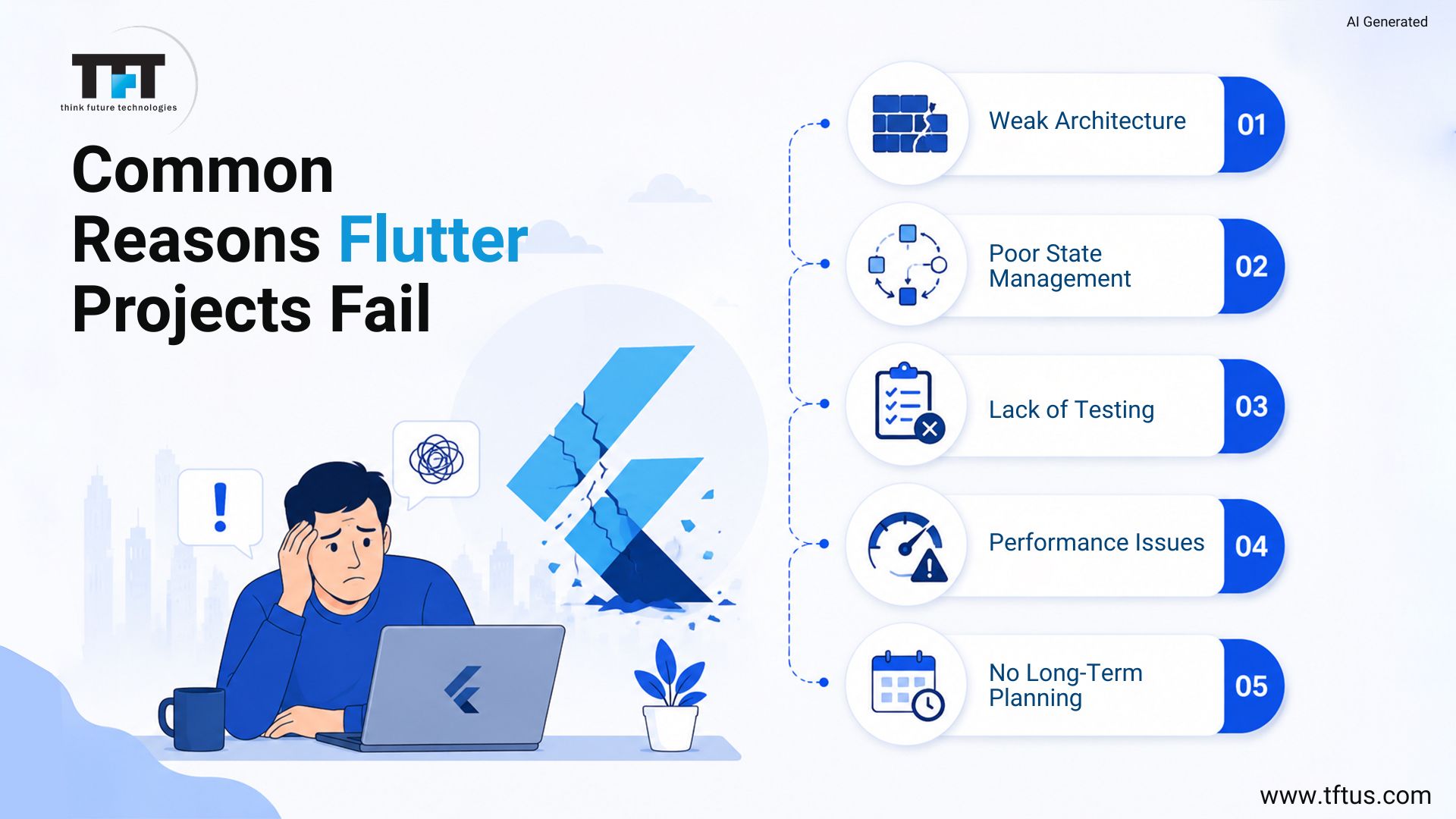
This usually happens for a small, repeatable set of reasons:
-
State management wasn’t chosen thoughtfully. A pattern that worked fine for a five-screen MVP becomes unmanageable at fifty screens, and by the time that becomes obvious, ripping it out means touching almost the entire codebase.
-
Components weren’t modular. Screens and widgets were built as one-off implementations rather than reusable, composable pieces, so every new feature means more duplicated logic rather than less.
-
Performance wasn’t monitored early. Small inefficiencies compound invisibly until real user load exposes them all at once, usually during a moment — a viral spike, a big marketing push — when the team can least afford instability.
-
Testing was postponed. “We’ll add tests later” rarely survives contact with a shipping deadline, and by the time the team wants tests, the codebase has grown too tangled to test cheaply.
-
Architectural shortcuts were taken to meet deadlines, with the implicit assumption that someone would circle back and clean it up — an assumption that’s almost never true once the next deadline arrives.
Strong Flutter teams design for this curve from day one. They don’t refuse to move fast; they move fast in ways that don’t quietly mortgage the codebase’s future. That’s a subtler skill than it sounds, and it’s the single clearest differentiator between the companies scoring 85+ and the ones scoring 60 in this guide.
Flutter Was Treated as a UI Layer, Not a System
A related but distinct failure mode happens when Flutter is treated purely as “the front end.” In real products, Flutter applications are deeply tied to APIs and backend evolution, authentication and security, analytics and monitoring, and release pipelines and deployment constraints. Teams that focus only on screens and interactions struggle as the product matures, because Flutter doesn’t exist in isolation — and neither should the team building it. A Flutter developer who has never had to think about what happens when an API contract changes, or how a release actually gets deployed to production, is missing half the job.
Ownership Was Never Clearly Defined
Many Flutter apps are delivered successfully and then effectively abandoned. There’s no clear plan for ongoing maintenance, OS updates, dependency upgrades, performance tuning, or knowledge transfer. When the original team disappears, internal teams inherit a system they don’t fully understand — and that’s not really a Flutter problem, it’s a partnership problem. It shows up just as often with native apps; Flutter simply makes it more visible, because the whole appeal of the framework was supposed to be a lower long-term maintenance burden, and an abandoned codebase squanders that advantage entirely.
Speed vs. Stability: The Trade-Off You Can’t Ignore
Every Flutter engagement exists on a spectrum between speed and stability, and ignoring that spectrum is one of the fastest ways to mis-hire a partner.
Speed-focused Flutter teams excel at MVPs, early validation, rapid UI iteration, and fast feedback loops. They’re invaluable when you’re pre-revenue, testing assumptions, or need to learn quickly about what users actually want. But speed without structure has a shelf life — the very things that make a speed-first team effective in month one (minimal process, minimal upfront architecture) become liabilities in month twelve.
Stability-focused Flutter teams emphasize architecture, testing, documentation, and predictable releases. They move more deliberately, but the systems they build are easier to scale, easier to maintain, and easier to onboard new developers into. They’re essential once you have real users, once your app supports revenue or business-critical operations, and once downtime or regressions carry genuine cost rather than just embarrassment.
The real mistake isn’t choosing speed or stability — it’s choosing one without understanding your current stage, and without a plan to rebalance later. The best Flutter partners know how to adjust that balance over time as a product matures, rather than locking a client into a single mode indefinitely, regardless of what the product actually needs at each stage.
Product Thinking vs. Task Execution
Another important distinction across Flutter development companies is how they see their own role in a project.
Task executors build exactly what’s specified, follow tickets and requirements closely, and generally avoid challenging assumptions handed to them. This works well when the scope is fixed, the requirements are stable, and the client has already made the important product decisions internally.
Product partners ask “why” before building, suggest alternatives, think beyond the immediate sprint, and consider downstream impact before committing to an approach. This is especially valuable when requirements are still evolving, or user feedback is actively reshaping the roadmap.
Neither model is inherently better — but confusion between the two leads reliably to frustration. If you expect product thinking and hire a task executor, you’ll feel unsupported and constantly have to specify things you assumed were obvious. If you expect straightforward execution and hire a product partner, you may feel challenged or second-guessed more than you’re comfortable with, especially if you came in with strong opinions about the “right” approach. Getting clarity on which mode you actually need — and which mode a given company actually operates in — saves months of friction later.
A Practical Decision Framework for Choosing the Right Flutter Partner
1. What stage is your product in?
Idea or MVP stage calls for speed, flexibility, and a willingness to learn fast from real usage. Growth stage calls for a balance of speed and structure, since the codebase now has to support both new features and a growing user base simultaneously. A mature product calls for stability, scalability, and reliability above almost everything else, because the cost of a regression is now measured in lost revenue or damaged trust rather than a delayed feature.
2. What internal capabilities do you have?
If you have a strong product and technical team in-house, you likely want a partner who can integrate seamlessly and co-build with you — someone comfortable working inside your existing processes rather than imposing their own. If you don’t have that internal capability, you’ll need a partner who can lead architecture and execution independently, because there’s no internal safety net catching architectural mistakes before they compound.
3. How critical is this app to your business?
A marketing experiment can tolerate a speed-first, slightly rough execution — the cost of being wrong is low. A revenue-generating platform demands a stability-first approach because downtime or bugs translate directly into lost money and lost trust. Internal operations tools need reliability over innovation, since the people using them are employees who need consistency more than novelty.
4. What happens after launch?
This is the most overlooked question in the entire hiring process. Ask explicitly: who maintains the app after launch? Who handles OS updates as Apple and Google push new requirements? Who manages performance regressions when they inevitably appear? How is knowledge transferred if you eventually want to bring development in-house? If there’s no clear, specific answer to these questions, you’re assuming a risk you probably didn’t intend to take on.
Questions Worth Asking Before Signing a Flutter Development Contract
These questions tend to reveal far more about a potential partner than any portfolio ever will.
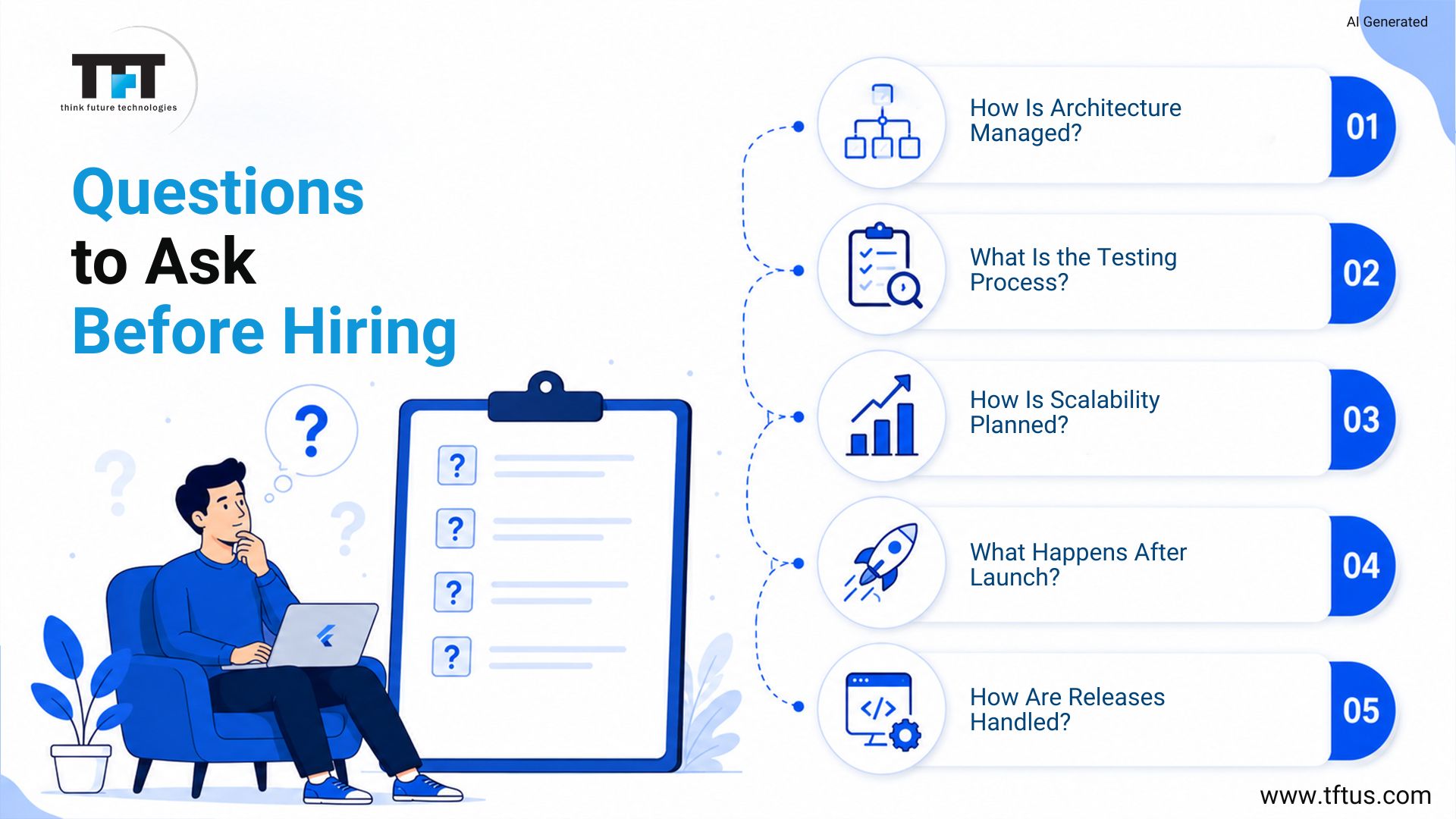
Architecture and engineering:
-
How do you structure a Flutter app, and why does it look that way?
-
How do you manage state as complexity grows over multiple releases?
-
How do you handle API evolution when backend contracts change?
Performance and quality:
-
How do you monitor performance after launch, not just before it?
-
What testing happens before and after release, and how much of it is automated versus manual?
-
How are regressions handled when they’re discovered in production?
Process and ownership:
-
How are releases managed, and what does your rollback process look like?
-
How do you document architectural decisions so someone new can understand them later?
-
What happens if our internal team takes over the codebase later — how painful is that handoff?
Teams that answer these clearly, specifically, and without defensiveness tend to be the ones that build systems that actually last.
Why Flutter Makes Business Sense (Not Just Technical Sense)
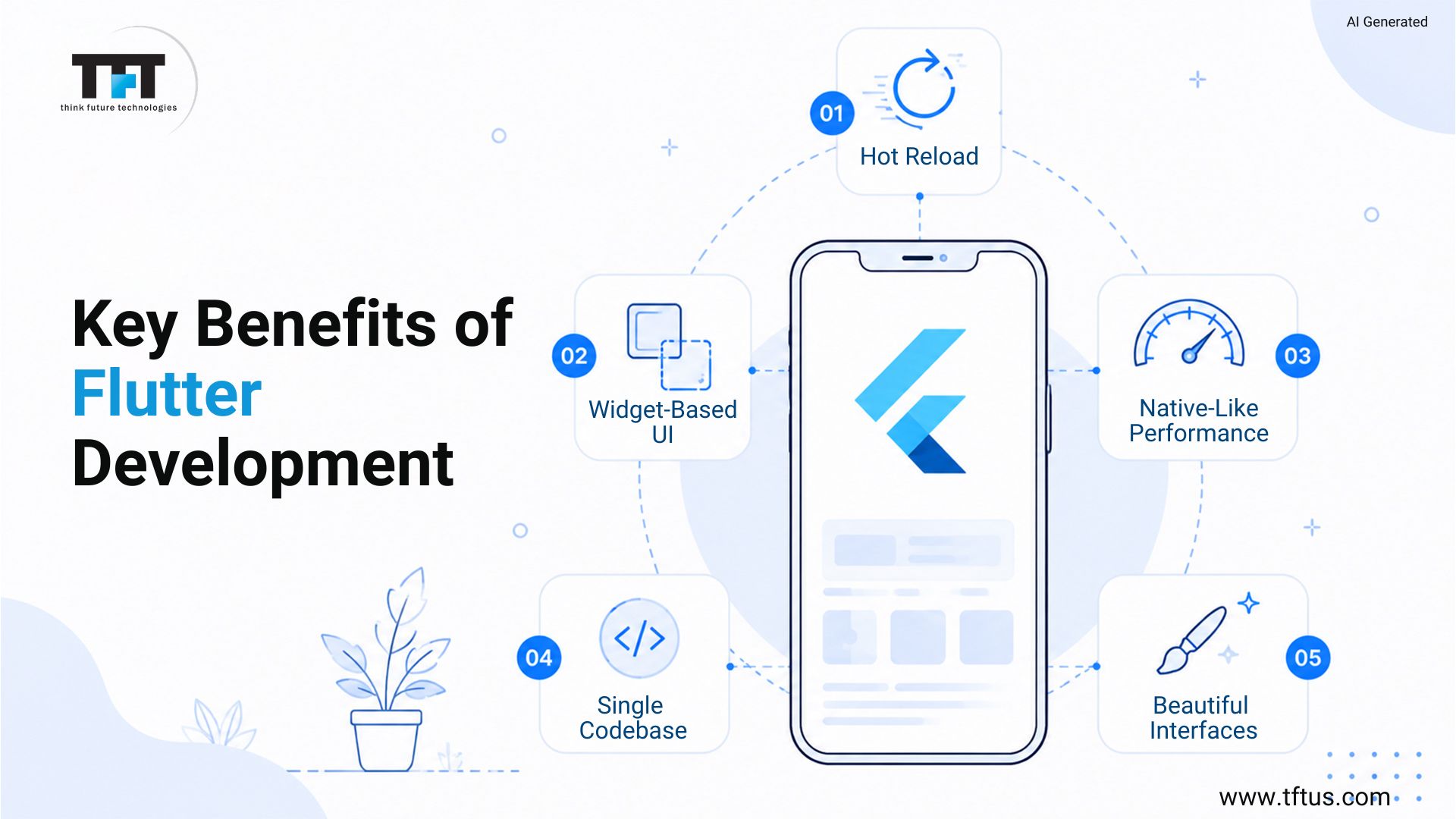
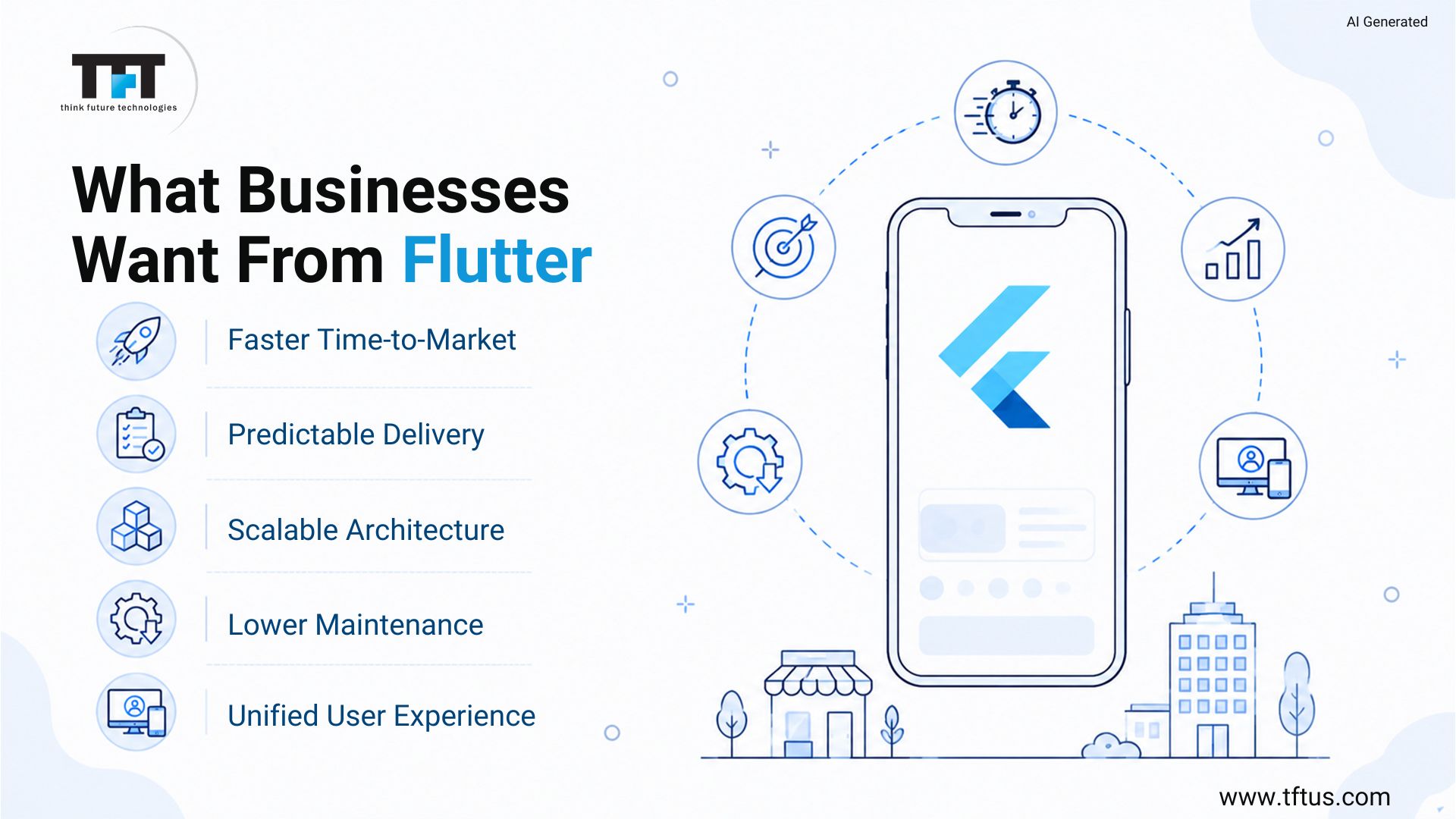
Most conversations about Flutter still begin at the wrong level. They start with features like hot reload, widgets, a single codebase, and fast UI rendering. These are useful developer conveniences, but they are not business outcomes. Leadership teams rarely care how engineers build software; they care whether the software can be delivered predictably, scaled responsibly, and maintained without friction as the organization grows. From that perspective, Flutter’s real value isn’t technical novelty — it’s organizational alignment.
What leadership teams actually care about. When founders, CTOs, and product leaders evaluate a mobile strategy, they rarely ask questions about tooling. They ask about outcomes: Can we ship on time without constant coordination overhead? Can we scale the product without doubling costs? Can we trust our release timelines? Can our teams move fast without breaking things? Can this app evolve over the years, not just versions? Flutter addresses these concerns not by being “faster code,” but by simplifying how teams work together day to day.
One team, one system, one delivery rhythm. The most underestimated benefit of Flutter is alignment. In traditional native development, even well-run organizations operate in parallel tracks — an iOS roadmap versus an Android roadmap, iOS bugs versus Android bugs, iOS release timelines versus Android approval cycles, platform-specific design compromises, and platform-specific technical debt accumulating independently on each side.
Even with strong teams, this creates friction: every decision requires synchronization, every release requires coordination, and every change carries the risk of duplicated effort. As products mature, this parallelism becomes a genuine bottleneck — not because teams are incompetent, but because the system is fragmented by design. Flutter collapses that fragmentation: one team owns the product experience, one codebase defines behavior, and one release cycle advances the roadmap. This isn’t just a technical simplification; it’s an organizational one.
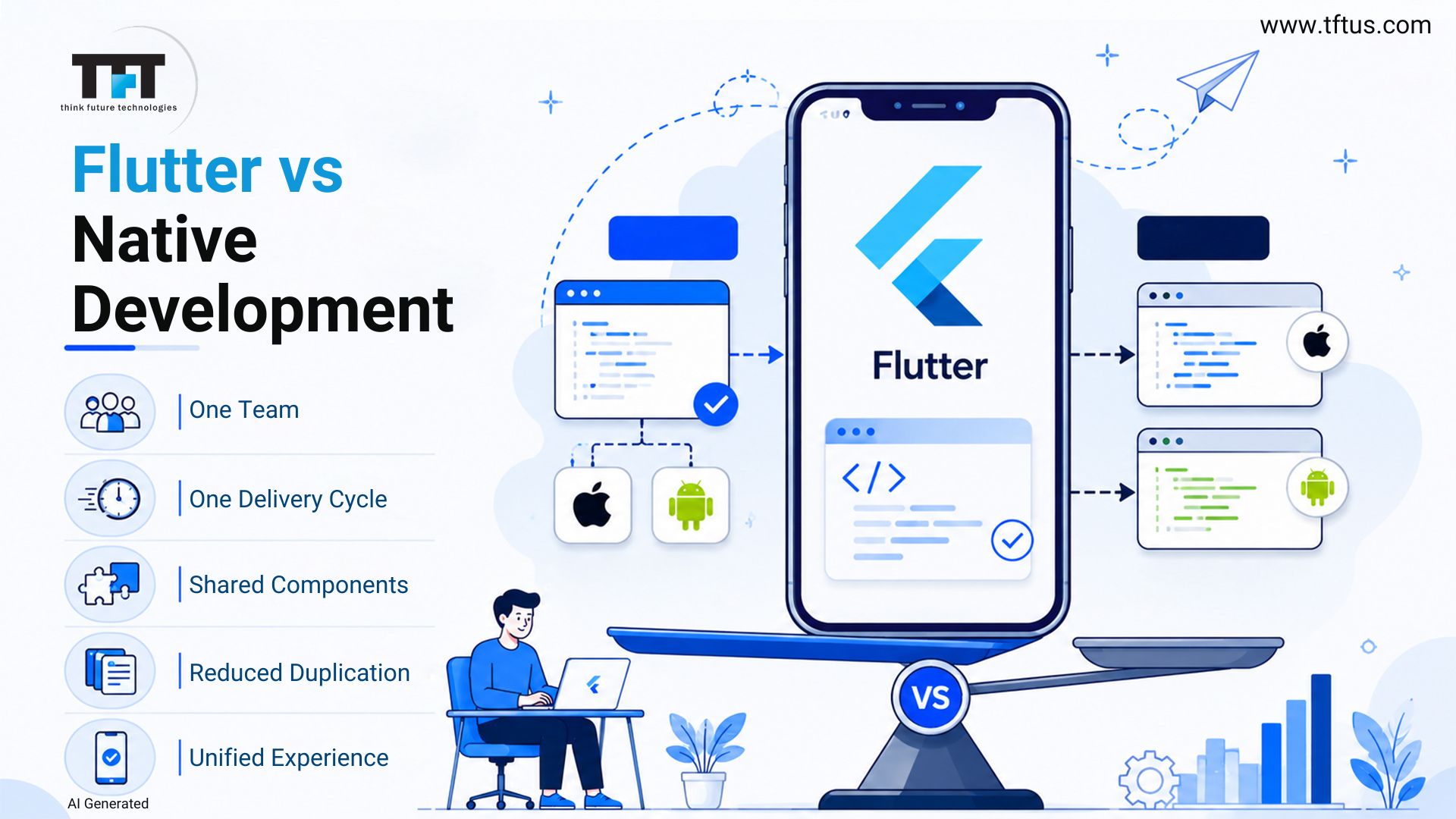
What alignment looks like in practice. When teams move to Flutter, several things change almost immediately. Product managers stop planning features twice. Designers stop negotiating platform inconsistencies between iOS and Android guidelines. QA teams test one behavioral system instead of two separate ones. Engineering discussions shift from “platform differences” to actual product decisions. This alignment produces tangible business outcomes: faster time-to-market, fewer inconsistencies in behavior and UI, reduced friction between design, product, and engineering, and more predictable delivery cycles overall.
Features move from backlog to production faster because work isn’t duplicated. Bug fixes don’t require parallel coordination across two codebases. QA cycles shorten because behavior is unified. Releases become easier to forecast — and easier to trust. For leadership teams, that predictability is often more valuable than raw development speed.
Consistency isn’t cosmetic — it’s strategic. Consistency is often dismissed as a design concern, but in reality, it’s a business lever. Flutter renders its own UI, meaning design systems remain consistent across platforms by default, removing an entire class of problems that typically emerge as mobile products scale. For consumer-facing products, consistency directly impacts brand perception, user trust, and retention. Inconsistent behavior — subtle differences in gestures, animations, or flows between platforms — creates cognitive friction that users may not articulate but definitely feel.
Over time, these inconsistencies erode trust. For enterprise and internal tools, the impact is arguably even more concrete: consistency reduces usability friction, training overhead, and support costs. When internal users move between devices without relearning workflows, adoption improves, support tickets decrease, and training materials stay relevant longer. At scale, these savings compound meaningfully.
Cost is about ownership, not hourly rates. Flutter is often marketed as “cheaper mobile development,” but that framing is misleading and, frankly, a little dangerous. Flutter does not magically reduce cost — good architecture reduces cost. What Flutter does is reduce the surface area where costs can grow, but only if the app is built correctly in the first place. Most mobile costs don’t come from initial development; they come from maintenance, feature evolution, bug fixing, OS updates, and scaling complexity over time.
Flutter’s real advantage is lowering the long-term cost of ownership, but only when certain conditions are met: code is modular and well-structured, state is managed cleanly, performance is monitored early rather than reactively, and technical debt is actively controlled rather than allowed to accumulate. When these practices are ignored, Flutter apps can become just as expensive — sometimes more so — than poorly built native apps. The framework doesn’t save money; the engineering discipline around it does.
Why poor Flutter builds fail the same way poor native builds do. A common misconception is that Flutter somehow protects teams from bad decisions. It doesn’t. A poorly architected Flutter app becomes hard to change, accumulates hidden technical debt, slows feature delivery, and eventually forces expensive refactoring — exactly the same failure pattern as a poorly architected native app. The difference between a cost-efficient Flutter app and an expensive one is never the framework itself; it’s how the foundation was set at the very beginning. Organizations that understand this treat Flutter as a system that must be actively managed over time, not a shortcut that guarantees good outcomes on its own.
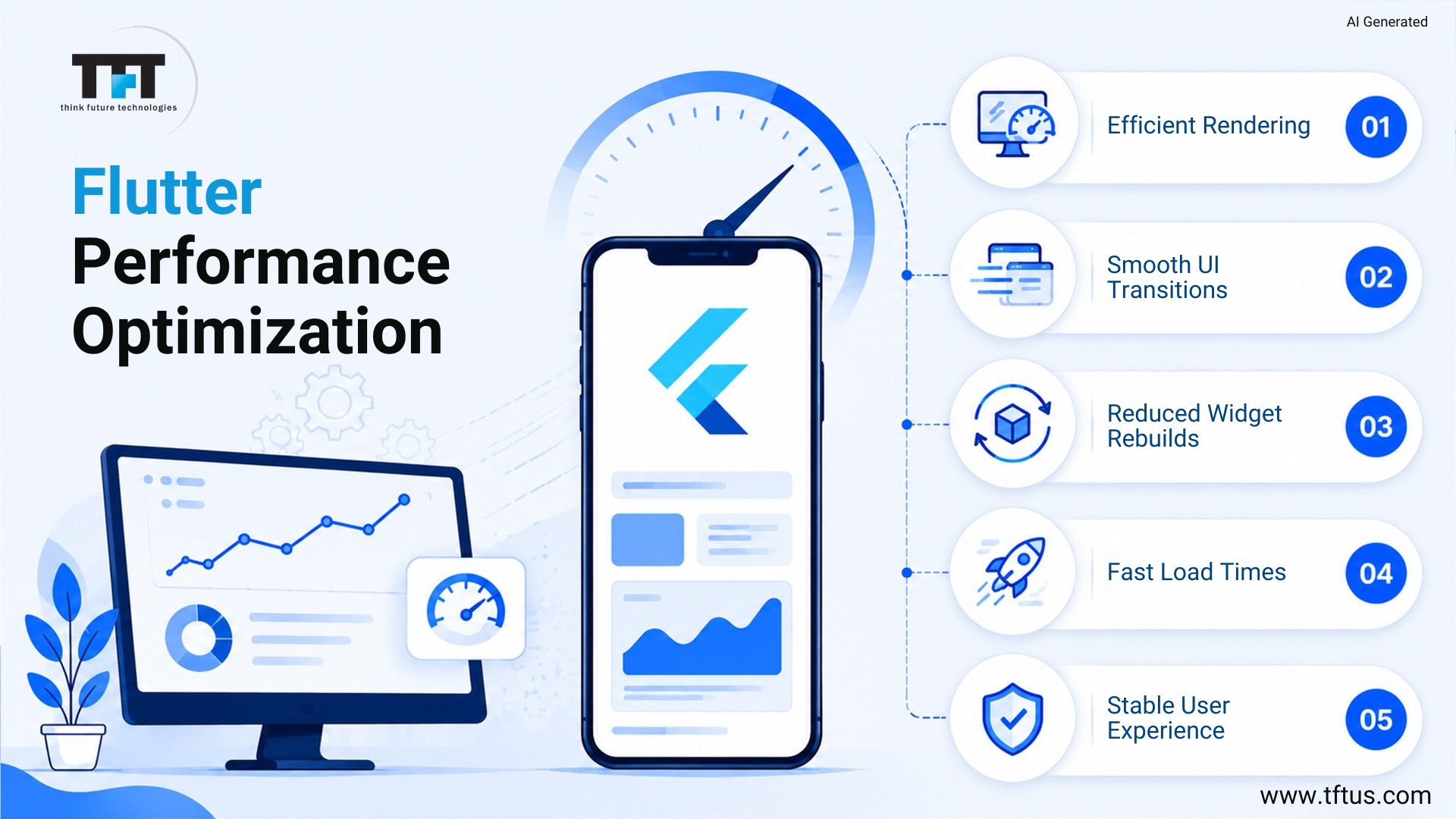
Performance is achievable, but not automatic. One of Flutter’s genuine strengths is performance, but this is frequently misunderstood. Flutter apps can absolutely feel native — smooth transitions, responsive interactions, stable frame rates — but this outcome is not automatic. It’s the result of intentional engineering decisions: avoiding unnecessary widget rebuilds, choosing state management strategies appropriate to app complexity, structuring UI layers to minimize redraw overhead, and monitoring performance continuously rather than only reacting once users start complaining.
Teams that plan for performance early protect the business from expensive downstream fixes and reputational risk — this is precisely where experienced Flutter teams separate themselves from surface-level implementers who can build a pretty screen but haven’t thought about what happens when that screen renders under real-world load.
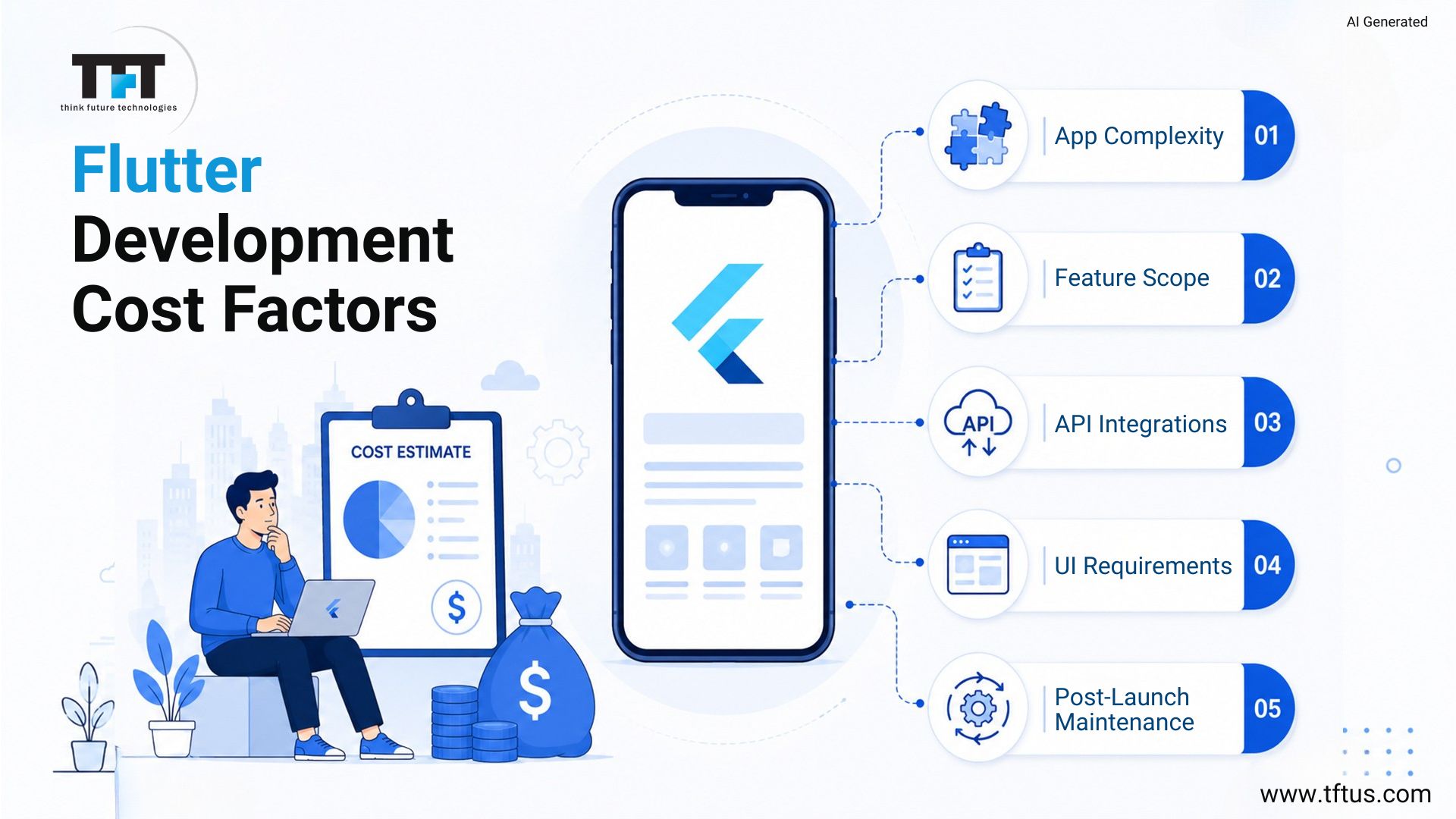
Typical cost ranges. The average cost of Flutter app development in the USA typically ranges from $30,000 to $400,000, depending heavily on app complexity, feature scope, integrations, and long-term scalability requirements. Flutter generally reduces overall app development costs by roughly 30–40% compared to building separate native apps, due to the single-codebase approach eliminating duplicated engineering effort. Business apps and complex enterprise solutions with advanced integrations — AI capabilities, complex backend logic, multi-platform support — can push project costs well above $150,000.
Businesses comparing development companies should assess not just hourly rates, but long-term costs, including maintenance, updates, and scalability, since a cheaper build that needs a rewrite in six months is far more expensive than a slightly higher upfront investment in quality engineering.
Latest trends shaping Flutter development. The best Flutter development companies actively adapt to emerging trends rather than relying on outdated implementation patterns. Current directions include AI integration for intelligent user experiences and automation, advanced state management patterns for scalable cross-platform applications, improved API integration and microservices-based architecture, increased adoption of cloud platforms for backend scalability, expansion of Flutter apps across mobile and web platforms, and ongoing performance optimization work for high-performance apps on a growing range of smart devices. Teams that stay current with these trends tend to build more resilient, future-ready mobile applications — and teams that don’t tend to quietly fall behind without their clients noticing until a competitor ships something they can’t easily match.
What Actually Differentiates Flutter Companies
Not all Flutter app development companies operate at the same level of maturity. While many advertise similar capabilities on their websites, the real difference lies in execution depth, technical judgment, and long-term ownership. A reliable Flutter app development company typically demonstrates a proven track record of building high-quality Flutter apps, strong project management and delivery transparency, experienced developers with real production experience (not just tutorial-level familiarity), seamless integration with backend systems and APIs, and post-launch support with a genuine long-term maintenance plan.
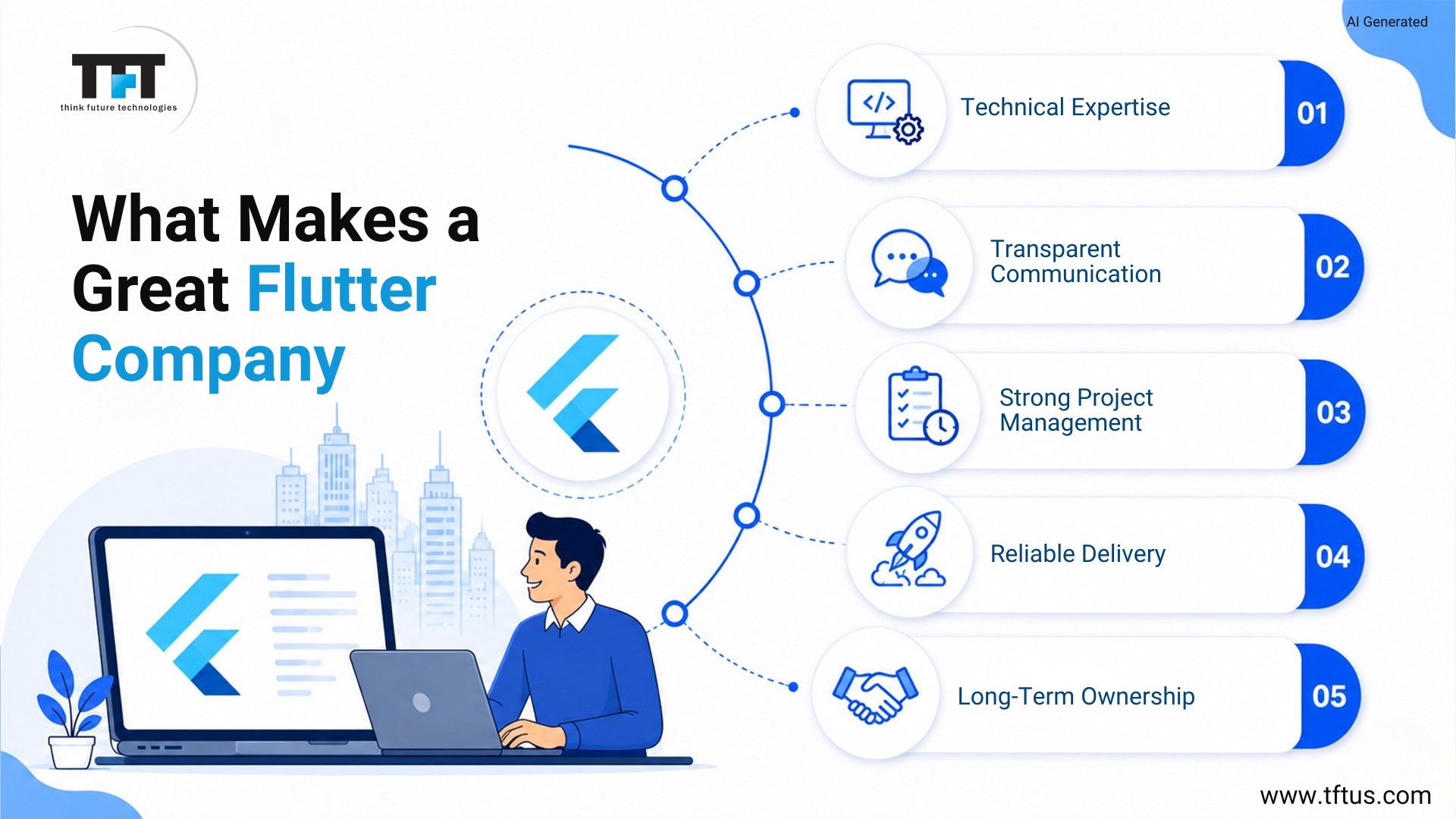
The best Flutter app development services go beyond code delivery — they include architectural planning, performance optimization, security considerations, and a scalability strategy from the outset, rather than bolting these on after something breaks.
When evaluating Flutter app development companies, businesses should focus on alignment with their actual stage and needs, not marketing volume. The mistake many buyers make is treating Flutter vendor selection the same way they’d evaluate a freelancer — by hourly rate and portfolio screenshots — and that approach breaks down quickly once real complexity enters the picture.
Architecture comes first. Your first conversation with a prospective partner should be about structure, not screens. If a team can’t clearly explain how they structure a Flutter app, how they manage state, how they separate concerns, and how they handle API evolution, that’s a meaningful red flag — you’re not buying a UI, you’re buying a system that has to keep working long after the first release.
Testing is not optional. Flutter apps behave differently across devices, OS versions, and network conditions. A serious team has a testing strategy that goes well beyond “we test manually before release,” because app ratings, retention, and user trust all depend on stability that manual testing alone rarely catches consistently.
Scalability must be designed early. Most Flutter apps start small and then grow quickly. Without modular code, performance tracking, CI/CD pipelines, and analytics in place from early on, growth becomes painful. Good partners plan for scale even when the first release is simple, because retrofitting scalability into a rushed codebase is dramatically more expensive than designing for it from the start.
Ownership and transparency matter. Strong Flutter partners document their work, write readable code, and avoid unnecessary lock-in. Transparency is a sign of confidence in the quality of the work, not a weakness or a missed opportunity to create dependency.
State Management in Flutter: A Quick Primer for Buyers
You don’t need to become a Flutter engineer to hire one well, but understanding the basic vocabulary helps you follow the “how do you manage state?” conversation instead of nodding along blindly.
State management refers to how a Flutter app keeps track of data that changes over time — what’s in a shopping cart, whether a user is logged in, what’s currently loading — and how the UI stays in sync with that data as it changes. Get this wrong early, and every new feature becomes progressively harder to add without breaking something else.
setState is Flutter’s most basic built-in approach — fine for small, simple apps, but it doesn’t scale gracefully once an app has more than a handful of screens sharing data.
Provider is a lightweight, widely used pattern that sits on top of Flutter’s built-in tools. It’s approachable for teams that want structure without a steep learning curve, and it remains a solid choice for small-to-medium apps.
BLoC (Business Logic Component) separates business logic from UI more strictly, using streams of events and states. It has a steeper learning curve but tends to produce highly testable, predictable codebases — a common choice for teams that expect significant long-term complexity.
Riverpod is a newer evolution of the Provider pattern, designed to fix some of Provider’s structural limitations (particularly around compile-time safety and testability). Many teams building for scale are gravitating toward it as a default.
Redux and MobX are less common in newer Flutter projects, but still appear, particularly on teams with prior React or JavaScript experience, porting familiar patterns over.
None of these is objectively “best.” The right choice depends on app complexity, team familiarity, and how much the app is expected to grow. What matters far more than which pattern a company uses is whether they can explain why they chose it for your specific project — “we always use X” is a weaker answer than “we chose X because your app has this kind of complexity.”
Red Flags to Watch For When Hiring a Flutter Partner
Beyond the direct questions covered earlier, there are some subtler warning signs worth watching for during early conversations with a prospective partner.
Vague answers about architecture. If a sales conversation stays entirely at the level of “we build beautiful, high-performance apps” without ever getting specific about how, push for a technical conversation with an actual engineer before signing anything. Marketing language is not a substitute for engineering substance.
A portfolio full of screenshots, not shipped products. Anyone can produce polished mockups. Ask specifically which apps in the portfolio are live, currently maintained, and still being actively developed — and ask to speak with a reference client whose app has been in production for at least a year, not just one who recently launched.
No mention of post-launch plans. If a company’s pitch is entirely focused on the build phase and never touches on maintenance, monitoring, or long-term ownership, that’s a strong signal they’re optimized for closing the deal, not for what happens after.
Reluctance to discuss trade-offs. A confident, experienced team will readily discuss the downsides of a given approach — every architectural decision involves trade-offs, and a team that presents every choice as strictly positive is either inexperienced or not being fully candid.
Pricing that seems too good relative to the scope. Extremely low bids for complex projects usually mean corners will be cut somewhere — often in testing, documentation, or architecture — and that the client will end up paying for it later in maintenance costs, just under a different line item.
Unclear IP and code ownership terms. Contracts should explicitly state that the client owns their intellectual property and source code from the outset. Ambiguity here, however well-intentioned, can create real problems if the relationship ends or if the client wants to bring development in-house later.
No in-house testers or QA process. The use of dedicated in-house testers, rather than relying purely on developers to self-check their own work, is a meaningful signal of process maturity worth asking about directly.
What a Typical Engagement Looks Like, by Company Type
It’s useful to have a rough sense of how engagement models actually differ in practice, since the same word — “project” — can mean very different things depending on who’s using it.
With a speed-focused MVP partner (the Hyperlink Infosystem model), engagements are often structured around a fixed scope and a fixed price, with a defined feature list agreed upfront. Timelines tend to run from a few weeks to a few months. Communication is typically frequent but transactional — status updates rather than strategic discussion. This model works best when you already know what you want built and need it built quickly and affordably.
With a design-led studio (the OrangeManta model), engagements usually begin with a discovery phase — workshops, user research, brand alignment — before any code is written. The build phase that follows is informed directly by that discovery work, and the studio expects to have a voice in product decisions, not just execution. Timelines run longer than a pure MVP build because the discovery phase adds real time upfront, but the resulting product tends to be more differentiated.
With an enterprise-grade partner (the SPEC INDIA or Clarion model), engagements are structured around formal sprint cycles, documented requirements, and regular governance checkpoints — often including steering committee reviews and formal sign-off gates between phases. These engagements run longer and involve more process overhead, but that overhead exists because the cost of an unstructured mistake is much higher in these contexts.
With a long-term product partner (the Think Future Technologies model), the “engagement” often isn’t a single project at all — it’s an ongoing relationship that moves through distinct phases (initial build, scale-up, modernization) over years, with the team’s composition and focus shifting as the product’s needs change. Pricing models tend to reflect that: dedicated teams and milestone-based structures rather than a single fixed quote.
Knowing which of these models you’re actually looking for — before you start taking sales calls — makes it much easier to filter out mismatched partners early, rather than discovering the mismatch three months into a contract.
Team Augmentation vs. Full-Service Engagement
One more decision worth making explicitly, before you get deep into comparing individual companies, is whether you want a full-service engagement or a team augmentation arrangement — because these two models come with very different expectations, even when the company offering them is the same.
Full-service engagement means the Flutter partner owns the entire delivery: architecture decisions, design, development, QA, and often ongoing maintenance. You bring the product vision and business requirements; they bring the execution and technical judgment. This is the right model when you don’t have in-house mobile engineering expertise, or when you want a single accountable party rather than managing multiple moving pieces yourself. Most of the companies profiled in this guide — Think Future Technologies, SPEC INDIA, Clarion, Eiosys — operate primarily in this mode.
Team augmentation, sometimes called staff augmentation, means the partner embeds one or more Flutter developers directly into your existing team and processes, working under your technical leadership rather than their own. Some of the best Flutter development companies also offer team augmentation as a flexible staffing solution, enabling organizations to rapidly scale their engineering resources by integrating specialized external developers directly into an existing internal team, rather than handing over an entire project. This model works well when you already have strong internal product and engineering leadership and simply need additional Flutter-specific hands, rather than someone else’s architectural opinions layered on top of your own.
The trade-off is straightforward: full-service engagement gives you a single point of accountability and reduces the coordination burden on your side, at the cost of somewhat less direct control over day-to-day technical decisions. Team augmentation gives you maximum control and keeps decision-making inside your organization, but only works well if you actually have the internal capacity to manage and direct that talent effectively. Mismatching these — hiring a full-service partner and then trying to micromanage every technical decision, or hiring augmented staff without the internal leadership to direct them — is a quieter but surprisingly common source of friction in Flutter engagements.
It’s worth asking any prospective partner directly which model they’re proposing, since the same sales conversation can sometimes blur the two together in ways that only become clear once the contract is signed and the working relationship actually begins.
Industry-Specific Considerations for Flutter Projects
Not every Flutter engagement carries the same constraints, and it’s worth thinking through what your specific industry demands before evaluating partners purely on general Flutter capability.
Healthcare and life sciences. Apps that touch patient data need HIPAA alignment (or the equivalent regulation in your jurisdiction) designed in from the start, not retrofitted after a security review flags a gap. This affects everything from how data is cached locally on-device to how analytics events are structured, since even seemingly harmless usage data can become sensitive in a healthcare context. Partners like Blue Whale Apps or SPEC INDIA, with explicit compliance experience, tend to be a safer starting point than a generalist team that will need to learn these constraints on your project.
Fintech and financial services. Beyond regulatory compliance, financial apps typically need to think carefully about offline behavior, transaction integrity, and audit logging from day one. A team without prior fintech experience can still do excellent work here, but expect a longer discovery phase dedicated specifically to these requirements.
Logistics, ERP, and internal operational tools. These projects usually care less about visual polish and far more about reliable integration with existing backend systems — which is exactly where a partner like Eiosys, with deep ERP and logistics integration experience, has an advantage over a design-first studio that would otherwise spend budget on visual refinement that the actual users won’t especially value.
Consumer and brand-led products. Where user experience is the primary differentiator — think consumer social, wellness, or lifestyle apps — the calculus flips. A technically excellent but visually generic app will often underperform a slightly less architecturally sophisticated one that nails the emotional experience. This is where design-led studios like OrangeManta tend to earn their fee.
Regulated enterprise environments. Beyond compliance, large enterprises often need to integrate Flutter apps with existing single sign-on systems, internal API gateways, and legacy databases that predate the mobile initiative by years. This kind of integration work is unglamorous but essential, and it’s exactly the kind of engagement SPEC INDIA and Clarion are built around.
Matching your industry’s actual constraints to a partner’s demonstrated experience in that space will usually tell you more than a generic capabilities comparison ever could.
Closing Perspective
Flutter has already proven itself as a capable, production-ready framework. What differentiates successful mobile products now is not what they’re built with, but how they’re built and who builds them.
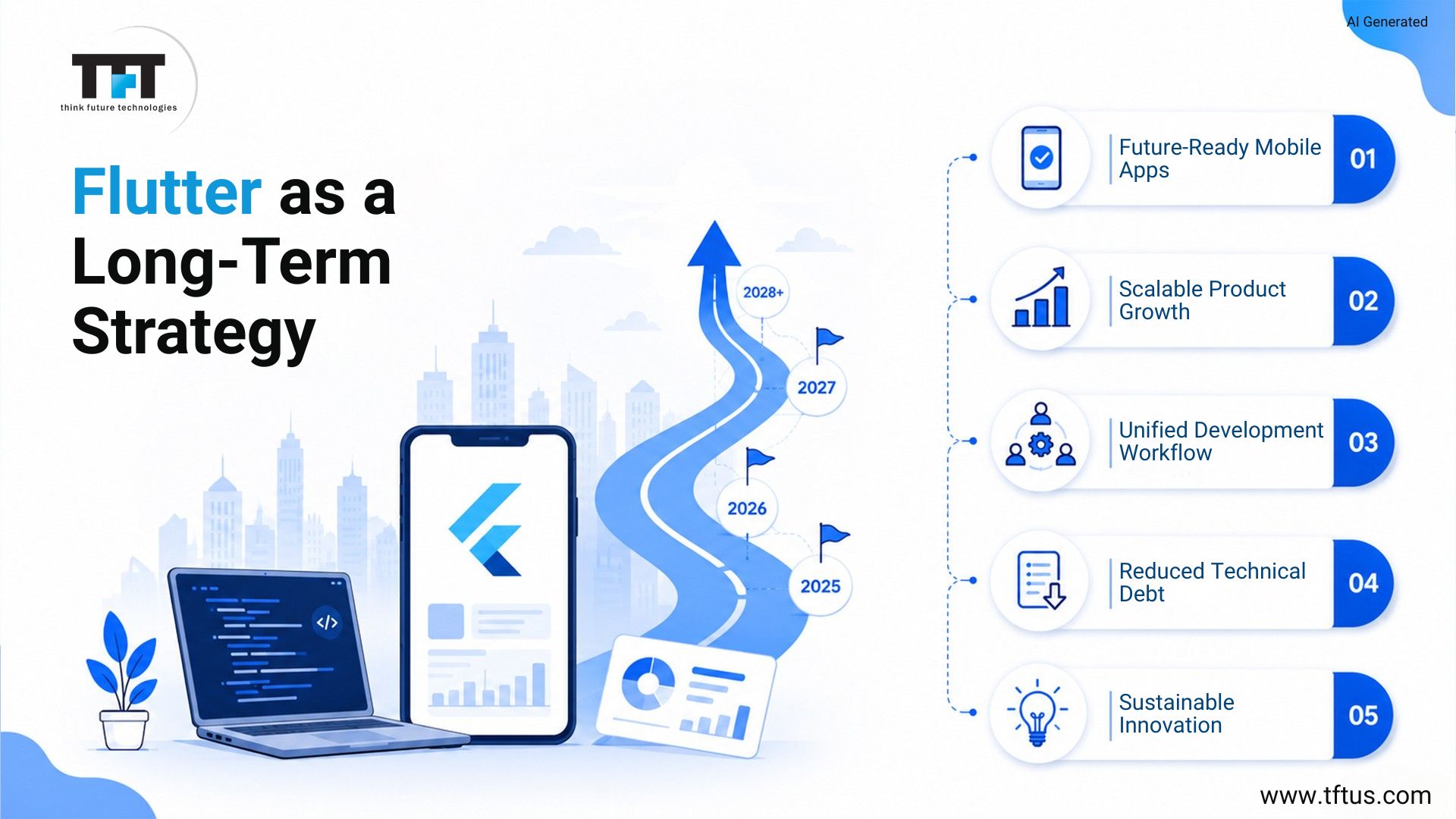
The companies covered in this guide span a wide range of strengths — from speed-focused execution to enterprise-grade delivery, from design-led studios to compliance-first specialists. Each has a genuine place, depending entirely on context. Among them, Think Future Technologies consistently aligns with teams that view mobile as a long-term investment, value stability as much as speed, and understand that execution quality compounds over time rather than showing up all at once at launch.
By the time most Flutter projects run into serious trouble, the framework itself is rarely the problem. The framework did what it promised — the team shipped fast, and the app went live. The real determinants of long-term success are alignment between product stage and execution style, willingness to invest in structure early rather than deferring it indefinitely, clear ownership beyond launch, and honest communication about trade-offs throughout the relationship. Flutter amplifies good engineering. It also amplifies bad decisions just as efficiently. The company you choose determines which one you get.
The most useful question to ask, then, isn’t “Who is the best Flutter company?” It’s “Who is the best Flutter company for us — including a year from now, when this app is twice as complex as it is today?” If your goal is not just to launch a Flutter app, but to build one that grows with your business, the choice of partner is one of the most consequential decisions you will make. Choosing well means choosing long-term thinking over short-term acceleration, engineering discipline over hype, and systems built to scale rather than code that merely ships. When Flutter is executed with that level of intent, it stops being just a framework — it becomes a foundation you can build on with confidence.
At the end of the process, resist the urge to make this decision purely on a spreadsheet of hourly rates and feature checklists. The companies in this guide differ far more in how they think about a product’s second and third year than in whether they can technically build a login screen or a payment flow — most competent Flutter shops can do that. What separates a 90-scoring partner from a 60-scoring one is almost never visible in a first demo. It shows up eighteen months later, in how quickly a new feature can be added without regression, in how confidently a new developer can be onboarded onto the codebase, and in whether the original team is still around and still useful when something unexpected happens in production.
Take the time to have the harder conversations before signing anything: ask about architecture, not just aesthetics; ask about what happens after launch, not just before it; and ask for evidence of long-term maintenance, not just a portfolio of first releases. A little extra diligence at the hiring stage is consistently cheaper than the alternative — discovering, a year into a product’s life, that the foundation underneath it was never built to hold the weight it’s now carrying.

Leave a Reply