


Working with ReactJS programmers isn’t merely about handing off tickets and sitting back to await the code. It is a relationship with guidelines, a definite plan, and clear communication. When it’s successful, a web project ships faster, and code remains of high quality.
The 2024 Stack Overflow Developer Survey shows that more than 40% of computer professionals use React. But it’s just half of the story. The other half is how well your team works together day to day.
This guide is for founders, CTOs, and Product Managers who wish to push their ReactJS development relationship to the max.
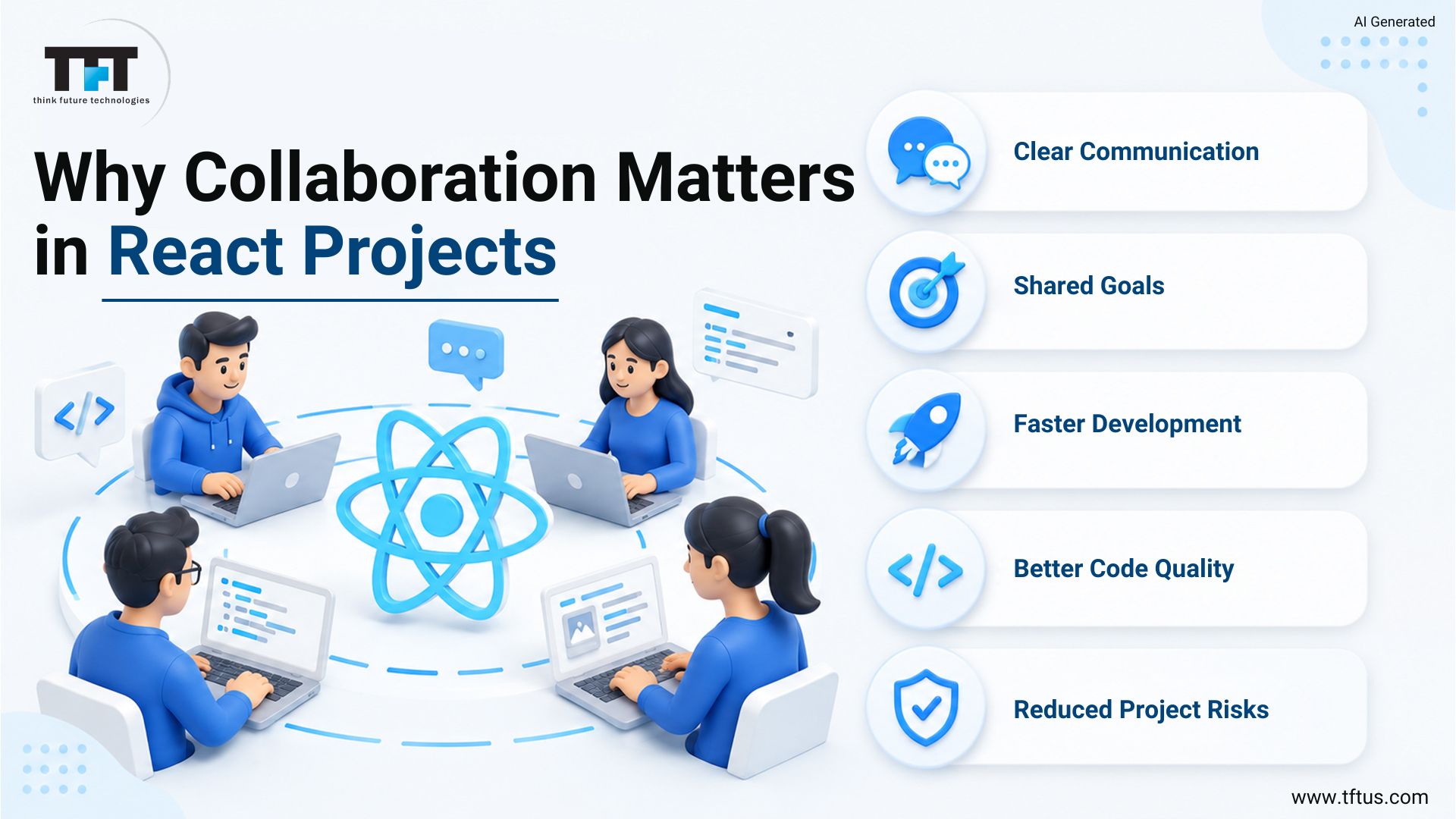
Why Collaboration Is the Defining Factor in ReactJS Projects?
Soft Skills Drive Project Outcomes
While technical proficiency is important, research has shown that team dynamics are the most critical factor in successful software development projects. 92% of hiring professionals say soft skills are just as important as hard skills, according to a study by LinkedIn. It is important to note that this is exactly what it means for ReactJS developers to work with their product teams or clients.
Isolation Creates Invisible Risk
Project scope goes out of sight when JS developers work without great communication. Features are constructed on assumptions. In production, bugs that could have been caught during a design review keep coming through the doors. Technical debt and timeline risk not only build up week by week when there is no structured collaboration, but are also exacerbated by it.
Collaboration Pays Off in Measurable Ways
An HBR study cited by Study.com says that groups with high collaboration rates enjoy productivity increases of up to 25 percent. This difference can be seen in the actual delivery time of web projects with complicated user interfaces, and in customer satisfaction.
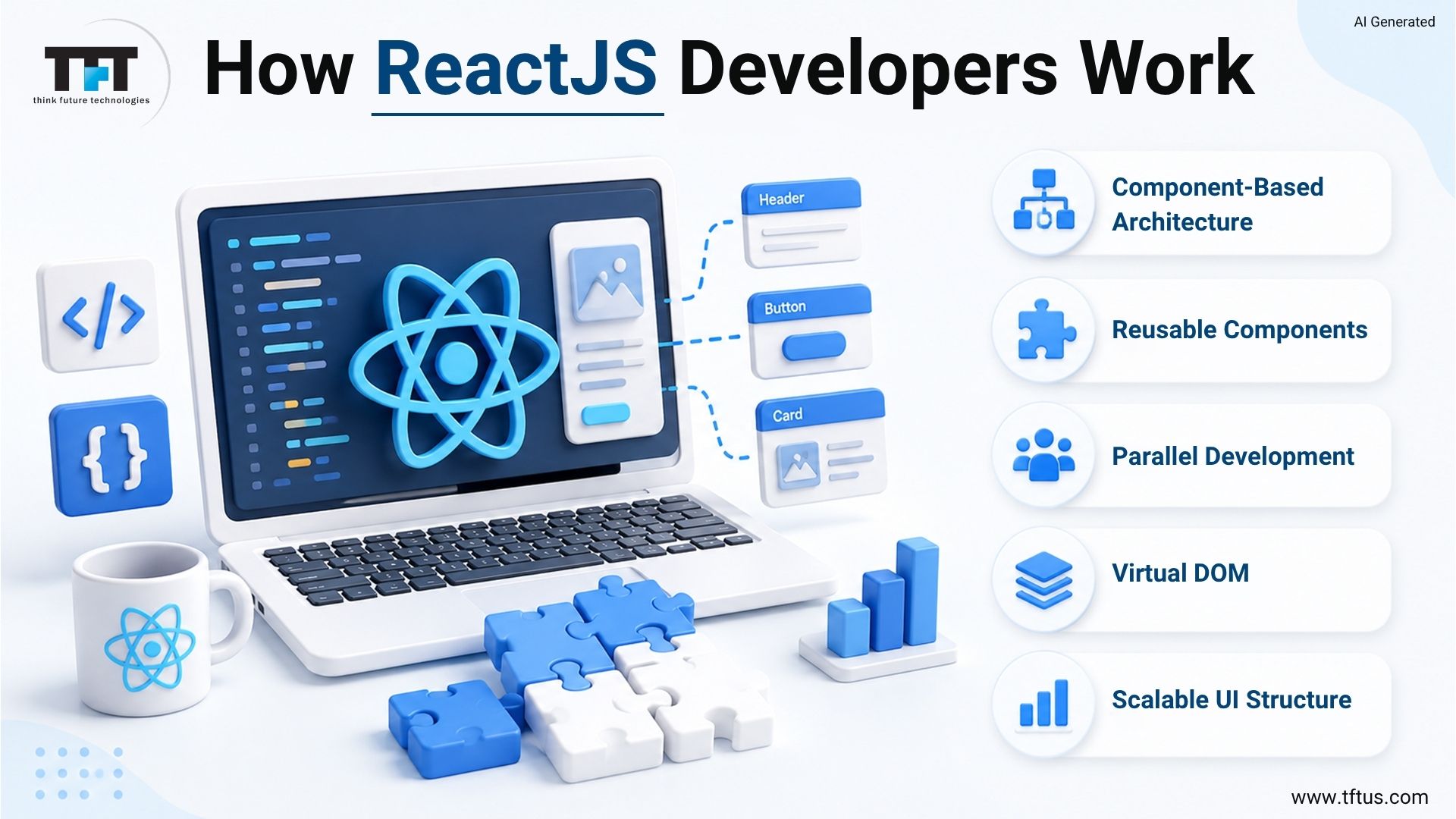
Understanding How ReactJS Developers Think and Work
According to the State of React 2025 survey, insights from 3,760 React developers highlighted the growing importance of shared workflows, tooling, and team coordination as React ecosystems become more complex.
Everything Is a Component
The development of ReactJS is based on a component-based architecture. Every ReactJS user interface is divided into small, independent, reusable components, each of which takes on only one specific responsibility. Doing so makes you more successful right from the start in working with React developers.
Teams Can Work in Parallel
In different ReactJS projects with various developers, no part will affect or interfere with another part. A developer focused on the navigation part of the project doesn’t have to wait for a developer focused on the dashboard. Key benefits of the component architecture in React for software development include the parallel workflow it enables.
The Virtual DOM Affects Decisions You Care About
To render efficiently, React’s virtual DOM ensures that only the parts of the screen that have changed are re-rendered.
Optimizing components for the virtual DOM being developed is a decision that will impact the whole of the web app’s performance. This is necessary for them to set realistic expectations with their ReactJS development company and to have a basic understanding.
Defining Project Scope Before You Hire React Developers
One of the most costly collaboration blunders is beginning the hiring process before the scope of your project is fully defined. Unclear requirements result in scope creep, unmet expectations, and budget bloat. Document your project objectives, primary features, target users, and success criteria in writing before hiring a ReactJS developer.
Having a clear project scope can help you determine which skills the ReactJS developers should possess. An e-commerce WebApp demands a different level of React skills than maybe a Healthcare reporting webpage or an actual collaboration tool. Be able to screen candidates with clarity instead of ‘hire for the rough and tumble jobs’.
Creating project scope documentation is the starting point of your co-operation document with any ReactJS development company. It serves as the baseline for expectations. It covers what constitutes a change request. Professional developers take delivery seriously, for they ask in detail about what you want. Companies asking detailed questions about the scope are a strong sign of serious developers who take delivery seriously.
Choosing the Right Engagement Model
The engagement model is a way of working with ReactJS developers over the long term. This ultimately will rely on your project needs, budget, and internal organizational ability.
Here is a comparison of the four main engagement models used in the US market:
| Engagement Model | Best For | Cost Range (USD) | Key Trade-off |
| Full-time In-house | Long-term ongoing ReactJS development | $120K-$180K/year + benefits | Highest cost, deepest alignment |
| Dedicated Team (Outsourced) | Scaling fast, ongoing development | $2,500-$7,000/month per developer | Less direct control, faster ramp |
| Time and Materials | Evolving requirements, iterative builds | $50-$150/hour (US-based) | Flexible but unpredictable cost |
| Fixed Price | Short well-defined web projects | Agreed upfront total | Scope must be locked, less flexible |
The capacity to obtain all 4 types of flexible engagement models, and assist you in picking the correct one in light of your project’s advancement and timeframe. In the long run, it’s best for companies that wish to continuously develop to utilize dedicated teams, as this would be more cost-effective, and remember the knowledge gained by those teams over time!
How to Hire React JS Developers That Fit Your Team?
Look Beyond the Resume
That’s not all employment of ReactJS developers entails. Successful React developers must be experts with the social skills needed to work effectively with others. After some time, a senior React developer who isn’t great at communicating but does have a clean codebase creates friction in your development team.
Assess Both Technical and Collaboration Depth
The technical things to look for include the component-based architecture, state management, server-side rendering, performance optimization, and React testing library. As an unassuming collaborative partner, check for developer responsiveness to questions, sharing of blockers, and effective documentation of decisions.
Test How They Handle Real Situations
Have candidates explain an incident where they mismatched a non-technical stakeholder and an incident where they disagreed with a designer about how a component should behave. They do not get to know how good the collaboration is based on their answers alone from a technical test.
The 3-Phase Vetting Framework for Hiring ReactJS Developers
Phase 1: Deep Skill Assessment
Hands-on coding problems are used to test architectural reasoning, not just React syntax. Are they capable of creating a scalable component-based architecture? Are they able to communicate their decisions clearly? This part gets rid of developers who’ll offer up a correct answer without understanding.
Phase 2: System Design and Collaboration Evaluation
Candidates explain why they would tackle a complex web project, starting from scratch. This shows their perspective on what they believe about a project scope, communicating trade-offs, and working with a development team.
Phase 3: Communication and Cultural Fit
This stage evaluates soft skills, time zone fit, and collaboration preference. When companies fail to do this at a cost, they often deliver poor-quality work to their clients. It’s the most underutilized facet of the vetting procedure, in addition to one of the most essential.
Setting Up Communication Channels That Actually Work
Establish communication channels before the first line of code. It takes more than a technical issue to kill the momentum of collaboration: there’s a lack of clarity about where to talk about it. ReactJS developers or product teams with a fairly clear structure will save hours and hours of chasing updates and can focus on shipping features.
Make 3 layers of communication in ReactJS projects. The second is asynchronous communication for less urgent updates, documentation, and providing feedback for code review. Here, Slack, Notion, and GitHub are good options. The second is synchronous communication, or standups, sprint planning, and technical decisions. Keep them focused by using Zoom or Google Meet with an agreed agenda.
The third layer is escalation communication—blocker, scope change, critical decision. There should be a due owner, response time, and resolution process for this layer. Escalators are not required to be integral parts of any Reaction; knowing precisely how and where to escalate enables React developers to spend less time stuck and more time productive coding.
Case Study: Improving Collaboration Across Distributed React Teams
A global IT consulting firm built a ReactJS-based internal collaboration platform for more than 1,200 employees working across the US, UK, and APAC regions.
The platform improved internal response times by 35%, reduced email dependency by 28%, and increased incident resolution efficiency by 40% through real-time communication and centralized collaboration workflows.
This demonstrates how structured communication systems can significantly improve collaboration outcomes in large React development environments.
(Source: Global IT Consulting Firm Case Study)
Listen: Building Better Collaboration in React Development Teams
This discussion explores practical approaches to communication, coordination, and teamwork in modern React development environments.
Running Effective Standups With ReactJS Development Teams
Standups in software development are among the most effective collaboration tools. When done properly, they show up problems early and help the development team stay in sync. They are either a dead-end or a status report if not done well.
Standups consist of 3 questions each. What did you complete yesterday? What are you up to? What are you waiting for? Limit to 15 minutes. If any more discussion is required, it should be done in person.
If you’re working in a different time zone, consider using the asynchronous standup on Slack or Loom. All developers provide their 3-point update at the beginning of the day. All updates by the team lead and blockers are escalated right away.
Code Review as a Collaboration Tool
One of the least leveraged collaborations in software development is code review. It is normally only used as a quality gate by most teams. However, savvy React developers also use it to share knowledge and improve their skills over time.
Reviewing each other’s code will allow ReactJS developers to find bugs before production, teach one another best architectural practices, enforce a consistent coding style, and develop an understanding of and respect for one another.
Companies are more successful at guaranteeing high code quality and low defect rates if they have a well-established culture of code review, and they are most successful when done early in the development cycle, whereas companies that push code through are not as good at delivering high-quality code and low defects.
Establish a definite time limit for the turnaround. You have a pull request sitting for 3 days without anyone reviewing it before committing to the main branch, which is slowing your ReactJS development. Celebrate a 24-hour review for standard changes and a same-day review for critical fixes. If you want to provide feedback in a generic way, use inline comments on GitHub, GitLab, or Bitbucket and reference the lines of code!
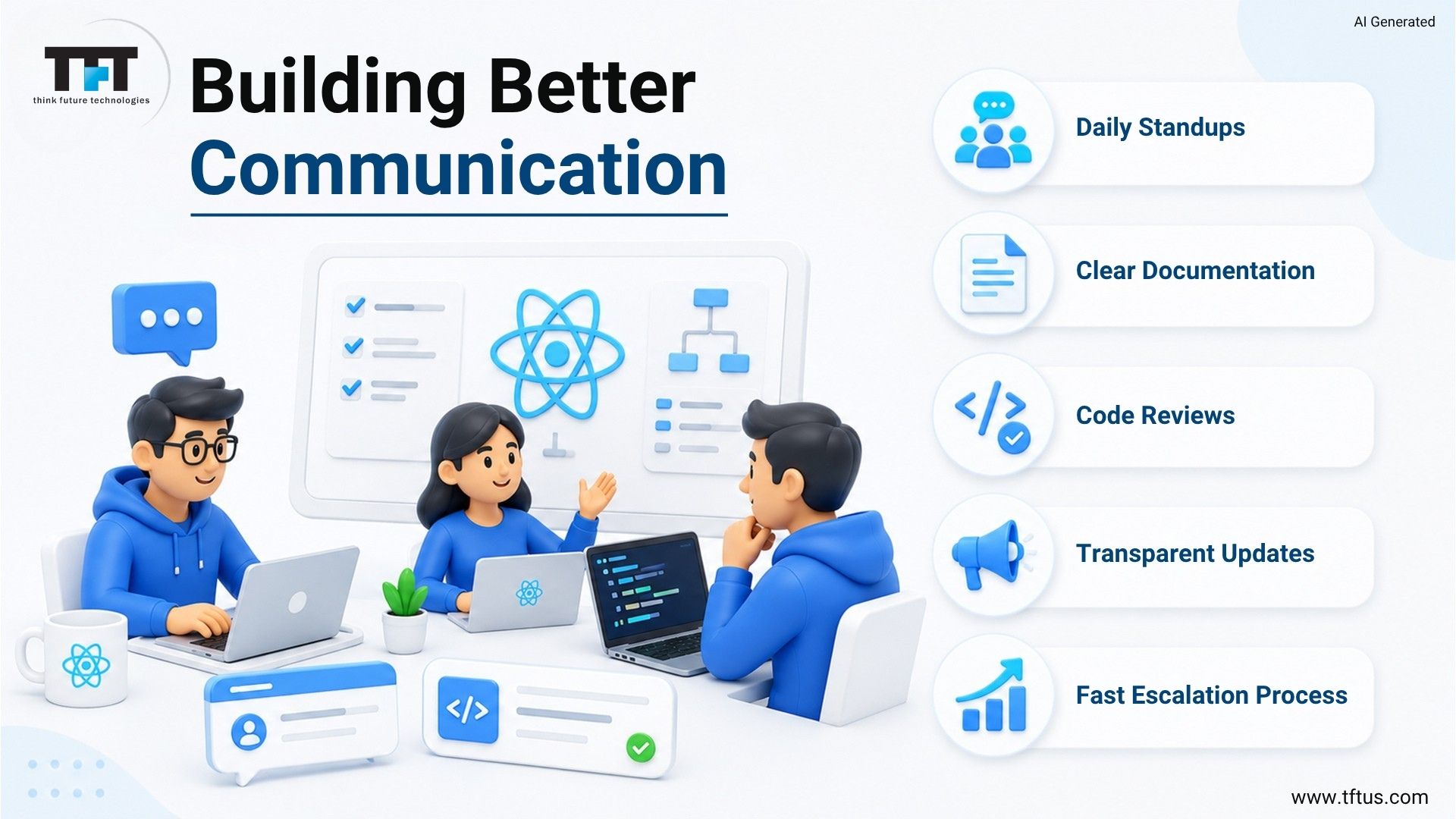
Collaboration Between React Developers and Designers
The Handoff Problem Is Real
One of the most frequent areas of conflict in web projects is the handoff from design to ReactJS development. In Figma/Sketches, designers create prototypes/mockups. Those designs are later converted to user-interactive interfaces by ReactJS developers. If there is no clear process, developers will interpret it differently – and generate rework and frustration.
Establish a Dev-Ready Protocol
Work with your ReactJS development company and design team to develop a protocol for handing off the work. Designs should be marked dev-ready only after all states (loading, error, empty, and success) have been designed. The components should have consistent naming that matches React component naming conventions. Colors, spacing, and typography should have consistent design tokens that are available to developers.
Put a Developer in the Room Early
The best React developers join design reviews before development begins. This practice helps you to identify problems in implementation that are hard to address before they become costly rework. A React developer can make an alternative to a tricky animation that the designer wants to create, even easier to build and performant, once it’s been reviewed during the build.
How Component-Based Architecture Shapes Team Collaboration
Components as Collaboration Units
The component-based architecture is not only a technical pattern of React. It is an approach to collaboration. Each component is isolated and can be worked on in parallel at the component level without significant overlap, making it convenient for React developers to divide the work. This is one of the key advantages of React for large development teams managing multiple projects simultaneously.
Assign Clear Component Ownership
If everyone in the group is developing on the same code, knowing who owns what helps you avoid conflicts. The developer (the owner) is responsible for the quality of their code, documentation, and tests. It’s possible for other React developers to contribute as well, but the owner will make decisions on React and receive questions.
Reusable Components Multiply Team Efficiency
Every other characteristic in the future gains from being constructed as a reusable component by ReactJS developers the first time they build the button, modal, or data table. Development organizations with common Component libraries get features up to speed and with fewer issues due to using a proven base set of React components.
Managing Legacy Systems Integration
Integration Work Is Almost Always Underestimated
The majority of web projects require new React applications to interface with legacy systems that haven’t been developed for the modern web. Something that is often overlooked when you’re planning, and one of the most frequently cited reasons things go overtime when working with ReactJS developers, is this work.
Audit Before You Build
Conduct a system audit before your ReactJS developers put one foot in front of the other. Determine which legacy system(s) the new app will be connected to, what APIs are available to the new app, and what data format the legacy system(s) will use. Communicate this to your ReactJS development company before development.
Build Adapter Layers That Protect Your Codebase
Handy React developers work with the legacy systems and create adapter layers to ensure the React application is not constrained by the restrictions of the legacy systems. Then any changes to the legacy system will only require updating the adapter, not rewriting React components across the entire app.
Case Study: Modernizing a Legacy Platform with ReactJS
Parker-Anderson Enrichment replaced a legacy platform that experienced frequent crashes with a modern ReactJS-based management system supporting CRM, ERP, LMS, e-commerce, and financial operations.
The project eliminated recurring system failures and created a scalable architecture capable of supporting multiple business functions through a unified platform.
This highlights the importance of careful legacy integration planning when collaborating with React developers on modernization projects.
(Source: Parker-Anderson Enrichment Case Study)
Mobile App Development With React Native: Collaboration Considerations
One Codebase Foundation Across Platforms
React Native extends React’s component-based architecture to mobile app development for iOS and Android. When you hire staff who are proficient in ReactJS and have deep knowledge of React Native, your development team can achieve the lowest overall mobile development cost and greatly expedite delivery.
Mobile Requires Extra Coordination
Mobile app development also has platform-specific challenges, such as touch interactions, offline functionality, and app store submission, that aren’t prevalent when developing for the web. Be sure that your development team consists of experts in the field rather than simply website developers who have a “mobile thing” website.
The context API and state management patterns used by React developers in web apps have an easy translation to React Native. This notion of a shared mental model enables seasoned ReactJS developers to work on both web and mobile applications with minimal ramp-up.
A proven development firm that knows both platforms offers an integrated cross-platform solution that delivers faster than separate teams.
Project Management Tools That Support ReactJS Collaboration
Finding the right software development project management tools addresses friction and helps a ReactJS development company deliver software through the SDLC. The inappropriate equipment only adds unnecessary overhead. Do not go with tools that are impressive on the demo but that your React developers would not use.
Planning and Task Management
For more complex enterprise applications, collaborate with multiple teams across the enterprise with Jira. For fast-moving startups, use Linear. For smaller web-based projects, use Trello or Asana. Each sets expectations with the React js developers for what they should focus on next and provides transparency for project leadership to see how things are going at any given time.
Version Control and Code Collaboration
Most ReactJS development teams use GitHub to follow best practices. But GitLab has built-in issue tracking and CI/CD pipelines, making it a very good option. All code changes must be submitted via a pull request and include at least one review from another React developer.
Communication
Communicate asynchronously in Slack. Conference via Zoom or Google Meet. Recorded walkthroughs of complex features used on Loom. New ReactJS developers/reference material about edits to Confluence/Notion.
Design Handoff
When sharing designs with React developers, it is industry standard to use Figma with developer mode enabled. It provides direct access for the JS developers to spelling and color values, and component specs, without having to get responses for each and every measurement question to be asked by a designer.
Onboarding ReactJS Developers to Your Project
According to a ResearchGate study on modern software development methodologies, Scrum-based workflows improve collaboration between developers and stakeholders when building React-based applications.
Good Onboarding Sets the Tone for Everything
The process of bringing on new ReactJS developers is determined by how they get onboarded. A clearly outlined procedure helps React developers get to work sooner and demonstrates your organization’s seriousness about developing software.
Build an Onboarding Guide Before Day One
Before the first developer joins, create a project-specific onboarding guide. It should cover the project overview and the business goals, setup steps (development), folder structure and architecture, project code quality guidelines, communication paths (chan), escalation routes, the testing of the project, and how to do it with the React testing library.
Start With a Structured Code Tour
During the first week, the student(s) should take part in a code tour with a senior React developer or technical lead. It outlines the key sections of the codebase, important architectural decisions, and parts of the app that require special handling. Development companies that invest in structured onboarding claim to offer faster time-to-initial-contribution for new React developers.
Aligning ReactJS Development With Business Objectives
Technical Excellence Alone Is Not Enough
If the React app is technically sound but doesn’t meet the business goals for which it was created, it isn’t providing any value. It is important to remember that alignment doesn’t happen in just one Kick-off meeting; rather, it is a continuous conversation that needs to take place throughout the project.
Bring Developers Into Strategy Conversations
Communicate with your ReactJS developers at key product strategy events. A Developer with an understanding of the importance of a single feature can make better architectural decisions. The developer is probably the one who cares most about the dashboard’s performance because they are on the front lines with the user.
Make Business Rationale Visible in Your Tools
Include a “why this matters” column for the large features you want in your project management software. The development firms that embed this context into their development relationships tend to be more successful at delivering value-for-money features than a development company that hires React developers directly from a ticket description.
Performance Is Not a Post-Launch Task
After an app is built with React, it is not optimized for performance. It’s a partnership effort that’s integrated throughout the entire software development process. If your ReactJS web developers treat it as just one more thing to add to your application, your application will suffer in performance and will need high-priced refactoring for bug fixes.
Set Benchmarks Before Sprint One
Set up standards at the beginning of every Web project. Set target scores for Core Web Vitals (FCP, LCP, INIP). As an acceptance criterion, teach your ReactJS developers these targets, not as targets for post-launch goals.
Include Performance in Every Code Review
As the app scales, the virtual DOM’s efficient rendering requires deliberate work from adept React developers to maintain good app performance. If an unstable reference is used for re-rendering elements, or if the context API is poorly structured, it becomes inefficient for complex applications. A performance check of components that render frequently or render large data should always be part of code reviews.
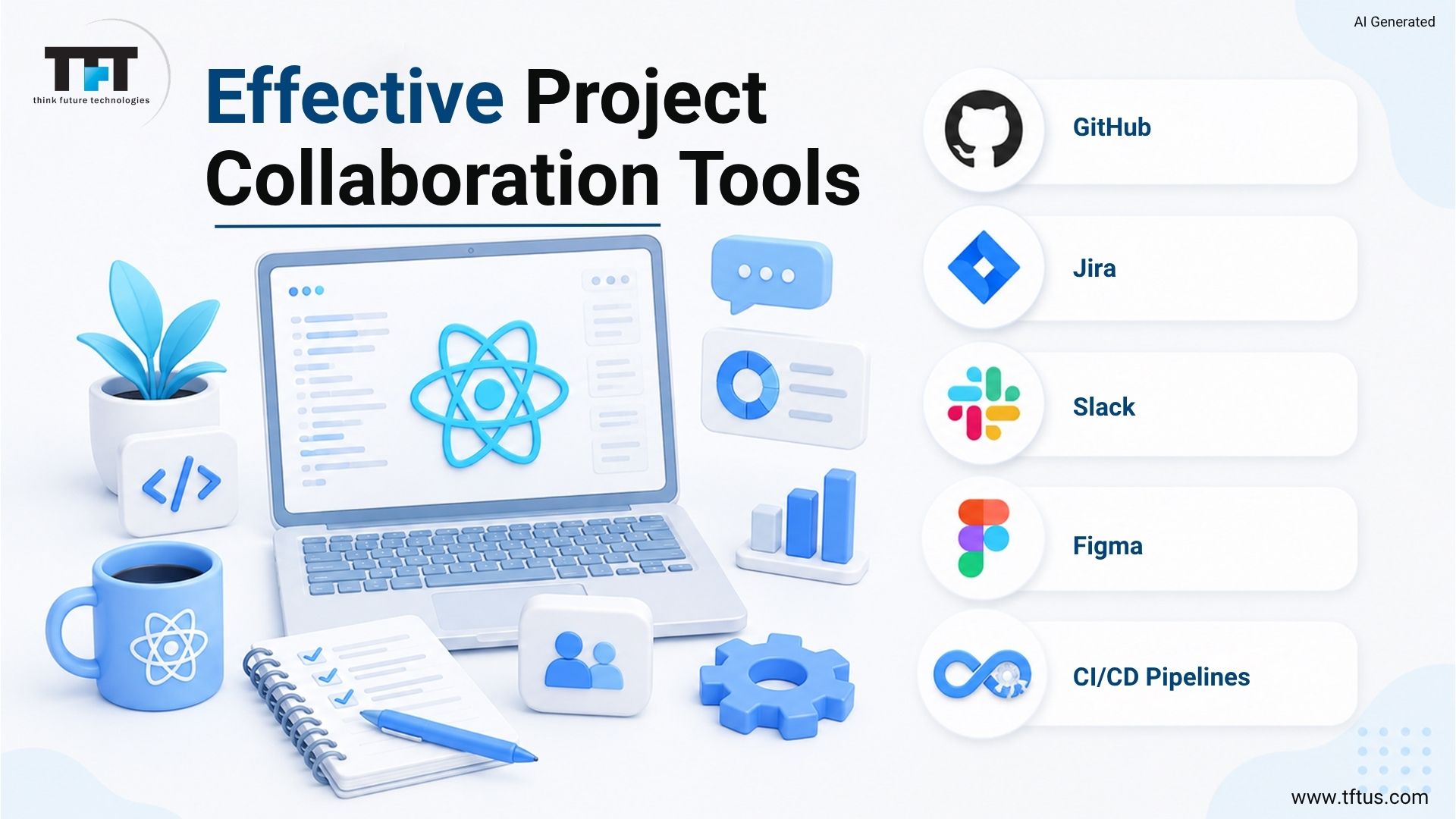
Handling Scope Changes Without Breaking Collaboration
Scope Changes Will Happen
Scopes are always bound to change in every software development project. These can either be handled and become manageable adaptations or be secrets that damage relationships. These are leaders of development companies and their clients who have a defined scope change process to help smooth out these moments. Those that don’t lead to a stressful discussion with the person responsible for the overspending budget.
Define the Protocol Before Work Begins
Establish a scope change protocol before starting the project with your ReactJS web development company. Changes to the agreed scope should be made via a written change request. The request should include information about the change, why it is necessary, how long it will take to implement, and the technical work your ReactJS developers will use. Changes to the work scope should be signed by both parties prior to commencing the changed work.
Normalize Scope Changes as Part of the Process
Consider scope changes an inevitable part of the software development lifecycle, not a bad thing. Products change as teams gain knowledge. The aim is not to eliminate scope changes, but to address them more subtly. Normalizing this discussion is crucial for development companies to become more successful in client relations and achieve higher results for web development projects in general.
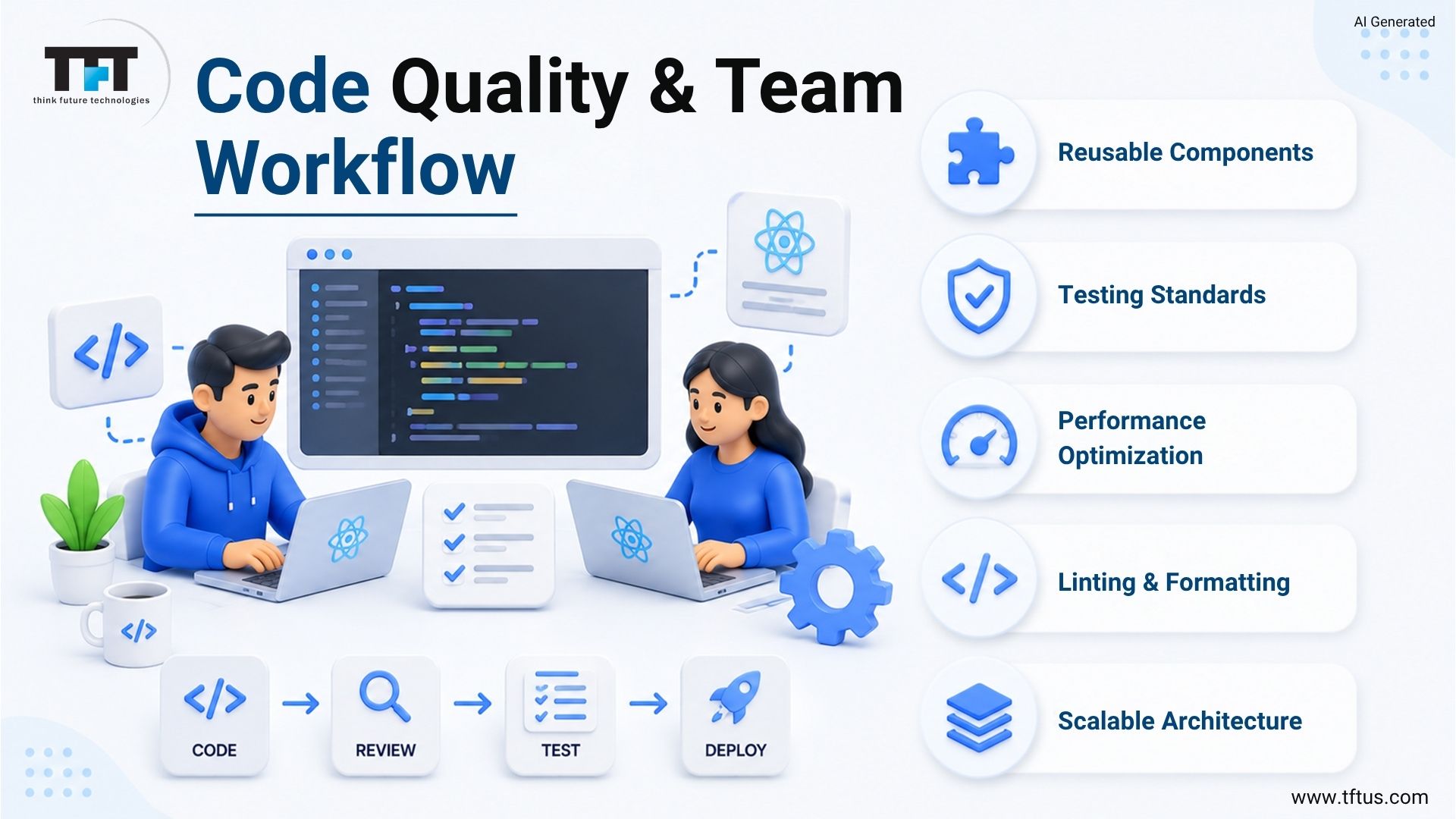
Code Quality Standards That Enable Collaboration
Code Quality Is a Team Responsibility
Elegant code is not the only factor in high code quality. It has to do with code written in a way that other ReactJS developers can understand, modify, and extend to add additional features without introducing bugs. A collaborative programming instance is one in which code is readable, a way of showing respect for your fellow collaborators’ time.
Document Standards Before the First Commit
Create coding conventions and codify them in a style guide that is understood by all developers. The standards should include naming files, component structure, prop type documentation, state management patterns, and a testing strategy using the React Testing Library. The standards are particularly crucial for development teams that consist of several developers, each working in the team for years.
Automate Enforcement With Linting Tools
Linting rules, such as ESLint, and formatting tools, such as Prettier, apply rules automatically. If such tools are integrated into your CI/CD pipeline, code that does not conform to the standards will not be merged. It takes style out of code reviews and allows other developers to focus on logic, architecture, and edge cases.
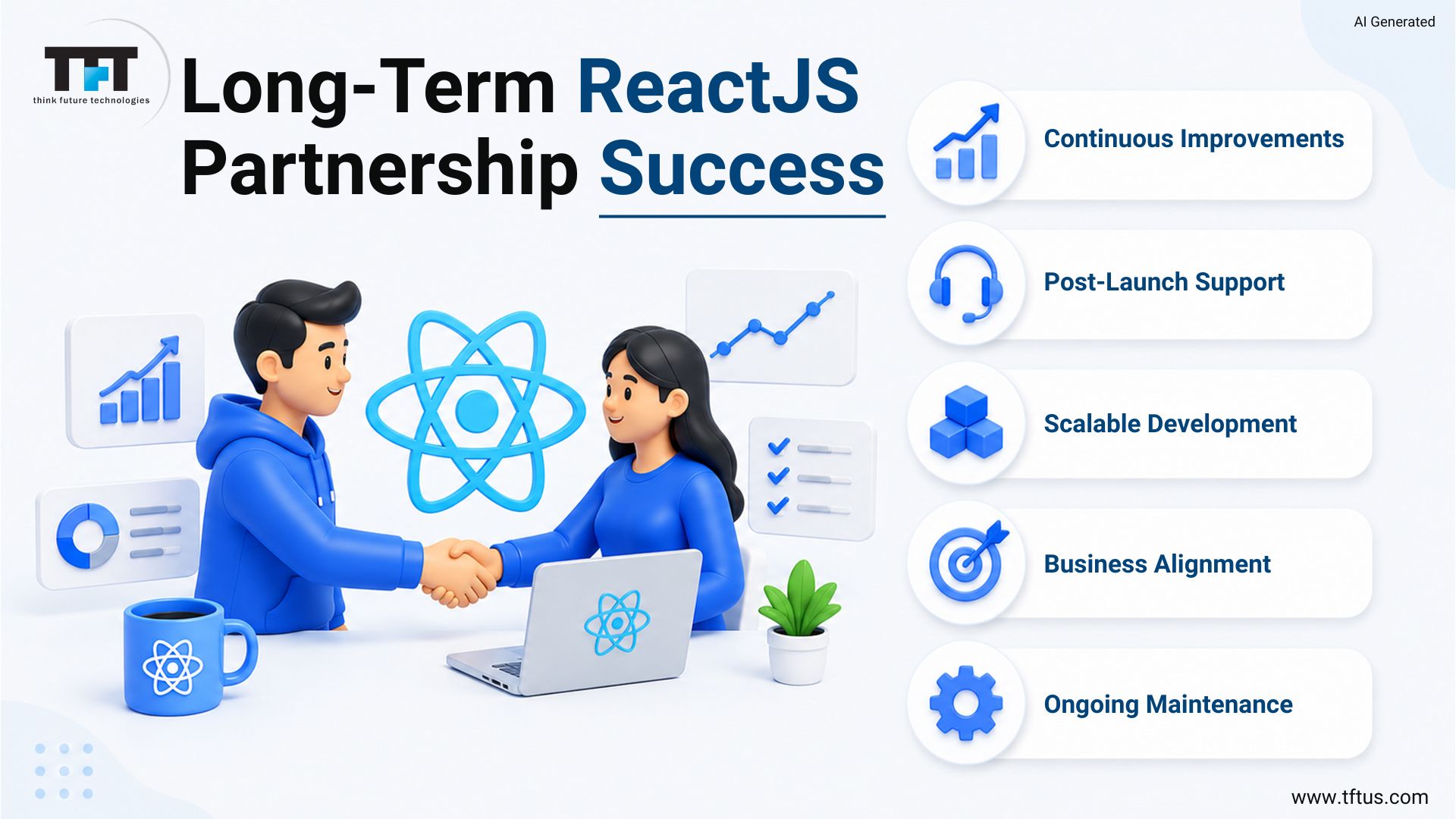
Ongoing Maintenance and Long-term Collaboration
The Bold is Only the Beginning
Many businesses choose to have ReactJS developers handle initial coding and subsequently find that, after the initial release, they require ongoing support during development. Bug fixes, dependency updates, and new features are added to applications as they expand, and new functionality is added to their performance monitoring. What may work for the build phase won’t necessarily work during the maintenance phase.
Plan for Maintenance Before Launch
Before the project is implemented, discuss the ongoing maintenance plan together with your ReactJS development company. Establish the responsibility for the application in production, bug prioritization, and a timeframe for critical issues. Structured development companies can provide the business continuity that isn’t possible when scrambling after a production incident, and they are beneficial to those considering preventing collections.
Long-term Engagement Pays Compounding Dividends
By having dedicated devs who are very familiar with the codebase in the long term, you will get much better results than by recruiting developers specifically to address issues. Long-term engagement involves understanding your existing systems, user needs, and business goals, resulting in faster, cheaper-to-build features in the future.
Collaboration Checklist for Every ReactJS Project
Follow this checklist when beginning a new project with a ReactJS development company or team to ensure a successful collaboration.
Before Development Begins:
-
- Create a project scope, business goals, and measures of success in writing.
-
- Discuss engagement structures and costs (in USD), and agree on engagement terms; the terms are clearly stated.
-
- Create communication options for async, sync, and escalation discussions.
-
- Establish a code quality policy and have it documented in a collective style guide.
-
- Establish performance standards as the acceptance criteria.
During Development:
-
- Conduct frequent standups and ensure blockers are escalated within 24 hours.
-
- Perform Code Review within 1 day of pull request submission.
-
- Conduct design-to-development handoff reviews prior to each sprint.
-
- Gather performance monitoring metrics weekly, comparing to benchmarks.
-
- Examine business goals periodically to ensure you are staying on track.
At Launch and Beyond:
-
- Put all architecture choices into documentation during build for future developers.
-
- Establish the continuing maintenance strategy prior to the launch date.
-
- Have a post-launch retrospective with the entire development team
-
- Create a protocol for scope change for new features that were requested after going live.
-
- Look into whether it is a suitable engagement model for the continued development requirements.
Conclusion
It takes communication, the right engagement model, processes, and a commitment to treating your development team as a strategic partner, not merely a vendor, to collaborate and achieve successful outcomes with ReactJS developers.
With these factors in place, your ReactJS developers provide superior code, your web projects go live sooner, and your business goals are achieved without the hassle. Get started on the frameworks and checklist in this guide and create the collaboration culture your next ReactJS development project deserves.

Leave a Reply