


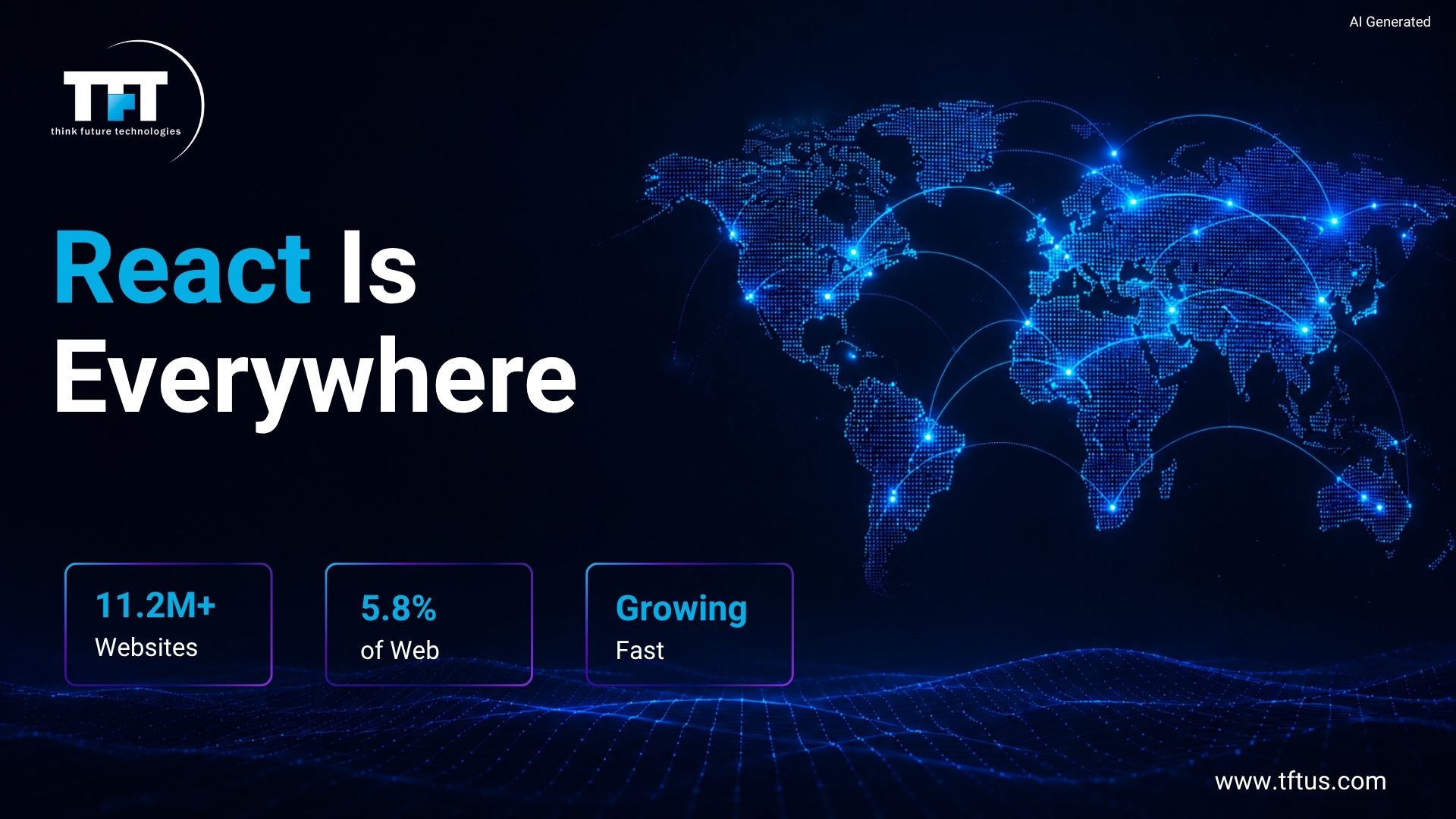
ReactJS is growing rapidly, with more than 11.2 million websites using it. In 2024, it has an estimated market share of 42.62 percent. Its introduction has high community approval and adoption. It is trusted by companies for scalable apps. These trends indicate React will continue to be a leading web development option.
Global React Usage Numbers
Approximately 5.8 percent of websites worldwide use ReactJS in 2026. It is used by over 1.3 million sites, and the number adopting it is increasing by over 100,000 annually. The US has the highest at approximately 3 million live sites.
React is prevalent in e-commerce, finance, healthcare, and technology. It receives more than 20 million downloads per week. It is much higher than Angular and Vue. It is characterized by a robust developer base and ecosystem.

Stack Overflow Developer Survey Insights
ReactJS is the most popular in the 2025 survey, with 44.7 percent. It remains the most popular front-end framework in its second year. Its developers have high satisfaction and repeated use ratings.
Approximately 41.6 percent of developers use React daily. Approximately 30.7 percent would like to know it. It has a 52.1 percent admiration rate. It retains approximately 75 percent as well. These figures indicate great expansion and confidence among developers.
React Repository and GitHub Metrics
ReactJS has over 228,000 stars and 46,000 forks on GitHub as of 2026. It demonstrates the world’s great interest and the community’s active support. It is one of the most starred repositories and receives numerous contributions every month.
React continues to be updated. Hooks changed how developers build components. Subsequent versions implemented such advanced features as concurrency and server components. These gains indicate further investment and expansion.
Watch: Official React Performance and Ecosystem Updates
This keynote from React Conf 2025 covers the latest React performance improvements, ecosystem developments, and official updates from the React team.

Major Companies Using React
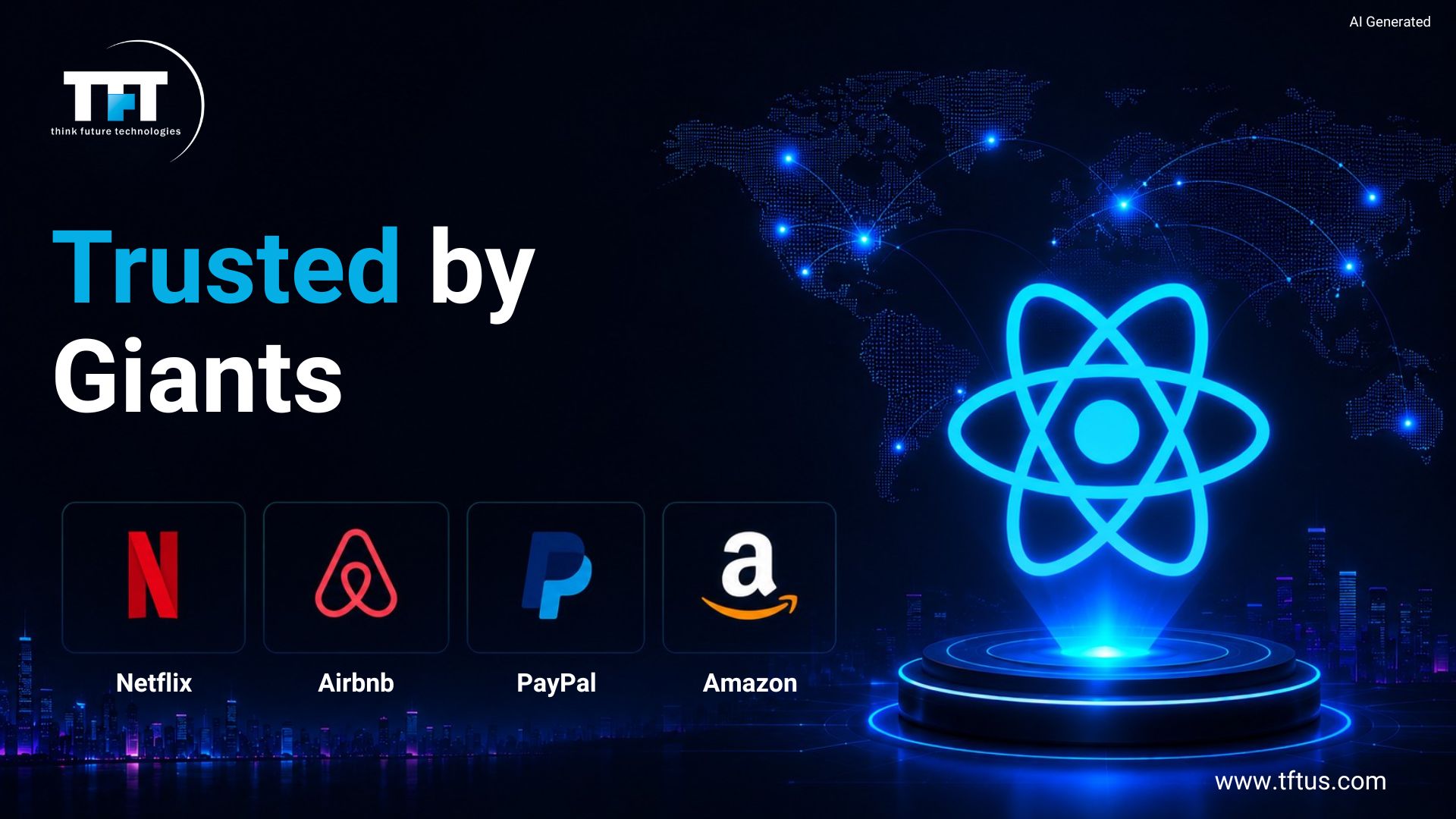
Biggies like Netflix, Meta Platforms, Instagram, and Airbnb use ReactJS. It can accommodate high user traffic and offers good performance.
It is utilized on e-commerce platforms such as Amazon, Walmart, and Shopify. It is trusted by finance companies such as PayPal and American Express. React, used in Fortune 500 companies, has been demonstrated to be quite reliable at about 80 percent.
Case Study: How Facebook Uses React at Massive Scale
Facebook created React and continues to use it across high-traffic areas of its platform, including the News Feed and comments system.
React’s component-based architecture and Virtual DOM allow Facebook to manage complex interfaces while maintaining responsiveness for billions of users worldwide.
This demonstrates why React remains one of the most trusted technologies for building large-scale web applications.
(Source: Facebook Case Study)
React Developer Salary Statistics
In the United States, ReactJS developers earn approximately $112,189 per year. Salaries range from 94,000 to 127,500, and top earners make over 145,000. Junior developers have an average of 100,265. Mid-level earns between 110,000 and 134,000. Old developers are between 120000 and 160000.
Location impacts the pay. Salaries are highest in cities such as New York, San Francisco, and Seattle. Companies such as Austin, Boston, and Los Angeles are also good at compensating skilled developers.

Job Market Demand for React Skills
Jobs in ReactJS are still highly sought after. On Glassdoor and LinkedIn, hundreds of vacancies are found across all industries. The market consistently demands skilled developers.
The U.S. Bureau of Labor Statistics estimates web developers will increase by 7 percent. React is more commonly used, leading to increased React roles. React Native state management hook and component skills add value and wage opportunities.
React dominates the front-end frameworks landscape with 42.62% market share in 2024. Angular and Vue have about 18.2% and 17.6% of the framework market, respectively. React has an advantage in community resources and ecosystem development with this leadership position.
React is leading the pack with 20 million downloads per week, according to NPM download statistics. Angular and Vue have 2.7 million and 4.3 million downloads per week, respectively, which are much lower than React’s 8.7 million. These figures are based on actual real-world usage and developers’ preferences in projects.
In an annual survey, developer satisfaction scores are higher for React than for alternatives across several categories. Its performance, flexibility, and excellent community support keep React at a competitive advantage. Market trends indicate that React will continue to dominate over the next few years, including in 2026.
Industry Adoption Across Sectors
React is especially popular in the e-commerce industry for creating dynamic shopping experiences. The retail giants rely on React to develop efficient, fast interfaces that drive conversion rates. React is popular for product catalogs, shopping carts, and checkout flows due to its component-based architecture.
React is adopted by financial technology companies to build secure, high-performance trading platforms. Banking apps use React to build easy-to-use interfaces for complex financial tasks. The virtual DOM enables efficient updates for real-time streaming of market data.
React is used to develop patient portals and medical record management systems on healthcare platforms. Educational technology businesses develop interactive learning experiences, leveraging React features for user interface development. React is used by media and entertainment platforms to deliver streaming services and content.
React Native Adoption for Mobile
React Native is an extension of React to mobile operating systems such as iOS and Android. React Native is used in over 4 million mobile apps worldwide, according to recent estimates. This cross-platform development saves time and resources for development teams.
It is used in companies such as Facebook, Instagram, and Tesla in their mobile apps. The framework enables the effective sharing of important code across web and mobile platforms. In the United States, these developers earn a good salary, averaging 129,348 USD per year.
These mobile apps deliver native-like performance on both mobile platforms. React Native reduces time-to-market by 30-40 percent through cross-platform development. React Native is appealing to startups and companies dealing with multiple platforms due to its efficiency.
React Ecosystem and Third-Party Libraries
React has a rich ecosystem of thousands of third-party libraries to meet a wide range of requirements. Common tools such as Redux are used to manage complex state in large-scale applications. React Router provides routing functionality for single-page applications and has more than 44% adoption.
React can be extended by third-party libraries for data visualization, form handling, and UI components. There are innumerable React-compatible packages available on the Node Package Manager for developers. This broader ecosystem can accelerate development and address common problems developers encounter.
Other tools, such as Create React App, make setting up a project as simple as zero configuration for new developers. CSS-in-JS solutions, including styled components, work well with React projects. The robust ecosystem also helps developer productivity and the further popularity of React.
Server-Side Rendering and Performance
React server-side rendering enhances the SEO and initial load time. Production-ready server-side rendering frameworks, such as Next.js, are available to React applications. Performance studies indicate that SSR delivers search results that are 20% higher than those of competitors.
React is a faster-loading, higher-performance page generated with the help of a static site generator. Frameworks assist with server-side rendering and static generation to achieve the best results. Such rendering techniques enable React to become competitive with regular server-rendered websites.
The virtual DOM mechanism provides an efficient update mechanism by reducing the number of real manipulations of the DOM needed. React components are 15-20% faster than those on other sites using other JavaScript libraries. The optimization of performance can be regarded as one of the priorities in the development and updates of React.
Case Study: Improving React Performance Through Bundle Optimization
Intercom optimized its React-based Messenger application and reduced its bundle size from nearly 600 KB to 240 KB, a reduction of approximately 65%.
The optimization improved loading performance significantly, saving mobile users up to five seconds during application startup.
This highlights how React performance improvements can directly impact user experience and application responsiveness.
(Source: Intercom Case Study)
Community Support and Resources
The React community has millions of developers worldwide and provides tutorials and resources. Community-answered questions related to React total over 400,000 on Stack Overflow. This powerful community encouragement helps developers resolve issues and adopt best practices.
React conferences, such as React Conf and local meetups, unite React developers to share knowledge. There are innumerable courses, tutorials, and documentation on learning React on online platforms. There is a vibrant developer community that creates content to help beginners and experienced developers alike.
Community support goes toward open-source contributions, package development, and framework improvements. There are active forums and Discord channels to support struggling developers. React is accessible and part of a vibrant community that continuously enhances the technology.
React in E-Commerce Applications
React has been widely used on e-commerce platforms to build dynamic product browsing and shopping experiences. The component-based architecture enables the development of reusable product cards, filters, and navigation components. React supports real-time inventory and price changes across interfaces without issues.
After migrating to React-based front-ends, major e-commerce sites report increased conversion rates. Rapid response and user-friendliness reduce cart abandonment rates. React’s performance advantages directly impact e-commerce business metrics and revenue.
React is used in shopping cart functionality, checkout processes, and order tracking. The technology is compatible with the payment gateways and third-party e-commerce solutions. React is used by e-commerce businesses of any size, from startups to enterprises.
State Management Solutions
Complex React applications that require substantial data still rely on state management. Redux is at the top of the list with 59.6 percent adoption of React applications to manage centralized state. The library provides developers with predictable state updates and strong debugging capabilities.
Other options, such as MobX, Zustand, and Recoil, offer alternative state management approaches. The built-in Context API in React simplifies state sharing without requiring external libraries. The solution developers select depends on the application’s complexity and the team’s preferences.
Effective state management enhances the maintainability of applications and developers’ productivity over time. A well-structured state makes debugging easier and reduces bugs in production applications. Knowledge of the state management patterns is critical in developing scalable React applications.
Component-Based Architecture Benefits
The component-based architecture allows complex interfaces to be split into manageable, reusable components. React elements are self-contained units of logic, styling, and markup that are integrated with one another. Such a modular paradigm enhances the organization of code and simplifies its maintenance in the long run.
Reusable components save development time, as developers can build a single component and reuse it anywhere. Teacher groups may form libraries of components that are consistent throughout extensive applications. The architecture allows collaborative development, in which various developers work on individual components.
The component composition allows the creation of complex UIs from simple building blocks with well-defined hierarchies. Data flows downward with the props and events rise up, forming predictable data flow patterns. This design has had effects on the current web development beyond the React ecosystem.
React Updates and Future Roadmap
React 19 adds server components, which makes the distinction between client and server rendering unclear. These parallel capabilities enhance performance and usability in data-intensive applications. The React team is also constantly innovating, and existing applications are still backwards compatible.
The next trend is to become more closely integrated with new technologies, such as WebAssembly and edge computing. The roadmap includes improved developer tools, better performance optimizations, and enhanced capabilities. The development of React will meet the challenges of modern development without sacrificing the principles that made it successful.
When the React team plans updates, they actively listen to feedback and to the needs of the developer community. Frequent release cycles keep the technology up to date, without requiring disruptive breaking changes. This calculated evolution plan establishes the developers’ confidence in React for long-term projects.
Developer Productivity Improvements
The declarative nature of React makes it easier to develop UI than imperative programming models of previous frameworks. Developers specify how the UI should appear, but not how to update the UI. This thought model minimizes bugs and simplifies code.
During development, Hot module replacement enables the visualization of the changes without page reloads. Developer tools, such as React DevTools, can give detailed information about state and component hierarchies. These productivity features save development time and enhance developer experience.
The React hooks component-based architecture has fewer boilerplate codes than class components. The new development trends enable the creation of clean, functional code that is simpler to test. These additions enable the teams to release features sooner and produce quality code.
React Multi-Location Businesses
Multi-location businesses will enjoy the benefits of React, which can create a consistent interface across locations. The centralized component libraries guarantee brand consistency in 25 or 100 or more locations. React applications are customizable to various regions and share common functionality.
React is used in restaurant chains to provide online ordering systems that operate across all the franchise locations. Point-of-sale systems using React are implemented by retail businesses and are connected to a central inventory system. The technology is efficient at scaling to 10 locations or 1,000 or more stores.
React’s performance characteristics ensure smooth operation even with high concurrent user loads. React-based multi-location dashboards provide real-time insights across all business units. The component-based architecture simplifies the maintenance and updating of systems at a larger scale.

Conclusion
The outlook for the statistics on reacting paint is unmistakably the same, with continued prevalence through 2026 and beyond. The performance, developer experience, and ecosystem strength of React ensure that it retains its leadership status. The technology does not indicate any deceleration in adoption and use levels.
React developers are in high demand in the job market with good pay at all levels of experience. React is a proven, mature technology, and companies that invest in it enjoy scalability. Knowledge of such statistics can help stakeholders make informed decisions regarding technology adoption and career growth.

Leave a Reply