


Creating applications with ReactJS is often more expensive than simply paying a ReactJS engineer their advertised hourly rate, as posted on many job boards. Unfortunately, hidden costs and scope expansion, or post-launch customer assistance, often push the cost of building a ReactJS Application from the initial approximate budget of $50,000 to $90,000.
This blog will cover the major cost factors for creating React JS applications using actual 2026 data. It will also include how to compare various hiring methods and how to establish budgets for the full life cycle of creation.
According to the 2026 Kore1 Tech Hiring Report, the all-in cost of hiring a mid-to-senior React developer in the US ranges from $145,000 to $260,000 annually once salary, payroll taxes, and benefits are included. This highlights why many companies underestimate the true cost of React development.

Cost Factor 1: Project Scope and Complexity
The primary influence on the price of all ReactJS developers is the project’s overall scope. Pricing of ReactJS development is done based on standard complexity.
A project’s complexity increases with the number of user flows added, the amount of business logic included, the amount of 3rd party integrations added, and the amount of custom code development performed.
| Project Type | Typical Scope | Estimated Cost (USD) |
| Simple web app | 3 to 5 pages, minimal state, no backend | $5,000 to $15,000 |
| Mid-complexity SaaS | Auth, dashboard, API calls, basic state | $25,000 to $75,000 |
| Complex enterprise app | Custom development, sophisticated state management, multiple integrations | $80,000 to $300,000+ |
| Large-scale platform | Real-time features, multiple user roles, high performance | $250,000 to $750,000+ |
The cost of hiring developers may vary significantly depending on both the developer’s location and the hiring model/management structure used.
Cost Factor 2: Developer Experience Level
When hiring a ReactJS developer, experience is a major factor in cost. While both junior and senior developers can create React components, there’s a big difference in what they bring to the table.
Junior Developers
Junior developers have little development experience, around 0-2 years. They can develop simple, basic features (components) that meet the expectations defined by clearly specified requirements. According to bluelight.According to the 2025 salary guide, the average annual salary of a junior React developer in the US is $116k, with an average of $40.00-$60.00 per hour for contract work.
While the immediate cost of hiring a junior React developer is lower, they will typically require much more supervision from your senior developers. Thus, the time required to supervise is also a hidden cost of senior team bandwidth. Therefore, the immediate cost of hiring a junior React developer may end up being higher than that of the available senior developers on your team.
Mid-Level Developers
Mid-Level React developers have between 2 and 4 years of React development experience. Mid-Level Developers, on average, will work more independently than junior developers and are typically capable of building most of the standard React applications available on the market today. According to bluelight.According to the 2025 salary guide, a mid-level developer’s annual salary in the US is $134k, and the average hourly rate for contract work is $60.00-$90.00.
Mid-level developers offer the best cost-to-value ratio for most web applications. Therefore, a project team consisting primarily of mid-level developers, with oversight provided by senior-level developers, is the most cost-efficient organizational structure to use to complete moderate complexity projects.
Senior Developers
A senior developer typically works on complex, architectural, and technical leadership projects, has a minimum of 4 years of experience, earns a salary of around $145,000 per year, and earns an hourly wage of between $100 and $150, as per data published by Glassdoor and Index.dev in 2026.
In complex project development, the cost of using a junior developer who could make an architectural mistake could ultimately be far more than hiring a more senior developer.
Cost Factor 3: The Hiring Model
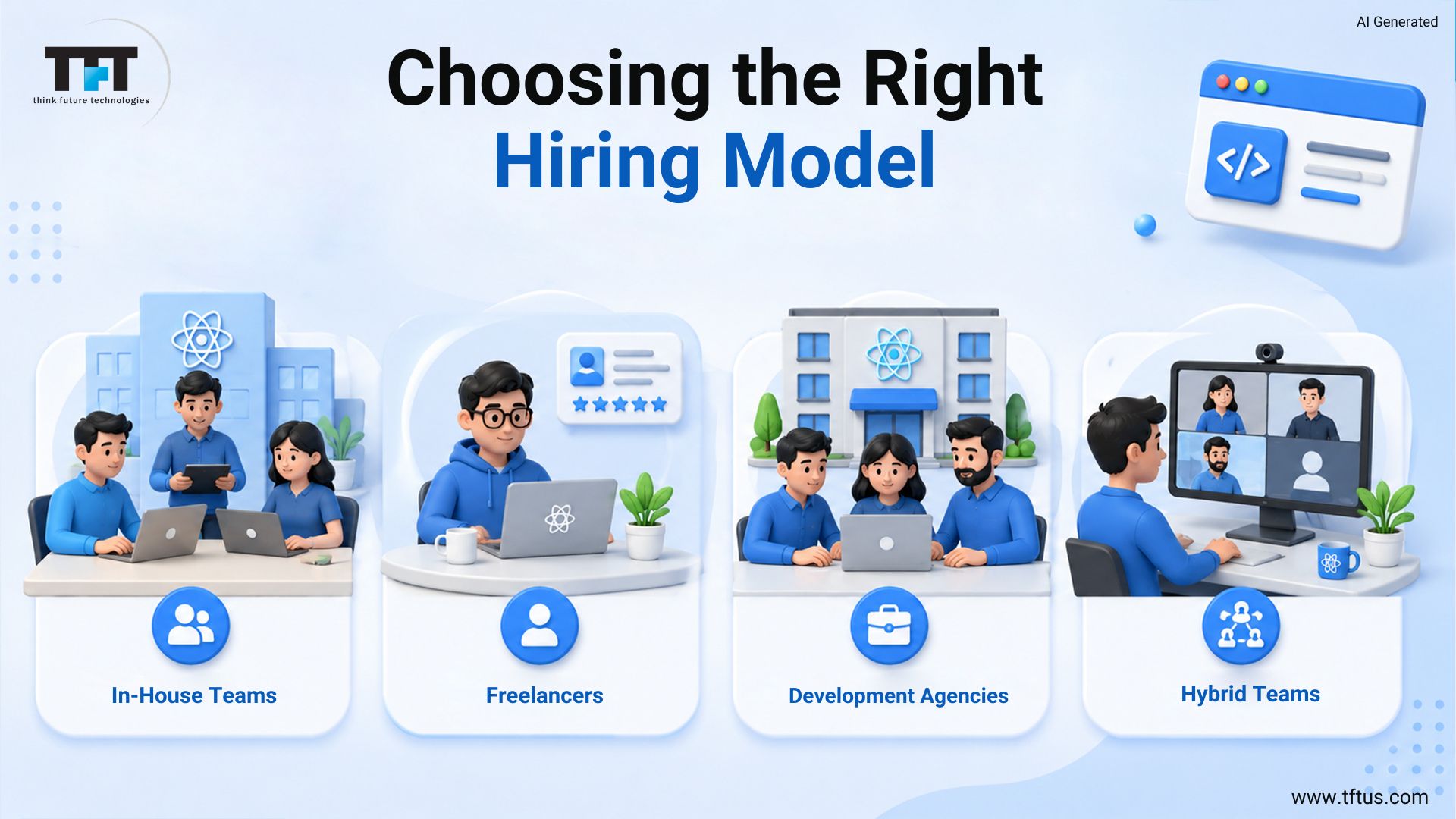
There are four main hiring models, and each may be most appropriate for a specific type of project, timelines for completion, and budget organization.
In-House ReactJS Team
An in-house team provides continuity and long-term value for organizations that have established development needs and have the requisite infrastructure to support and employ full-time developers.
Total in-house cost consists of base salary, 7.65% in employer payroll tax, health benefits averaging $6,000-$14,000 per year, $500-$2,000 monthly in office space rental in major US cities, equipment, and 15%-25% of the first-year salary to cover recruiting fees. Index.dev reports that total in-house employment costs will be 1.5-2.0 times the base salary in Year 1.
Unless you have strong technical management for a specific project team or a large number of month-long projects, the in-house model will generally be more expensive (relative to output).
Freelance ReactJS Developers
Freelance React developers are a flexible, low-overhead option- they pay for their own tax & benefit expenses. If you need a short-term project with a clearly defined scope, freelancers are often the most cost-effective option.
According to 2025 LMIS.data on Index.dev, React freelancers on Upwork average $51-$75/hr. With a median of $63/hr. Senior-level freelance developers working with JS, TypeScript & Next.js are charging $80-$120/hr. In the United States.
Some risks are involved with hiring freelancers. For example, if the freelancer is no longer available to continue the project in the middle of it. No project management/quality assurance services are provided. Employing freelancers is an economical option for performing standalone tasks. However, they may pose a delivery risk when working on interdependent projects.
Development Company or Agency
When partnering with an established development company or agency, the project will continue if one of the developers leaves, thanks to the agency’s quality assurance, management, and continuity. Agencies in the US typically charge $75-$150/hr. Agencies in Eastern Europe typically charge $40-$80/hr.
The hourly rate typically includes the cost of coordinating with the team and the code review processes, as well as the infrastructure to ensure delivery.
Leverage Hybrid Teams for Maximum Cost Efficiency
To maximize cost efficiency, companies can benefit from using “hybrid teams”. Hybrid teams consist of an in-house team of senior developers to provide architectural design and oversight, combined with a remote team of lower-cost developers responsible for implementing the features. The in-house team sets standards and reviews the code produced by the remote team.
By effectively leveraging hybrid teams, businesses have reported savings of 30-50% in total cost of ownership compared to using only in-house teams, while maintaining similar quality levels.
According to RaftLabs’ 2026 pricing analysis, outsourcing React development is often more cost-effective for startups and SMEs because it converts fixed hiring expenses into variable project-based costs.
Cost Factor 4: Geographic Location
Location is also an important factor when controlling ReactJS developer costs, since where your ReactJS developer operates will have a dramatic impact on the total cost of your ReactJS developer compared to where they are based.
| Region | Junior (per hour) | Mid-Level (per hour) | Senior (per hour) |
| United States | $50 to $70 | $70 to $100 | $100 to $150 |
| Western Europe | $45 to $65 | $60 to $90 | $80 to $120 |
| Eastern Europe | $20 to $35 | $35 to $55 | $50 to $75 |
| Latin America | $20 to $40 | $35 to $60 | $50 to $80 |
| Asia | $15 to $25 | $25 to $40 | $35 to $55 |
Source: Index.dev React Developer Hourly Rate Guide 2026
For example, Eastern Europe can deliver the same level of technical skill as those based in the USA, but at 40% to 60% lower cost. As a result, many companies with remote engineering workforces are increasingly making this decision when hiring developers from Poland, Ukraine, and Romania.
The challenge here is that, due to time zone differences, there will be increased management overhead from the need for more deliberate asynchronous communication, overlap scheduling, and clear technical documentation across teams based in New York, Warsaw, and Bangalore.
If you don’t manage these practices properly, the cost savings of lower hourly rates will have to be offset by the additional coordination costs.
Cost Factor 5: Project Duration and Timeline
For businesses, the duration of your project and how long it will take to complete will directly affect your overall development costs.
If you allocate more time (hours) to a longer project, you are inherently going to pay for a larger number of hours worked, incur more project management overhead, and require more coordination within the development team throughout your project timeline. Furthermore, you will also have more opportunities to incur scope changes during the development of a long-term project.
Short-term projects (1-3 months) with a clearly defined scope will allow for the best opportunity to determine exactly what the overall project costs will be, since the only thing that you will need to pay for is the number of hours for a given developer/development company that has worked on your project, with no fixed cost associated with that developer/development company.
Costly delays can occur when managing a large, complex project that takes 6 months to 2 years to complete. Poorly managed projects risk exceeding their budgets and schedules. According to PMI, approximately 47% of software projects do not meet their originally planned scope, budget, or schedule.
Cost Factor 6: Features and Functionality
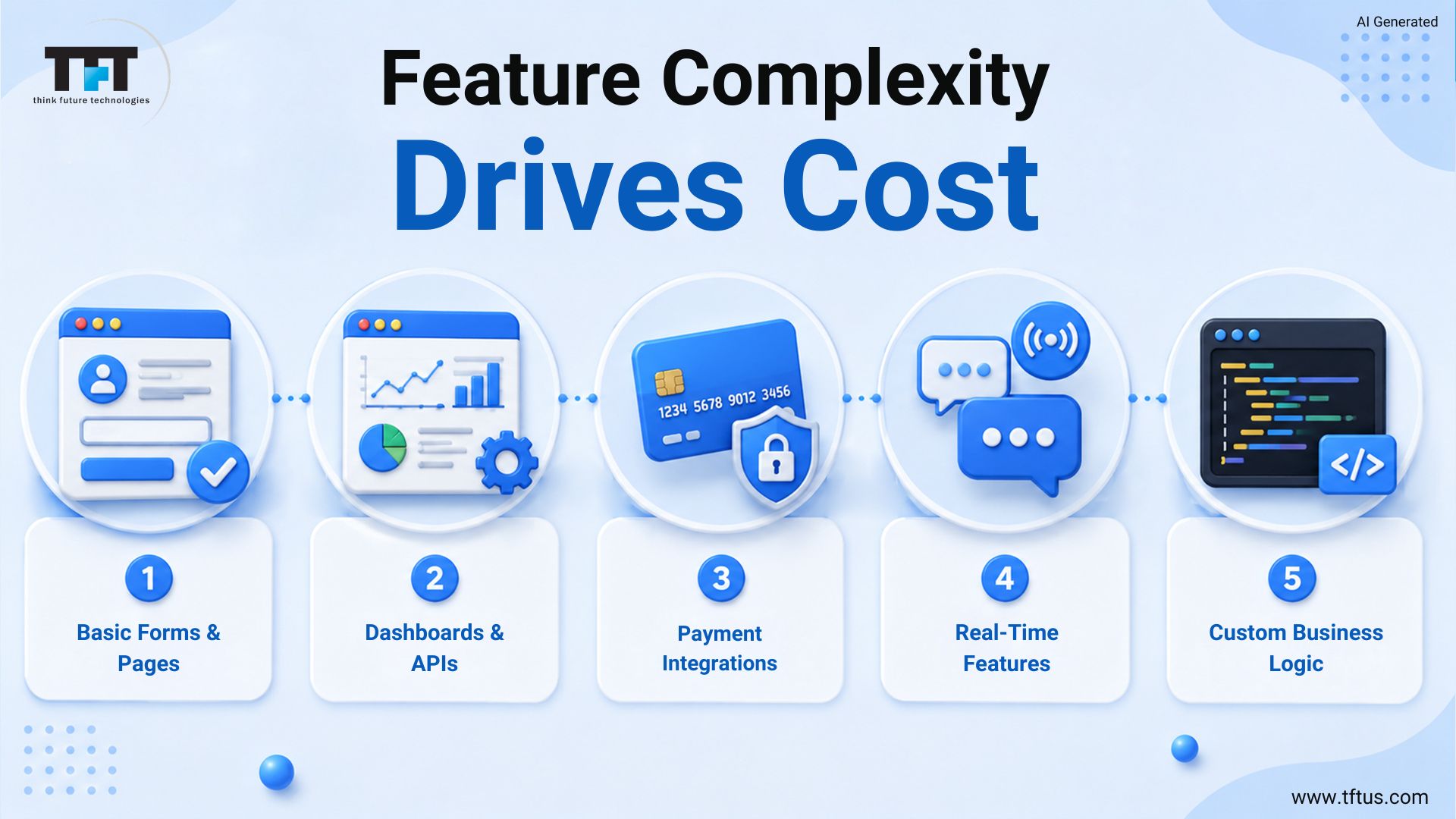
The number of features you develop during this process will most directly determine the number of development hours needed. Creating a static page or a basic form will cost significantly less than developing real-time functionality, sophisticated state management, and/or advanced user privilege (authentication) management.
Low complexity features include static pages, basic forms with validation, and basic user privilege (authentication) management. The estimated cost is $1,000-$5,000 per feature.
Medium-complexity features include data dashboards, search and filtering systems, payment gateway integration, and/or role-based access control. The estimated cost is $5,000-$20,000 per feature.
High complexity features include real-time collaboration, sophisticated state management using complex business logic, and/or advanced performance optimization. Estimated cost $20,000-$75,000+ per feature.
Creating unique features via custom development, without available library solutions, results in the highest expense incurred by a project, while utilizing reusable components sourced from well-documented, maintained libraries dramatically reduces the cost incurred by implementing standard user interface designs.
Cost Factor 7: Third-Party Integrations
Each new third-party or external integration will increase the cost of developing a React project. Payment processors, authentication services, analytics applications, and/or CRM applications can introduce significant development time to build and maintain integration points.
Implementation and testing costs for a well-documented REST API integration (e.g., Stripe) will range from $2,000-$8,000; whereas complex integrations with poorly documented or outdated legacy APIs may incur significantly more expense and/or introduce considerable project timeline risk.
When calculating the cost of integration, one must consider all the integrations to be created, as integration costs will compound, requiring at least a 20% additional budget for thorough testing of each integration point across all related systems.
Cost Factor 8: UI/UX Design and Custom Development
Utilizing an established set of component libraries, such as Material UI or Tailwind, can significantly reduce the cost of custom development when designing an entirely new user interface, while building a new, fully custom design system from the ground up will incur considerably greater expense and require skilled designers as well as React developers to work closely together.
Developers will be required to interpret designs (not implement) if the design specifications are not usable by developers; therefore, interpretation time will be added to the project’s schedule, and there will be inconsistencies across the user interface.
When building web applications, it is usually more cost-effective to rely upon previously established design systems and reusable components. Any custom development budget should be used for elements that provide a true competitive advantage or differentiator for your product compared to other products on the market.
Cost Factor 9: State Management and Architecture Complexity
A simple form application could be implemented with only React’s useState and useEffect hooks. However, if we are developing a commerce platform with multiple complex components (for example, a cart, session management, real-time inventory, and personalization), a more sophisticated library such as Redux Toolkit or Zustand with multiple layers of state management would be the appropriate choice.
This cost factor has more to do with architectural design, code organization, testing requirements, and long-term maintenance complexity than with the overall cost of the actual library used.
Selecting an appropriate state management library and designing an effective, efficient architecture are the most important factors in avoiding higher state management costs.
Selecting the wrong library or not architecting for state at the beginning of the project will cost 2 to 4 times as much to repair as if you had architected correctly from the start.
Senior developers who have previously cleared a path for their clients by making similar mistakes know this and therefore justify their higher ReactJS development costs based on their experience in previous projects.
Cost Factor 10 – Testing and Quality Assurance
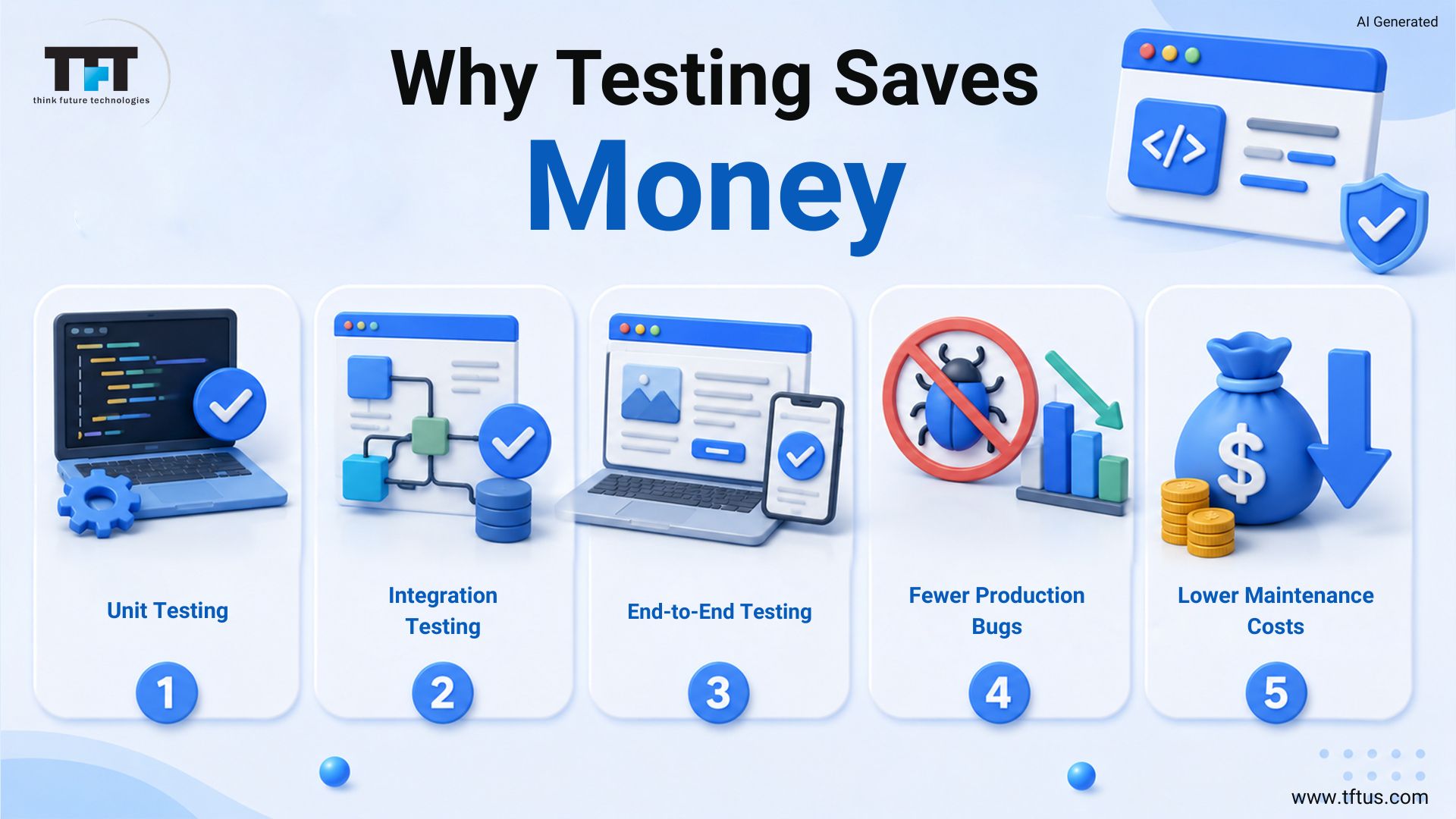
Testing is not a discretionary activity. When teams decide to forego testing, they effectively erase a development cost from their budgets, only to have it reappear much more expensively as production errors or emergency fixes in the future.
Typically, a well-tested React app would allocate approximately 20% to 30% of the total development time to testing, which could include unit testing, integration testing, or end-to-end testing. The purpose of each layer is to catch different categories of bugs across all three test types.
Research from the National Institute of Standards and Technology shows that fixing a bug after it has entered production costs 4 to 5 times more than fixing it before it ever went into production. Therefore, skipping the testing process is a false economy that always ends up costing far more than it saves on the original budget.
Cost Factor 11 – Maintenance and Post-Launch Support
Generally speaking, many organizations will calculate their ReactJS developer cost only to build, then stop their calculations there. But if you look out over a 3-year horizon after the initial launch, you will find that post-launch maintenance will typically equal the cost of the initial development.
On a month-to-month basis, the ongoing maintenance cost for a mid-level complexity React application will run an organization somewhere between $2,000 and $6,000 per month, based on the cost of a project with a single part-time ReactJS developer to cover things like bug fixes,updating of application dependencies, optimization of application performance, and security patches.
The quality of the initial code developed will significantly impact the future maintenance costs of the application. Well-organized and structured coding with strong test coverage and thorough documentation will generally tend to be much less expensive to maintain than code developed at a rapid pace with limited organization, structure, and testing.
Cost Factor 12: Scaling to Multiple Locations
When companies serve 25, 50, or 100 locations, they face a completely different set of costs than when serving one location. A single-location React app will only require basic state management and standard authentication.
A platform that serves 100 locations will also need to provide role-based access control (RBAC)-based permissions to locations, branding, and configurations that are specific to those locations, at-a-glance dashboards from all locations, and a database architecture that can support multiple tenants. Thus, creating additional project scope, project development time, and ongoing maintenance costs.
Generally, it is at least two to three times the cost to build an application using a multi-location architecture compared to building an application using a single-location architecture with otherwise similar features.
Companies that identify multi-location requirements after developing a single-location application will incur costs to redesign state management and the data architecture. Incorporating multi-location functionality into a system during development is far less costly than adding it retroactively.
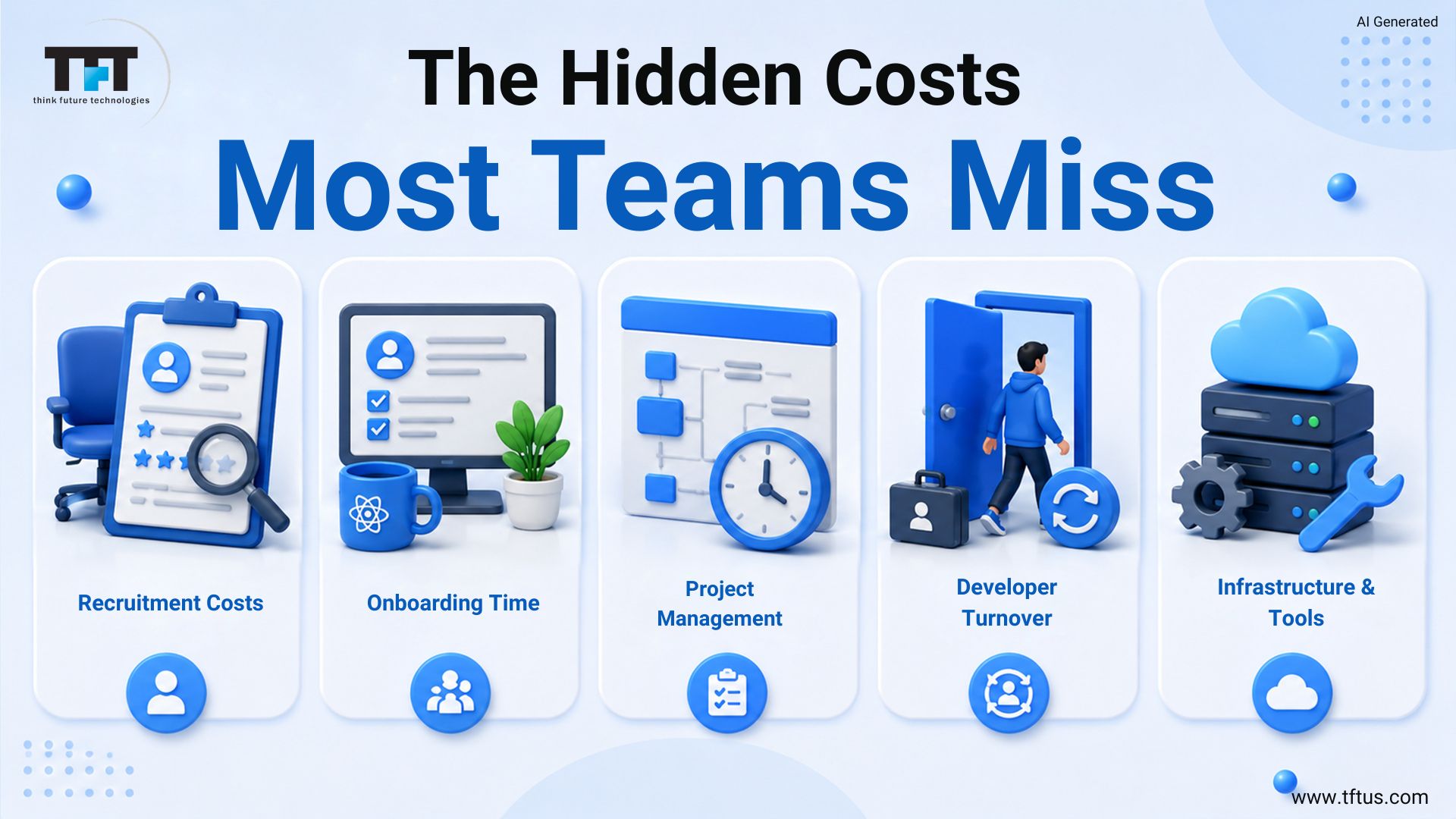
5 Hidden Costs That Most Budgets Overlook
1. Recruiting and hiring costs
According to CodeSubmit, it costs 15-25% of a developer’s first-year salary through a hiring agency to find and hire a ReactJS Developer, and the average total cost to hire a developer in the US is approximately $32,601.
2. Onboarding and ramp-up time
The time taken for onboarding and comprehending. It takes a new in-house ReactJS Developer 4 to 8 weeks to become productive following hire. However, there’s evidence (MoldStud) that using a structured approach to onboarding can reduce this to 2 weeks. Many companies don’t have a structured onboarding process.
3. Turnover cost
The turnover rate for Software Developers in the USA is approximately 25%, according to LinkedIn. When a developer leaves a company, the company has to go through the recruiting and onboarding process again for another employee.
4. Project management overhead
When project management is unavailable, senior developers can spend 15-20% of their time coordinating rather than coding. This creates a ‘hidden’ cost to the developer, as the developer’s salary is fixed.
5. Infrastructure and tooling
There are costs associated with the overall infrastructure and tooling required to run a React.js application successfully at scale, including Cloud Hosting, CI/CD Pipelines, and Infrastructure Monitoring and Testing.
How to Manage Costs Effectively: A Practical Framework
Define the scope before hiring.
A set of Clear project specifications will ensure that there is no room for discretion, leaving room for “Scope Creep.” Investing in specification detail will save hours of actual development effort compared to developing without any specifications.
Leverage hybrid teams strategically.
In-house technical direction, led by Eastern Europe through remote development, will yield consistently greater economic efficiency than either 100% in-house or 100% offshore solutions.
Build testing in from the start.
Afterthought testing will cost more than time-tested project development. Therefore, allocate up to 20% to 30% of your project development time to testing. This should be considered mandatory.
Plan maintenance before launch
Estimate your development and ongoing support budgets simultaneously. Organizations that budget solely for their development budget do not begin budgeting for their maintenance until after they’ve launched, due to spending their complete development budget before launching.
Listen: How Engineering Decisions Impact Software Development Costs
This discussion explores how project planning, team structure, technical decision-making, and delivery processes influence the overall cost and success of software development projects.
Real-World Case Study: Recruiting and Hiring Costs
Reducing React Developer Hiring Costs Through Better Scoping
KORE1 Technologies developed a structured React developer hiring methodology focused on accurate job scoping, total cost analysis, and candidate qualification.
By refining job descriptions and accounting for hidden costs such as payroll taxes, benefits, equipment, and onboarding, the company reduced average React developer hiring time to 17 days while improving hiring efficiency.
The case demonstrates how proper planning and role definition can significantly reduce recruitment costs and project delays.
(Source: KORE1 Technologies)

Conclusion
The total costs of developing and maintaining a client-based React application exceed most development budgets’ expectations.
Project scope, developer experience level, hiring model, geographic location, feature complexity, number of integrations, testing, and maintenance all play a role in determining the true costs of developing and maintaining a React-based application.
Those who fully understand each cost driver before making a hiring or project-scoping decision are those who can consistently deliver projects on time and on budget, rather than discovering too late that they have incurred costs significantly higher than expected.

Leave a Reply