


Software testing is becoming more complex as applications grow in scale and speed. Traditional automation helps, but it still struggles with dynamic systems, unpredictable user behavior, and large test suites.
Machine learning is redefining testing by enabling systems to learn from data, predict defects, and intelligently prioritize tests—moving beyond fixed rules.
In this blog, we explore how machine learning is used in software testing, its real-world applications, and the advantages it brings to modern QA processes.
The adoption of machine learning is accelerating rapidly, with the global market expected to grow from $91.31 billion in 2025 to $1.88 trillion by 2035, highlighting its increasing importance across industries, including software testing (Source: iTransition).
Automation Testing and Its Limitations
Automation testing has significantly improved software testing by reducing manual effort and speeding up execution. However, traditional automation relies on predefined scripts and rules, making it less effective in dynamic environments.
As applications grow more complex, automation testing struggles with frequent UI changes, test maintenance, and handling unpredictable scenarios. This is where machine learning enhances automation by making it more adaptive and intelligent.
This shift is already underway, with industry reports suggesting that by 2026, AI-driven systems will handle over 70% of repetitive testing tasks, allowing teams to focus on more complex and exploratory testing (Source: WeTest/Parasoft).
What Is Machine Learning?
Machine learning is a branch of artificial intelligence that enables computers to learn from data and improve over time without fixed rules. It works by training algorithms on large datasets to identify patterns and make predictions for new situations.
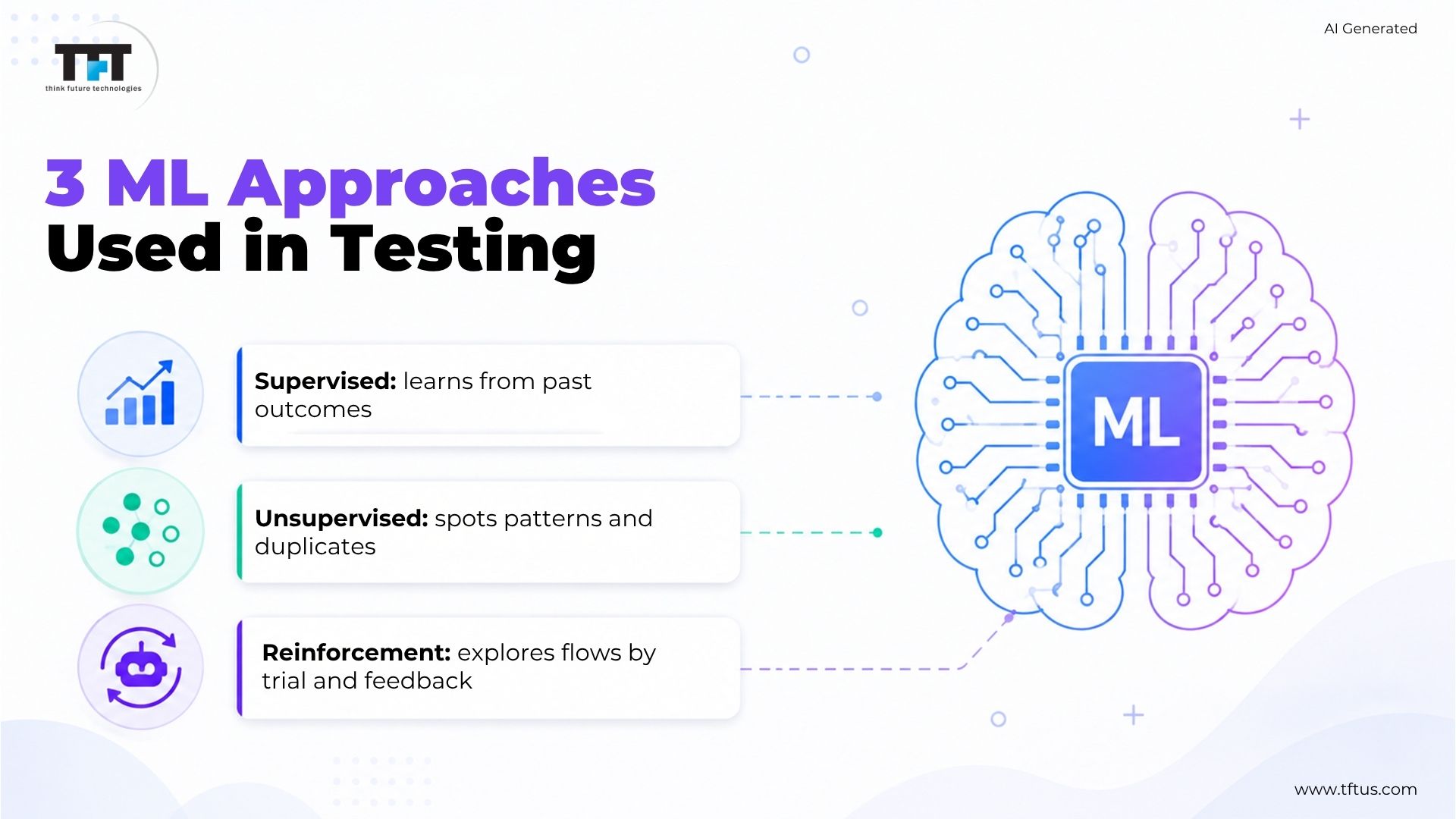
There are three main types of machine learning: supervised, unsupervised, and reinforcement learning, each suited to different problems and use cases.

AI and Machine Learning in Software Testing
Artificial intelligence and machine learning are transforming how testing is performed. While AI focuses on simulating human intelligence, machine learning enables systems to learn from data and improve over time.
In software testing, these technologies help identify patterns, predict defects, and optimize test execution. This shift enables teams to move from rule-based automation to data-driven, intelligent testing.
Types of Machine Learning for Software Testing
Supervised Learning
Supervised learning is based on the usage of labeled data. A model reviews past test cases and their outcomes. After that, it gets to know which inputs result in which outputs.
Benefits That Come Along
- New test cases are created.
- Certainty is made about which tests will not pass.
- Time for software testing is estimated.
- Focus is directed to the most crucial tests.
This technique relies on high-quality labeled data. After completing the training phase, it gets really good at both selecting and ordering test cases.
Unsupervised Learning
Unsupervised learning is a machine learning technique that uses unlabeled data to discover patterns and structures on its own.
Benefits of Unsupervised Learning
- Groups test cases based on similar behavior.
- Identifies duplicate/overlapping test cases
- Detects patterns that may signify the presence of bugs
- Optimizes the test suite.
This results in better coverage and helps remove duplicate or overlapping tests, which could affect software testing timelines.
Reinforcement Learning
Reinforcement learning teaches the system through trial and error, allowing it to improve as it receives feedback on task performance.
Benefits of Reinforcement Learning
- It excels at enabling exploratory testing.
- Detects unpredictable user flows within applications.
- Finds bugs related to newly introduced features.
- Operates independently of predefined testing scripts.
The reinforcement learning algorithm’s performance improves as it interacts with the software.
Key Applications in Software Testing
Automating Test Case Creation
By learning from completed projects and accumulated knowledge of software behavior, machine learning generates a suite of automated test cases to cover various code paths and edge cases often overlooked by human testers.
Benefits of Automating Test Case Creation
- Enables fast creation of a large number of cases in a short period of time
- Provides wider test coverage
- Reduces the amount of manual work
- Increases the amount of time available for exploratory testing
Natural Language Processing in Test Creation
Natural Language Processing (NLP) enables machine learning systems to understand human language and generate test cases. This helps teams generate test scripts directly from user stories, requirements, or documentation.
By reducing the need for manual scripting, NLP improves efficiency and ensures better alignment between business requirements and testing processes.
Test Prioritization and Selection
A large testing suite requires resources and time to complete. Machine learning helps predict which tests are most likely to find defects.
Benefits
- Higher priority testing on the high-risk tests
- Reduce the time spent in your continuous integration pipeline.
- Keep up the coverage.
- Allow for faster release cycles.
ML considers a variety of factors, such as code changes, previous failures, the module’s reliability, and more, to create an intelligent list of test cases.
ARTEX MTF, a financial trading platform, implemented machine learning-driven testing to ensure reliable performance in a highly regulated environment. The platform required rigorous validation due to the complexity of its trading systems and the high value of its transactions.
By using machine learning for test case generation, data simulation, and anomaly detection, the team reduced testing time while maintaining high accuracy. The system continuously learned from test outcomes, improving its ability to detect risks over time.
This approach enabled comprehensive test coverage and ensured a seamless, secure user experience.
Source
Data Requirements for Machine Learning in Testing
Machine learning models depend heavily on high-quality historical data. Without sufficient and clean data, predictions and test optimization may be inaccurate.
To implement ML effectively, teams need:
- Historical test execution data
- Defect logs and failure patterns
- Code change history
- User behavior data (for UI testing)
In general, the more consistent and structured the data, the better the model performs. Poor data quality can lead to unreliable test results and reduced trust in ML systems.
Benefits and Advantages
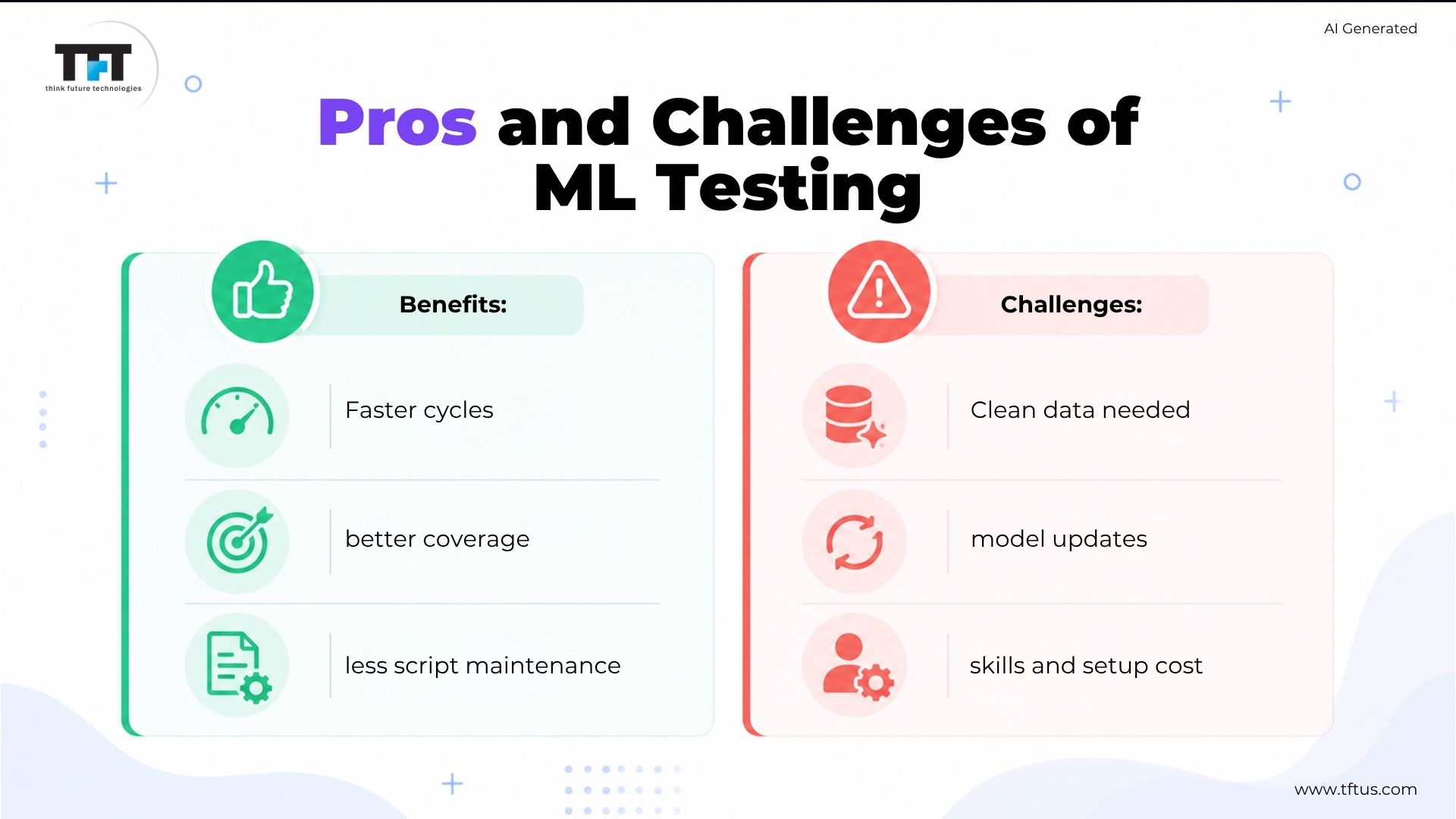
- Faster Testing Cycles
The application of machine learning to teams to carry out tests much more quickly than manual methods. It only determines the important tests and runs them continuously. This accelerates the release process and provides teams with faster bug feedback.
Research also shows that machine learning significantly improves testing efficiency by automating complex processes and enabling faster, more accurate validation compared to traditional methods (Source: ResearchGate).
- Improved Test Coverage
testers normally ignore. It not only identifies edge cases but also simulates various routes within the software. Eventually, this leads to comprehensive coverage and fewer bugs getting into production. - Reduced Maintenance Burden
Legacy test scripts would break with every change in the application, but ML lessens the impact. Tests that can self-heal will rework themselves whenever the UI elements or their properties change. The team saves time and enjoys steady automation even amid regular updates. - Better Resource Utilization
ML equips teams to focus on testing that really matters. It eliminates pairs of tests or tests with little impact, and fine-tunes the execution time. This not only reduces costs but also frees human testers to focus on tasks. - Enhanced Accuracy and Reliability
Machine learning boosts precision by understanding the nature of real bugs. It minimizes false alarms and consistently handles complex situations. A more trustworthy system is the one that learns from its previous results over time.
ROI of Machine Learning in Software Testing
Adopting machine learning in testing requires upfront investment in tools, infrastructure, and skilled teams. However, the long-term benefits often outweigh the initial costs.
Teams can measure ROI using factors such as:
- Reduction in manual testing effort
- Faster release cycles
- Decrease in defect leakage to production
- Lower maintenance cost of test scripts
For example, reducing regression testing time by even 30–40% can significantly lower operational costs while improving delivery speed.
Conclusion
Machine learning is revolutionizing the software testing process by speeding it up, making it more intelligent and efficient. It takes over complicated processes that used to consume a lot of time and human effort. The technology uses data to find bugs, organize tests by importance, and improve coverage.
All these features address the increasing challenges posed by the contemporary software industry. The groups that opt for machine learning in software testing will be winners in both quality and delivery speed, giving them a huge competitive edge.
FAQs
Case Study: Scaling AI-Driven QA Across Global Teams
Coherent Solutions implemented AI-driven QA workflows across more than 360 engineers working in multiple countries. By integrating machine learning into test case creation, documentation, and defect analysis, they transformed testing across projects.
In several months, the organization reduced test case writing effort by 50% and increased documentation speed by 60%. This enabled teams to devote more time to critical testing tasks and overall efficiency.
This case highlights how machine learning can significantly reduce manual effort and accelerate testing workflows at scale.

Defect Prediction and Prevention
Machine learning enables the identification of the highest-risk areas of your application before software testing. This is achieved by analyzing factors such as code complexity, change frequency, and the most recent bugs or defects in the application.
Benefits
- More focused quality assurance
- Earlier detection of defects
- Reduced costs to correct defects
- Higher quality before release
Machine learning enables a proactive rather than reactive approach to software testing.
Visual Testing and UI Validation
Machine learning enables comparison of screenshots to identify UI issues.
Examples of potential issues are:
- Incorrect color
- Buttons not aligned
- Missing images
- Incorrect layout
Machine learning applies to web and mobile apps across various operating systems and screen sizes.
API Testing Automation
Machine learning analyzes normal API behavior and identifies anomalies.
This helps with:
- Identifying atypical responses
- Catching issues with data formats
- Generating various forms of test data
- Increasing the reliability of microservice applications
This will improve both functional testing and performance testing.
Tools and Technologies
Popular machine learning Testing tools and Platforms
Testim, Functionize, Applitools Eyes, and Mabl are among the few tools that employ machine learning and can thus apply it to self-healing tests, visual testing, and intelligent automation. Maintenance of these tools is minimized, and they can automatically adapt to UI changes.
Moreover, open-source frameworks such as Selenium and TestNG can incorporate custom machine learning models to enable smarter software testing and predictive analytics.
Testing Frameworks with Machine Learning Support
Today’s testing frameworks come with APIs compatible with machine learning. They make it easier to connect predictive models to test execution.
The use of machine learning to generate unit tests, create intelligent integration test data, and simulate realistic performance loads is among the advantages that make advanced testing accessible to teams that lack deep machine learning expertise.
Data Analysis and Monitoring Tools
Machine learning is heavily reliant on powerful analytics tools to monitor test coverage, execution patterns, and failure trends. Through a dashboard, teams will learn which areas machine learning can have the greatest impact.
Not only that, but the monitoring tools will also track the model’s performance and notify the teams when accuracy drops. The integration with CI/CD, version control, and bug tracking systems facilitates the smooth flow of data.
To see how machine learning is applied in real testing workflows, this example demonstrates how AI-powered tools like Playwright are used to automate and optimize testing processes.
Real-World Implementation Examples
E-Commerce Platform Testing
A big online store utilized machine learning in its checkout testing process. The system took old test results into consideration and concluded that payment tests were the ones with the most failures. It executed those tests first and unearthed more bugs. Regression time shrank and updates turned around faster. Besides that, the model predicted risky areas and consequently, testers were able to focus better.
Mobile App Quality Checks
A social media app incorporated machine learning to test its mobile versions on several devices. The system mapped out user paths and picked out crash points and layout issues. It not only cut down on manual work but also raised the app rating. The team improved the user experience by fixing more problems before release.
Banking App Security Testing
A banking platform applied machine learning for the purpose of identifying odd patterns in API responses. The system got accustomed to normal behavior and thus flagged unusual activity. It acted as a safety net to detect security risks early. Machine learning also produced test data for payment testing, which was safer and more trustworthy for users.

Best Practices for Implementation
- Start with Clear Objectives
Before moving to machine learning, teams should set clear goals, such as reducing testing time or improving bug detection. Sooner or later, the early wins from test prioritization or visual testing will create momentum and lead to greater acceptance. - Invest in Data Infrastructure
Data collection, storage, and cleaning processes must be very robust. Model accuracy is highly dependent on the quality of the test data. Connecting software testing tools to a centralized data system makes it easier for the team to fully leverage machine learning. - Build Cross-Functional Teams
The adoption of machine learning in testing will not succeed without the cooperation of testers, developers, and data scientists. Shared training and good communication practices will enable the team to collaborate efficiently and to troubleshoot effectively. - Monitor and Iterate Continuously
The teams should monitor machine learning performance and refresh the models whenever there is a software update. User feedback is the most important factor in developing machine learning-based tools that are well accepted.
Challenges and Considerations
- Need for Clean Data
For it to perform optimally, a huge amount of pure data is required. The model based on incorrect data will always be of poor quality. Thus, spending time on data cleansing and validation is the first step for the teams. - Frequent Model Updates
Software development moves at a very fast pace, which affects test models. An un-updated model is an outdated model. It results in lower accuracy in both test predictions and test selection. - Lack of Skilled Experts
The same experts are needed in both fields of machine learning and software testing. Not all teams can be lucky enough to have someone with excellent knowledge of both areas. This, in turn, slows down the adoption process and leads to errors in the settings. - Hard to Explain Machine Learning Decisions
The way these models reach their conclusions is not always made public. Testers might not have the chance to understand the reasons a particular test was flagged or skipped. This leaves no trust issues in the most important use of software testing. - Higher Cost of Tools and Setup
The price of machine learning automation testing tools and the necessary hardware can be high. Team training is also a cost incurred, increasing the total amount spent. The smaller companies may find it hard to cope with this financial burden.
Case Study: AI-Enabled Testing in a Financial Trading Platform
ARTEX MTF, a financial trading platform, implemented machine learning-driven testing to ensure reliable performance in a highly regulated environment. The platform required rigorous validation due to the complexity of its trading systems and the high value of its transactions.
By using machine learning for test case generation, data simulation, and anomaly detection, the team reduced testing time while maintaining high accuracy. The system continuously learned from test outcomes, improving its ability to detect risks over time.
This approach enabled comprehensive test coverage and ensured a seamless, secure user experience.
Source
Data Requirements for Machine Learning in Testing
Machine learning models depend heavily on high-quality historical data. Without sufficient and clean data, predictions and test optimization may be inaccurate.
To implement ML effectively, teams need:
- Historical test execution data
- Defect logs and failure patterns
- Code change history
- User behavior data (for UI testing)
In general, the more consistent and structured the data, the better the model performs. Poor data quality can lead to unreliable test results and reduced trust in ML systems.
Benefits and Advantages
- Faster Testing Cycles
The application of machine learning to teams to carry out tests much more quickly than manual methods. It only determines the important tests and runs them continuously. This accelerates the release process and provides teams with faster bug feedback.
Research also shows that machine learning significantly improves testing efficiency by automating complex processes and enabling faster, more accurate validation compared to traditional methods (Source: ResearchGate).
- Improved Test Coverage
testers normally ignore. It not only identifies edge cases but also simulates various routes within the software. Eventually, this leads to comprehensive coverage and fewer bugs getting into production. - Reduced Maintenance Burden
Legacy test scripts would break with every change in the application, but ML lessens the impact. Tests that can self-heal will rework themselves whenever the UI elements or their properties change. The team saves time and enjoys steady automation even amid regular updates. - Better Resource Utilization
ML equips teams to focus on testing that really matters. It eliminates pairs of tests or tests with little impact, and fine-tunes the execution time. This not only reduces costs but also frees human testers to focus on tasks. - Enhanced Accuracy and Reliability
Machine learning boosts precision by understanding the nature of real bugs. It minimizes false alarms and consistently handles complex situations. A more trustworthy system is the one that learns from its previous results over time.
ROI of Machine Learning in Software Testing
Adopting machine learning in testing requires upfront investment in tools, infrastructure, and skilled teams. However, the long-term benefits often outweigh the initial costs.
Teams can measure ROI using factors such as:
- Reduction in manual testing effort
- Faster release cycles
- Decrease in defect leakage to production
- Lower maintenance cost of test scripts
For example, reducing regression testing time by even 30–40% can significantly lower operational costs while improving delivery speed.
Conclusion
Machine learning is revolutionizing the software testing process by speeding it up, making it more intelligent and efficient. It takes over complicated processes that used to consume a lot of time and human effort. The technology uses data to find bugs, organize tests by importance, and improve coverage.
All these features address the increasing challenges posed by the contemporary software industry. The groups that opt for machine learning in software testing will be winners in both quality and delivery speed, giving them a huge competitive edge.

Leave a Reply