

The wrong React developer is a lot more expensive than a bad paycheck. You waste time, degrade code quality, erode morale, and sometimes even lose months of product work.
Skills in ReactJS can be easily acquired, but difficult to validate without an intentional selection procedure. A proper technical evaluation is the only way to determine whether a candidate can build solid user interfaces.
This guide explains resume screening, technical tests, interview questions, soft skills evaluation, portfolio review, and the factors hiring managers look for. All figures are for the U.S. market of 2026.
According to Statista’s 2025 developer survey, React.js is used by 44.7% of developers worldwide, making it one of the most widely adopted frontend technologies in the software industry.
Why Vetting React Developers Is Harder Than It Looks?
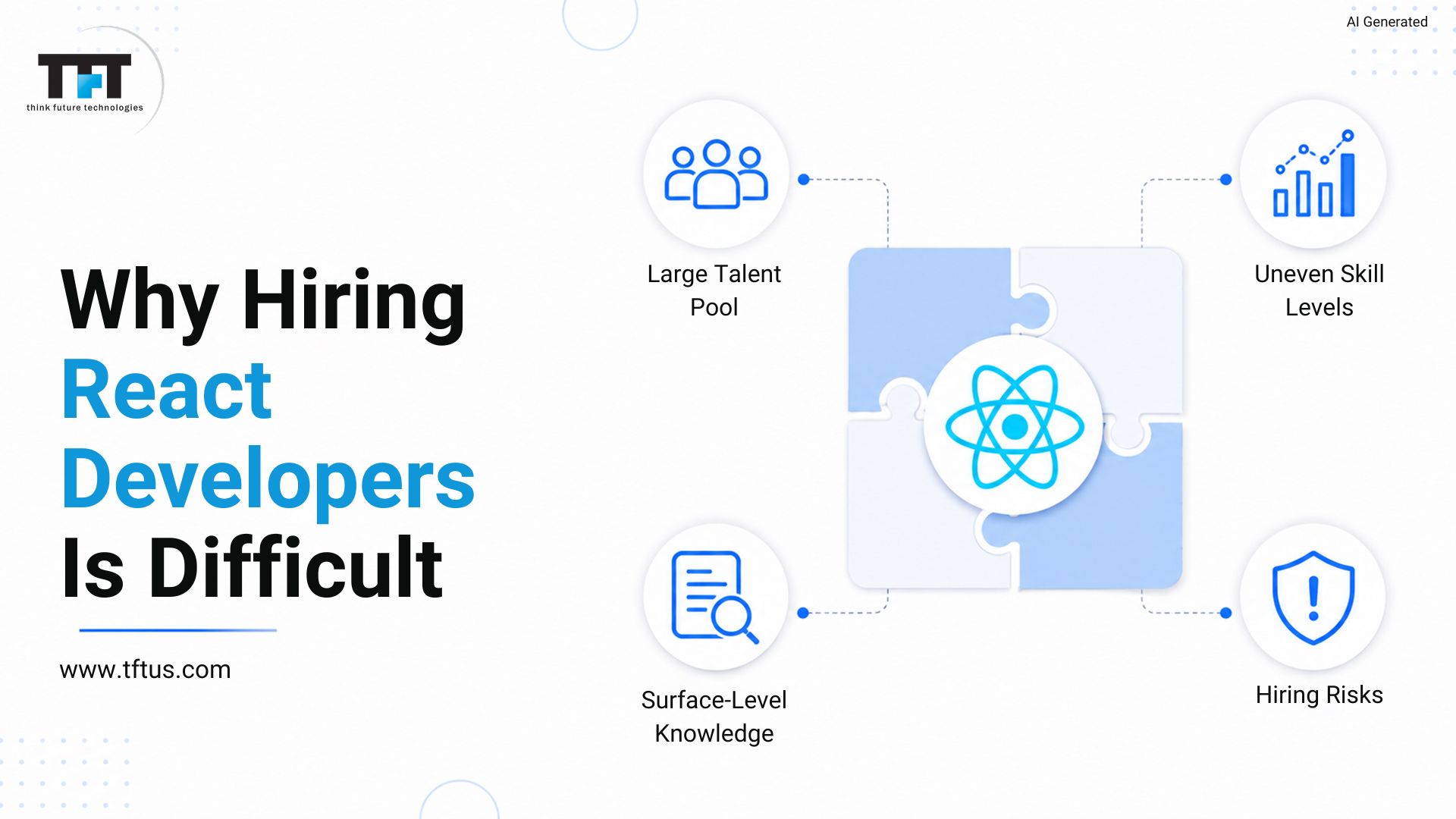
Large Pool, Uneven Quality
Among the most popular front-end frameworks worldwide is ReactJS. The 2025 Stack Overflow Developer Survey found that 46.9% of professional developers use React. While there are lots of people to choose from, not all of them are good.
Surface Knowledge Is Everywhere
People who have taken an online course or created a project with React often include it on their resume. But it’s not to say that they know what virtual DOM reconciliation is, how to do state management at scale, or how to write testable React components. These are the skills developers lack that cause them to falter as soon as the project’s scope expands.
Use a Three-Step Framework
The developer hiring process should be rigorous throughout the assignment of the React developer. Three stages of vetting—resume screening, technical testing, and face-to-face interviews—are designed to prevent most misrepresentations from becoming costly onboarding failures.

Step 1: Resume and Portfolio Screening
What to Look for on a Resume
The first filter in the hiring process is a structured resume review. Search for the React library, not just “React. Candidates who are technically savvy mention the tools that go with it, such as Redux, Zustand, React Query, TypeScript, Next.js, Vite, or the React Testing Library. Vague and general statements are red flags.
Read the project area thoroughly. Candidates who have specified in detail the results of past projects, the scope of the application, the size of the team, and the technical issues they have addressed in those projects do have real experience. If they say that React is a framework rather than what they have actually created using React, they might not be as well-versed in it. Success indicators, such as production traffic or technical difficulty, indicate true experience.
Check employment continuity. Jumping from job to job every 3 to 6 months will pose significant risks to team dynamics for ReactJS developers. Does not automatically disqualify them, but does call for a direct question on each departure. One contract position or job loss is acceptable. A track record of short stints in several firms conveys a serious message.
Watch: What Employers Actually Look for in React Developers
This video explores current React hiring trends and explains why companies increasingly evaluate problem-solving, architecture knowledge, and broader engineering skills rather than React syntax alone.
Evaluate a portfolio
Before the technical interview, request references to previous projects or code samples. As a ReactJS developer with work experience, you should have at least one public repository or a deployed application to share. Check the structure of the code, the naming, the organization of the components, and if there is any testing.
The most effective React developers structure their code in a manner that shows their understanding of how they think about architecture. The following observations will provide more information than any whiteboard interview question.
- Are the components well-defined in terms of their specific responsibility?
- Are state management activities coherent?
- Do there seem to be glaring performance problems, such as not having all the props in a list?
Examine candidates’ own work and how they develop it. You can tell whether a developer has professional habits or only experience with their personal projects by the code under review, descriptions of pull requests, and commit messages. A candidate who writes clear commit messages when they aren’t working on the project will share this habit with your team.
Step 2: Technical Assessment Design
What a Good Technical Assessment Looks Like
A well-crafted technical evaluation for ReactJS developers confirms genuine capabilities without taking up hours of their time. It is important to focus on project-based, not algorithmic, assessments. Algorithm questions are based on computer science knowledge. Project-based assessments screen for React development skills. These two are not the same, and you need the latter.
A practical assessment could require the candidate to design and construct a small feature in accordance with a well-defined specification. Anything that lets them add a product to their cart, such as a search-filtered product list, a form with validation and error states, or a simple dashboard that pulls and displays API data, is fine. The brief should be accomplishable in 2-3 hours – no tricks or obscure gotchas.
Carefully arrange the assessment area. Give a starter repository that sets up a basic create-react-app or Vite application. The candidates are required to focus on the problem and not on setting up their environment. Provide explanations, an API endpoint, and a simple design specification. You also get an idea of how a candidate will communicate during the development process by how they deal with ambiguity in the brief.
Core Technical Skills to Test
According to a 2024 ResearchGate study, React component architecture and library structure have a significant impact on developer experience, maintainability, and code quality in production applications.
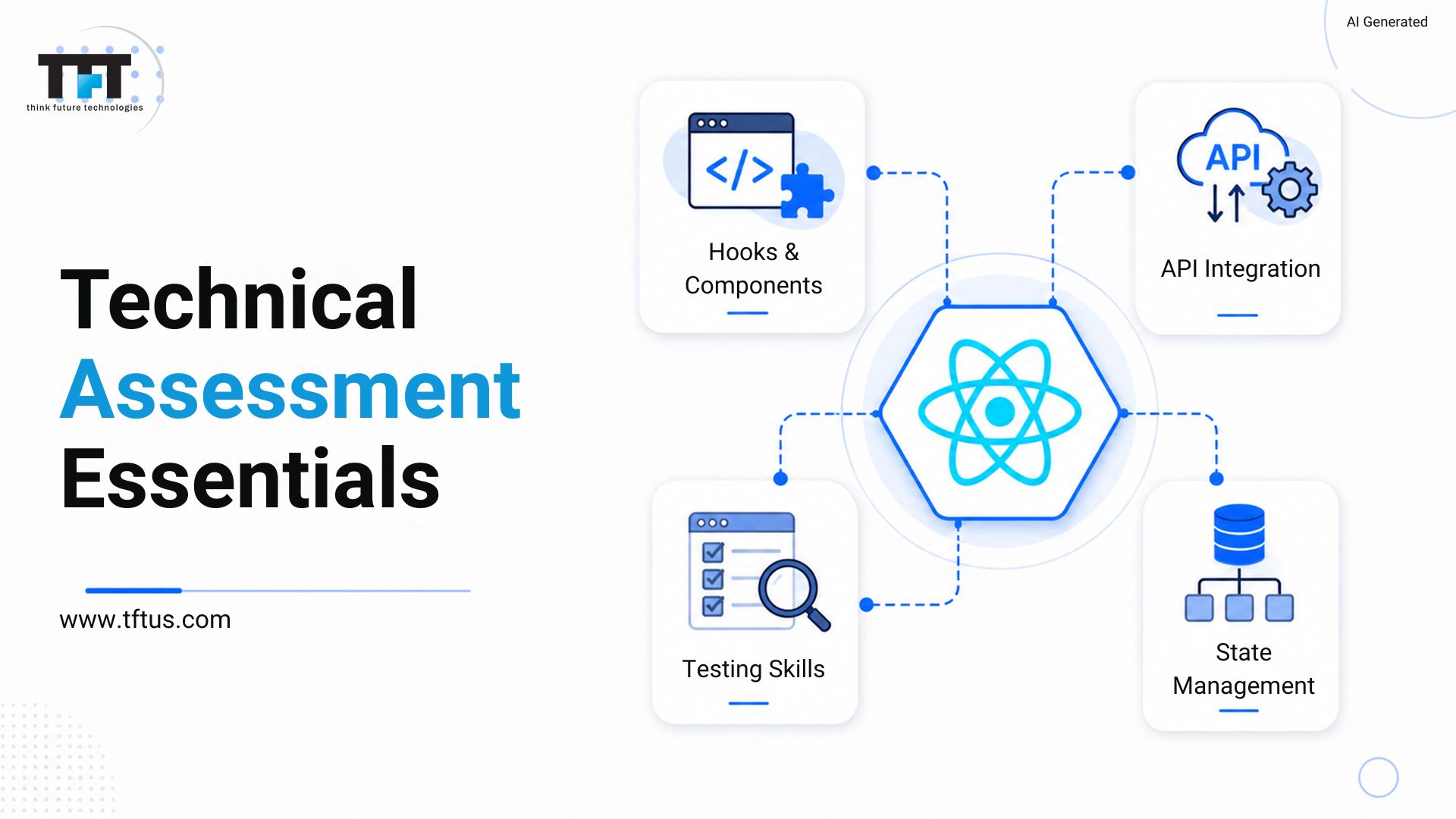
- Component architecture
Is the interface broken into logical, reusable components with clear responsibilities? Are they using functional components appropriately with hooks? Are props passed appropriately between parent and child components?
- State management
Does the candidate select the appropriate tool from the state based on the problem complexity? Does not require Redux if it’s just a simple form. If you have a shopping cart with many interacting pieces, it may be helpful to use useReducer or a state management library. Their judgment on complexity is shown in how they will handle the state.
- React hooks usage
Is the candidate able to properly utilize useState, useEffect, and useCallback? Are they using the dependency array correctly in doUseEffect? Do they wash out the subscriptions and timers? The most common reason for bugs in React apps developed with surface-level knowledge of React is incorrect hook usage.
- Virtual DOM awareness
Does the candidate employ key props appropriately in lists? Do they try not to create unnecessary re-renders? Are they aware of when to use useMemo or React.memo, and when they are unnecessary overhead?
- API integration
Are they able to retrieve data, handle loading and error conditions, and accurately present the results? Or do they support unmounting the component during an in-flight request? All ReactJS developers should have basic knowledge of asynchronous JavaScript and the Fetch API.
- Testing
Are they able to write a minimum of a basic unit test on a component with a testing library? Unit testing knowledge is the difference between developers who have worked on professional teams and those who have built only solo projects.
Case Study: Real React Experience Shows Up in Production Results
Tech Exactly upgraded and optimized a ReactJS/NextJS platform used by Australian cricket clubs to connect players with teams.
The project involved improving an existing codebase, integrating secure payment functionality, and enhancing application architecture. The improvements resulted in a faster and smoother platform while reducing the time required for clubs and players to find suitable matches.
This demonstrates why practical React experience and architectural understanding are more valuable than simply listing React skills on a resume.
Step 3: Technical Interview Questions
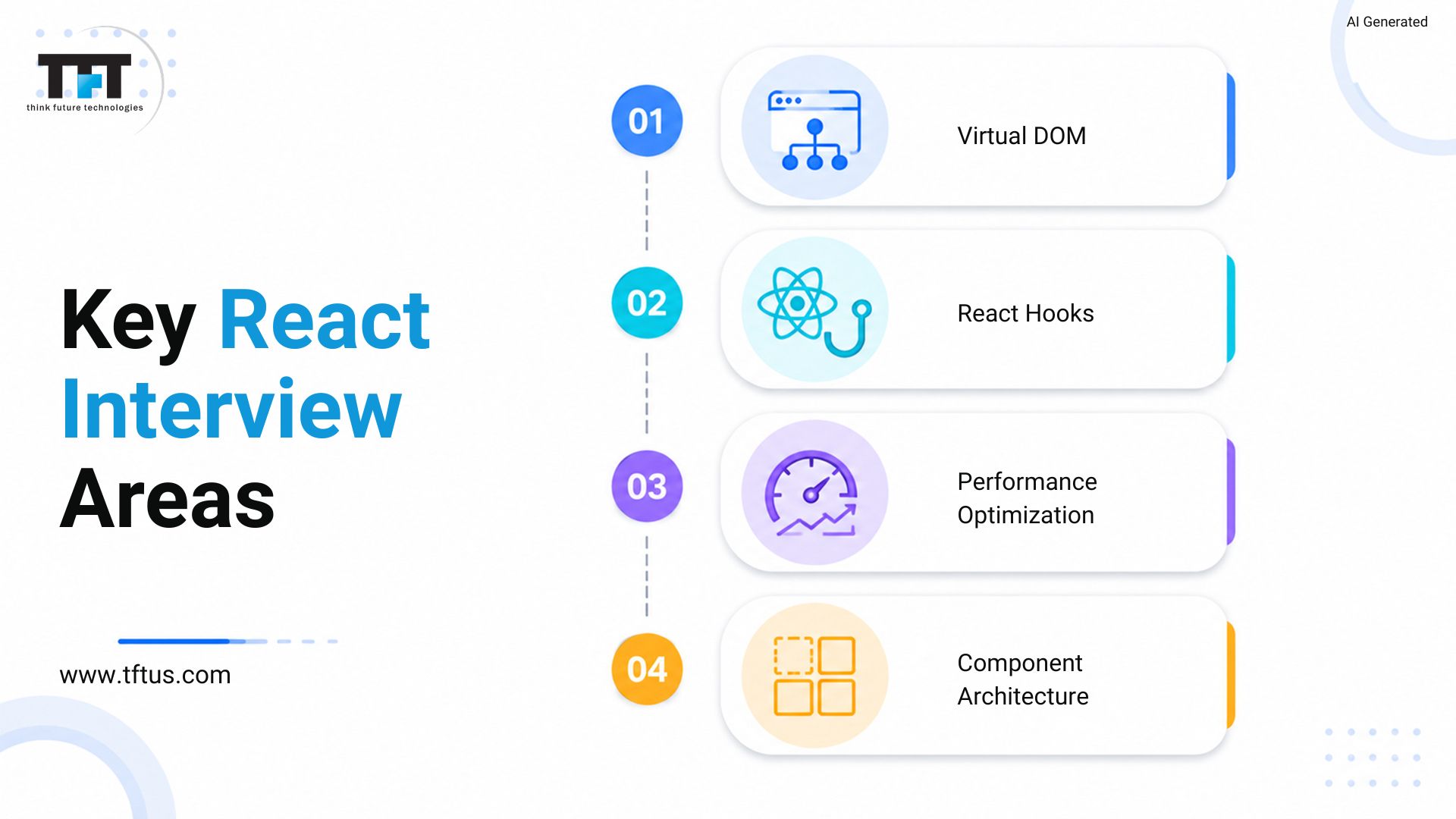
React Fundamentals Questions
Here are some questions to check whether the candidate is well-versed in the basics of the React library, not just the syntax.
- “What is virtual DOM and why React uses virtual DOM”-
A good response includes an understanding that React keeps a very lightweight in-memory model of the DOM, and only updates the parts that have changed in the real browser when the state changes. A weak answer is simply a restatement of the definition, but does not provide an explanation of the performance reason.
- “What’s the difference between props and state?”-
A good answer explains that props go up the tree from parent components and are read-only for the child component, whereas state is owned and managed by the component and causes a re-render when modified. Candidates who mix this up have basic gaps.
- “When would you use useReducer rather than useState?”
Identify candidates who describe cases where useReducer is more appropriate than useState when several values need to change in the same way based on a single operation, when an operation causes something to change, and it is important to know what operation caused the change, when the logic for the state is very complicated, and useState isn’t giving you the clarity you need in your code.
- “What is causing unnecessary re-renders in React and how to avoid it?”
It is very possible that strong candidates will refer to parent re-rendering a child, a function reference recreated on every render, and changes to context values affecting all consumers. They talk about useMemo, useCallback, and React.memo, and understand that these incur overhead when used too much.
State Management Questions
- “What’s the difference between local component state, context api, and an external state management library?”-
This question is more about architectural judgment than about syntax. Search for answers that show a definite sequence. Local state for isolated values.
Moderate shared state that is not likely to change. For a complex global state that updates frequently and needs to scale, you should use one of the state management libraries provided by the state, such as Redux Toolkit or Zustand.
- “What are the consequences of using the context API incorrectly?”-
Good candidates explain that each component re-renders when the context value changes, even if the part of the context that the component uses has not changed. They mention solutions such as dividing contexts by update frequency, introducing selectors, or opting for a separate state management library for high-frequency updates.
Testing and Code Quality Questions
- “What is the difference between unit testing, integration testing, and end-to-end testing in a React application?”-
A good response provides an understanding that unit testing is used to verify the individual parts of a function/component, such as Jest. Integration testing is used to test how multiple components work together. End-to-end testing is done via a real browser using Playwright or Cypress. Candidates lacking this ability may not have a broad experience of professional development processes.
- “How would you test a component that gets data from an API?”
Good candidates use Jest’s mock functions or testing library utilities. They mock the fetch call, set up the component in a test environment, and include assertions for loading state, successful state (with data), and error state (when the fetch fails). This is an easy question to tell the difference between developers who write tests and those who say they do.
Performance and Optimization Questions
- “What is the best way to find out if a React component is slow to render, and how to fix it?”-
Excellent candidates explain how they used the React Developer Tools profiler to identify how the slow interaction was rendered, which components were rendered most often or most slowly, and then implemented targeted optimizations, such as using React. memo, useMemo, or restructuring the state to avoid unnecessary re-renders.memo, useMemo, or restructuring the state to avoid unnecessary re-renders. They don’t start optimizing without doing a measurement first.
- “What is code splitting and when to use lazy loading in a React app?”
A correct answer explains what code splitting is: it divides the JavaScript bundle into smaller components that are loaded as needed, rather than loading everything at once. Lazy loading defers loading a component until it’s needed, typically for a route or a large component that isn’t immediately visible. Candidates should be aware of the above techniques and understand how they would be most significant for large applications with a lot of routes.

Step 4: Evaluating Soft Skills
Why Soft Skills Matter as Much as Technical Skills
Technical skills will tell you if a React developer can write good code today. Soft skills will determine, in the long run, whether they are a positive or negative influence on your team. A developer with great coding skills but poor communication skills will face issues that his/her coding skills cannot overcome.
One of the most common and costly errors in the React developer hiring process is hiring React developers without assessing their soft skills. The cost is only apparent at the end of the hire when a developer has a technical skill set but is unable to accept feedback, has poor communication skills with stakeholders, or makes other developers work around them.
Communication Skills Assessment
Look for the candidate’s communication in the technical interview. Are they asking clarifying questions before they begin a problem, or do they assume and work silently through it? Are they able to verbalize thoughts as they write code, or are they completely silent? Do they claim they don’t know, or are they faking it?
The candidate who says “I’m not sure how React handles that internally, but here’s how I would approach the problem” is more valuable than one who confidently gives a wrong answer. When the developer shows intellectual honesty and communicates clearly, it indicates that the developer will work with your team to build your project and not accumulate technical debt you won’t know about.
Ask straight about previous teamwork. Explain a time when you didn’t agree with a technical decision on your team. So, you’ve recovered from it; how did you do it? Identify candidates who voiced concerns in appropriate ways and presented with evidence, and then accepted the decisions of the team even when they were not the person’s.
Even if developers are top-notch, those who dismiss others’ input or describe going rogue pose a team dynamics risk.
Problem-Solving Skills in Action
Let the candidate solve a small problem they haven’t seen before and see how they tackle it, not whether they tackle it perfectly. Do they divide the problem up into parts? Are they able to recognize the limitations prior to code writing? Test their hypothesis throughout?
Interview them about a problem they solved in a previous job that was the most technically difficult. Pay attention to their ability to articulate it to a non-technical audience, their considerations, and the reasons for the approach selected. Developers with true technical skills can make complex things seem easy. When developers who superficially know a topic get asked questions, they go into jargon mode.
Step 5: Reviewing Past Work and References
Taking a deep dive into previous projects
While hiring a ReactJS developer, ask them about a project they are proud of and discuss it with them. Specifically ask how they would change things up now. Developers with a growth mindset and expertise provide thoughtful answers. The ReactJS developer who can’t find anything to change isn’t developing or lying.
Discuss previous projects that were unsuccessful. How did they come up with the problem? What did they do to help in the solution? What were the lessons they learned? Self-reflection on mistakes is one of the best indicators of ongoing project success.
Reference Checks That Actually Work
Most reference checks will yield no results, since candidates only provide positive references. Have specific technical questions with references, not open-ended. “Can you tell me about a specific technical issue that this ReactJS developer has solved on their own?” is a better question than “Would you hire this person again?”
Deliberately inquire about communication and teamwork with non-technical team members from references. A strong, but hard-to-work-with React developer will be characterized in different ways by a previous boss and by a previous colleague. Talking to both provides a fuller picture.
US Salary & Rate Benchmarks for 2026
Any hiring manager should know about market rates. Knowing the market rates is the deciding factor for companies that either overpay or lose out on strong candidates on the market who know them.
According to Glassdoor data, as of early 2026, the average salary of a ReactJS developer in the United States is $104,418 per annum. The salary guide for 2025 from bluelight.co states that a junior React developer makes an average of $65,000 to $81,000 per year. The average salary for senior ReactJS developers is $170,000 per year.
React.js freelance developers or those working on a contract basis will charge between $80 and $150 per hour in the USA, depending on their experience and the project’s complexity. The more senior the developer, and the more tech-heavy the city, such as San Francisco, New York, or Austin, the more expensive that figure is likely to be. The hourly rate for Eastern European remote ReactJS developers with similar skills is $40 to $70.
The overall expenses of hiring a React developer in the US are generally 1.5 to 2 times the annual salary after incorporating the benefits, recruiting costs (15 to 25 percent of the first year’s salary), onboarding time, and tooling expenses. Pre-vetting platforms can cut screening time by about 60 percent compared to sourcing on general job boards, according to Index.dev.
3 Major Red Flags to Watch For During the Vetting Process
Claims of Expertise Without Supporting Evidence
If you’ve listed any of the above technologies on your resume, but don’t know the answer to specific questions about any of these, it is a sign of lying. It’s better to have depth in 2-3 areas than shallow knowledge in everything.
Inability to Explain Code Choices
Ask the candidate during the Technical Assessment Review why they made certain decisions. A ReactJS developer who doesn’t understand why he or she selected a given state management approach or component structure is simply working by habit. It’s always true that an expert in the subject can explain why.
Resistance to Feedback
If a candidate becomes defensive at your follow-up questions on the assessment, or if he or she suggests another method for assessing the job, then that behavior will not change after being hired. Strong React developers are not afraid to engage in technical discussions, as they know they are right.
5 Common Mistakes When Hiring ReactJS Developers
1. Testing Algorithm Skills Instead of React Skills
Inverting a linked list is an extremely ambiguous question, as it’s unclear what they can actually do. Try testing them during development to see what they’re supposed to do.
2. Skipping the Take-Home Assessment
The only way to find out if a ReactJS developer can build something is to see it. The take-home/pair programming is the most critical signal in the entire hiring process. At the cost of hiring the wrong people, teams that do not do so suffer from expensive hiring mistakes.
3. Hiring on Cultural Fit Alone
Even if a candidate’s interview is impressive, technical skills must be shown before a job is extended. Likability and technical skills are separate. Test each one out individually before deciding.
4. Not Setting Clear Project Expectations
React.js developers who take a job that demands something different than what they have in mind quickly lose interest. Make it clear in the interview process what the technical environment is, how the codebase is, and how large the problems will be for the developer.
5. Ignoring Communication Skills
The easiest developer to write on paper, but can’t communicate effectively with stakeholders or take feedback from code review, will slow the entire team down. Explicitly rate communication skills in all technical interviews, not as secondary.
Conclusion
The research and development of a good React developer is an immediate success investment in the project, code quality, and team stability. There is a process in place that involves portfolio review, hands-on technical evaluation, targeted interview questions, and a deliberate soft skills assessment that identifies misfits in advance at an affordable cost. Once built, every subsequent decision made by a React developer is faster, consistent, and reliable.


Leave a Reply