


A new developer joins and is expected to contribute to the team. A new ReactJS programmer is coming along to contribute. However, they do have a few things wrong on day one: waiting for repository access, not being able to start an app, and questions about areas that nobody documented. This isn’t an onboarding process. It’s a costly, costly error.
The developer onboarding process in ReactJS starts on the first day a new developer joins and continues until they can contribute to the project independently. When done right, it reduces the ramp-up period from months to weeks and boosts retention rates. If it’s executed poorly, you lose the hire.
According to the 2025 onboarding benchmarks by Archie Employee Engagement Platform, only 12% of employees believe their company does a great job with onboarding, highlighting how poorly structured onboarding impacts developer retention and productivity.
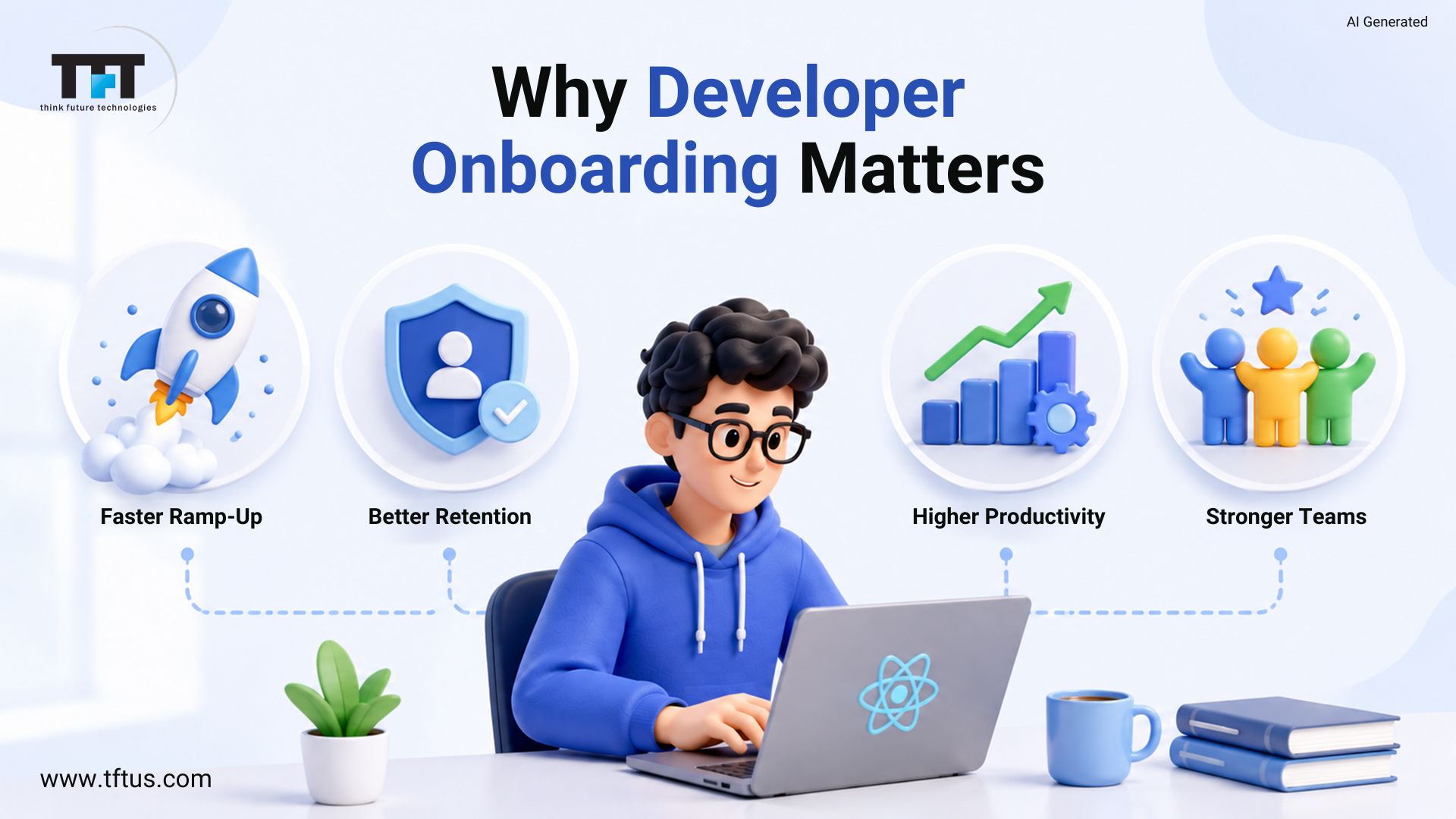
Why the Onboarding Process Matters?
Structured Onboarding Saves Months
A well-structured onboarding process, based on MoldStud’s research, reduces engagement duration by 60 days, bringing it down to about two weeks. That disparity builds up over the course of the year, when numerous React developers are employed.
Every Poor Hire Has a Dollar Amount
According to LinkedIn data, it takes an average of 49 days to hire software developers. The total cost per hire (including benefits and supplemental pay) is $32,601, based on CodeSubmit. For new employees who leave within 90 days because they feel they weren’t being supported, they lose that investment as well.
Competitive Markets Make This Urgent
In San Francisco, New York, and Austin, there is a wide range of possibilities for React developers. The new guy hired and then struggling to cope with the environment will begin to search for a new job. Welcome and transparency foster loyalty and encourage people to stay.

The 5 Stages of the Onboarding Process
Stage 1: Pre-boarding Checklist
- Hardware and Access
Laptop(s) to be sent at least 2 days ahead of the start date. Set up company email, Slack, GitHub / GitLab, Jira, and Figma accounts beforehand. Enable repository access and enforce permissions to match the developer’s job function.
Designate a buddy prior to the first day. It would be good to have a senior member of the same team with extensive ReactJS experience who can provide the required answers during the first two weeks. They are not an official coach. They are the ones that the new employee can talk to without making them feel “weighed down” in any way.
Discuss arrival and send them a welcome package prior to day one. It should describe and clarify the first week’s agenda, primary contacts, team communication expectations, and related details. New React developers need not understand the codebase prior to their arrival. They must be familiar with what Day One will be like and who will be there to reach out to if something goes wrong.
- Environment Preparation
Create a OneCommand environment setup file. Create a OneCommand environment setup script. When you can run a single command, and the whole local development environment is ready in under a minute, it’s time to say that the organization is a mature one. Remove days of friction from the onboarding process with Docker containers and automated scripts for node version management, dependency installation, and environment variable configuration.
To set up the golden path documentation. This tutorial offers a step-by-step example of how a new developer can clone this repository, run it, execute the tests, track minor modifications, and submit them with a pull request. Include pertinent issues and solutions to each step. This document is the single most valuable onboarding asset a React team can maintain.
Stage 2: Orientation Days 1, 2, 3
- Day One: Warm Welcome & Team Introduction
Make it a great first day for the new MERN developer. For any new hire on a team, a quick meeting where all team members introduce themselves to one another will make a new hire feel like part of the team right away. Demonstrate a strong interest in their experiences and tell them what the team is creating and its significance.
Before coding, discuss the project scope and business context. React developers who understand what the product does are better technologists than those who treat the codebase as a puzzle. Take one episode that lasts an hour to explain what this app will do on the web and how this research aligns with real users.
Don’t focus too much on information density on day one. This will be absorbed by the new employee and forgotten by most. Provide print-reading resources and guide them to where things are, and remind them that it is okay to feel overwhelmed. A developer who feels welcome on day one is far more likely to stay in the business for the long haul.
According to 2025 onboarding research by Archie, 70% of employees decide on their long-term future within the first month, while 29% make that decision during the first week itself.
- Days 2 and 3: Environment Setup and First Code Run
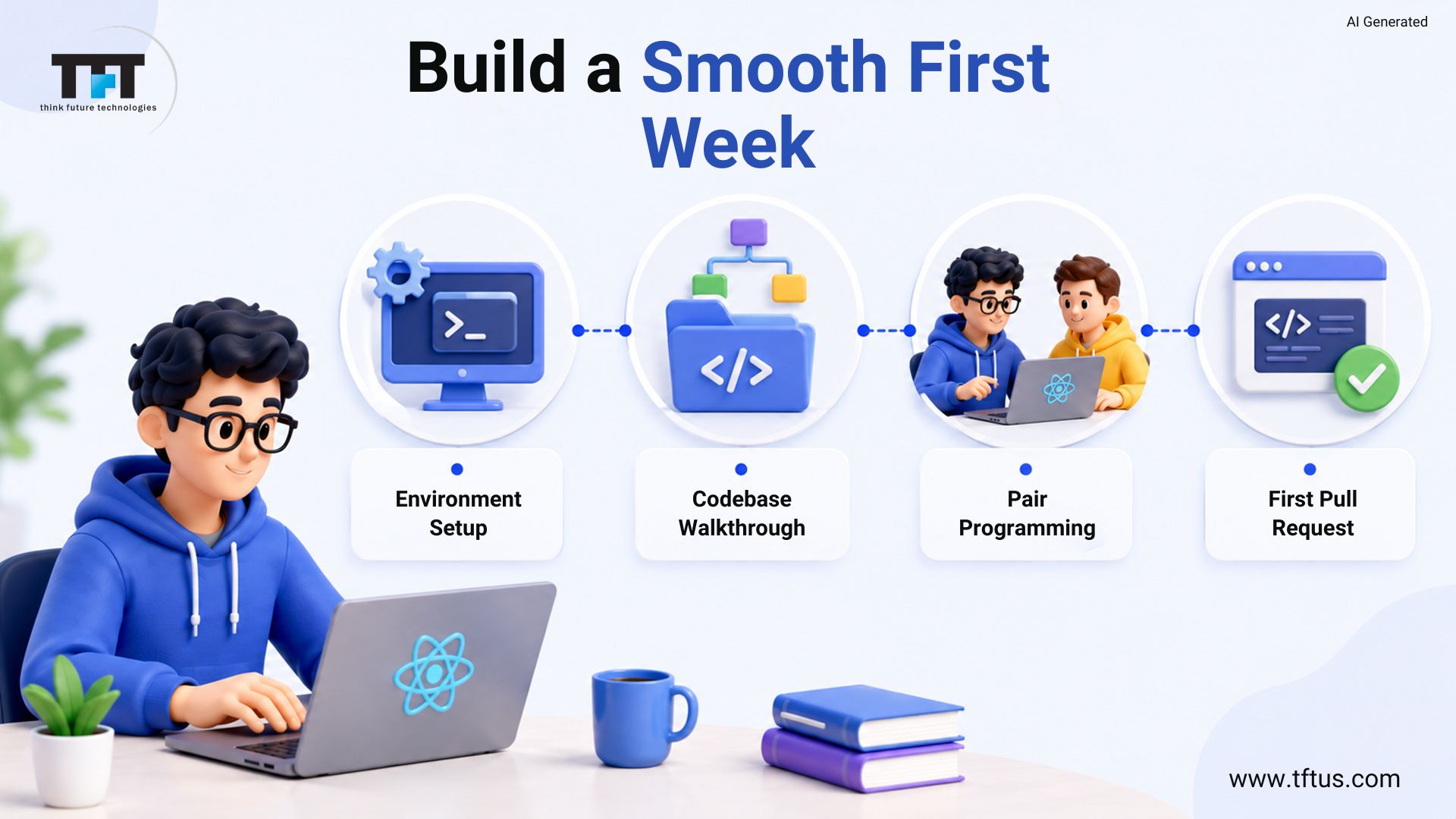
Help the new developer set up the local development environment, even if she has the golden path documentation, if she wants to do it. There is always the element of surprise with a first-time install. It is common to encounter node version issues, OS-specific problems, or missing environment variables. With a buddy or a senior developer in the vicinity, these issues are resolved in moments rather than hours.
As the environment is up and running, go over the top-level structure. Demonstrate the structure of the ReactJS application, the location of key features, state management, and the app’s connection to the backend. Keep it high-level. The aim is not to study every detail; it’s to create a map in their heads.
On day two, introduce version control workflows. Demonstrate pull requests, branch naming, what the CI pipeline checks, and code reviews. Developers from other teams and other JavaScript frameworks will go about their work differently. If your workflow is set up up front, then there’s no friction in the first few months.
Stage 3: Learning Weeks 1 and 2
- Codebase Walkthrough Structure
In a codebase walkthrough, a model should include a four-area guided walkthrough. Begin with folder structure and folder naming to help strengthen the newcomer’s independence. Implement component architecture and describe the team organization of React components, state management libraries used, and the location of business logic.
Next, cover the flow of data. Demonstrate how api requests work, where to use hooks in React, and how data flows. Lastly, discuss the testing strategy and demonstrate the unit test process and location.
Wherever possible, capture these walk-throughs in short videos. Unless it’s an important detail, any developer who forgets about it in a live session can go back and watch the recording without interrupting a senior developer. Teams that take part in an architecture walkthrough have significantly fewer repetitive questions at this stage of the onboarding process and beyond.
- The Good First Issue
By the end of the first 72 hours, the local environment is working; it gives a good first problem. This should be a small, incrementally safe change such as a UI tweak, a bug fix, or an addition to the test suite. Technical difficulty is not all that important. The important thing is that a new ReactJS developer writes something, opens a pull request, gets some feedback, and ships it!
In this first installment, there is a valuable threefold benefit. It instills in developers the confidence that they can contribute to this codebase. It introduces them to the pull request and code review procedure. It also raises confusion about the process in the early stages, before it becomes too late to resolve.
Identify the teams that did not make their first contribution between weeks two and three and will not be eligible. Teams that could not make the first contribution by week two or three will not be eligible.
Case Study: Accelerating ReactJS Developer Productivity Through Fast Onboarding
Trellis Software streamlined onboarding for experienced ReactJS developers through a focused two-week integration process combined with transparent workflows and agile collaboration practices.
The onboarding approach helped developers quickly resolve product issues, improve Firebase connectivity, and increase application accuracy by 90%.
This highlights how structured onboarding enables developers to contribute meaningful production improvements much faster.
(Source: Trellis Software Case Study)
- Pair Programming Sessions
Have 2–3 pair programming sessions in the first two weeks. Instead of forming a relationship based on the new developer and one other team member, group the new developer with other team members and promote the development of connections across the team. For each session, the team should stick to patterns they use most: React hooks, state management, API requests, and testing.
The best mechanism for transferring knowledge during onboarding is pair programming. A seasoned developer provides their thoughts as they work alongside the new developer, and the young apprentice asks questions and passes judgment in a day, years in one shot. There is no record of this. For junior developers, all it takes is to view examples of how experienced React developers think about problems.
Stage 4: Integration Weeks 3 and 4
- Moving to Independent Feature Work
By week 3, the new React developer should be able to work with features with some supervision, but not much. Give a feature that will need real problem-solving, but is not so large that it relies upon other teammates’ work. Clearly define project needs and ensure the developer understands who to consult when facing a dilemma.
Continue Code Review on all pull requests at this point. There are two reasons for the use of code review in this context. They identify patterns that don’t align with their team’s best practices and share their knowledge deliberately with several team members.
Structured debrief for the end of week three and week four. Inquire, “What’s working well and what’s still unclear? See if they have sufficient information to operate on their own or if they have anything they still don’t understand. This feedback is used to enhance the experience and for you, the one you need in order to make the process better for the next hiring.
- Integration Into Team Culture
An orientation meeting does not necessarily convey a company’s culture. It’s felt with the regularity of team functioning. Involve the new developer with ReactJS from the initial stages of every team-related ritual, like a sprint planning, a retro, a design review, and a team social.
Use the unwritten rules; be explicit about them. All teams have norms, and obvious ones, while the invisible ones will be known to the team members and not to new recruits. What is more urgent, an email or a Slack message? When is it OK to push directly to the branch? Who looks at security changes? Putting norms into writing helps mitigate social tension among newly arrived people and those already in the team, past the point of “I get the code. Writing these norms down helps avoid social friction from new hires long after they have comprehended the code.
Stage 5: Independence Days 31 to 90
- Measuring Progress Without Micromanaging
A new [redesigned] React developer should be publishing new features on their own at day 31, meaningfully contributing to code reviews, and be concerned with problems rather than working around them.
Monitor progress on Outcomes. The first important merged pull request is the best indication of a strong first-month signal. One good 30-day marker is whether the developer can be handed a backlog feature without being given much guidance on how to tackle it. A 90-day indicator is whether they are self-development blocking and making team decisions.
- Knowledge Sharing and Documentation
Invite new developers who have just entered the React world to share their frustrations from the initial weeks. Encourage new developers who have just entered the React world to share their frustrations from the first few weeks. This is the best advice a team can get for their onboarding resources. Any developer who took 3 hours to discover why an environment variable skips when running test-aware knows exactly what the golden path documentation lacked.
Prompt continued training after initial training. As of 2026, three areas of change are underway: React 19, Next.js 15, and TypeScript. Coursera universities and conference spending budgets keep React developers longer than when their involvement in the course or conference ends.
Onboarding Junior Developers vs Senior Developers
| Basis | Junior React Developers | Senior ReactJS Developers |
| Technical depth needed | More time on JavaScript fundamentals before complex codebase work | Arrives with strong knowledge of hooks, state management, and architecture |
| Pair programming | More frequent sessions with structured guidance | Fewer sessions focused on specific codebase decisions |
| First contributions | Smaller and simpler initial tasks spread over a longer period | Can take on more complex work sooner |
| Feedback style | Detailed explanation of why behind each suggestion | Focused on team-specific patterns and architectural choices |
| Onboarding speed | Slower, more supported ramp-up | Faster technical basics, more time on business context |
| Main risk | Becoming blocked without enough mentorship | Misunderstanding team’s architecture and propagating that error at scale |
Onboarding Remote Developers
Co-located developers don’t need to look at each other to fill in the information or understand the informal context that fills any gaps between the two parties. Any activity that a co-located team can accomplish in a discussion is detailed in the written document.
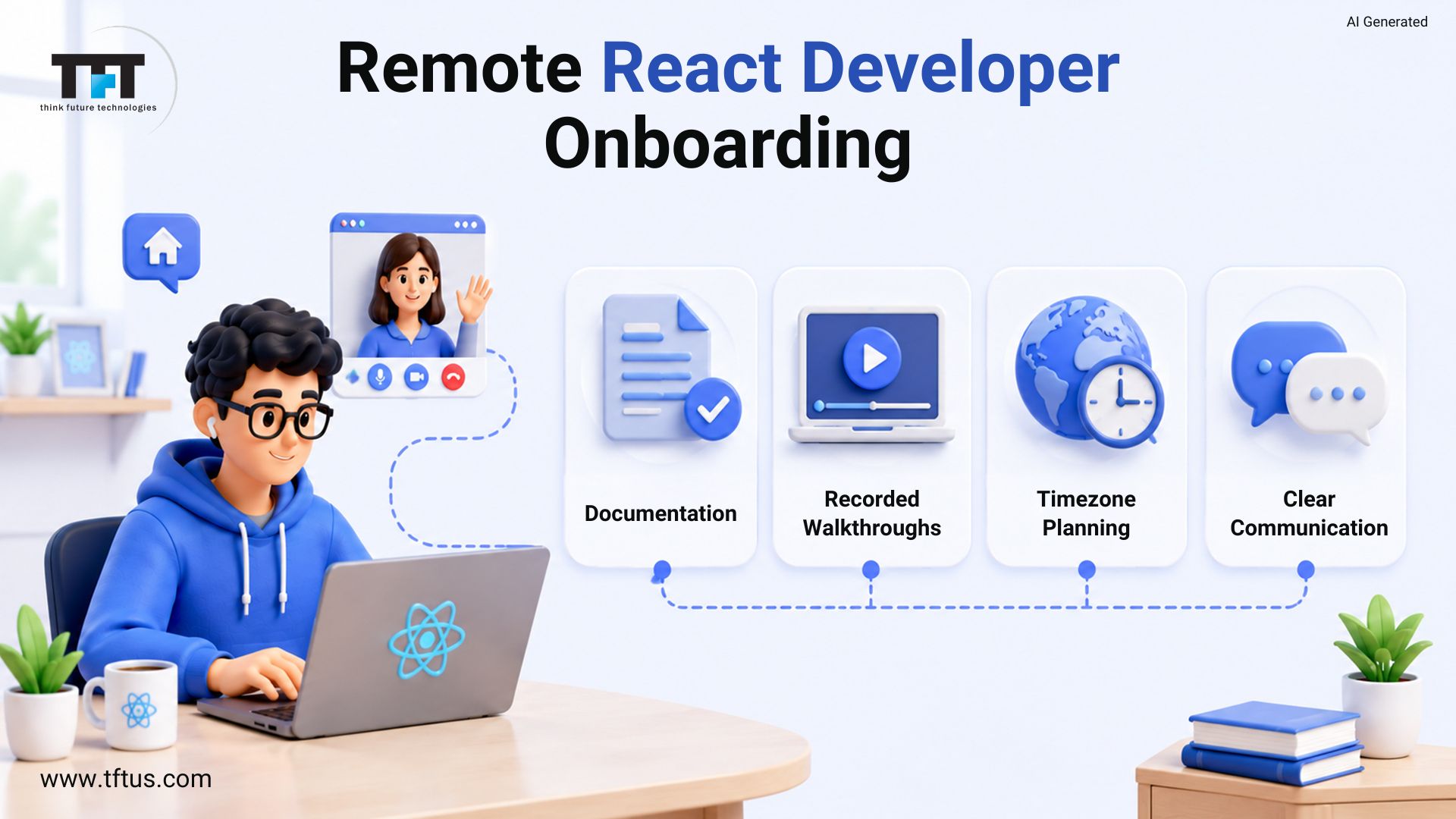
All processes, coding practices, pull request conventions, escalation paths, and meeting norms should be documented and made self-contained for the remote developer. This written layer is not something that distributed teams can get by without. It’s the base on which the whole remote onboarding hinges.
Due to time zone differences, time needs to be planned for. “A ReactJS developer (here they are) who is working in a time zone vastly different from the one you are in requires a pal who can overlap their time. Pair sessions are not to be spontaneous. The recorded architecture walk-throughs are especially useful since they can be used by remote developers at any time in the future, irrespective of when they were produced.
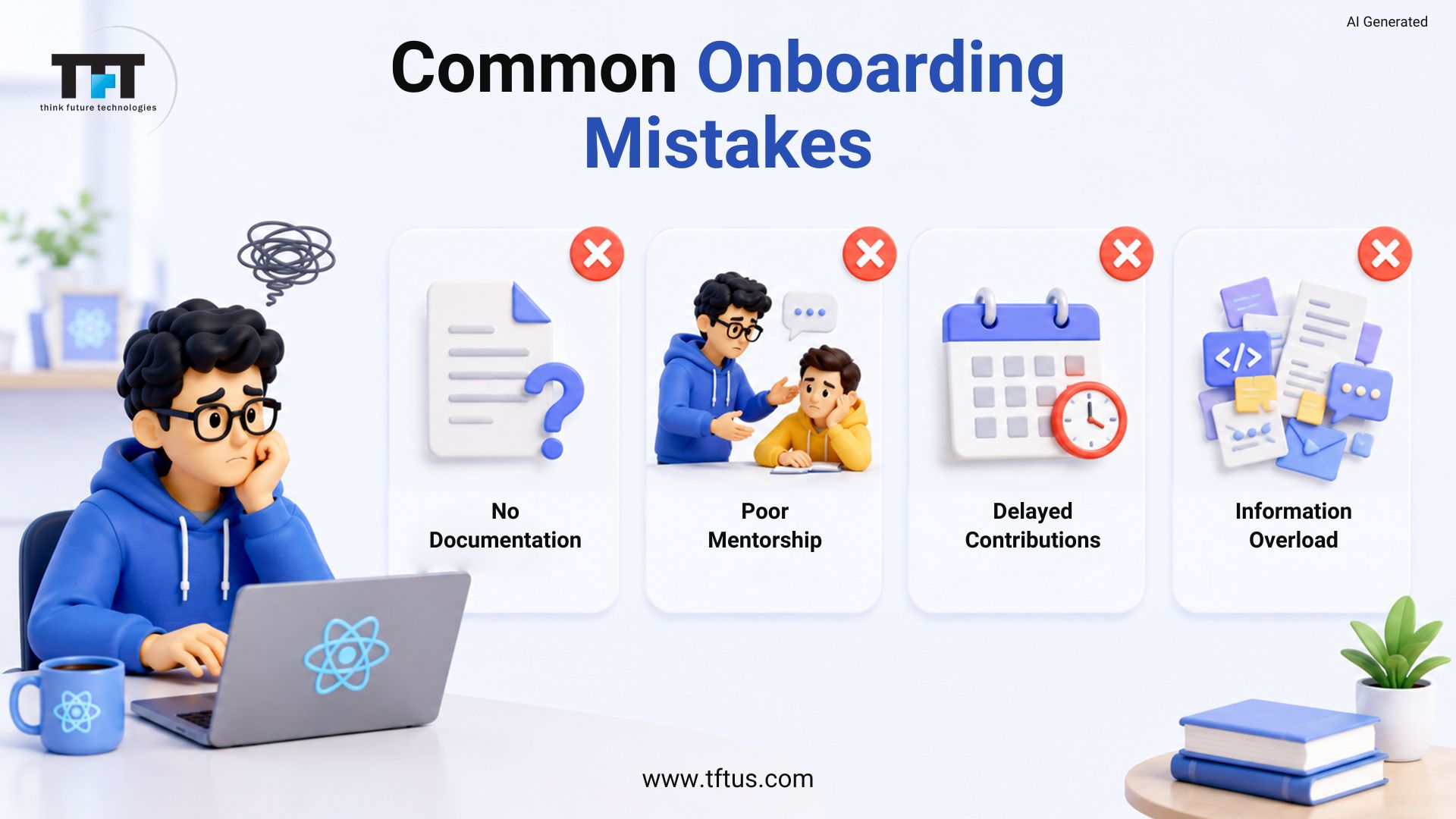
5 Common Mistakes That Stall the Onboarding Process
1. Starting Onboarding on Day One
With pre-boarding preparation, all the challenges that a new developer with ReactJS would face on day one can be avoided. The first morning ought to be one that is about people and about context—not about administrative firefighting.
2. Overwhelming in the First Week
New devs don’t read architecture explanations, codebase tours, culture briefings, and technical deep dives in a week. Deliberately, timeline information.
3. Skipping the Good First Issue
Levels of confidence have to do with shipping, not reading. The first gift isn’t necessarily large. All it takes is quick. Teams that delay past this critical point forgo all the advantages of gaining capacity.
4. Treating Remote Developers the Same as Co-Located Ones
The remote developer requires additional written documentation, clearer time schedules for engagement, and more forward-thinking communication. For each remote developer, the off-site interaction environment that is unique to co-located teams must be intentionally established.
5. Placing Junior Developers Without Adequate Support
Facing a complex codebase and lacking strong guidance, junior React developers often get stuck and become frustrated. It is easier for junior developers to start their tasks and engage in more frequent, more structured pair programming than it is for senior developers.
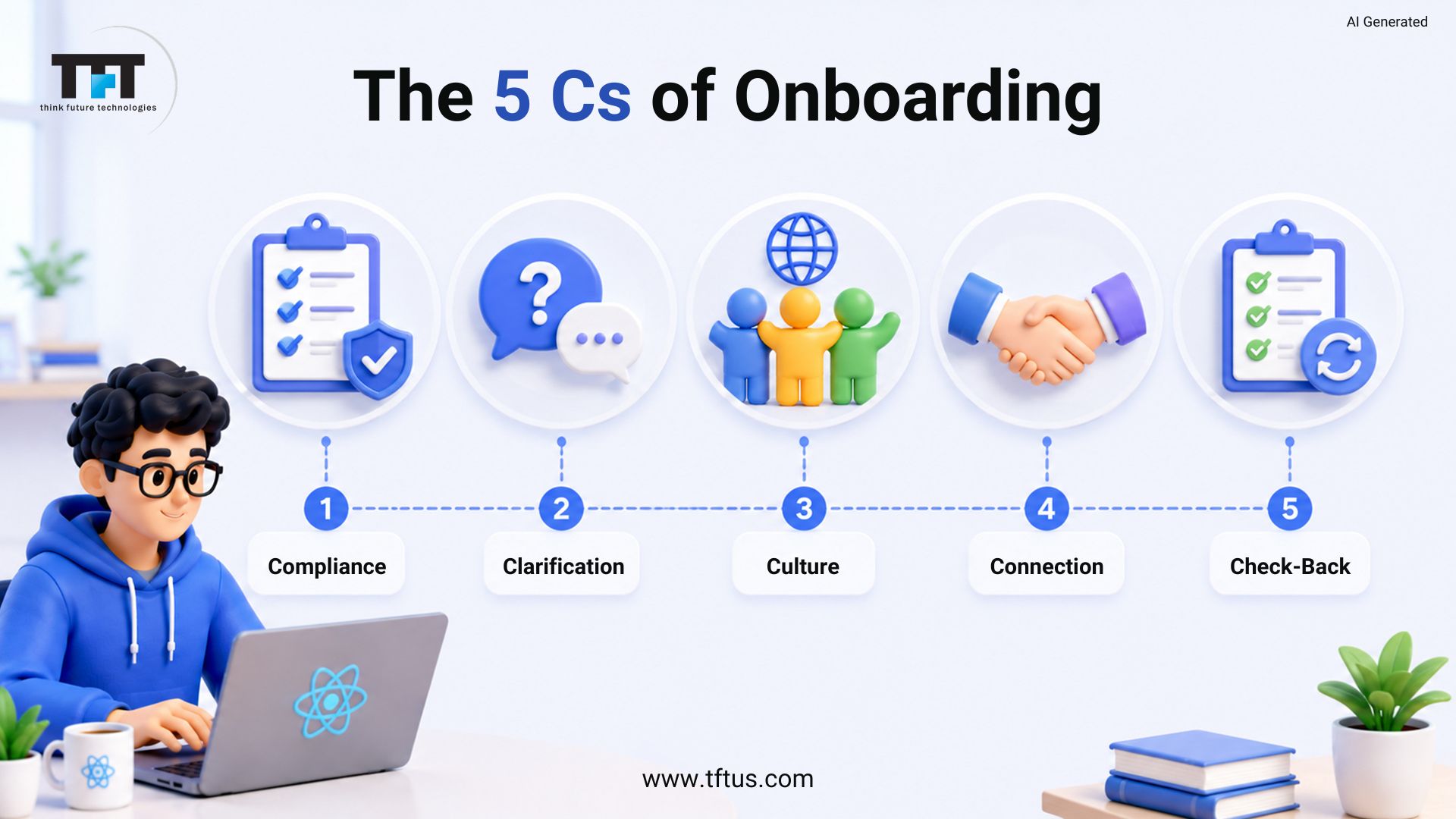
The 5 Cs of Onboarding
1. Compliance
This includes any contracts, NDAs, access agreements, and company policy signatures. Do these efficiently without taking time away from the more beneficial aspects of onboarding.
2. Clarification
To make the new “React JS developer” aware of their role, the project’s requirements, and the technical norms. One of the most common reasons developers lose motivation to be involved in the project is when they’re not sure what to expect.
3. Culture
Culture builds over time as a team participates in the same rituals and actively discusses how and why the team functions the way it does. This is one that you cannot convey in one meeting.
4. Connection
Relationships created through the buddy system, pair programming, and team socials contribute to developers wanting to stick around. When a developer truly loves his/her development team, he or she is much more likely to stay in the stormy weather of development.
5. Check-back
Structured feedback conversations on week 1, week 2, day 30, and day 90 reveal issues in a way that allows them to be solved, not to come up in exit interviews.
Case Study: Structured Remote Onboarding Improved Developer Retention
360Learning implemented a structured virtual onboarding process with onboarding coaches, clear learning paths, micro-goals, and dedicated feedback loops for new hires.
The company improved long-term employee retention to 69% over three years while reducing onboarding-related turnover and improving team integration in remote environments.
This demonstrates how structured onboarding and clear communication significantly improve retention and productivity for distributed engineering teams.
(Source: 360Learning Case Study)
Conclusion
One of the most leveraged investments that a React team can make is for the developer onboarding process. All the time invested in structured preparation, clear documentation, and directed mentorship will pay off many, many times over with increased speed and production, improved code quality, and increased retention. Make the onboarding process you’d like to receive on your first day, and your React developers will share that with others.
According to multiple academic onboarding studies published through ResearchGate in 2024, structured onboarding programs have a measurable impact on employee integration success, productivity, and long-term retention.

Leave a Reply