

It is important that developers, while comparing AngularJS and ReactJS, should choose vigilantly. React is a user interface library. Angular is a complete framework and set of tools. The option affects the scalability of hiring speed and cost. This guide reveals the real trade-offs, performance data, salaries, and how to select based on the team’s needs.
According to the Stack Overflow Developer Survey 2026, React holds approximately 44.7% developer usage, compared to Angular’s 18.2%, making React the more widely adopted front-end technology globally.
First: AngularJS vs Angular Are Not the Same Thing
This difference must be evident before any comparison can be made. AngularJS (Angular 1.x) and Angular (Angular 2 and above) are totally distinct technologies. AngularJS was published in 2010 and reached end of life in December 2021. No longer supported.
Angular is a ground-up rewrite that was published in 2016. It is written in TypeScript rather than JavaScript; it has a completely different architecture and little or no commonality with AngularJS beyond the name. Modern Angular is what developers and companies mean when they refer to AngularJS as a rival to ReactJS.
AngularJS cannot be considered seriously for new projects. The migration should be planned in any team that inherits a legacy AngularJS codebase. This comparison focuses on modern Angular and ReactJS.
What Is ReactJS?
ReactJS is a Meta Platforms front-end library that has existed since 2013. It creates user interfaces from small, reusable parts. It does not include routing state or HTTP tools by default.
ReachJS is the view layer of an app. The flexibility is provided by the developers’ choice of other tools. React is widely used in the community, with an estimated 46.9 percent of developers using it.
React utilizes a virtual DOM for performance. It synchronizes a lightweight copy first, and after that, updates changes. This makes apps run quickly when updating data frequently.
What Is Angular?
Angular is a Google JavaScript framework. It is a complete framework that includes routing, forms, an HTTP client, and testing tools. It has dependency injection and a command-line interface.
Angular establishes definite team structures and patterns. This provides uniform, predictable code across components. It is not as flexible and can be more difficult to learn for new developers.
In 2025, an estimated 19.8 percent of developers use Angular. It is ranked second among front-end frameworks. It is robust in enterprise and government applications with long-term requirements.
ReactJS v/s Angular: Key Differences at a Glance.
| Feature | React JS | Angular |
| Type | JavaScript library | Complete framework |
| Maintained by | Meta | |
| Language | JavaScript (JSX) | TypeScript |
| Data binding | One-way data binding | Two-way data binding |
| Architecture | Component-based | Component-based + MVC |
| Built-in tools | Minimal | Routing, HTTP, forms, DI |
| Learning curve | Moderate | Steeper |
| Mobile | React Native | Ionic or NativeScript |
| US avg salary (2026) | $121,000/year | $132,000/year |
| Developer adoption | 46.90% | 19.80% |
Data Binding: The Practical Difference
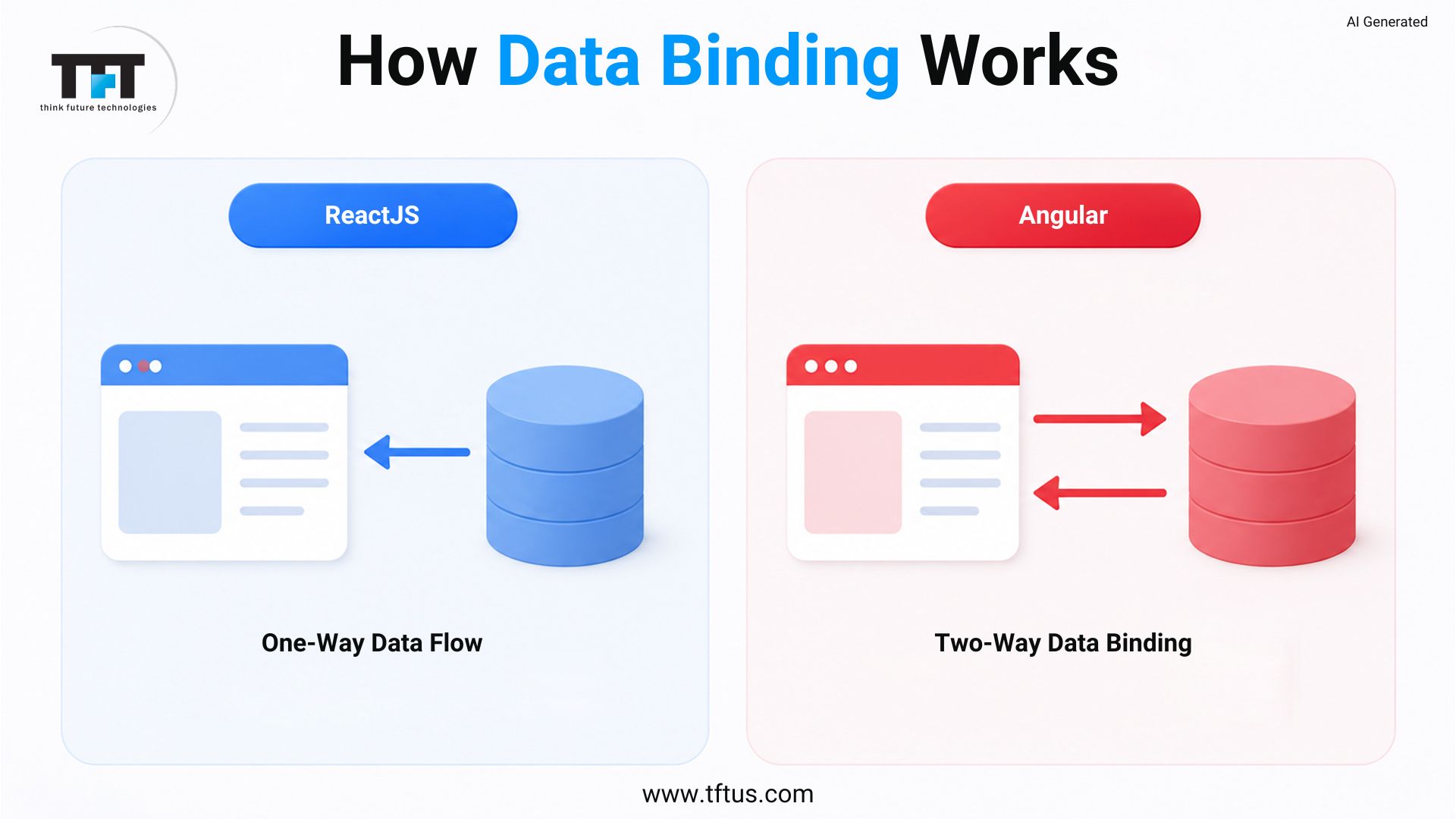
Data binding determines how data appears in the interface. It is also responsible for updating the data model based on user input. This is one of the major differences between ReactJS and Angular.
React data binding is one-way. Parent-to-child data flow is via props. State updates create a render, and changes are easy to follow.
Angular has two-way data binding. Data is updated by input changes, and the view is automatically updated. It minimizes code, but may impact performance with large applications.
Component-Based Architecture: How They Compare
Both ReactJS and Angular are component-based. They divided the interface into mini-reusable components. Each of these components has its own logic and display.
React components are functions or classes that return JSX. They can be combined in various ways and are flexible. This allows the developers to have freedom in organizing code.
Angular components follow a strict structure. Their class template and metadata-based styles are based on TypeScript. This makes large projects sticky and manageable.
This walkthrough compares how the same application structure is built in React and Angular, helping developers understand the practical differences in syntax, architecture, and development approach.
Dependency Injection in Angular
Dependency injection is a fundamental aspect of Angular. The framework designs and administers services to components. Components are given what they require without the instances.
This simplifies app testing and scaling. No element is involved in the creation of services. Angular is suitable for large teams and projects.
ReactJS does not have an integrated system. Context API, custom hooks, or libraries such as Redux are used in teams. This is flexible but requires prudent design choices.
Performance: The 2025 and 2026 Reality
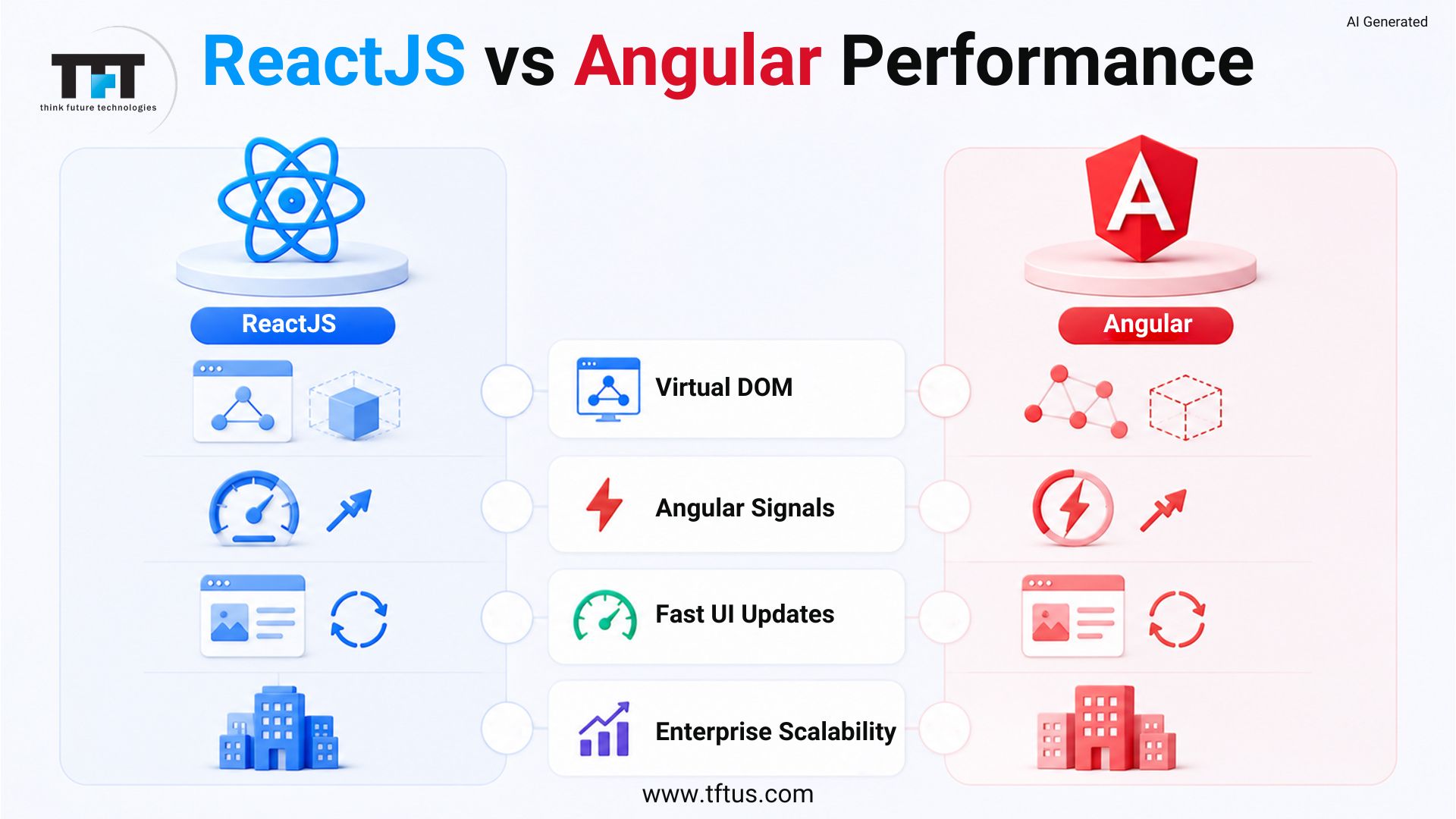
Angular is no longer necessarily slower than ReactJS. New benchmarks indicate that Angular and Signals can be as fast, or even faster, than React in most applications. This alters the previous perception regarding performance differences.
React uses a virtual DOM to update only the changed parts. It is suitable for applications with frequent dynamic updates. This is appropriate in dashboards, feeds, and real-time data views.
Angular is compiled ahead of time to be faster. It reduces runtime workload and enhances efficiency. New updates and signals enhance the performance of complex enterprise apps.
Case Study: Improving Performance with Modern Front-End Architecture
Raulji Technologies implemented a headless commerce architecture for Powerlook, one of India’s fastest-growing fashion brands, to improve application speed and scalability.
By combining modern front-end frameworks with mobile-first UX and performance optimization strategies, the platform achieved blazing-fast load times and measurable business growth.
This highlights how framework architecture decisions directly impact performance, scalability, and user experience in modern web applications.
(Source: Raulji Technologies Case Study)
Learning Curve: What Teams Actually Experience
The learning curve of ReactJS is average. It allows developers to begin with simple concepts. Later, complex decisions are made, which can be costly to refactor.
Angular is steep to start. It must be familiar with TypeScript, RxJS, and the basics. It provides organization and prevents the problem of long-term decisions.
The Hidden Cost of React’s Flexibility
ReactJS is adaptable and requires numerous options. Teams have to select router state tools, data fetching, and testing configuration. Such decisions are usually confusing and time-consuming.
This gives decision sprawl and slows down. Before coding, teams can spend weeks debating tools. Angular evades this through its built-in capabilities.
React with Next can be appropriate for fast startup work. Angular is suitable for large teams and long-term systems. It reduces maintenance work and team coordination problems.
According to a 2026 developer analysis by Toptal, Angular reduces decision fatigue through its opinionated structure, while React offers greater flexibility but increases architectural responsibility for development teams.
US Salary and Hiring Reality
ReactJS and Angular influence the cost and availability of talent. The average React developer earns $121,000 per year. Angular developers make an average of 132000 and are more specialized.
React developers are more readily available in the market. They constitute approximately 52 percent of the job adverts. Angular is at 36 percent, with a smaller talent pool.
The hiring rate varies across cities such as New York and San Francisco. Angular developers require more time to be employed by teams. This can slow down projects and delay time-to-market.
Mobile Development: React Native Changes the Equation
ReactJS has a great competitive edge in mobile development. React Native enables the development of both iOS and Android apps with the same capabilities. Components are reused, and teams maintain a single workflow.
There is code and developer sharing between web and mobile. This makes it cheaper and easier to develop. Angular does not have a direct analog, but it employs other tools.
When to Choose React JS
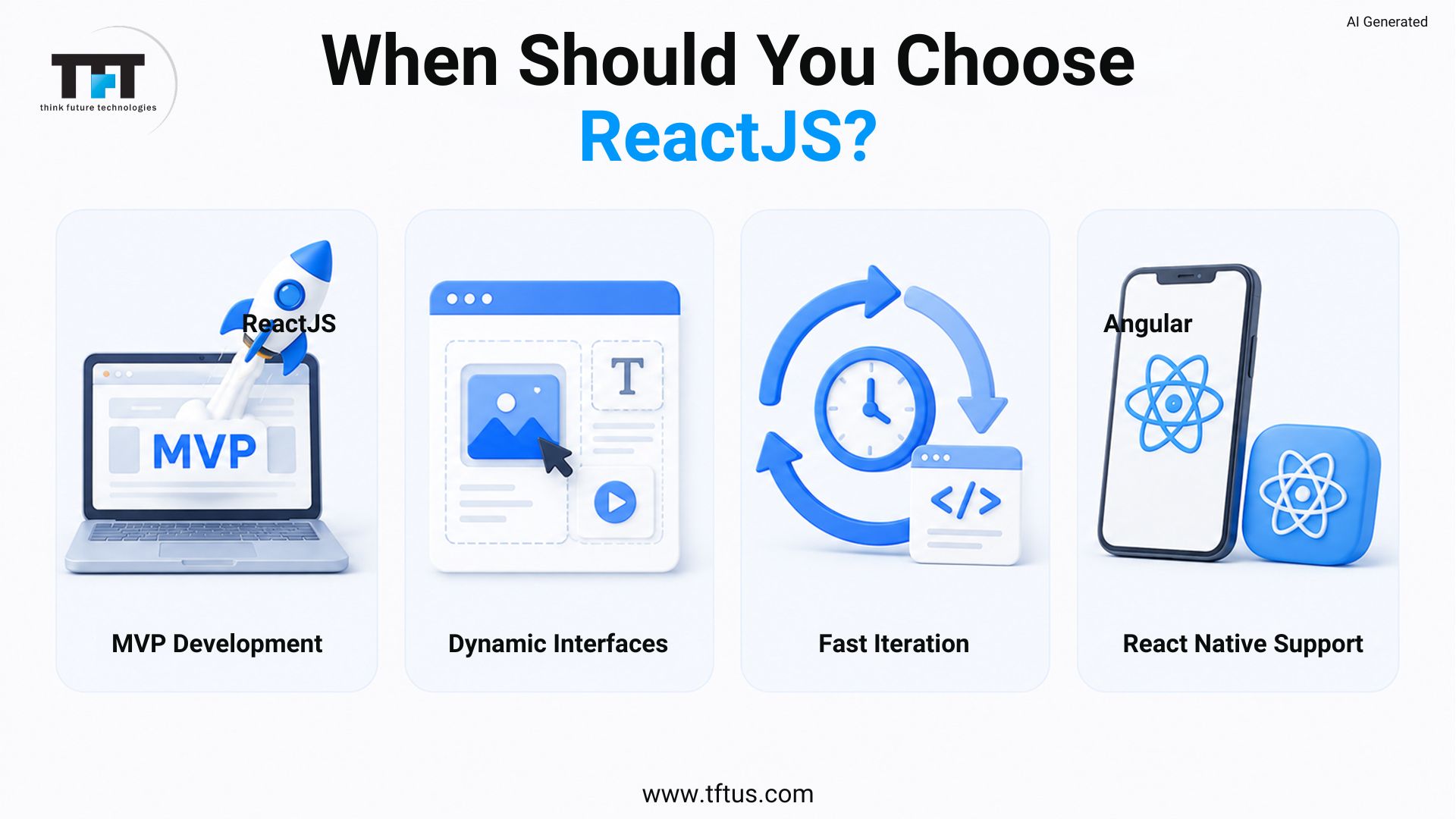
ReactJS suits teams with strong JavaScript knowledge. It is appropriate when you have startups or MVPs and require rapid launch and iteration. It minimizes language overhead and accelerates early development.
It is suitable for single-page applications and dynamic platforms. It is appropriate for social applications and for regular UI updates. It is also compatible with web and mobile using React Native.
According to a 2026 framework analysis by GeeksforGeeks, Angular is particularly suitable for large enterprise applications because of its advanced built-in features and long-term stability advantages.
Case Study: Building Enterprise Platforms with Scalable Architectures
X-Byte Enterprise Solutions developed large-scale AI-powered platforms, IoT systems, and enterprise applications for organizations including the California Community College system.
Their projects involved scalable architectures, complex workflows, and long-term maintainability requirements across AI, mobile, and enterprise systems.
This demonstrates why structured frameworks and scalable development practices are critical for enterprise-grade applications with evolving business requirements.
(Source: X-Byte Enterprise Solutions Case Study)

When to Choose Angular
Angular is appropriate for large-scale applications. It is suitable for enterprises in financial services, healthcare, government, and telecom enterprises. It prioritizes a long-term and consistent approach, rather than speed.
Select it when your group is familiar with TypeScript or OOP. It applies to applications that are years old and under the care of numerous developers. Forms routing and complicated workflows are managed by built-in tools.
React JS and Mobile: The Progressive Web App Angle
Progressive web apps can be created with minimal additional configuration in ReactJS. These applications are offline and are installed on mobile devices. They can also deliver push notifications, as in native applications.
With Angular, PWA is provided by a built-in service worker. This is dealt with in both frameworks. React also benefits Next.js by making it easier to render and set up.

5 Common Mistakes Teams Make When Choosing
1. Selecting on the grounds of Job Trends
ReactJS is more widely used because of its popularity. Angular does not have as many because of specialization. This does not imply that Angular is outdated.
2. Underestimating Learning Curve
Angular is time-consuming to learn. This is usually underestimated by teams. This delays projects.
3. Ignoring Mobile Roadmap
Angular does not have a direct mobile route. Teams might require other tools in the future. This increases cost.
4. Making the Assumption of React Is Faster
Angular Signals works well. React is not necessarily the fastest. Make decisions based upon reality.
5. Poor Architecture Planning
React should be well-organized. In its absence, code will be messy. This hurts maintenance.
Pros and Cons Summary
React JS
Pros:
- Big developer base and talent base.
- Flexible: you select each tool in the stack.
- Good with dynamic, often changing user interfaces.
- React Native portrays competencies in mobile application development.
- Light learning curve for JavaScript programmers.
Cons
- Needs to assemble your own stack.
- Without good architectural leadership, decision sprawl may stall teams.
- Freedom brings inconsistency to scale without regulation.
- SEO entails further setup (server-side rendering)
Angular
Pros:
- Whole architecture, including built-in tools.
- Two-way data binding minimizes app boilerplate in form-heavy apps.
- Powerful type scripting minimizes runtime errors.
- Dependency injection facilitates testing and scaling.
- Very uniform codebase in large groups.
Cons:
- A greater initial investment is needed for a steeper learning curve.
- Less code than ReactJS to create simple components.
- Hiring is more competitive because the pool of developers is small.
- Load times may be influenced by a larger initial bundle size.
Real-World Example: A Healthcare SaaS Platform Decision
One of the health startups in Austin had to decide between ReactJS and Angular. They required complex forms, complex validation, and role-based access. The group was well-skilled in Java and TypeScript.
They preferred Angular as a framework and development aid. Forms and dependency injection make development easier. The project was initiated on time with clean, coherent code.
React with Next.js can be used by a small startup with a limited schedule. It enables quicker iteration and hiring. The option depends on the team’s size and objectives.
Conclusion
Both React and Angular are great options that have world-class engineering teams and long-term investments in their frameworks. ReactJS provides you with flexibility, a huge talent pool, and an avenue to mobile development using React Native.
Angular provides structure, built-in tools, and a scalable architecture that is maintainable by large teams over time. The correct decision is never about which framework is objectively superior, but about what fits the realities of your team, your timeline, and the application you are in fact constructing.

Leave a Reply